

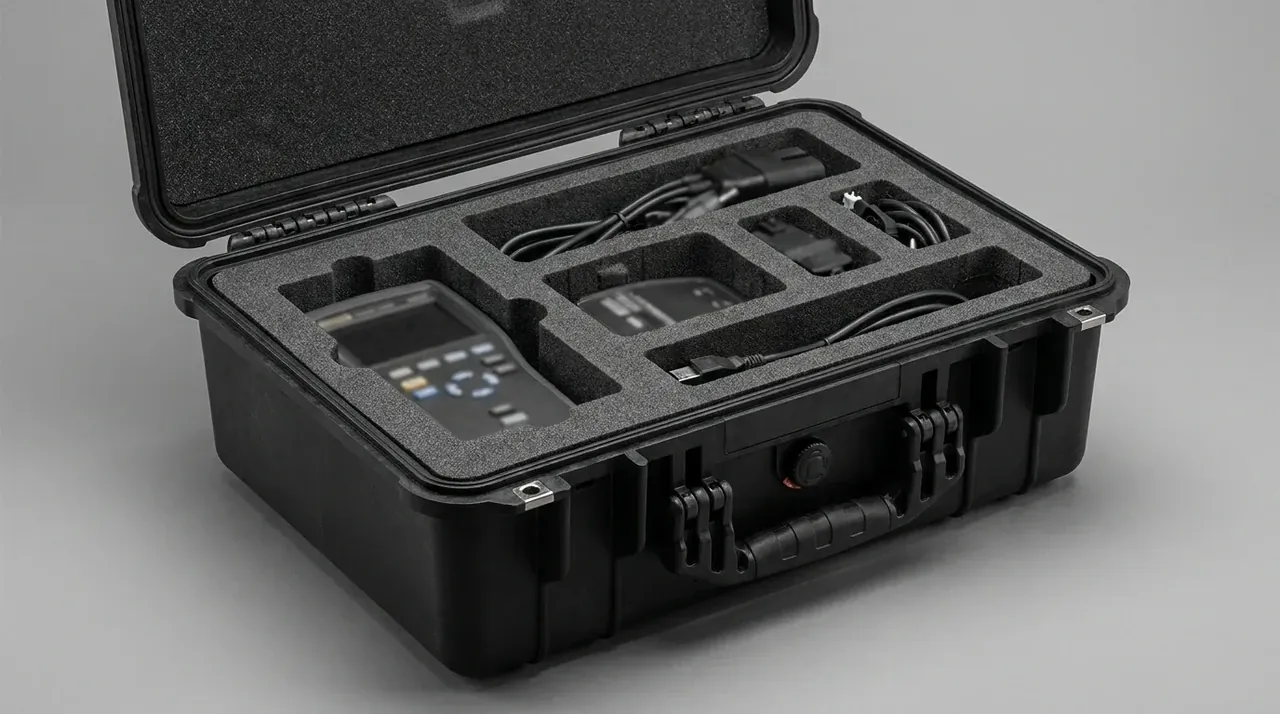
Quick answer: An AED defibrillator hard protective case runs 480×360×180 mm outside, 430×310×140 mm inside, 4.6 kg empty, with 4×φ6 mm wall holes and a 105° lid.
Table of contents
- AED defibrillator hard protective case at three deployment points
- A 105 degree lid angle and a 45 N one-hand pull
- Reworking the fixing holes from wall to column clamp
- Gasket compression, breather valve and the IP67 line
- Wall thickness, foam and temperature headroom
- FAQ
1. AED defibrillator hard protective case at three deployment points
A corridor wall unit never moves. The load is 4.6 kg plus a few dozen lid cycles a day, and what ages is the shell around the fixing holes.
An ambulance cabin is a different problem. A speed hump loads the case at 3 g, so 4.6 kg briefly pushes down with 135 N, and the lid is the first part that wants to leave. Two latches answer that: 320 N each, 640 N together, against a lid and 30 mm pad near 2.1 kg.
A terminal column adds geometry. Columns run near 400 mm, and a clamp band pulls the case onto them, so it projects its full 180 mm height; at 105° the lid edge swings 180×sin15°, about 47 mm, behind the hinge.
| Deployment point | Single-point load | Case design response |
|---|---|---|
| Corridor wall | about 3 kN per fixing | 4×φ6 mm holes, 22 mm edge distance |
| Ambulance cabin | 1.2 m drop, six faces | 2 latches, 320 N holding each |
| Terminal column | 47 mm lid sweep | 105° lid angle, 120 mm clearance |
2. A 105 degree lid angle and a 45 N one-hand pull
45 N is the ceiling for a one-hand lift, set from what an adult can pull up without bracing. Past it the AED defibrillator hard protective case takes two hands, and two hands means putting something down first. The lid weighs 1.9 kg, so 180 mm from hinge to edge already costs 3.4 N·m; 45 N over that arm gives 8.1 N·m, and the rest compresses the gasket.
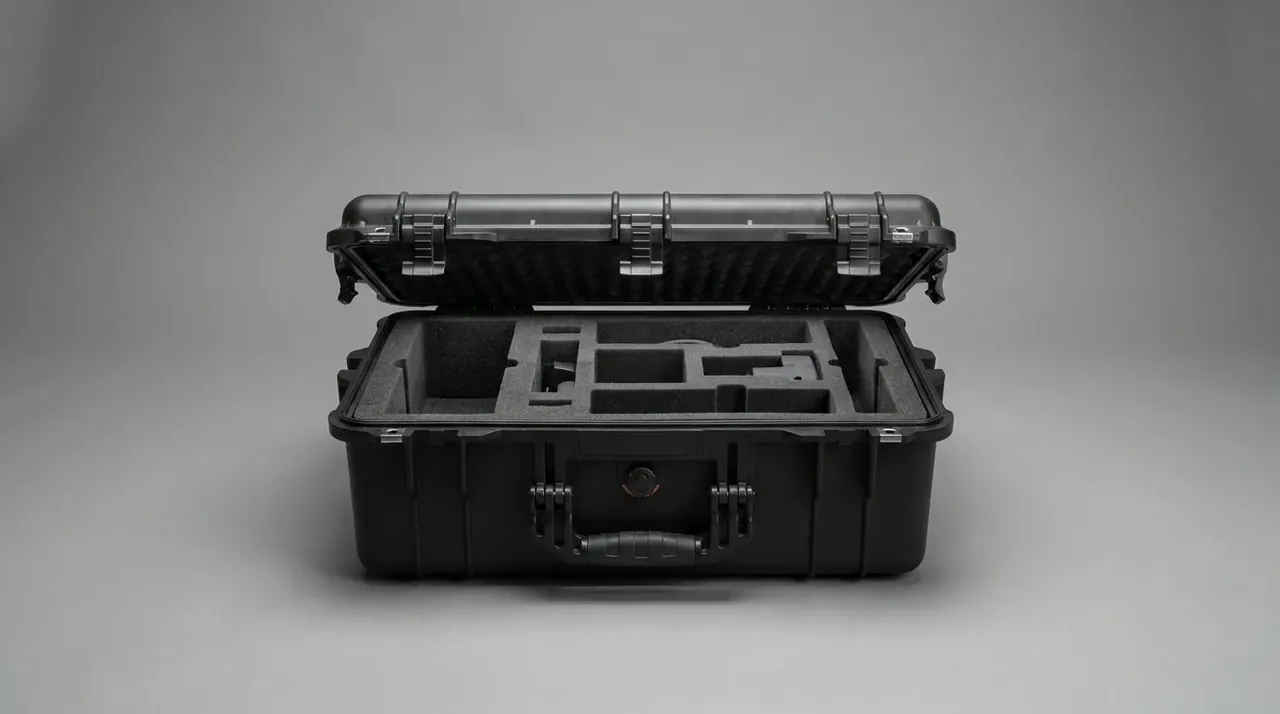
The 105° stop lets the lid pass vertical by 15° and stay there. Below 100° the centre of mass is forward of the hinge, the lid falls back and pinches a hand; above 110° the rear hinge goes from tension to prying. On an AED defibrillator hard protective case, 105° is the band between those two failures.
5 000 cycles is the floor for hinge and latch life: two years at eight openings a day on a wall, eight months at twenty in a cabin. With the gasket at 25%, the pull climbs from 45 N to 53 N.
3. Reworking the fixing holes from wall to column clamp
Wall fixing has four layouts, and the wrong one means drilling again. The four-corner 4×φ6 mm pattern with M6 anchors and a 22 mm edge distance is the default, and slotting each hole to 6×10 mm absorbs ±2 mm of wall flatness.
A clamp band moves the holes to two horizontal slots on the back, 120 mm apart, on a 30 mm band. That forces the clearance to be recalculated: the band holds the AED defibrillator hard protective case 40 mm off the column face, and 40 mm of the 47 mm lid sweep is already gone.
Cast-in inserts belong to new walls only. The pattern has to be drawn, 60 mm deep, within 2 mm of plumb, because an AED defibrillator hard protective case has no adjustment left once it is up.
| Fixing pattern | Hole type and count | Base it suits |
|---|---|---|
| Four-corner wall | 4×φ6 mm round | Masonry, double-layer plasterboard |
| Back slots | 2 sets of 6×10 mm | Column clamps, cabinet sides |
| Base counterbore | 4×φ8 mm countersunk | Vehicle floor, cast-in plate |
4. Gasket compression, breather valve and the IP67 line
IP67 at 1 m for 30 min is a whole-case rating built on three variables: gasket compression, latch holding force and breather opening pressure. The contact band is widest at 25%; under 20% the seal breaks at the corners first.
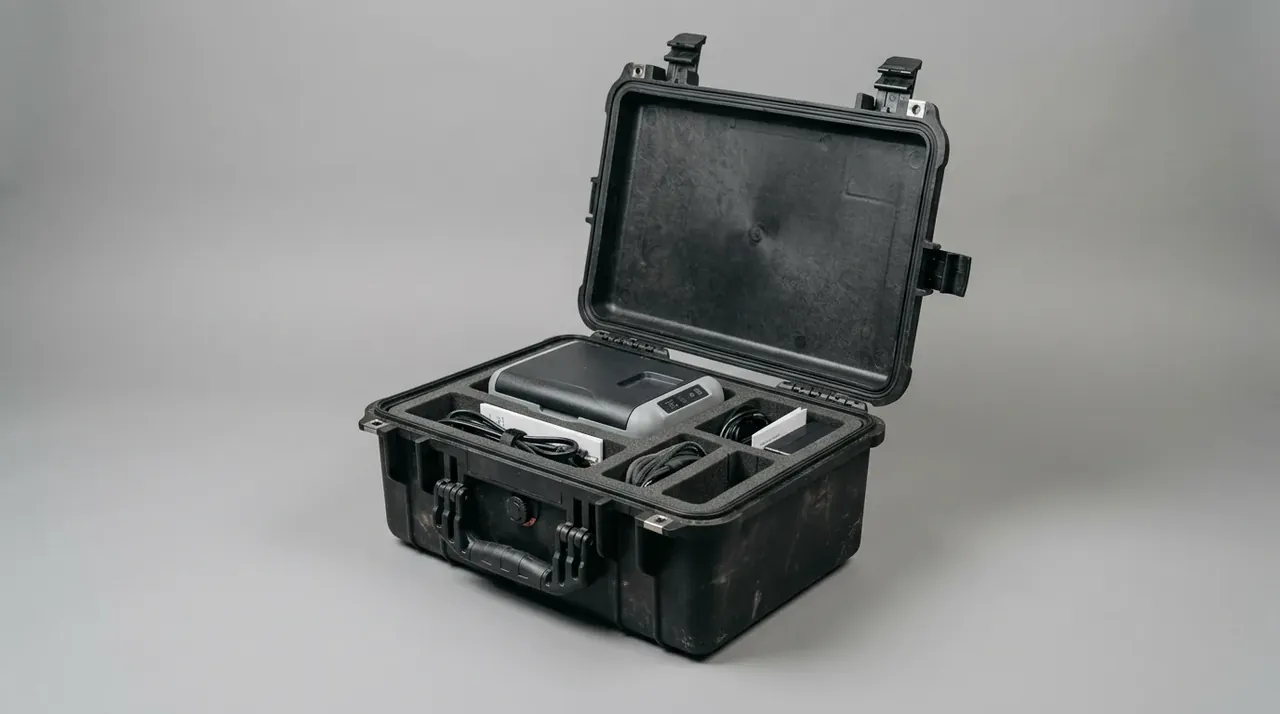
The breather opens at 18 kPa. A 430×310×140 mm cavity holds 18.7 L, and a 20 ℃ corridor against a 60 ℃ cabin makes only about 8 kPa, so the valve stays shut and the latches carry it.
The −20 ℃ to 60 ℃ range is written for the rubber: at −20 ℃ the gasket stiffens and 25% compression needs over 60 N, which nobody opens one-handed in gloves.
| Lid clearance needed | Value | What happens when short |
|---|---|---|
| Wall mounted | ≥80 mm | Lid scrapes the wall, paint wears through |
| Column clamp | ≥120 mm | Lid hits the column, 105° never reached |
| Vehicle side wall | ≥150 mm | Lid rebounds into the wall on bumps |
5. Wall thickness, foam and temperature headroom
The 430×310×140 mm cavity takes a 30 mm PU pad, 30 mm per side, leaving 370×250×80 mm clear of the wall.
3.0 mm is the floor for this class. The 480×360×180 mm outside works out to about 0.65 m² of surface, and a 3.0 mm wall shortens the flow path 18% against 2.5 mm, lifting weld-line strength a grade; a 4 mm cross rib at 70 mm pitch adds roughly 30% bending stiffness.
Empty at 4.6 kg, this AED defibrillator hard protective case sits at the edge of one-hand carrying. Past 5 kg the handle widens from 22 mm to 28 mm, and loaded to 12 kg it wants a trolley.
Conclusion
The three sites look like a change of address, yet on the drawing they become three numbers: 4×φ6 mm holes, a latch force that takes a 1.2 m six-face drop, and 120 mm of clearance. Once the outside and cavity are fixed, 45 N and 105° lock the feel of the lid on any AED defibrillator hard protective case. Set the location, then the holes, then check clearance; reverse that order and the shell goes back to the mould.
Related Reading
- How to shortlist an AED case
- What IP67 verification covers
- When a gasket is changed
- Choosing latches and hinges
Related Products
- 8 Series — Gun Cases; Military Equipment Cases; Camera Equipment Cases; Drone Cases; Watch Cases; Knife Cases; First Aid Cases; Electronics Equipment Cases
- WL8-2812 PP Gun Case — model WL8-2812
- All protective cases and toolboxes: 7 series, 158 models