

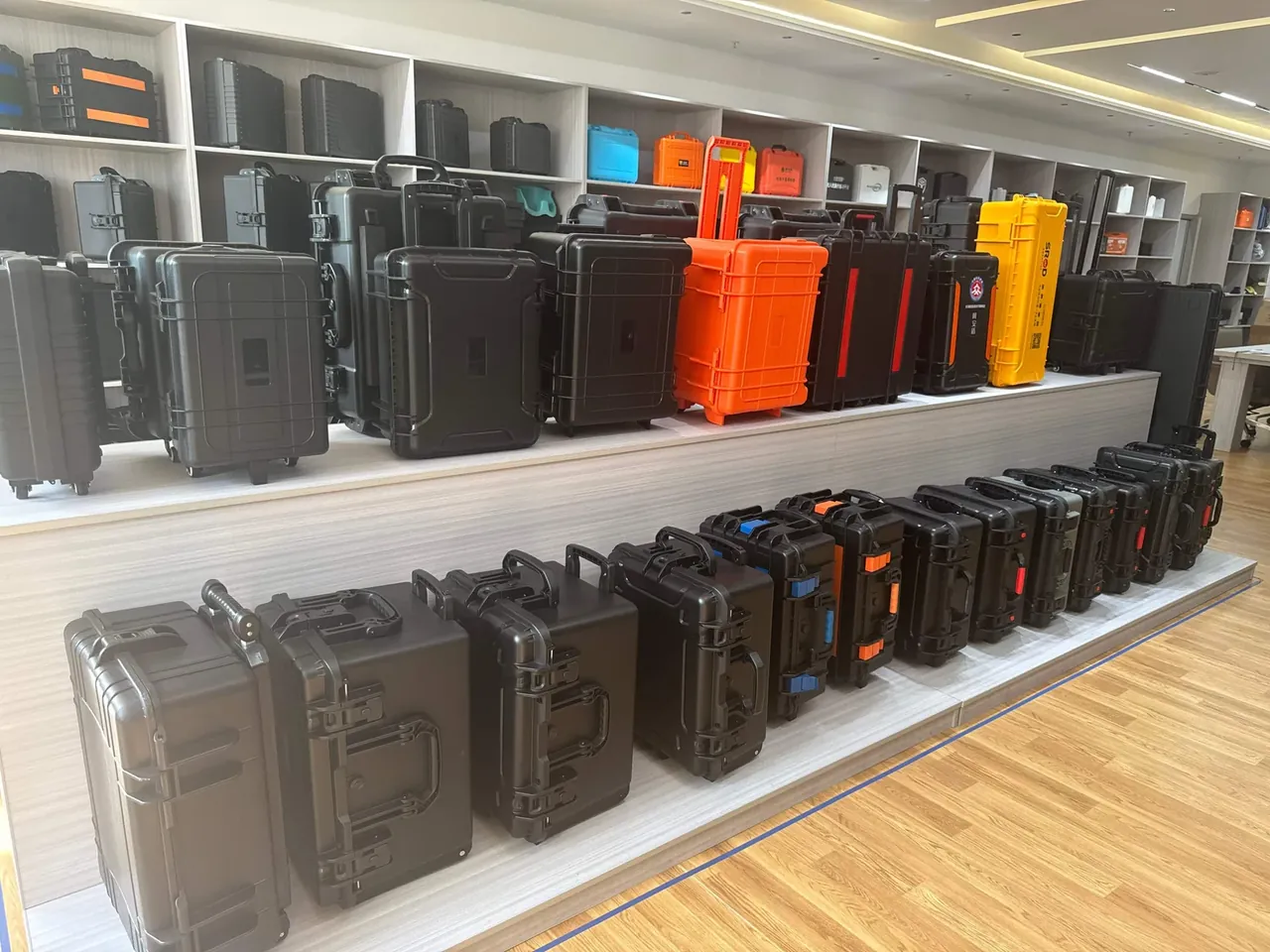
Quick answer: An agv spares case fails at two contact faces: the lidar window that must never touch foam, and a 12 kg wheel needing 2 mm axial play.
Table of contents
- Where an AGV spares case actually fails
- Why the optical window must not touch foam
- Six faces of the lidar bay
- Axial end stops and the 8 mm damper
- Reaching a 90 second swap
- FAQ
1. Where an AGV spares case actually fails
A welding line at a vehicle plant runs 26 automated guided vehicles and keeps four spare-part enclosures. Twice the fitters reported the same pattern: a freshly fitted lidar lost point density within three days, and a new drive wheel pulled the vehicle 15 mm off line over a 40 m straight. Neither fault traced back to electronics.
The lidar died at its window. The coating is a few hundred nanometres thick, and one slide against foam leaves a scratch 2 μm to 5 μm deep. On a shop floor at 45 ℃ the foam also releases low-molecular compounds that settle on the glass as a faint haze. Transmission falls 3% to 5% before anyone notices.
The wheel died along its axis. A 150 mm, 12 kg wheel hangs on a φ20 mm shaft whose only axial stop is one circlip; a forklift knock shifts it 2 mm to 3 mm, and the wheel no longer runs concentric with the gearbox.
Adding 2 mm of wall thickness fixes neither problem.
| Spare | Symptom | Deviation | Case-side fix |
|---|---|---|---|
| Lidar φ70×80 mm | Sparse cloud | 3% loss | Window left open |
| Wheel φ150 mm | Straight-run drift | 3 mm float | Stops at 2 mm |
| Hub bearing | Grinding | 0.1 mm | 8 mm pad |
| Lidar plug | Dropouts | 4 mm | 8 mm slack |
2. Why the optical window must not touch foam
Foam is soft, but what it does to a window is not. Expanded polyethylene and EVA outgas slowly under sustained load, and the residue lands on the coating as an invisible film. Abrasive dust in the cell structure also rubs across the glass through every vibration cycle.
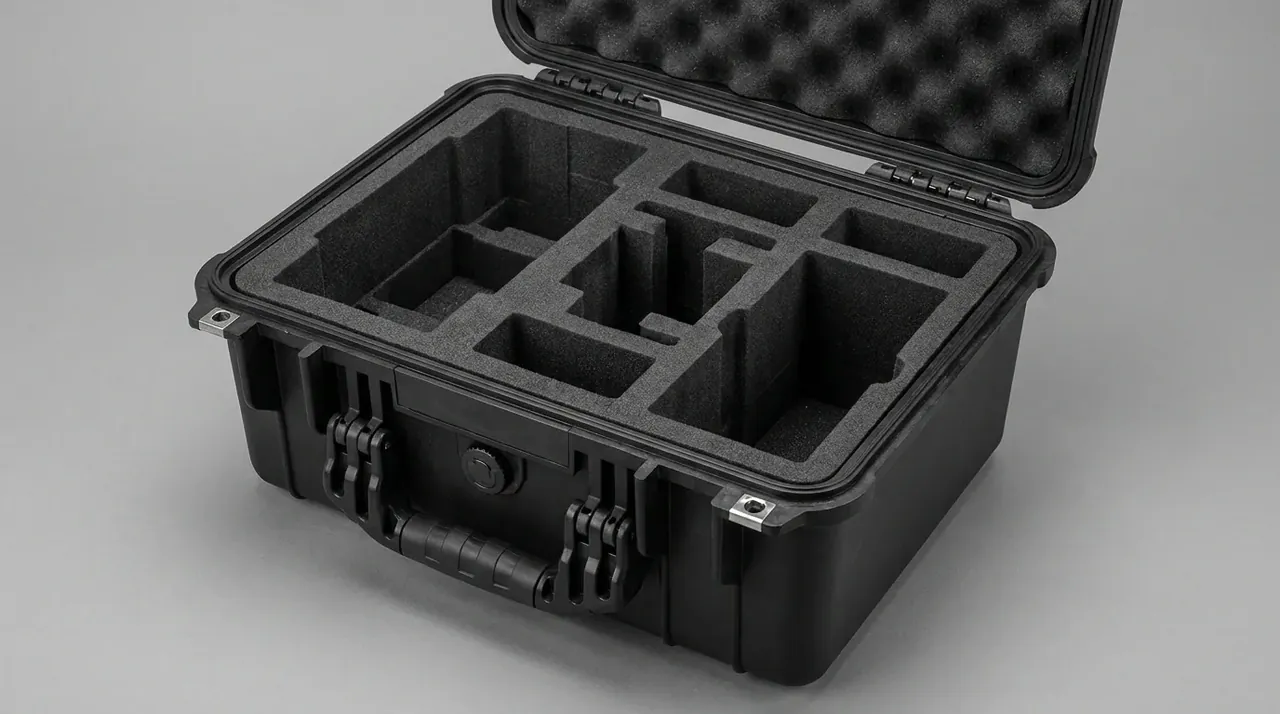
The fix is an air gap in front of the window. The cavity wall carries a 5 mm step, and the glass touches only a 1.5 mm ring at the edge of that step. The ring is faced with 2 mm black EVA at 30 Shore A, soft enough to stop rattle and too soft to carry load.
The bay also has to be sealed off from the wheel bay. A 12 mm EPE partition separates them, its top edge standing 8 mm proud of the foam face. A 3 mm notch at the bottom stops the closing lid from pressurising the cavity and lifting the foam.
A window can touch something soft. It just cannot be pressed against it.
3. Six faces of the lidar bay
Only one of the six faces is meant to be empty. The other five have to work, and getting any one wrong lets the unit rotate a few degrees under 3 g of vibration.
| Bay face | Contact | Gap |
|---|---|---|
| Window side | Open air | 5 mm |
| Window rim | 2 mm EVA ring | 1.5 mm preload |
| Floor | 20 mm EPE | 0 mm |
| Ceiling | 10 mm EPE, webbing | 2 mm |
| Sides | 12 mm EPE | 3 mm |
| Cable side | φ24 mm channel | 8 mm |
The floor takes the whole weight. EPE at 45 kg/m³ compresses about 1 mm under a 0.6 kg load and recovers in 2 s.
The webbing across the top is a retention device, not a clamp. Pulled snug it still leaves 2 mm to the lid, and a finger press shows movement.
The cable channel needs 8 mm of slack. Tie a harness tight and the load lands on the connector, where a 4 mm shift breaks contact intermittently.
4. Axial end stops and the 8 mm damper
A wheel wants to sink when the case lands and to slide along its shaft when the vehicle moves. The pad handles the first, the stop handles the second.
| Stop element | Build | Value |
|---|---|---|
| Axial blocks | 15 mm PP | 1 mm per side |
| Shaft bushing | 3 mm steel, H8/f7 | 0.02 mm |
| Floor support | 8 mm nitrile | 1.5 mm compression |
| Tread | 5 mm EPE wrap | Grooves clear |
One millimetre per side gives the 2 mm float the specification asks for. The blocks carry no weight, so 15 mm of PP is enough, provided the block is moulded into the same rib network as the case floor. Bolted on afterwards, it will lean under the 12 kg inertia.
The 8 mm nitrile pad works on a different principle: it stretches the impact pulse instead of blocking it. On a 3 g sweep from 5 Hz to 200 Hz for 30 minutes, acceleration at the shaft drops from 3 g to 1.4 g, and hub clearance is still 0.1 mm after 500 km of road transport.
The tread stays unloaded: a 2 mm permanent set takes the effective diameter from 150 mm to 149.6 mm.
5. Reaching a 90 second swap
Ninety seconds is the number the maintenance room is measured against; a minute of lost output costs far more than the enclosure does.
| Swap step | Time | Where it stalls |
|---|---|---|
| Release two latches | 8 s | 320 mm spacing |
| Lift lid to 100° | 5 s | 2 N·m hinge |
| Slide out tray | 25 s | 180 mm travel |
| Open webbing | 20 s | One-hand buckle |
| Refit and reseat | 32 s | Two bosses |
The tray is the only moving part. It carries the unit out of a bay 180 mm deep so the operator never reaches past the window. Two cold-rolled slides rated 15 kg give the travel, a 1 mm stop at the end.
Two φ8 mm bosses on the bay floor solve the refit. The tray drops in one way only, more reliable than a label inside the lid.
Hitting 90 seconds comes from removing steps, not from moving faster.
Conclusion
An AGV spares case is a constraint problem on two faces, not a strength problem: 5 mm of air in front of the lidar window and 1 mm of clearance at each side of the drive wheel. Fix those two numbers and the remaining bays can follow a conventional insert layout.
This article only covers the enclosure side: its dimensions and what the design values mean. It does not address handling, loading or use of anything carried inside.
Related Reading
- Components and protection for AGV and AMR cases
- Packaging for complete AGV units and accessories
- How to divide bays in a robot end effector case
- General selection rules for industrial equipment cases
Related Products
- 8 Series — Gun Cases; Military Equipment Cases; Camera Equipment Cases; Drone Cases; Watch Cases; Knife Cases; First Aid Cases; Electronics Equipment Cases
- WL8-2812 PP Gun Case — model WL8-2812
- All protective cases and toolboxes: 7 series, 158 models