

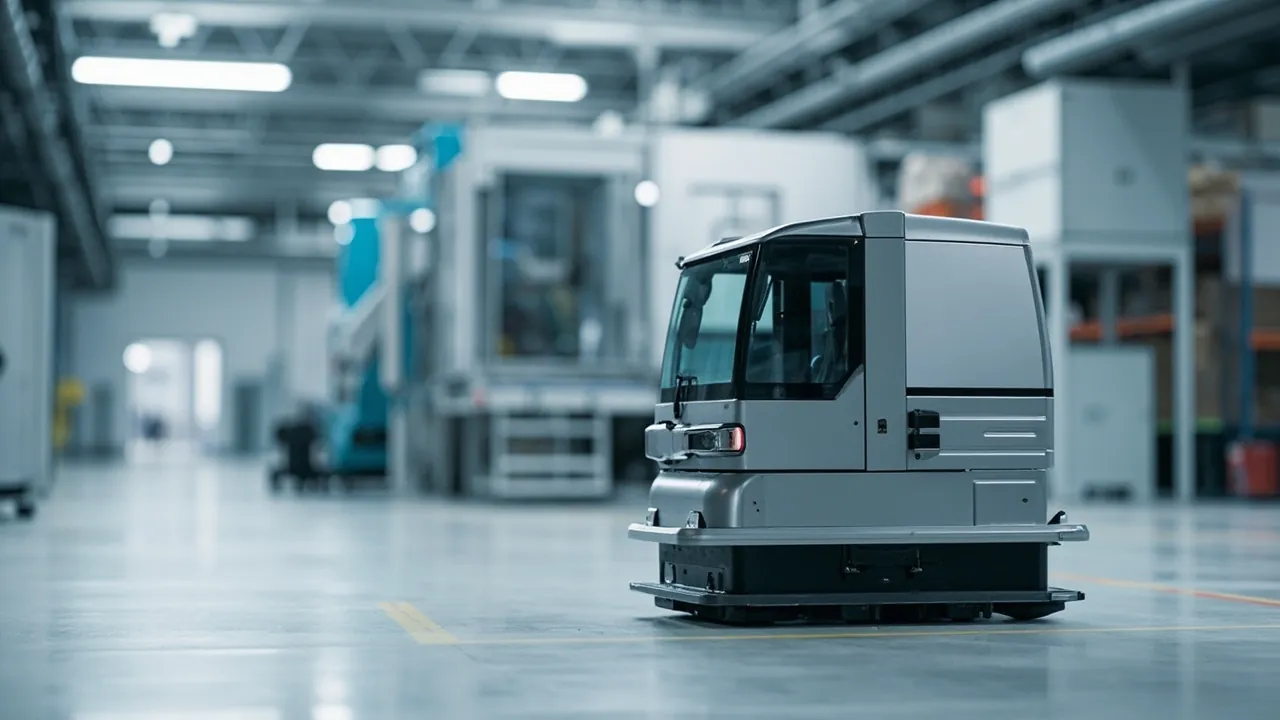
For automated guided vehicles and autonomous mobile robots, the packaging challenge is not the complete machine. It is component-level segregation, regulatory compliance and mutual isolation. A traction lithium battery is a Class 9 dangerous good and must satisfy UN38.3 testing plus the applicable packing instructions. A drive wheel assembly with its gearbox is a heavy precision item that hates axial shock. A controller, a battery management system and a lidar are precision electronics that hate electrostatic discharge and moisture. These three requirement sets actively conflict: the battery needs venting and thermal isolation, the electronics need dryness and ESD control, and the mechanical parts need high load-bearing capacity. The correct approach is one machine, several cases, with separate compartments: the traction battery ships in its own case built to dangerous-goods packaging requirements, drive units get a structure sized for their weight, and electronics plus sensors share an ESD-safe lined case. When all three ship on one pallet, arrange them by weight and by dangerous-goods rules. This article is written for AGV and AMR manufacturers, integrators and overseas channel buyers, and gives structural parameters, a compliance checklist and acceptance methods that can be applied directly.
In practice, after-sales problems on AGV and AMR projects cluster in two places. First, a battery shows capacity loss, rising internal resistance or swelling after shipment, and the root cause turns out to be prolonged high temperature combined with vibration during a long journey. Second, a controller or lidar develops intermittent communication faults on arrival, and teardown reveals ESD damage or oxidized connector pins. Neither problem comes from a case that was "not strong enough". Both come from a packaging plan that did not classify protection by component characteristics. This article splits an AGV or AMR into four component families, the battery pack, the drive unit, the controller and safety modules, and the perception sensors, and gives the liner construction, sealing class, compliance documents and test criteria for each. It also explains what JUNZHJIA can deliver in custom liners and OEM/ODM case development.
Table of Contents
- 1. What makes AGV and AMR component shipping different: from complete machines to modular supply
- 2. Protection differences and conflicts across four component families
- 3. Lithium battery transport compliance: UN38.3, packing instructions and state of charge
- 4. Battery case structure and thermal safety: isolation, venting and insulation
- 5. Load capacity and shock protection for drive units and wheel assemblies
- 6. ESD-safe packaging for controllers, BMS and safety modules
- 7. Clean optical protection for lidar and perception sensors
- 8. Liner zoning and short-circuit prevention measures
- 9. Sealing class and pressure equalization: IEC 60529, GB/T 4208, IP65 and IP67
- 10. Transport test references: ISTA, GB/T 4857, ASTM D4169 and MIL-STD-810H
- 11. Materials, flammability (UL94) and marking requirements
- 12. Customization workflow, delivery documents and acceptance (AQL)
- 13. Frequently Asked Questions
- 14. Conclusion and Related Reading
1. What makes AGV and AMR component shipping different: from complete machines to modular supply
AGVs used to ship as complete machines, so the case only had to handle overall dimensions and forklift handling. The industry structure has changed. When AGV and AMR manufacturers ship overseas today, they generally use component-level, modular packaging, for three reasons.
First, duty and freight cost. A complete machine is bulky with a high center of gravity and poor container space utilization. Breaking it into components substantially improves load factor and simplifies customs declaration by category in the destination country.
Second, service and spare-part strategy. AGVs and AMRs run continuously, often around the clock, and customers expect fast on-site part replacement. Once the battery pack, drive wheel assembly and controller are modularized, the same packaging must serve two roles at once, factory shipment and spare-part transfer. That requires a case that is reusable, stackable and easy to return empty.
Third, regulatory requirements. When lithium batteries enter air or ocean channels they fall under dangerous-goods rules, and the packing instructions for a complete machine containing batteries differ completely from those for batteries shipped on their own. Modular packaging lets dangerous-goods items be managed separately, avoiding the extra cost of treating an entire machine as a dangerous good.
Conclusion: the first step in an AGV or AMR packaging plan is not choosing a case. It is building a component list with attribute classification — which items are dangerous goods, which are precision electronics, and which are heavy mechanical parts. Get the classification wrong and every downstream design decision goes wrong with it.
2. Protection differences and conflicts across four component families
| Component family | Typical weight | Sensitive factors | Protection priorities | Recommended sealing class |
|---|---|---|---|---|
| --- | --- | --- | --- | --- |
| Traction battery pack or module | 8 to 120 kg | Heat, crush, short circuit, state of charge | Separate compartment, venting, thermal insulation, electrical isolation | IP65 to IP67 |
| Drive unit, wheel assembly, gearbox | 5 to 40 kg | Axial shock, bearing brinelling, seal damage | High-load liner, axial restraint, anti-tipping | IP54 to IP65 |
| Controller, BMS, safety module | 1 to 15 kg | ESD, moisture, pin deformation | ESD-safe liner and shielding bag, vibration control | IP65 to IP67 |
| Lidar, vision sensor | 0.5 to 8 kg | Optical window scratches, calibration shift, dust | Clean liner, optical face relief, dust exclusion | IP65 to IP67 |
There are three main conflict points.
Conflict one: dryness versus venting. Electronics need low humidity and therefore desiccant, while a battery that warms or produces trace internal gas raises case pressure and needs a vent path. If a battery and a controller share one case, you face an impossible choice between sealing dry and venting. That is why the battery must have its own case, which may use a one-way vent or a breathable but water-tight structure plus its own desiccant.
Conflict two: weight versus cushioning. Heavy mechanical parts need high-density EVA for load bearing, but the cushioning layer cannot grow indefinitely or the item will move inside the case. Electronics need a softer cushion. When mixed, the heavy item transmits shock through the liner into the light item. Heavy items should therefore sit on the case floor and close to the vertical walls, with light items in separate upper compartments.
Conflict three: cleanliness versus flammability. Lidar and optical sensors need a liner that does not shed particles, while some flame-retardant modified foams use fillers that are prone to dusting. When selecting material, confirm particle shedding behavior and UL94 rating together. Neither can be sacrificed.
3. Lithium battery transport compliance: UN38.3, packing instructions and state of charge
This is the most critical and most error-prone part of AGV and AMR packaging. The following is general compliance information only. Every actual shipment must be confirmed by a dangerous-goods qualified freight forwarder and carrier.
What UN38.3 is. UN38.3 refers to Section 38.3 of Part III of the United Nations Manual of Tests and Criteria. It is the mandatory pre-transport test requirement for lithium batteries and includes eight tests: T.1 altitude simulation, T.2 thermal test, T.3 vibration, T.4 shock, T.5 external short circuit, T.6 impact and crush, T.7 overcharge and T.8 forced discharge. Lithium cells and batteries must be accompanied by a UN38.3 Test Summary before transport, and it is a required document for both air and ocean freight. The case does not replace UN38.3. The case is the packaging step that sits alongside UN38.3.
Common transport states and their packing instructions:
| Transport state | UN number | Typical packing instruction (IATA / IMDG) | Key points |
|---|---|---|---|
| --- | --- | --- | --- |
| Lithium-ion cells or batteries shipped alone | UN3480 | PI 965 / P903 | State of charge usually limited to 30 percent or less |
| Packed with equipment | UN3481 | PI 966 / P908 | Battery must be protected against short circuit and unintentional activation |
| Contained in equipment | UN3481 | PI 967 / P909 | Equipment must be protected against unintentional activation, terminals protected |
| Lithium metal batteries shipped alone | UN3090 | PI 968 | Different rules from lithium-ion, confirm separately |
State of charge is a hard metric that is often overlooked. Air transport of UN3480 generally limits state of charge to 30 percent of rated capacity. AGV and AMR battery packs commonly leave the factory at 40 to 60 percent SoC for long-term storage and first power-up, so shipping them by air without adjustment will be refused. The solutions are to add a discharge station to the packing process, or to have a qualified facility bring SoC into the transport range and record it on the battery label. Ocean freight is more permissive on SoC, but carrier rules still apply.
Container and stacking compliance notes. Dangerous-goods cases must not be mixed with incompatible cargo inside a container, and stacking layers are limited by package strength and carrier rules. For general structural and marking requirements for dangerous-goods transport cases, see ADR and IMDG hazmat transport cases. For compliance and thermal safety design of larger energy-storage modules, see energy-storage battery module cases.
Important note: the case solutions described here fall within the scope of transport packaging and do not constitute a compliance conclusion for dangerous-goods transport. Before any actual shipment, the shipper must confirm classification, packing instruction, markings, labels and documents against the current edition of the IATA Dangerous Goods Regulations, the IMDG Code, or the applicable national regulations.
4. Battery case structure and thermal safety: isolation, venting and insulation
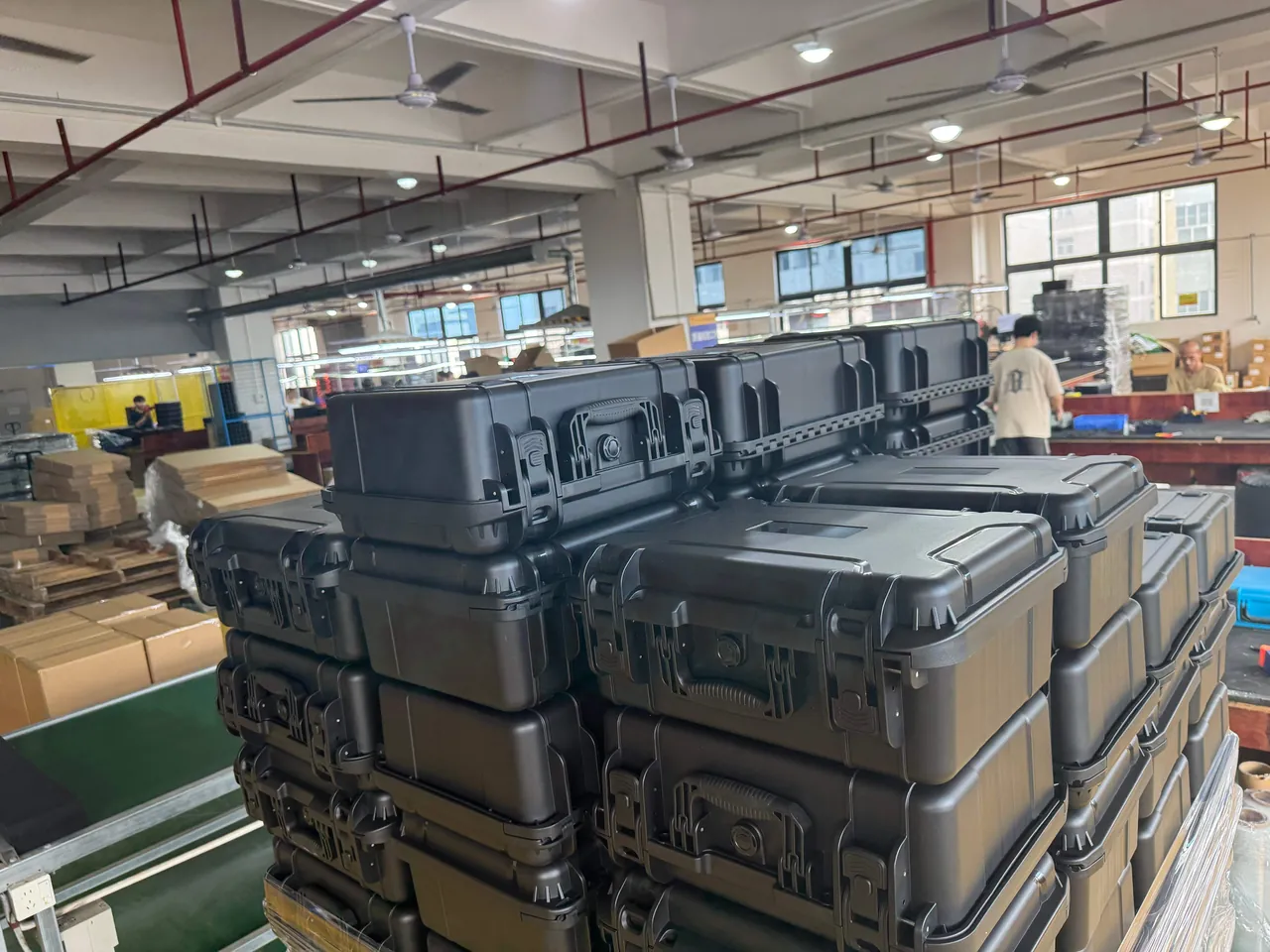
A battery case has three design goals: prevent mechanical damage that could cause an internal short circuit, control the temperature rise inside the case, and provide cushioning and a venting path in extreme situations.
Structural points:
- Separate compartments and electrical isolation. Each battery pack occupies its own compartment, with walls molded from EVA or flame-retardant PE foam. Maintain at least 20 mm of insulating clearance between battery modules and between battery and case wall, as an engineering value to be adjusted for battery size and voltage class. Never allow metal items such as tools, brackets or bolts to share a compartment with battery terminals.
- Terminal protection. High-voltage terminals must carry insulating caps and low-voltage signal terminals need dust caps. Orient connectors upward or inward so they do not become load-bearing faces.
- Venting and breathing. The case should include a breathable but water-tight structure, typically a PTFE membrane, to equalize pressure. Never use a fully rigid sealed design without any vent path, especially where the battery will experience temperature swings.
- Insulation and thermal buffering. If the transport environment may exceed 40 degrees Celsius for extended periods, for example the top of a container or unventilated container storage, add an insulating layer between case and battery or use a light-colored outer case. A light-colored, white or light gray case can run 10 to 20 degrees Celsius cooler on its surface in direct sun than a dark one, as an engineering estimate.
- Full support and crush prevention. The battery pack base must be fully supported to avoid localized loading. For long modules, place one support point roughly every 300 mm.
Temperature monitoring recommendation: for high-value or high-volume battery shipments, place a temperature and humidity logger inside the case with a sampling interval of 10 minutes or less, and apply "avoid direct sunlight" and "do not stack on top" labels outside. Exporting the data on arrival shows whether the shipment experienced high-temperature exposure and provides evidence for battery health assessment.
5. Load capacity and shock protection for drive units and wheel assemblies
A drive unit typically consists of a drive wheel, a gearbox, a servo motor, an encoder and a suspension mechanism, making it one of the densest components in an AGV or AMR. Its failure modes are concentrated: bearing brinelling, gear tooth damage, encoder zero shift and seal leakage.
Four design points:
Load-bearing face design. The center of gravity of a drive unit usually sits toward the motor side. The liner must use the rigid mounting face of the housing, usually a flange face or base plate, as the primary load-bearing surface, rather than the wheel surface or shaft end. The wheel is a friction layer and will flat-spot under compression, and axial force at the shaft end damages bearings.
Axial restraint. The axial fit between gearbox and motor is precise, and axial shock during transport changes bearing preload. Add axial restraint blocks to the liner and limit axial movement to about 1 mm.
Posture selection. Ship the drive unit with the suspension released or in the posture specified by the manufacturer. If suspension springs are pre-loaded, long-term storage causes them to relax, so use shipping locks to secure them.
Anti-tipping and handling. A single case containing a drive unit often reaches 40 to 80 kg, so the case floor needs a load-bearing structure, and the center of gravity and lifting points must be marked on the sides. Use a forklift or a two-person lift rather than dragging.
The liner is mainly high-density EVA at 80 to 120 kg/m3, with an outer EPE energy absorption layer of 20 to 40 mm. For drive units above 30 kg, design the interface between liner and case floor as a distributed load path rather than point contact, so the liner cannot crush locally.
6. ESD-safe packaging for controllers, BMS and safety modules
A controller case typically holds a main control board, drive boards, a BMS master, a safety PLC or safety relay module, and I/O expansion cards. The shared sensitive factors are ESD and moisture.
ESD control essentials:
- Bags: use antistatic shielding bags for boards, either metallized or carbon-loaded types with surface resistance in the 10^4 to 10^6 ohm range or shielding types. Do not use ordinary PE bags. Seal the bag opening so boards cannot slide out in transit.
- Liner: use ESD-safe PE or EVA foam with surface resistance between 10^6 and 10^9 ohm. Ordinary foam generates static charge through friction. For related solutions see ESD shielding case options.
- Grounding and equipotential bonding: operators should wear a grounded wrist strap during packing. Store metal tools and boards in separate zones. If a metal bracket must be placed inside the case, keep it insulated from boards.
- Humidity control: use desiccant at 30 to 60 g per case and add a humidity indicator card so the condition can be judged at a glance on arrival. Keep relative humidity below 60 percent as an engineering value.
- Vibration control: boards are low-mass, high-stiffness items with high resonant frequencies, making them responsive to high-frequency vibration. The liner should match the board contour and provide face support rather than leaving an air gap. Never store boards in an edge-insert arrangement without lateral support.
- Connector protection: fit dust caps or protective covers to all exposed connectors such as RJ45, M12 and D-SUB. Industrial M12 connectors have fine pins that bend easily under compression.
A note on the BMS. The BMS master usually ships in the same case as the battery pack or immediately adjacent. Ideally store the BMS in a separate compartment. There are two reasons: the battery compartment may experience a temperature rise that is unfriendly to electronics over long periods, and the BMS requires ESD-safe packaging that a battery compartment does not. If the customer insists on one case, use at least a divider plus separate desiccant.
Sharing a case with industrial PCs or edge devices: if an industrial computer or edge gateway, a common AGV and AMR configuration, goes in the same case, apply the ingress protection and securing requirements described in industrial PC and edge computing cases, and make sure card-based devices have independent retention and that ventilation openings are sealed.
7. Clean optical protection for lidar and perception sensors
AGV and AMR perception units include single-layer and multi-layer lidar, 3D cameras, ultrasonic sensors, bumper strips and safety laser scanners. Their shared characteristics are an optical window and, in most cases, completed factory calibration.
Optical window protection. The optical window, whether glass or acrylic, must be relieved and must not touch any liner material. Leave a 10 to 20 mm cavity in front of the window and design a ring support in the liner so pressure lands on the metal housing rather than the window. Keep the original protective film in place during packing. If it has already been removed, apply a cleanroom cloth and protective tape.
Calibration retention. Multi-layer lidar contains a rotating mechanism and an angular encoder, and high-frequency vibration during transport can shift the angular zero. Recalibration on arrival is expensive and requires dedicated fixtures. Use the manufacturer's mounting datum face as the locating face in the packaging design, and add restraint blocks to limit all movement other than that of the rotating part.
Cleanliness control. The liner must not shed particles. Prefer closed-cell PE or EVA and avoid open-cell sponge or friable foam. Consider adding a clean PE bag or dust cover inside the case and removing it on arrival.
Dust exclusion and sealing. Optical components are highly sensitive to dust, so specify IP65 or better and IP67 if the route passes through dusty environments. Wipe the seal channel before closing the case so dust does not compromise the seal. Cleaning and maintenance methods are covered in how to clean a protective case.
8. Liner zoning and short-circuit prevention measures
The core of AGV and AMR component case liner design is zoning, restraint and non-conductivity.
Zoning principles:
- One compartment per component, separated by EVA dividers. Divider thickness should be at least 15 mm for light items and at least 30 mm for heavy items.
- Heavy items low, light items high. Orient long items along the long axis of the case to shorten the moment arm.
- Put accessories such as harnesses, bolts and mounting brackets in a dedicated accessory compartment. Never mix them with batteries or boards.
- No hard protrusions on compartment floors. Any metal support must be wrapped in foam.
Short-circuit prevention for batteries and live parts:
- Insulating caps on battery terminals and insulating clearance between packs.
- No freely moving metal items anywhere inside the case.
- Liner materials must be insulating. EVA, PE and EPE typically have volume resistivity above 10^12 ohm-cm. Avoid conductive foam unless it is used in a board compartment specifically for ESD control.
- If the case itself is metal, the liner must fully cover every area a battery could contact and must keep the battery insulated from the case wall.
The value of a removable divider system: AGV and AMR projects frequently need one case type to hold battery type A in one order and battery type B in the next. A removable divider system allows compartment dimensions to be adjusted without changing the case, which significantly reduces the number of case variants per project. For related construction see case removable divider systems. Keep divider locating accuracy within about plus or minus 1.5 mm, otherwise dividers shift under vibration.
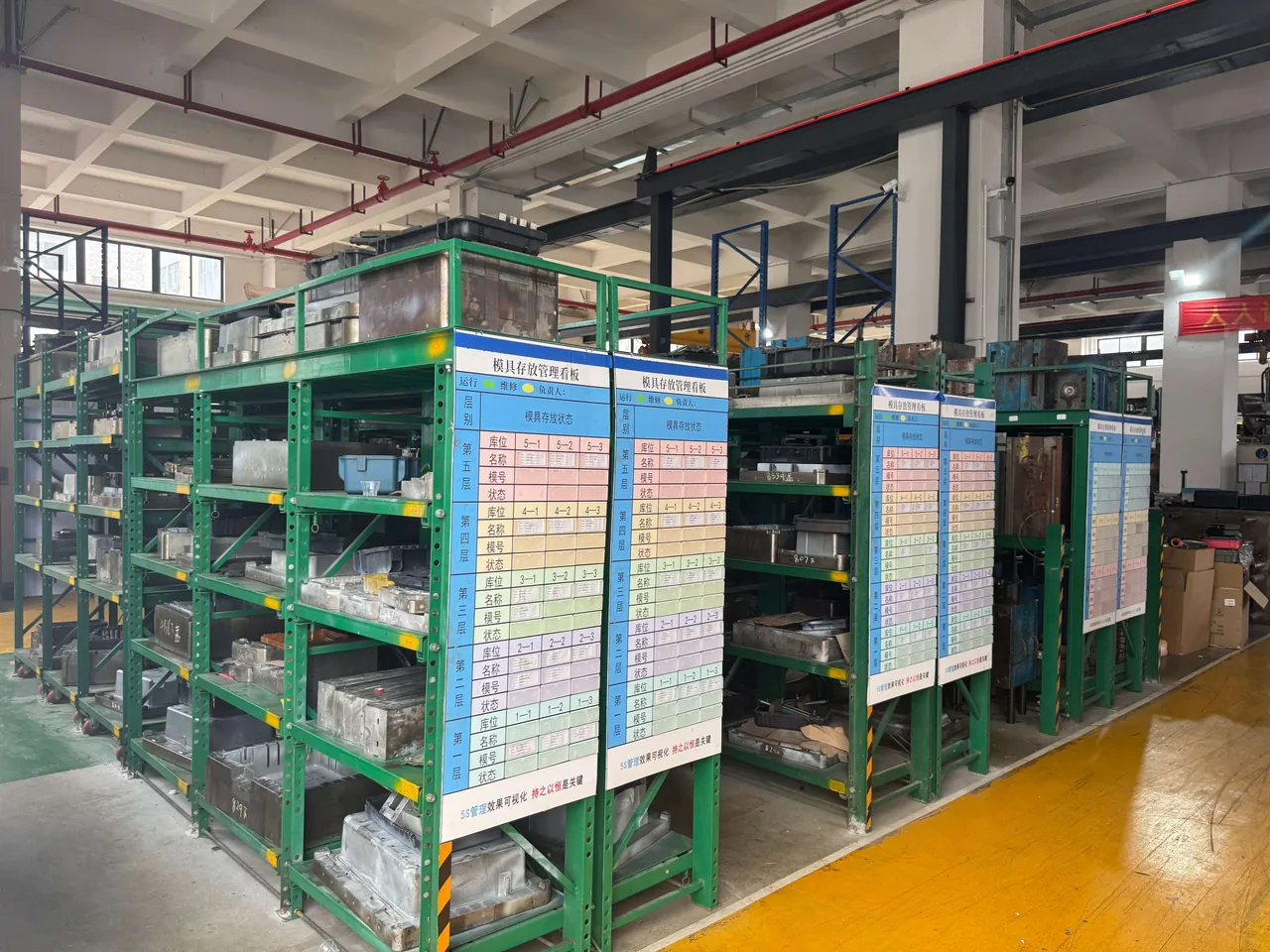
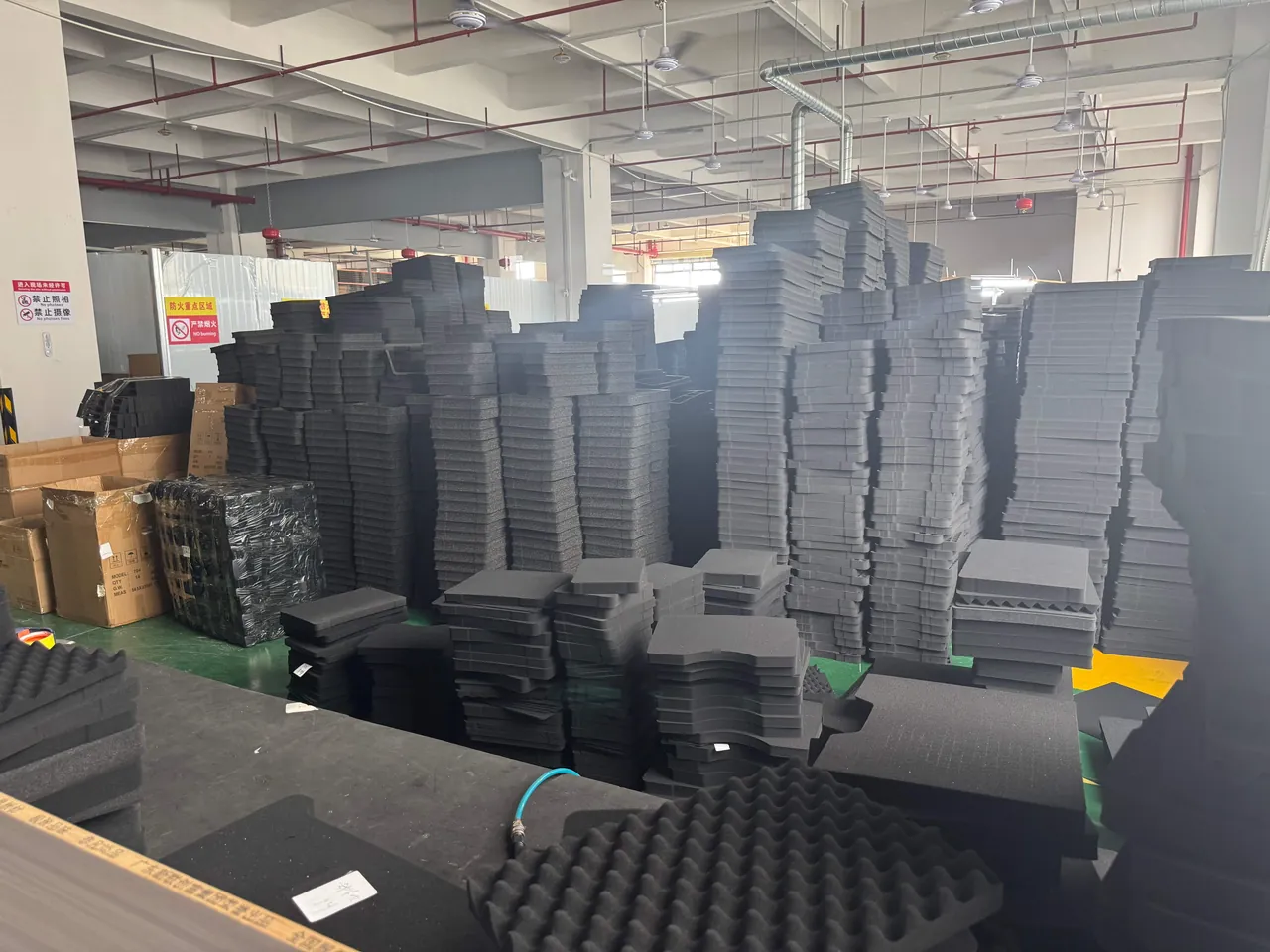
Liner molding route: as with cobot liners, small batches favor CNC carving at plus or minus 0.5 mm accuracy with no tooling, while high volumes favor compression molding. If a customer has several models with fragmented total volume, a "common case plus model-specific liner" strategy that only tools the liner dramatically lowers tooling investment. The underlying cost logic is explained in custom protective case mold cost analysis.
9. Sealing class and pressure equalization: IEC 60529, GB/T 4208, IP65 and IP67
The sealing class of AGV and AMR component cases should be set per component sensitivity and per logistics route, not uniformly across all cases. Classes are defined by IEC 60529 and GB/T 4208.
| Component category | Recommended class | Rationale |
|---|---|---|
| --- | --- | --- |
| Traction battery pack | IP65 to IP67 | Water and dust protection for terminals and housing insulation; must include a breathing structure |
| Drive unit with gearbox and motor | IP54 to IP65 | Mainly dust and splash protection; most drive units already have some ingress protection |
| Controller, BMS, boards | IP65 to IP67 | Electronics are moisture sensitive and need to work with desiccant |
| Lidar and optical sensors | IP65 to IP67 | Optical faces are sensitive to dust and condensation |
Seal construction essentials:
- Gasket: EPDM or silicone sponge with 30 to 40 percent compression, combined with a labyrinth double-lip profile. Compression set is the main cause of long-term failure.
- IP67 requires a pressure-equalization valve. Day-night temperature differences in ocean freight, low pressure in air cargo holds and high-altitude road transport all create differential pressure. Without a valve, the lid can seize shut or the seal can rebound and draw in moisture. Selection guidance is in case pressure equalization valve.
- The battery case is a special case. The breathing structure in a battery case must not be understood as an explosion vent. It only equalizes differential pressure from normal temperature variation. Genuine thermal runaway protection belongs to battery system design and transport compliance and must be handled under requirements separate from UN38.3.
- Gasket cleanliness: sand, metal chips and debris create leak paths. Keep the packing area clean and wipe the seal channel before closing.
A common misjudgment about IP67: many buyers assume IP67 is simply "the best". In reality IP67 requires higher latch force, a more precise seal construction and stricter inspection, all of which add cost, and if the logistics route carries no immersion risk the marginal benefit is limited. Set the class against the actual route, including whether there is open-air storage, rainy-season handling or quay transfer. The detailed difference between IP65 and IP67 is covered in waterproof cases and IP ratings.
10. Transport test references: ISTA, GB/T 4857, ASTM D4169 and MIL-STD-810H
The ISTA series from the International Safe Transit Association: ISTA 2A covers simulated performance testing of individual packages up to 68 kg including conditioning, drop, vibration and compression. ISTA 3E covers unitized load compression and vibration for full pallets. ISTA 3A covers parcel delivery. AGV and AMR component cases are commonly organized against ISTA 2A or 3E. Details are in ISTA transport testing procedure.
The GB/T 4857 series is the Chinese basic test standard for transport packages, aligned with the ISO 4180 framework and covering drop, stacking, vibration and impact parts. Domestic customers usually require a report to this standard. See GB/T 4857 transport packaging testing.
ASTM D4169 is a performance test standard for distribution cycles. It combines test sequences by defining a distribution cycle and an assurance level, which suits a full multimodal evaluation. See ASTM D4169 distribution cycle testing.
MIL-STD-810H is frequently cited for its method-level environmental testing, including Method 501 high temperature, 502 low temperature, 507 humidity, 514 vibration and 516 shock. It must be stated clearly that citing MIL-STD-810H means only that the environmental test methodology is referenced. It does not mean the product holds any military certification, and it does not mean the product is a military product.
Recommended test matrix, with engineering values that must be confirmed against the actual logistics route:
| Test item | Suggested parameters | Pass criteria |
|---|---|---|
| --- | --- | --- |
| Temperature and humidity conditioning | Minus 20 to plus 60 degrees Celsius at 85 percent RH, cycling | No condensation-induced corrosion or electrical fault |
| Drop | One corner, three edges, six faces; 400 to 600 mm common for the 30 to 80 kg class | No liner rupture, no component displacement, no functional failure |
| Random vibration | 5 to 200 Hz, PSD per ISTA 2A, 30 to 60 minutes per axis | No loosened fasteners, no terminal abrasion |
| Compression | Actual layers times a safety factor of 1.5 to 2.0 | No permanent case deformation, no load damage to contents |
| Battery-specific | The eight UN38.3 tests, applied to the battery itself | Test summary issued by the cell maker or a third party |
Evidence chain recommendation: place a temperature logger inside the battery case, apply a shock indicator label outside with a selectable threshold of 25 g, 50 g or 100 g, and read both immediately on arrival. This evidence serves quality traceability and also provides the basis for liability assignment in the event of a dangerous-goods transport incident.
11. Materials, flammability (UL94) and marking requirements
Case material comparison for AGV and AMR applications:
| Material | Load capacity | Weathering | Flammability | Application |
|---|---|---|---|---|
| --- | --- | --- | --- | --- |
| Copolymer PP | Good | Good | UL94 HB, modifiable to V-0 | Battery and drive cases, recommended |
| Homopolymer PP | Good, brittle at low temperature | Requires UV stabilizers | UL94 HB | General parts |
| ABS | Good | Moderate | UL94 HB to V-0 | Controller cases, appearance parts |
| PC | Good | Good | UL94 V-0, V-2 in thin walls | High-strength or windowed applications |
| Flame-retardant PE foam liner | Moderate, cushioning | Good | UL94 V-0 | Battery compartments, electronic liners |
UL94 rating explanation: HB is the lowest horizontal-burning rating. V-2, V-1 and V-0 are vertical-burning ratings of increasing severity, and 5VB and 5VA are stricter still. For AGV and AMR battery and electronics cases, the recommendation is case material at UL94 HB or better and liner material in battery and electronics compartments at UL94 V-0. If the customer has explicit fire-safety requirements or the case must enter specific facilities, the whole case may be required at V-0.
Markings and labels, subject to final confirmation against carrier rules:
- Battery cases: UN number, either UN3480 or UN3481, the lithium battery mark, the Class 9 dangerous goods label where applicable, consignor and consignee details, and a 24-hour emergency contact where the rules require it.
- General component cases: this-side-up arrow, maximum stacking layers, center of gravity and lifting points, keep-dry marking and ESD marking as applicable to contents.
- Case reuse: check label integrity before each shipment and remove old labels so they cannot mislead handlers.
Hinges, latches and gaskets are the life-limiting parts. Evaluate latches by open-close cycles, commonly 5000 to 20000, and by pull force, and manage gaskets on a 2 to 4 year replacement cycle. Selection guidance is in toolbox hinge, latch and seal construction.
12. Customization workflow, delivery documents and acceptance (AQL)
Standard JUNZHJIA customization workflow, with milestones adjusted per project:
- Requirements gathering, 1 to 3 working days: component list and models, individual weights and dimensions, battery specification and UN38.3 summary, logistics route, target IP class, test requirements, annual volume.
- Concept and structural design, 3 to 7 working days: case dimensions, material, wall thickness, zoning plan, liner layering and load-bearing structure, with 2D and 3D deliverables for confirmation.
- First article, 7 to 15 working days: CNC liner plus first-article case shell, with physical packing validation covering load bearing, extraction and insertion force, and handling ergonomics.
- Test validation, 5 to 10 working days: drop, vibration and compression testing to the customer-specified standard, which may be delegated to a third-party laboratory.
- Tooling and mass production: compression-molded liner or molded case shell, full first-article inspection, then AQL sampling in production.
- Delivery and documentation: packing SOP, accessory location map, material declarations and test reports where testing is delegated.
Acceptance recommendations, with AQL per GB/T 2828.1 and ISO 2859-1:
| Inspection item | Defect class | Recommended AQL | Method |
|---|---|---|---|
| --- | --- | --- | --- |
| Appearance, color, scratches, burrs | Minor | 2.5 | Visual, color card |
| Dimensions and fit | Major | 1.0 | Gauges and fixtures |
| Seal performance | Major to critical | 0.65, or 100 percent | Pressure decay or IEC 60529 IPX5 and IPX7 |
| Hinge and latch function | Major | 1.0 | Cycle and pull force testing |
| Liner fit and extraction force | Major | 1.0 | Physical assembly, force gauge |
| Flammability and material declarations | Major | 1.0 | Report verification |
| Marking and documents | Minor | 4.0 | Visual and document verification |
Seal performance should be inspected 100 percent. Seal failure is a critical defect and is hard to trace after shipment. Pressure decay, charging to a specified pressure and holding for 30 to 60 seconds while monitoring decay, and water immersion or spray testing under IPX5 and IPX7 conditions are the two common methods. Related acceptance methods are described in custom case acceptance and AQL sampling.
Incoming acceptance checklist:
- Outer packaging, pallet and label condition, and whether shock indicator labels have triggered.
- Completeness of dangerous-goods labels, UN numbers and documents for battery cases.
- Export and interpretation of temperature and humidity logger data.
- After opening, check batteries for swelling, electrolyte leakage or terminal damage.
- Visual inspection of boards, connectors and optical windows.
- Complete a 4 to 12 hour temperature soak before power-up to prevent condensation, then run functional and self-check routines.
Final compliance responsibility for dangerous-goods transport rests with the shipper. A case supplier can provide structure, sealing, liners and test coordination, but cannot replace the shipper's obligation to confirm classification, packing instructions and documents.
13. Frequently Asked Questions
Q: Can an AGV lithium battery be shipped in the same case as other components? A: It is not advisable. Three requirement sets conflict. First, a battery that warms or produces trace internal gas changes case pressure and needs a breathable or vented structure, while controllers and boards need a low-humidity sealed environment maintained by desiccant, so sharing a compartment means the battery venting requirement undermines the electronics drying objective. Second, electronics need ESD-safe liners and shielding bags, while battery compartments usually use flame-retardant foam, so the material systems and cost structures differ. Third, from a compliance standpoint lithium batteries are Class 9 dangerous goods, and mixing them subjects the entire package to stricter management, while mixing incompatible cargo is itself restricted. The recommended approach is one machine, several cases, with separate compartments: the battery in its own case, drive units sized for their weight, and electronics plus sensors in a shared ESD-safe case. When shipping on one pallet, arrange by weight and dangerous-goods rules with the heaviest case at the bottom. JUNZHJIA can design a complete multi-case, one-pallet solution with matching liners.
Q: What is the relationship between UN38.3 and the transport case? Does the case need UN38.3 certification? A: UN38.3 refers to Section 38.3 of Part III of the United Nations Manual of Tests and Criteria. It is the mandatory pre-transport test applied to cells and batteries themselves, covering altitude simulation, thermal, vibration, shock, external short circuit, impact and crush, overcharge and forced discharge. The cell manufacturer performs it and issues a UN38.3 test summary that travels with the goods. The transport case is not the certification object for UN38.3, but it is the packaging step alongside UN38.3 and must meet the requirements of the applicable packing instruction, such as IATA PI 965, 966 or 967, or IMDG P903, P908 or P909, for package strength, short-circuit prevention and protection against unintentional activation. The correct framing is that UN38.3 governs the battery while the packing instruction governs the case and the complete package, and both must be satisfied. Before any shipment, a dangerous-goods qualified shipper must confirm classification and documents against the current edition of the rules.
Q: How should the state of charge requirement for air shipment of battery packs be handled? A: Air transport of lithium-ion batteries shipped alone under UN3480 generally limits state of charge to 30 percent of rated capacity, while AGV and AMR battery packs commonly leave the factory at 40 to 60 percent SoC for long-term storage and first power-up, so they will be refused as-is. There are three practical options. Add a discharge station to the packing process to bring SoC into the transport range and record it on the battery label. Switch to ocean or road transport, which is more permissive on SoC but still subject to carrier rules. Or ship in the "packed with equipment" or "contained in equipment" configuration under UN3481, which falls under different packing instructions but still requires short-circuit prevention and protection against unintentional activation. Whichever route is chosen, confirm the current IATA Dangerous Goods Regulations or IMDG Code clause with the freight forwarder before shipping, because these rules are updated annually. Requirements of this kind fall within the compliance domain and nothing in this article constitutes a compliance conclusion.
Q: If an AGV drive wheel assembly leaks oil or rattles after transport, what can packaging change? A: Work backward from the failure mechanism, and there are three improvement points. First, load-bearing face selection: the drive unit should be carried on the rigid mounting face or base plate of its housing, never on the wheel surface or shaft end. Wheel compression causes flat spots, and axial force at the shaft end damages bearings and seals. Second, axial restraint: the axial fit between gearbox and motor is precise, and axial shock in transit changes bearing preload and leads to seal leakage, so add axial restraint blocks to the liner and limit axial movement to about 1 mm. Third, posture and springs: if suspension springs are pre-loaded, long-term storage relaxes them, so use shipping locks or pack in the manufacturer-specified posture. In addition, for drive units above 30 kg, design the liner-to-floor interface as a distributed load path rather than point contact, so local crushing cannot cause secondary displacement. Two further points are worth adding. Never ship a drive unit with the wheel resting directly on a hard case floor, because the rubber tread takes the full self-weight over weeks of storage and can develop a permanent flat. And log the suspension lock state on the packing sheet, since a unit shipped without its lock will arrive with a measurable spring relaxation that shows up later as uneven traction.
Q: How should the optical window of a lidar or vision sensor be protected in packaging? A: The core is relief, cleanliness and restraint. Relief means leaving a 10 to 20 mm cavity in front of the optical window and forming a ring support in the liner so pressure lands on the metal housing rather than the window. The window must never touch liner material directly, because foam outgassing and dust contaminate the coated surface. Cleanliness means the liner must not shed, so prefer closed-cell PE or EVA over open-cell sponge or friable foam, and consider adding a clean PE bag or dust cover inside the case for removal on arrival. Restraint means using the manufacturer's mounting datum face as the locating face and adding blocks to limit movement inside the case, because multi-layer lidar contains a rotating mechanism and an angular encoder whose zero can shift under high-frequency vibration and then require dedicated fixtures to recalibrate. Specify IP65 or better, and IP67 for dusty routes, and wipe the seal channel before closing. Cleaning and maintenance methods are covered in the protective case cleaning article.
Q: What transport tests should AGV and AMR component cases undergo? Does MIL-STD-810H count as a certification? A: A common test set includes temperature and humidity conditioning from minus 20 to plus 60 degrees Celsius at 85 percent RH, drop and random vibration per ISTA 2A or GB/T 4857, compression at the actual stacking layers, and optionally an ASTM D4169 distribution cycle. The battery itself undergoes the eight UN38.3 tests with a test summary issued by the cell maker or a third party. One point must be stated explicitly: MIL-STD-810H can only be cited as an environmental test methodology. It does not mean the product holds any military certification, and it does not mean the product is a military product. Civilian industrial equipment cases cite this standard to use its mature methodology, such as Method 501 high temperature, 502 low temperature, 507 humidity, 514 vibration and 516 shock. If a customer writes MIL-STD-810H into a technical agreement, state which methods and which procedures within those methods are referenced, so acceptance does not become ambiguous. The testing workflow is described in the ISTA transport testing procedure article.
Q: How can a multi-model AGV project reduce case cost? A: The most effective strategy is a common case with model-specific liners. AGV and AMR projects usually spread across several models with limited annual volume per model, so tooling a case for every model quickly accumulates tooling cost. The practical approach is to consolidate case sizes into two or three common formats, for example by longest edge and maximum weight, and to tool or CNC-carve only the liner per model. Liner tooling costs far less than case tooling, and switching models only requires changing the liner. With a removable divider system, compartment dimensions can also be adjusted without changing case or liner to accommodate different battery pack or controller sizes. In addition, validating a CNC liner prototype before committing to tooling avoids mold rework, and that step usually costs far less than a single mold modification. JUNZHJIA can provide consolidation recommendations and cost comparisons based on the customer's component list to help find the balance between tooling investment and number of case variants.
Q: How can a buyer verify that a supplier's battery case genuinely meets transport requirements? A: Check five areas. First, structure: is there a dedicated battery compartment, insulating clearance between modules, insulating caps on terminals, and are there any freely moving metal items. Second, is there a breathable but water-tight structure for equalizing normal thermal pressure changes, together with a clear statement that this is not a thermal runaway vent. Third, is the seal inspected 100 percent, by which method, pressure decay or IEC 60529 IPX5 and IPX7 conditions, and with what pass threshold. Fourth, are UL94 reports and RoHS and REACH declarations available for the materials, and do battery and electronics compartment liners meet the required flammability rating. Fifth, can the supplier provide a packing SOP, an accessory location map and test coordination support. To repeat an important point, a case supplier can provide structure, sealing and test coordination, but classification, packing instructions, markings, labels and documents for dangerous-goods transport are ultimately confirmed by the shipper, and any claim that a case is "UN38.3 certified" misreads the standard. Related identification methods are covered in the genuine versus fake protective case article.
14. Conclusion and Related Reading
The value of AGV and AMR component cases lies in breaking one mixed-load risk into three controllable subsystems: the battery case handles compliance and thermal safety, the drive case handles load bearing and shock resistance, and the electronics case handles ESD and moisture. When all three are forced into a single case, you inherit the triple conflict of venting versus dryness, weight versus cushioning, and cleanliness versus flammability. The result shows up on arrival as capacity loss, communication faults and mechanical noise, none of which can be fixed easily in the field and all of which cost far more than the packaging.
For procurement and engineering teams, a practical four-step plan is: first, classify component attributes into dangerous goods, precision electronics and heavy mechanical parts; second, set the sealing class and test matrix from the logistics route; third, design the multi-case and multi-compartment plan, using removable dividers to improve reuse; and fourth, build the evidence chain from shock labels, climate loggers and packing photographs. JUNZHJIA, operated by Kexin New Materials (Guangdong) Co., Ltd., supports AGV and AMR manufacturers, integrators and overseas channels with custom liners, OEM/ODM case structure development, model-specific gaskets and pressure-equalization valves, plus material property tables, UL94 and RoHS and REACH declarations and test coordination, covering everything from single-piece first articles to volume delivery.
Related Reading