

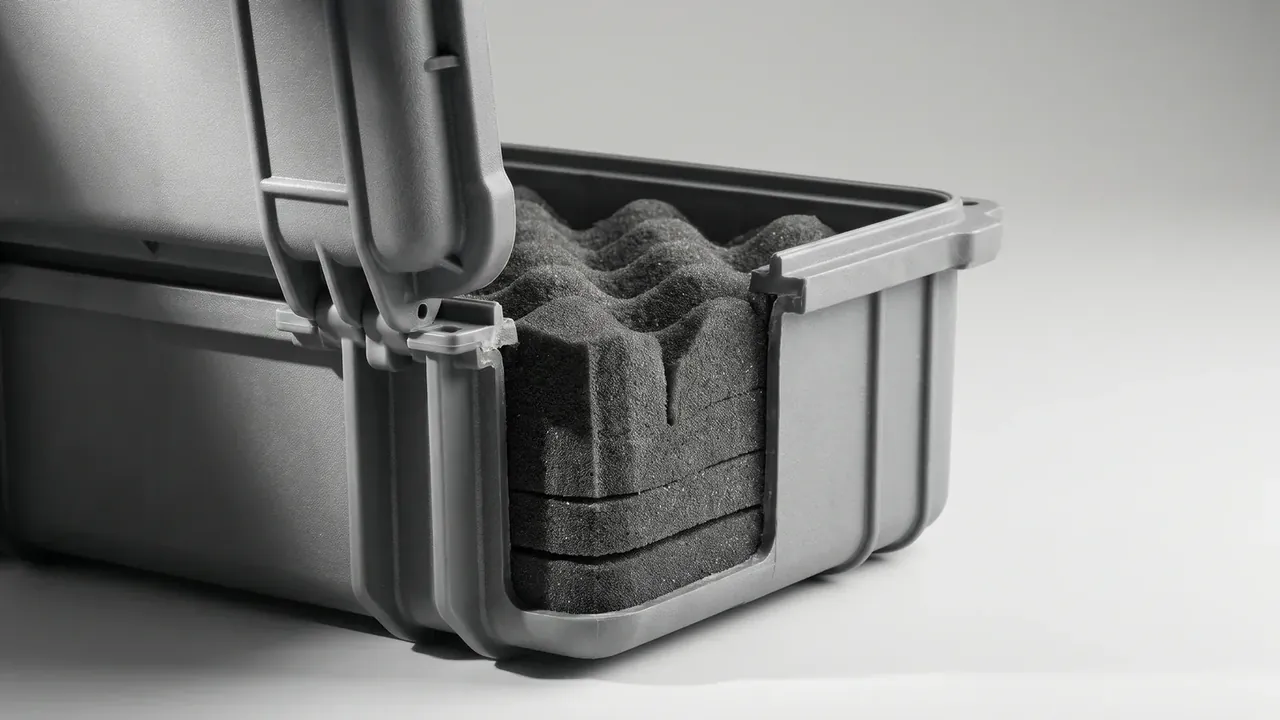
Quick answer: An airborne equipment protective case works at 75 kPa, 5–500 Hz and -40 to 70 ℃ inside a 6 kg budget, with 12 fasteners, 8 connectors and 4 tie-downs.
Table of contents
- How cabin pressure loads the seal
- Vibration spectrum and fastener locking
- Splitting the weight budget across parts
- How cables and connectors are fixed
- Handling and tie-down points
- FAQ
1. How cabin pressure loads the seal
Every gram an airborne equipment protective case saves has to be found again in its structure, and the seal shows that trade first. A cabin held at 75 kPa puts a steady differential across the shell, and that differential reverses with flight phase: on climb trapped air pushes the lid out, on descent it returns and leaves a partial vacuum.
That reversal rules out a gasket chosen for a static load. An airborne equipment protective case runs a TPE gasket at Shore A 50–60 in a groove sized for about 30% compression, so spring is left when the vacuum pulls the lid down. A shell sealed tight with no balance valve fights the operator on the ground, and prying it open rolls the gasket out of its groove.
Temperature works on the same part of any airborne equipment protective case. The spread from -40 to 70 ℃ covers a cold ramp and a warm cabin, and TPE stiffens at the cold end while softening at the hot end. Pick the compound on cold compression set rather than bench feel, because supple indoors can mean leaking after a night outside.
| Cabin condition | Load on the case | Structural answer |
|---|---|---|
| 75 kPa cabin | lid cycled through positive and negative differential | 30% groove compression plus valve |
| -40 to 70 ℃ | gasket hardness drifts | low-temperature TPE, rounded lip |
| tight bay | outline cannot exceed the mount | latches and hinges recessed |
2. Vibration spectrum and fastener locking
An airborne equipment protective case meets a 5–500 Hz spectrum: low frequencies move the whole shell with its bracket, high frequencies flex the thin walls, and fasteners loosen first at the top of the range. The 12 fasteners sit at 4 hinge blocks, 4 latch blocks, 2 handle mounts and 2 tie-down bases, and each one sees a different direction of load.
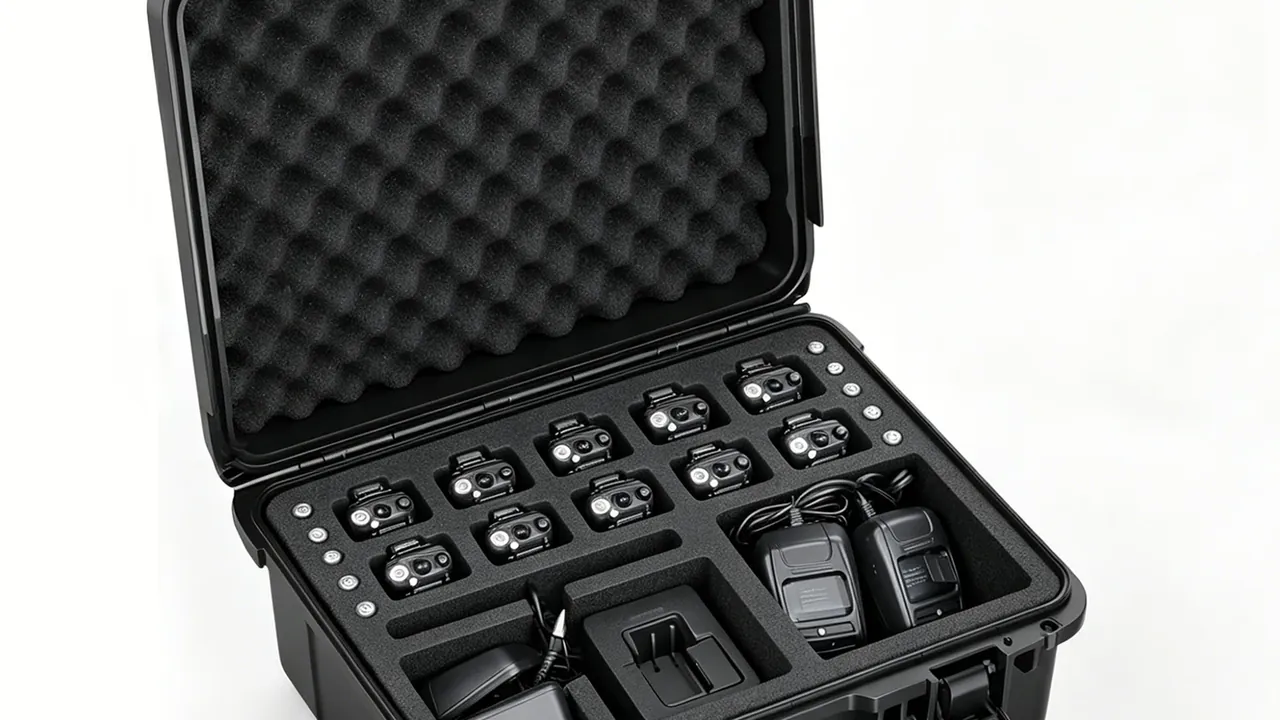
Locking on an airborne equipment protective case comes from three layers, not one heavy measure. Threadlocker goes on the middle of the thread, clear of the first and last 2 mm; nylon-insert nuts grip after tightening; disc washers under the head absorb part of the energy. Together they hold 12 screws at torque through a run.
Witness marks are the cheapest field check. Draw a paint line across head and seat at assembly, and any shift past 1 mm after a test flight means the joint has moved. An airborne equipment protective case with stainless screws in aluminium inserts corrodes galvanically and binds after a few removals, so match materials or grease the thread.
3. Splitting the weight budget across parts
An airborne equipment protective case starts from 6 kg to divide before drawing, not to weigh at the end: 4.1 kg of shell, 0.8 kg of insert, 0.6 kg of hardware and 0.5 kg held back. The shell takes the most because 3–6 mm is the band that still holds a seal groove.
Shape gives more back than material choice. Ribs stiffen a panel and let the wall drop a step; bosses thicken locally; inserts go only where load enters. On an airborne equipment protective case every thick patch answers a named load path, and the rest gets cut.
A verdict line keeps the budget honest: a case running 10% over target, or losing more than one fastener in a vibration run, goes back to design. Weigh after assembly with the insert fitted, since an empty-shell number misses damp foam, and a case found heavy that late cannot be fixed in the mould.
| Part | Budget kg | How weight comes out | What stays |
|---|---|---|---|
| Shell | 4.1 | ribs, stepped thickness | seal groove, latch bosses |
| Insert | 0.8 | low density within 25–45 kg/m³ | load-bearing pads |
| Hardware | 0.6 | aluminium inserts | hinge pin, latch tongue |
4. How cables and connectors are fixed
Eight connectors sit on the panel, and how they are fixed decides how many mating cycles they survive. Cut-outs follow the flange, with a locking nut and flat washer behind it, so the body cannot rotate and drag the cable.
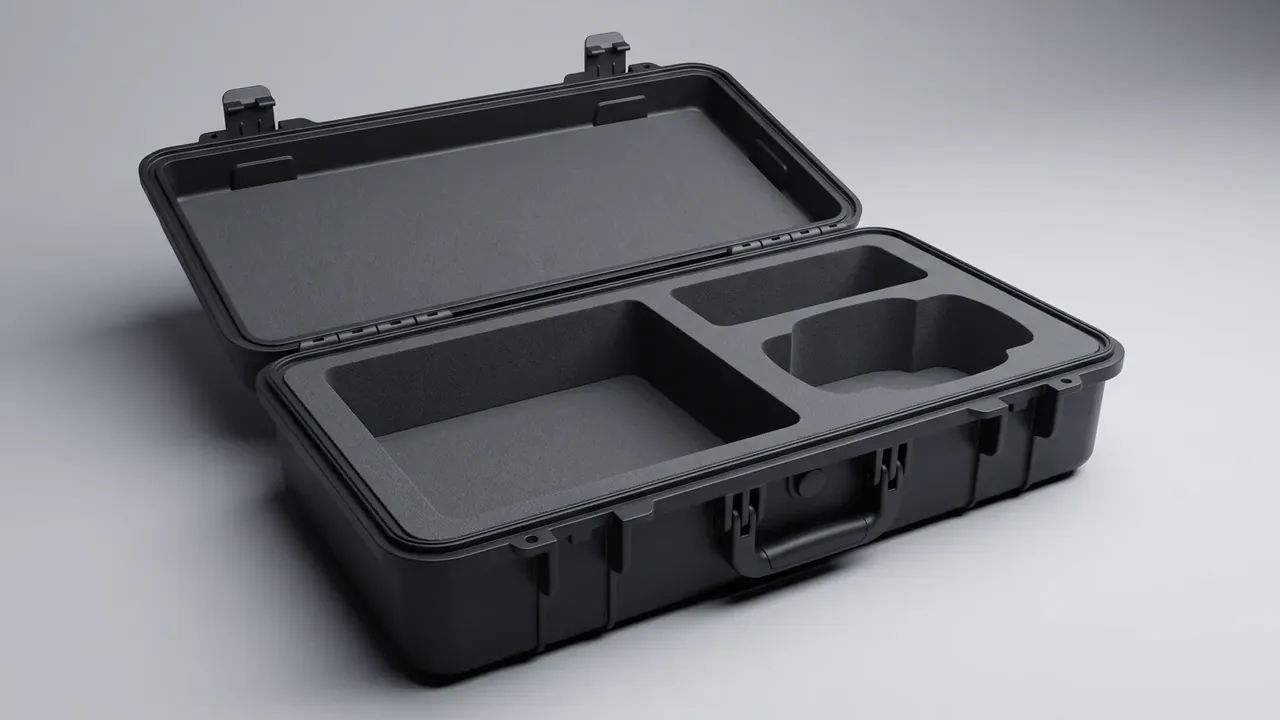
Routing on an airborne equipment protective case stays clear of the hinge sweep. Harnesses run in wall channels with slack between ties, so the lid opens without pulling a contact, and every pass through a divider gets a grommet instead of a bare edge. Bends ease to at least five times the cable diameter, because a tighter bend breaks strands inside insulation.
Mating order goes on a label inside the lid: signal off first, power second, reverse on reassembly. Group the connectors by function with coloured ties, since in a 90 s turnaround the search takes longer than the plugging.
| Location | Fixing method | Failure it prevents |
|---|---|---|
| Panel connector | flange plus locking nut | nut back-off, body rotation |
| Interior harness | channel plus ties | hinge contact, worn jacket |
| Divider pass-through | grommet | cut jacket at a bare edge |
| Connector tail | strain clamp | pull reaching the solder joint |
5. Handling and tie-down points
An airborne equipment protective case carries 4 tie-down points, and position matters as much as strength. They sit either side of the centre of gravity, one pair forward and one aft, with straps near 45 degrees; flatter straps let the case slide, steeper ones press the lid and crush the gasket.
Load must reach a rib rather than stop in thin wall. The base sits on a metal insert with a sealing washer, screw outside, nut inside, and force spreads along the rib. Points added after tooling rarely land on a rib, so the four positions belong on the drawing before the mould is cut.
The handling target is 90 s. Two people lift by the handle with the lid latched, because a half-latched case puts the latch in shear first. At 6 kg one person can carry it a short distance, yet loading it into a bay still goes faster with two.
Related Reading
- How airborne equipment cases are used in aviation
- Common problems in communication equipment cases
- Lid depth and the space left for accessories
- Usable volume: cavity, corners and the real ratio
This article covers the case side only: shell, seal, hardware and tie-down, not the equipment that travels inside.
JUNZHIJIA
Related Products
- 8 Series — Gun Cases; Military Equipment Cases; Camera Equipment Cases; Drone Cases; Watch Cases; Knife Cases; First Aid Cases; Electronics Equipment Cases
- WL8-2812 PP Gun Case — model WL8-2812
- All protective cases and toolboxes: 7 series, 158 models