

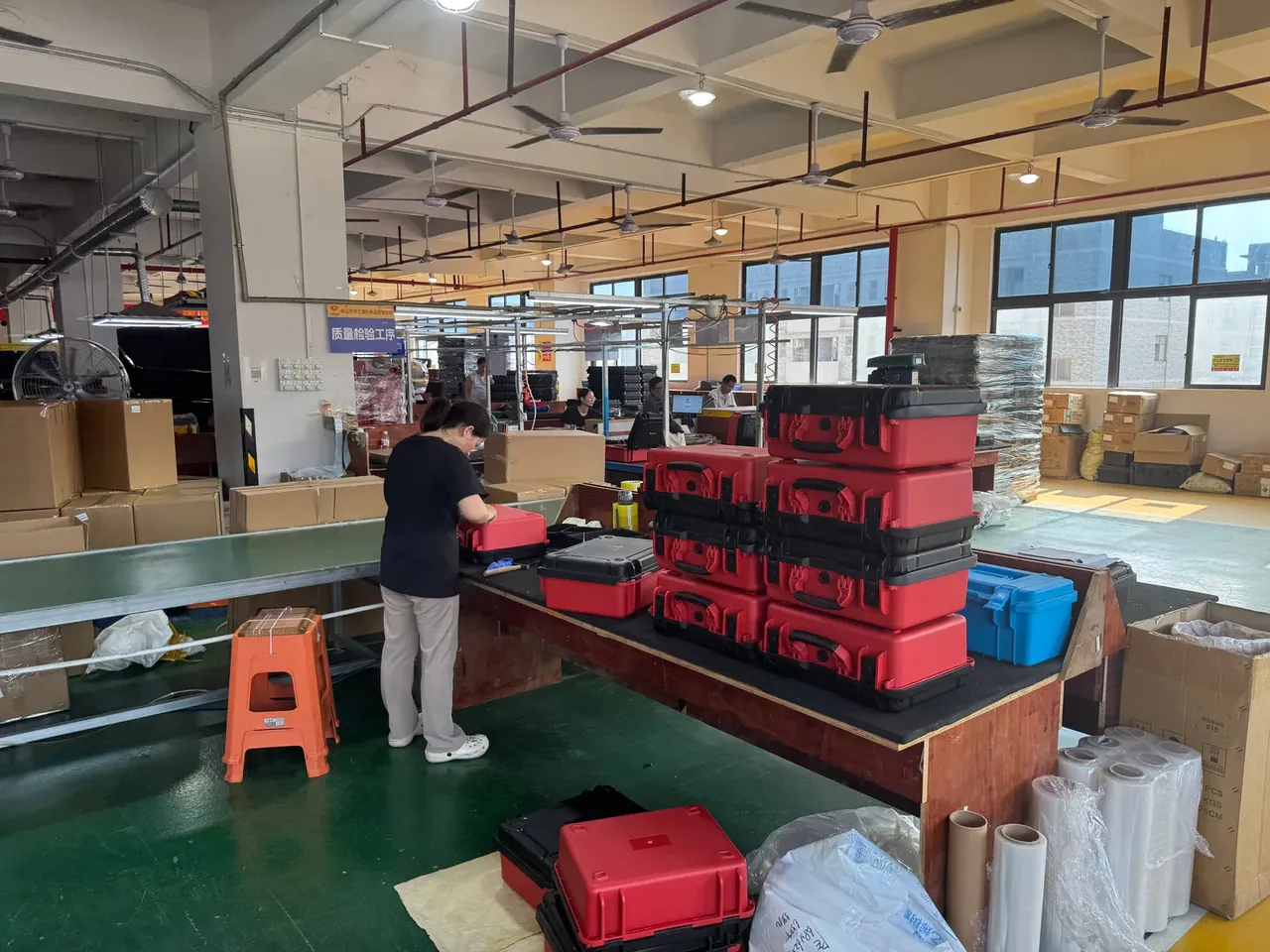
Quick answer: A ground support case opens in 3 s, spends 8 s per item and tows 300 m back, using 5.5 of the 25 minutes a narrowbody turnaround allows.
Table of contents
- Where a Ground Support Case Sits in a 25 Minute Turnaround
- Three Seconds to Open: Two Latches and a 105° Lid
- Twelve Compartments and Four Colour Codes
- Finding the Right Slot With Gloves On
- The 300 m Tow and 75 mm Castors
- FAQ
1. Where a Ground Support Case Sits in a 25 Minute Turnaround
A narrowbody turnaround runs 25 minutes: 2 for the bridge, 8 for disembarking, 6 for cleaning, 5 for catering and fuelling, 3 for pushback, 1 buffer. The ground support case takes three gaps inside that block, each ending with the lid shut behind the yellow line.
Nine turnarounds per shift means nine openings, so each gets 6 minutes: 3 s to open, six items at 8 s, 3 s to close, 4.6 minutes to tow 300 m, 5.5 minutes in total.
| Turnaround stage | Duration min | Pick and place action |
|---|---|---|
| Bridge on | 2 | Two-person lift, lid open in 3 s |
| Disembarking | 8 | Red slots, 3 compartments, 8 s per item |
| Cabin cleaning | 6 | Yellow slots, lid shut, shifted 2 m |
| Catering and fuelling | 5 | Blue slots, grey left untouched |
| Bridge off | 3 | Lid down, latches closed, 300 m tow |
Timing pressure sits in closing: a shell at the door obstructs the bridge once it moves, so the 12 compartments are ordered backwards from that countdown.
2. Three Seconds to Open: Two Latches and a 105° Lid
Three seconds is three movements: 0.6 s on a latch, 1.4 s to lift, 1 s for the stay. Every extra latch costs 0.6 s, so a four-latch shell spends 2.4 s on latches alone. This ground support case carries two, 150 mm either side of centre.
The 105° stop lets the lid hold itself: past the balance line both hands are free, while 90° falls back 15° and 120° fouls the handrail. A cold seal stiffens until opening force climbs from 40 N to 64 N, and the lid needs 4.8 s at -10 °C.
| Surface temperature °C | Opening force N | Opening time s |
|---|---|---|
| -10 | 64 | 4.8 |
| 20 | 40 | 3.0 |
| 40 | 41 | 3.1 |
| 55 | 44 | 3.3 |
Heat causes a shape problem instead: at 55 °C the 550 mm lid sags 1.5 mm and the latch sits 0.8 mm off its keeper.
3. Twelve Compartments and Four Colour Codes
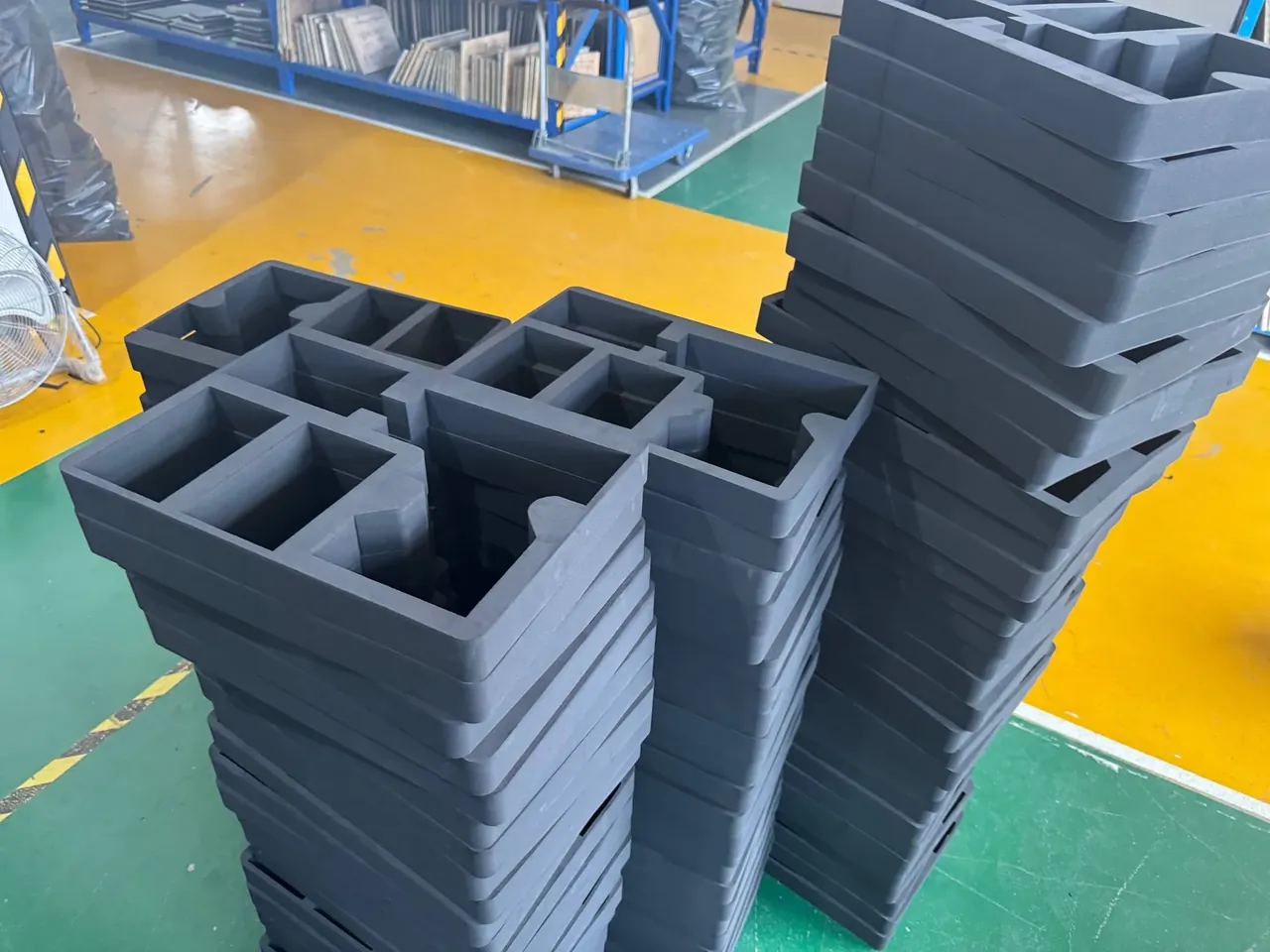
Twelve compartments sit in three rows of four, each 110×90×80 mm with 8 mm walls, filling a 520×370 mm plan. They are not equal: the two columns nearest the handle are 80 mm deep and the two nearest the hinge 60 mm, because fingers enter at a sharper angle.
Four colours run red, yellow, blue and grey on the front wall of each compartment at 15 mm, never on the floor or in the lid. A floor stripe hides while the lid is shut and a lid stripe has to be opened first; the front wall shows at 30° and a sweep across 12 compartments takes 1.2 s.
| Colour code | Compartments | When it is used | Pick time s |
|---|---|---|---|
| Red | 3 | Disembarking, first out | 8 |
| Yellow | 3 | Cabin cleaning | 8 |
| Blue | 3 | Catering and fuelling | 8 |
| Grey | 3 | Spares, never opened mid-turn | 0 |
Colour follows frequency, not size. The red three open on all nine turnarounds and the grey three once in nine, so the ground support case puts the frequent group 120 mm from the fingers.
4. Finding the Right Slot With Gloves On
Apron floodlights on 12 m masts give 50 lx, and the working plane about eight tenths of that. A 15 mm block subtends 2.9° at 300 mm, enough to separate red from grey but not to read a 3 mm numeral, so the compartments carry no numbers.
Colour solves seeing; shape solves feeling. A 1.2 mm winter glove lifts the touch threshold from 0.1 mm to 0.4 mm, so the four zones differ in opening width instead: 110, 106, 102 and 98 mm, 4 mm apart, felt as a finger crosses the slot.
What decides the 8 s is the path: 2 s to reach, 3 s to draw, 3 s to return. The return leaks time with a wet glove, and a 2 mm concave floor centres the item to 2.2 s.
5. The 300 m Tow and 75 mm Castors
The run from door to handling position is 300 m, the shell weighs 20 kg, and four 75 mm castors carry it. At 1.1 m/s the tow takes 4.6 minutes, and 40 s goes on the 20 mm apron joints, where a 75 mm wheel against a 20 mm gap gives 3.75 and anything under 4 catches.
With a 180 mm centre of gravity on a 550 mm footprint, tipping needs 1.53 g sideways. Crossfall is 1% and a turn applies 0.15 g, leaving 1.38 g of margin, which is why this ground support case has no telescopic handle: it would raise the centre of gravity 200 mm and drop the threshold to 0.72 g.
At 55 °C the wheels lose 15% hardness and rolling resistance rises 12%, adding 30 s.
Conclusion
A ground support case is designed from a 25 minute turnaround rather than from capacity. Three seconds to open, 8 s per item and 4.6 minutes for the 300 m tow set the shell at 20 kg and 550×400×250 mm, with the lid held at 105°. Twelve compartments in four colours follow the turnaround order.
Related Reading
- Ground service and security screening cases compared
- Modular carriage of line maintenance equipment
- Apron impact protection and external marking
- Aviation tool control and FOD prevention
Related Products
- 8 Series — Gun Cases; Military Equipment Cases; Camera Equipment Cases; Drone Cases; Watch Cases; Knife Cases; First Aid Cases; Electronics Equipment Cases
- WL8-2812 PP Gun Case — model WL8-2812
- All protective cases and toolboxes: 7 series, 158 models