

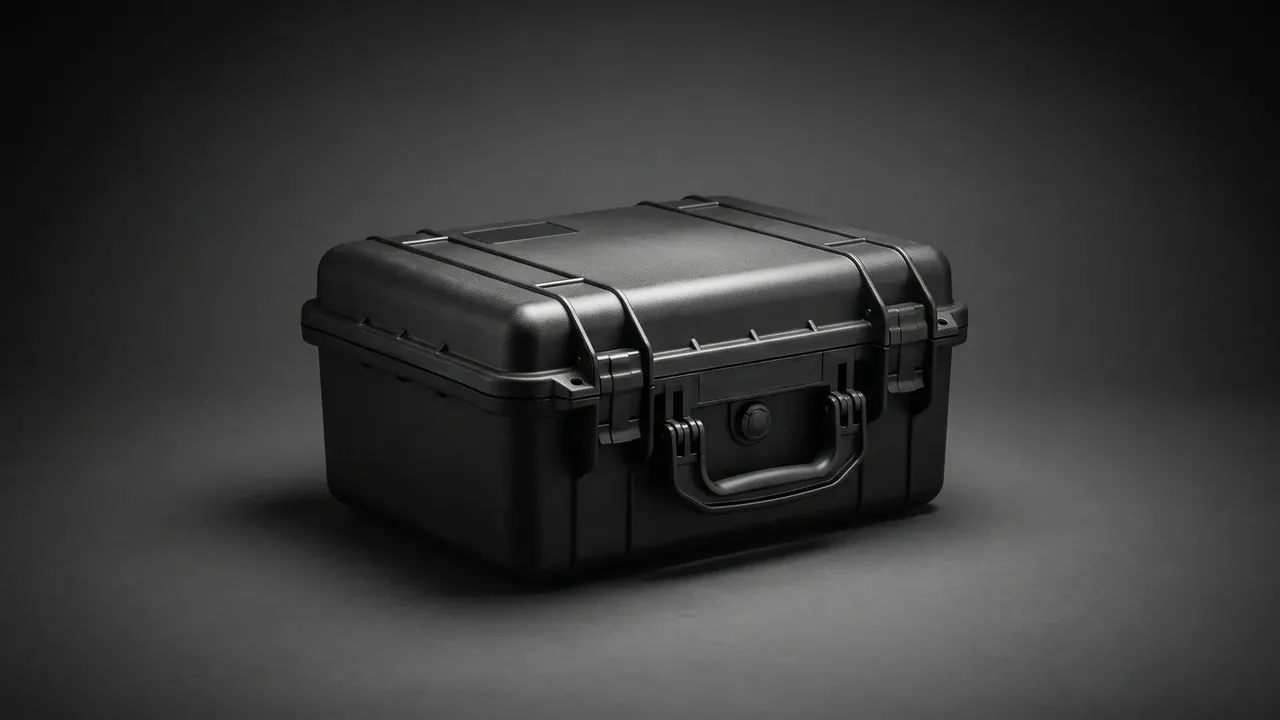
Quick answer: An aviation tool control case prevents foreign object debris by giving every tool its own cut foam slot over a red underlay that shows through when a tool is missing, and by latches plus a numbered seal that let a supervisor confirm the case is shut and untampered without opening it.
Table of contents
- Aviation Tool Control Case Foam Layout: One Tool, One Slot
- Slot Numbering and Label Systems
- Latches, Seals and Closed-State Marking
- Isolating ESD-Sensitive and Magnetic Items
- Stacking and Securing in the Stores Area
- FAQ
1. Aviation Tool Control Case Foam Layout: One Tool, One Slot
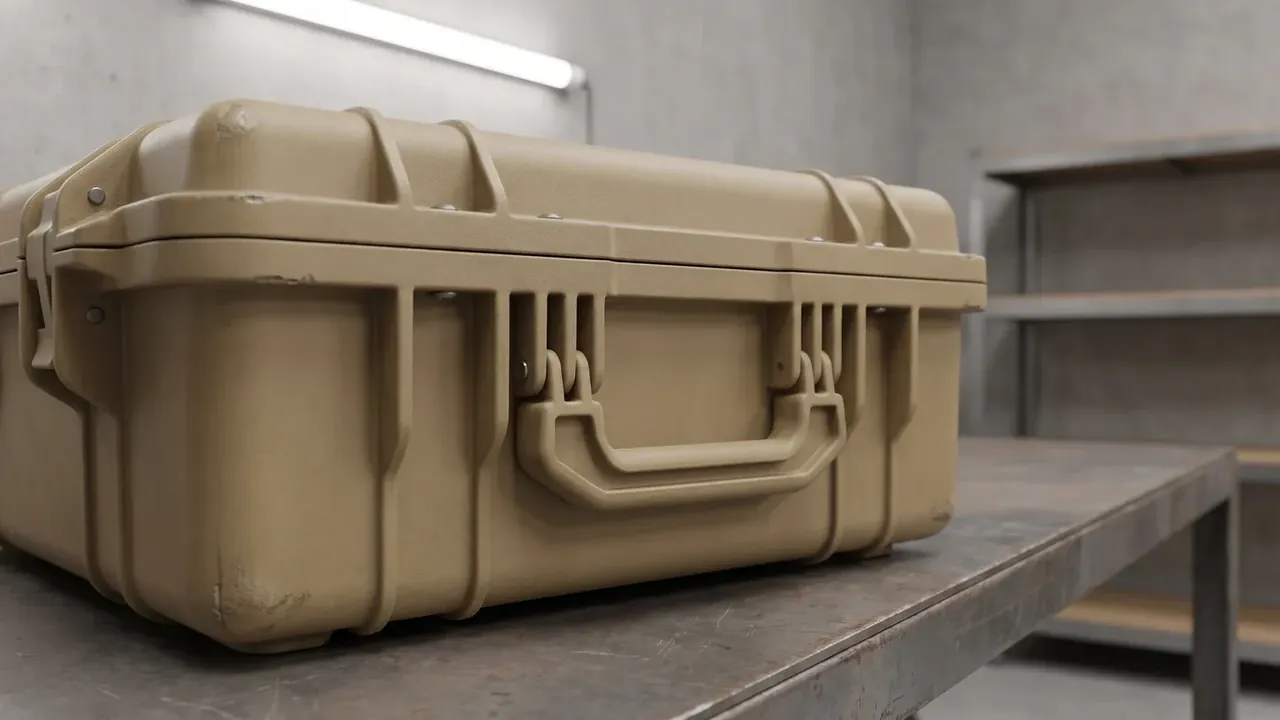
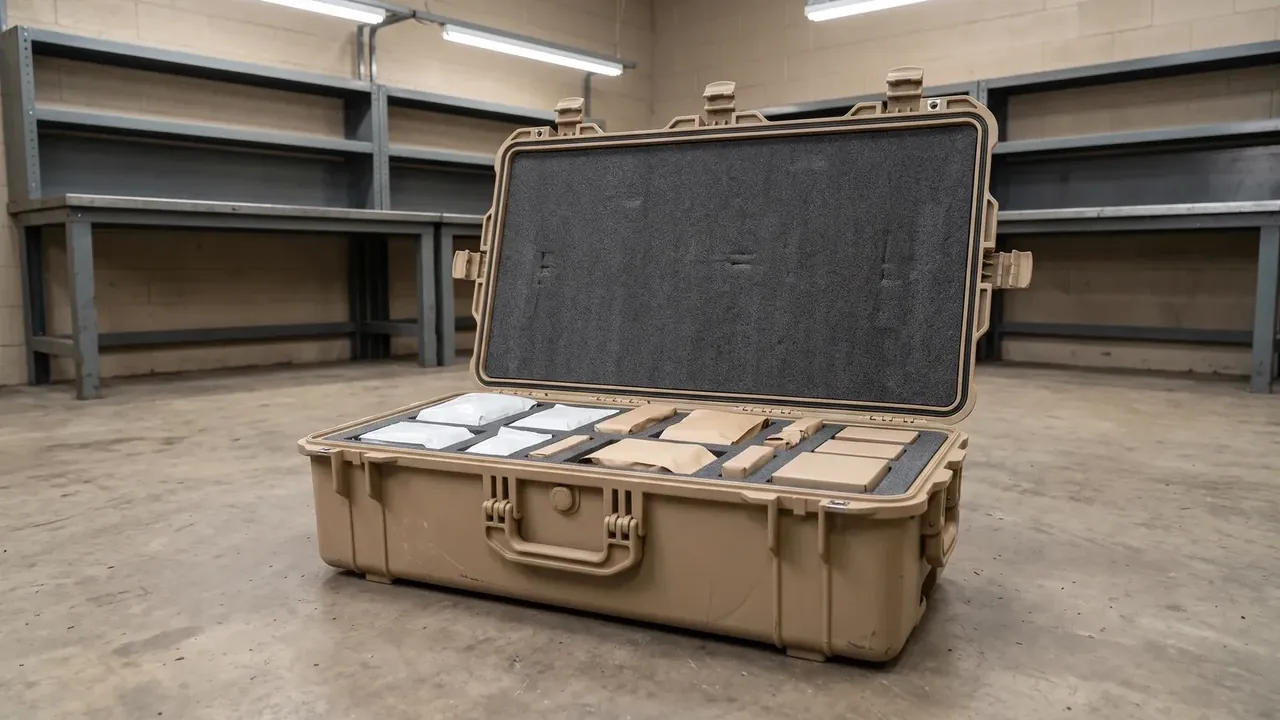
Layout starts from tool footprints, not from tool categories. A typical aviation tool control case measures about 450 × 320 × 150 mm internally, and the hinge side eats 15 mm, leaving 430 mm of usable width. At roughly 55 mm per slot that is 24 slots per layer, 48 across two layers. Each cut-out runs 2 mm larger than the footprint, so a thin glove fits and nothing shifts more than 5 mm once the lid is down.
The top layer is 20 mm polyethylene at 35 kg/m³ for shape, the base is 30 mm EVA at 70 kg/m³ for energy absorption, and a 3 mm red EVA sheet sits between them so a vacant slot reads from a metre away.
| Item | Value | Criterion |
|---|---|---|
| Internal size | 450 × 320 × 150 mm | As moulded |
| Slot clearance | 2 mm per side | 0.5–3 mm |
| Top layer | 20 mm, 35 kg/m³ | Recovers after 25% strain |
| Base layer | 30 mm, 70 kg/m³ | Recovers after 40% strain |
| Slot count | 48 across two layers | Set by the task list |
Two tools sharing one slot defeats the board within a shift.
2. Slot Numbering and Label Systems
Numbers run row by row, A-01 top left to D-12 bottom right, and belong to the slot rather than to the tool. Each plate is 25 × 12 mm at 0.5 mm thick, laser engraved 0.1 mm deep and bonded 5 mm in from the outer edge, so it still reads at 45 degrees.
A 12 × 12 mm QR code with 0.25 mm modules resolves on a phone at 80 mm. Face stock is 50 µm PET over 25 µm adhesive at 8 N/25 mm peel, surviving ten cycles between −20 °C and 70 °C without lifting.
A 13.56 MHz inlay in the lid reads at 30 mm, so counting all 48 pieces takes about 40 seconds. Steel tools cut that to under 10 mm, which is why inlays sit on foam walls, never on tools.
3. Latches, Seals and Closed-State Marking
Closure hardware decides whether the case can be sealed at all. Two cam latches at 150 N each pull the lid gap to 0.5 mm or less, and a four-latch body drops to 110 N per latch with a more even gap.
A φ8 mm padlock hole front and rear takes a 4 mm numbered seal, recorded on the handover sheet, with two signatures to break it. A padlock answers whether the case was opened; a seal answers who opened it and when.
| Closure part | Value | Criterion |
|---|---|---|
| Latch force | 150 N each | 110–180 N |
| Lid gap | Closed | ≤0.5 mm |
| Padlock hole | φ8 mm | Takes 4 mm seal |
Status runs on three colours: green in store, amber for repair, red for a missing item, hung on 20 mm webbing and readable with the case shut. The tag is a prompt; the trail is the seal number matched against the slot list.
4. Isolating ESD-Sensitive and Magnetic Items
Static-sensitive items take a slot walled with 3 mm conductive polyethylene held between 10^6 and 10^9 Ω, a band that bleeds charge away without the near-instant discharge of metal.
Magnetic items go behind a 1.5 mm cold-rolled steel divider, which pulls flux at 10 mm from 30 mT to below 5 mT.
An aviation tool control case cycles between −20 °C and 55 °C, so moving one from a 5 °C store to a 25 °C bay leaves condensation inside for about 20 minutes. Closed-cell foam absorbs under 1% of its weight; open-cell foam takes eight times its own weight in water. Leave the lid shut for those 20 minutes.
5. Stacking and Securing in the Stores Area
Load is rated at 25 kg per aviation tool control case against 120 kg static capacity, stacked no more than 3 high with 15 kg maximum on the top unit. A fourth layer pushes lid deflection past 3 mm and the gap opens.
Cart restraint uses two 25 mm nylon straps with 5 mm EVA corner pads. Tugs run at 15 km/h, slab joints throw 3 G to 5 G peaks, and foam at 25% compression transmits that peak least.
| Transport item | Value | Note |
|---|---|---|
| Stack height | 3 layers | Top unit ≤15 kg |
| Load per case | 25 kg | Static capacity 120 kg |
| Strapping | 25 mm × 2 | With 5 mm pads |
| Tug speed | 15 km/h | 3–5 G at joints |
| Temperature | −20 °C to 55 °C | 95% RH ceiling |
Temperature and humidity limits belong on the handover sheet, and the shell should survive fifty isopropanol wipes.
Conclusion
An aviation tool control case earns its place by turning a count into something visible: shaped slots, red showing where a tool should be, numbers that match a list, a seal number that can be traced. Read the closure hardware next, where 150 N latches, a 0.5 mm lid gap and a 4 mm seal make the closed state verifiable. Let foam, labels or latches go slack and FOD control falls back on memory. With the lid shut, can you still say whether anything is missing?
This article discusses only the container (case body) side of specifications and design intent, and does not cover any handling, loading or use of the contents.
Related Reading
- Specifying an aviation maintenance tool case
- Protective cases for aviation equipment on the ramp
- Case labelling and asset tracking
- General hardware standards for tool boxes
Related Products
- 8 Series — Gun Cases; Military Equipment Cases; Camera Equipment Cases; Drone Cases; Watch Cases; Knife Cases; First Aid Cases; Electronics Equipment Cases
- WL8-2812 PP Gun Case — model WL8-2812
- All protective cases and toolboxes: 7 series, 158 models