

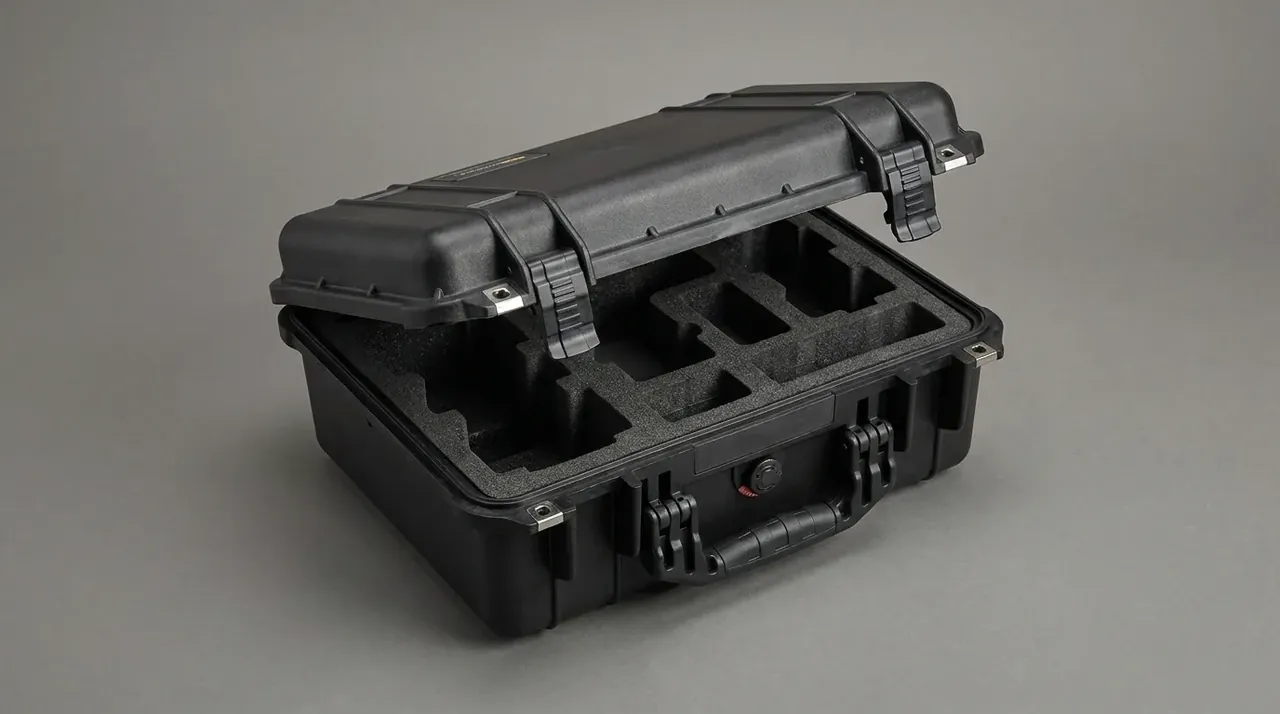
Quick answer: A case airtight test passes when a 30 L case charged to 3.0 kPa and held for 120 s loses no more than 0.3 kPa, a leak of about 44 mL/min.
Table of contents
- What 0.3 kPa means as a leak rate
- Setting 3.0 kPa and the 60 s settle
- Bigger cases drop less pressure
- Temperature drift and the IP67 link
- FAQ
1. What 0.3 kPa means as a leak rate
A 30 L case held at 3.0 kPa for 120 s loses 88.8 mL when the gauge falls 0.3 kPa, which is 44.4 mL/min. Leaked volume equals volume times drop over atmosphere, so 30 × 0.3 ÷ 101.3 = 0.0888 L, read as a minute: a 50 mL syringe emptied in 60 s.
Zero is not the threshold because gauges have resolution. A 0 to 10 kPa gauge at 0.25% full scale resolves 0.025 kPa, and 0.3 kPa is 12 times that. Zero logs a draught as a leak; 1.0 kPa passes a pinhole.
| Drop on 30 L (kPa) | Air lost (mL) | Leak rate (mL/min) | Usual cause |
|---|---|---|---|
| 0.10 | 29.6 | 14.8 | Gasket lightly under-compressed |
| 0.20 | 59.2 | 29.6 | One latch not fully closed |
| 0.30 | 88.8 | 44.4 | Threshold |
| 0.50 | 148.0 | 74.0 | Gasket split or short-shot |
| 1.00 | 296.0 | 148.0 | Debris in the groove |
The 0.30 row holds 88.8 mL and 44.4 mL/min, where threshold and leak rate meet.
2. Setting 3.0 kPa and the 60 s settle
A 3.0 kPa charge trades sensitivity against lid load. Push higher and the same leak grows into a bigger drop sooner, but the lid lifts and the latches enter yield, so the leak belongs to the fixture. At 3.0 kPa, or 306 mm of water, a 0.10 m² lid sees 300 N, four latches taking 75 N each.
Settling lets pressure even out: air enters at the relief valve port and strikes the far wall, so an instant reading shows 0.1 to 0.2 kPa high on that side. Close the valve, watch the needle hold at 3.0 kPa, then start the hold.
Holding 120 s cannot be separated from the 0.3 kPa figure. At 60 s the same leak reads 0.15 kPa and hides in noise; at 300 s the threshold could reach 0.12 kPa, but each case then ties up a bench for 5 min, and a line at 200 units a day falls behind.
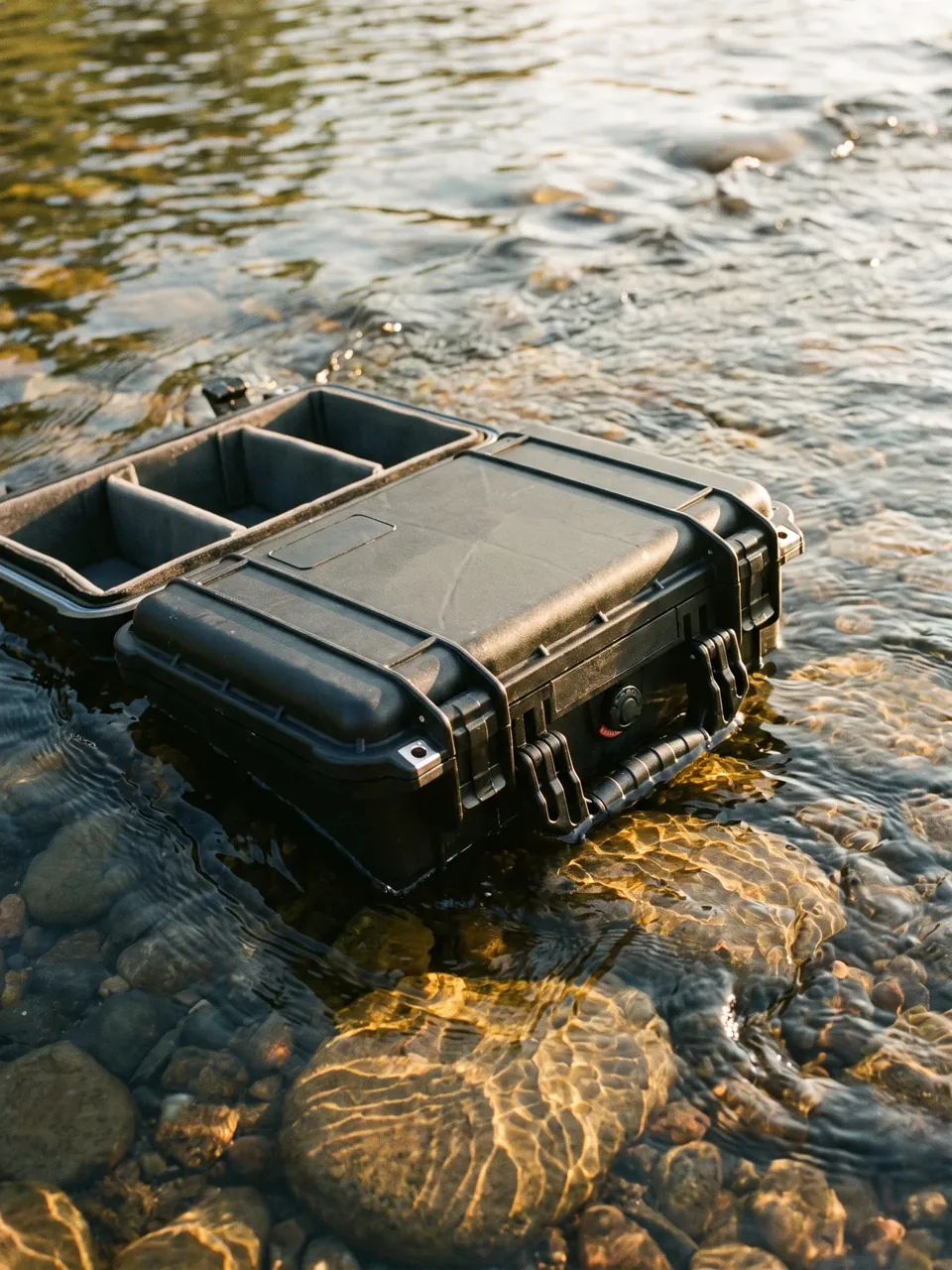
Log charge pressure, both readings and ambient temperature; without temperature the curve cannot be corrected. A gauge logging at 1 s shows whether the loss is a slope or a step, and a step means the lid domed rather than leaked, the shape common under 5 L.
3. Bigger cases drop less pressure
Two cases from one family, 15 L and 30 L clear, share gasket section, latch count and a 44 mL/min leak, yet read 0.60 kPa and 0.30 kPa. Written as a flat 0.3 kPa the small case fails and the large one passes, though neither leaks faster.
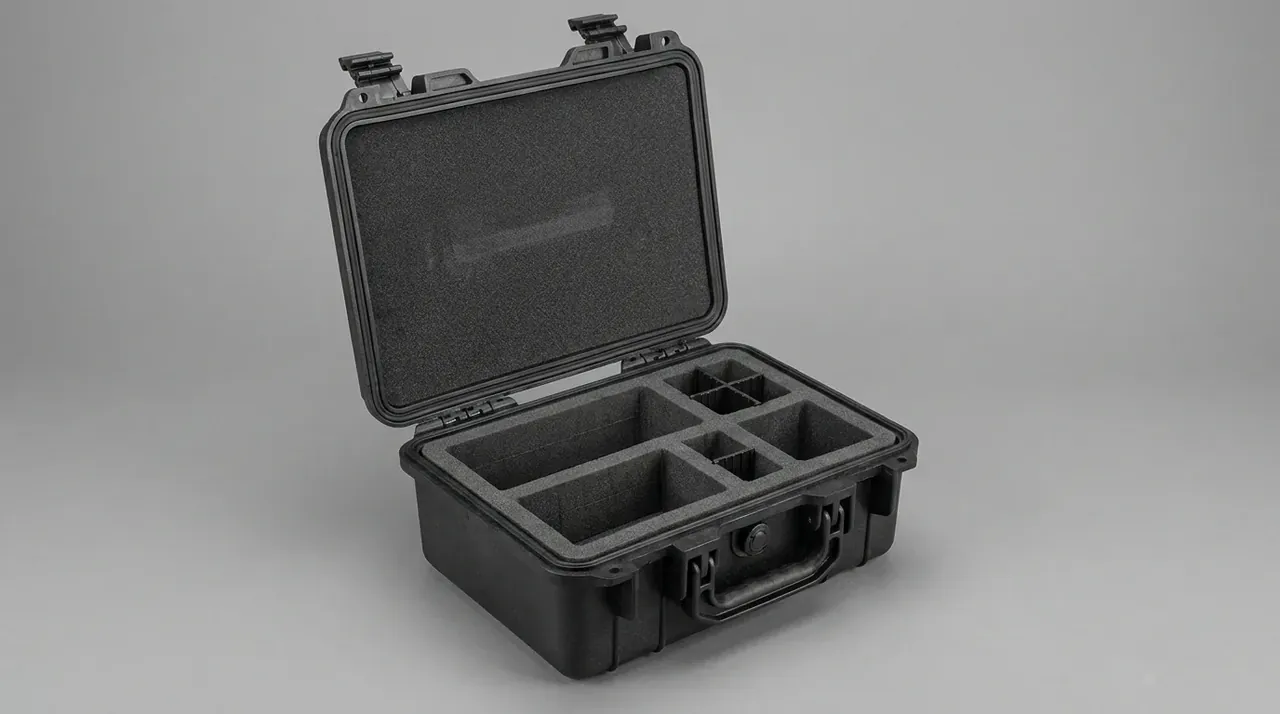
Clear volume causes more errors than the threshold. It is the air a closed case holds with foam, dividers and liners deducted. A case sold as 33 L, fitted with 24 mm foam and four dividers, often holds 26 L, and reading it as 33 L overstates the leak by 27%.
Large cases need no looser limit, since the allowance scales: 100 L may leak 148 mL/min, 3.3 times the 30 L figure. Below 15 L the number is strict, so stretch the hold to 300 s rather than relaxing the line.
4. Temperature drift and the IP67 link
Air in a sealed case follows the gas law, and 1 ℃ at 3.0 kPa is worth 0.35 kPa, more than the whole allowance: 104.3 kPa absolute over 293 K gives 0.356 kPa per K. That is why a case off a truck cannot be tested on arrival.
Correction is one step: absolute pressure times temperature difference over absolute temperature, subtracted from the reading. A fall of 0.42 kPa while the interior warms 0.6 ℃ carries a 0.21 kPa term, leaving 0.21 kPa and a pass.
| Drift during hold (℃) | Apparent drop (kPa) | Share of 0.3 kPa | Action |
|---|---|---|---|
| 0.2 | 0.07 | 24% | Ignore |
| 0.4 | 0.14 | 48% | Note it |
| 0.6 | 0.21 | 71% | Correct |
| 0.8 | 0.29 | 95% | Correct |
| 1.0 | 0.36 | 119% | Void the run |
The IP67 link runs one way. One metre of water gives 9.81 kPa, 32.7 times the 0.3 kPa used here, and 0.3 kPa alone equals 30.6 mm of water. Flow through a defect rises with the square root of differential pressure, about 5.7 times at one metre, so the pressure run screens and immersion decides.
Report both lines: one for the case airtight test, one for immersion. A pressure line alone invites the question of where the IP rating came from.
Conclusion
The verdict holds only when clear volume, charge pressure with hold time, and temperature correction line up. On 30 L the 0.3 kPa limit equals 44.4 mL/min, the anchor worth memorising; change the volume and the anchor moves between 14.8 and 148 mL/min while the threshold never moves. Four steps cover it: measure clear volume, charge to 3.0 kPa and settle 60 s, hold 120 s and read, subtract 0.35 kPa per ℃. Put volume and limit on one line of the acceptance sheet, and treat a 0.1 kPa spread across 3 units as a gasket fault, not a threshold fault.
| Clear volume (L) | Typical cavity (mm) | Allowed drop (kPa) | Leak limit (mL/min) |
|---|---|---|---|
| 10 | 300 × 230 × 150 | 0.30 | 14.8 |
| 15 | 360 × 270 × 170 | 0.30 | 22.2 |
| 30 | 460 × 330 × 200 | 0.30 | 44.4 |
| 45 | 530 × 380 × 230 | 0.30 | 66.6 |
| 60 | 580 × 420 × 260 | 0.30 | 88.8 |
| 100 | 680 × 490 × 330 | 0.30 | 148.0 |
This article discusses container-side specifications and design implications only, and does not cover any handling, loading or use of the contents.
Related Reading
- How the IP67 immersion test is run
- Pressure decay leak testing in practice
- IP67 against IP68: what changes
- Relief valves on sealed cases
Related Products
- 8 Series — Gun Cases; Military Equipment Cases; Camera Equipment Cases; Drone Cases; Watch Cases; Knife Cases; First Aid Cases; Electronics Equipment Cases
- WL8-2812 PP Gun Case — model WL8-2812
- All protective cases and toolboxes: 7 series, 158 models