

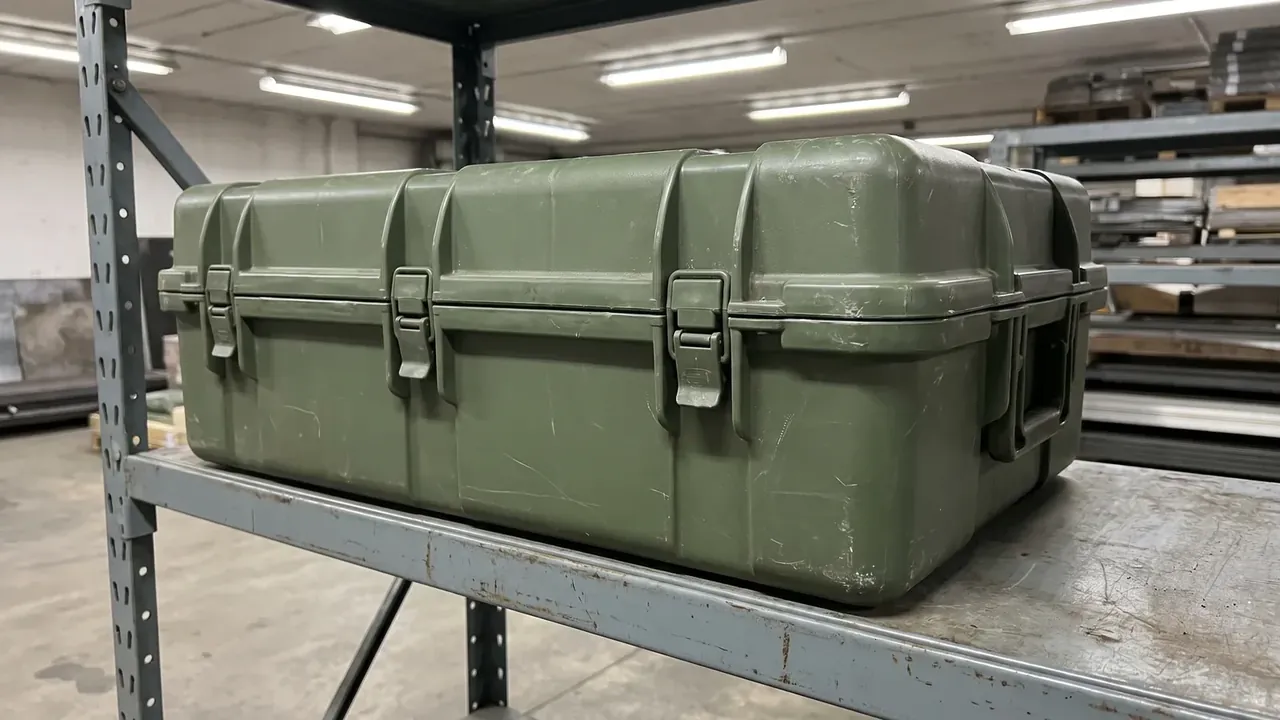
Quick answer: A case nameplate is either a 0.5 mm aluminium plate riveted at two points or a 0.1 mm laser engraving, and only the plate can be swapped when the model code changes.
Table of contents
- Why two carriers exist
- Riveted plate: thickness, points, pitch
- Adhesive plate at low temperature
- Laser depth and minimum character height
- Salt spray, abrasion and the price gap
- FAQ
1. Why two carriers exist
A run of 800 cases changed its model suffix from A to B before shipment. The 420 engraved units had 0.1 mm cut into the wall already, and sanding that back drops local thickness from 3 mm to 2.9 mm, so the whole lot went to scrap. The 380 riveted units came back the same afternoon: two rivets out, new plate on, ten minutes each. The case nameplate carrier chosen at drawing stage decides who pays.
An aluminium plate is a separate part, 0.5 mm of 6061 sheet fixed by two rivets or adhesive; engraving is a surface state burned 0.1 mm deep by a 30 W fibre source.
| Item | Riveted 0.5 mm plate | 30 W laser engraving |
|---|---|---|
| Unit price | 1.8 | 0.6 |
| Assembly | 2 rivets, 60 mm pitch | no added part |
| Model change | 10 min per case | irreversible, lot scrapped |
| Water path | rivet holes and adhesive | bottom of the cut |
| Character wear | plate replaced whole | lives with the shell |
The row buyers skip is model change. Suffixes, certification numbers and part codes move once or twice in three years. On a 1000-unit lot, one engraving change throws away 68,000 in product; plates cost 1800 plus 400 in labour.
2. Riveted plate: thickness, points, pitch
0.5 mm is the floor for plate thickness. Thinner sheet curls at the corners, cutting hands and lifting paint off the wall. Going to 0.8 mm fails the other way: the sheet will not follow the shell curvature, so the middle arches 0.3 mm and water walks into the gap.
Two rivets, 60 mm apart, φ3.2 mm blind aluminium rivets into φ3.4 mm holes. Pull the pitch under 40 mm and the plate between the points never seats; push it past 80 mm and a fingernail lifts the middle by 2 mm, which also breaks the seal.
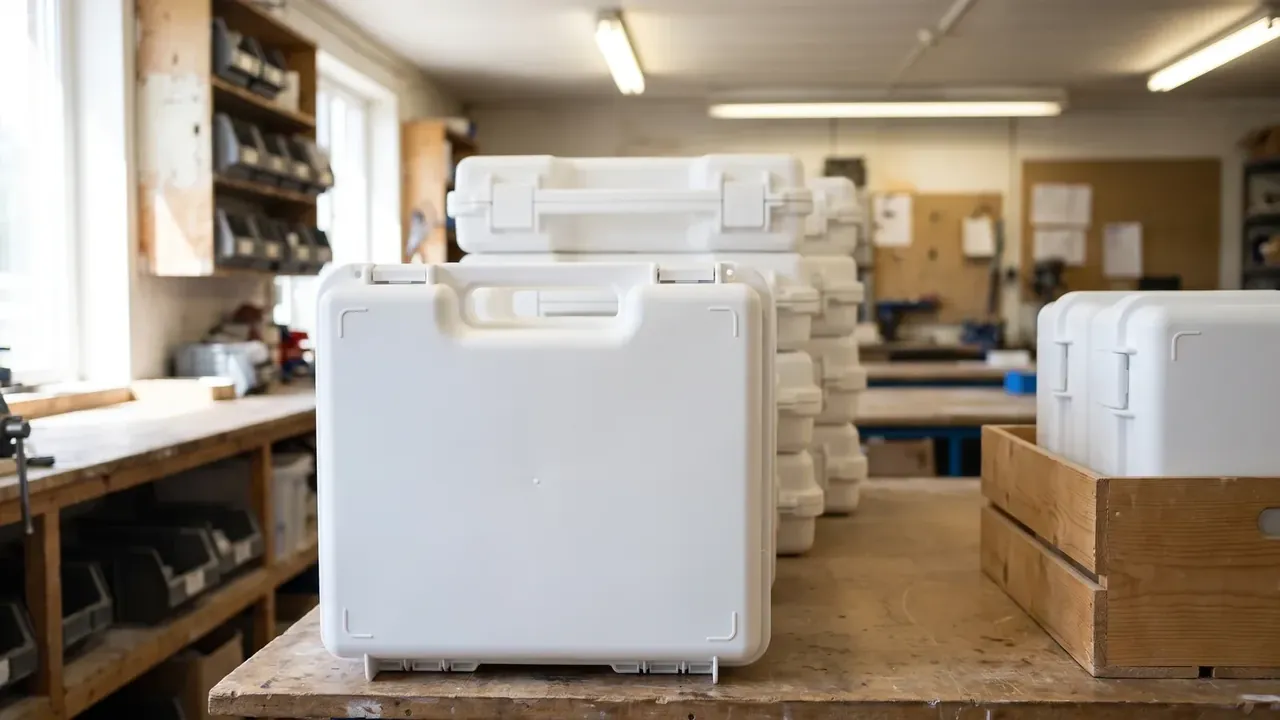
The rivet hole is the one weak path in this design. A 0.1 mm clearance around each shank lets water creep into the wall section, so every rivet sits on a φ6 mm nitrile washer, 1 mm thick, compressed to 25%. Final check is not a full immersion: soap solution around the holes, 0.3 kPa from inside, no bubble within 30 s. Set both rivets before pulling tight, since most leak complaints start with riveting first and reading the wall gap later.
3. Adhesive plate at low temperature
An adhesive plate removes two holes and moves the whole risk into the glue line. The sound build is 0.8 mm acrylic foam tape at 12 N/cm peel on polypropylene, enough for a 5 kg vertical pull at room temperature.
Cold is where it ends. After 48 h at −20 ℃ the same tape reads 4 N/cm, a third of its room-temperature grip, and a 45 N sideways push starts the edge lifting. Winter container loading and unheated air freight both cross that line.
Surface energy explains it. Bare polypropylene sits at 29 mN/m, where the tape holds by weak dispersion forces that fade as chains stiffen. Flame or primer lifts it to 38 mN/m and brings −20 ℃ peel back to 7 N/cm, at 0.4 per case.
The rule is short: any destination below −10 ℃ gets rivets. Above −10 ℃, indoors, the tape saves two holes and one leak path. Corners under R10 always need rivets, since tape cannot follow that curvature at any temperature.
4. Laser depth and minimum character height
A 30 W fibre laser at 1064 nm, run at 800 mm/s for two passes, cuts 0.1 mm into polypropylene. Depth is a narrow window: under 0.05 mm the marking polishes away within two summers of UV, and past 0.2 mm the groove silts until characters vanish.
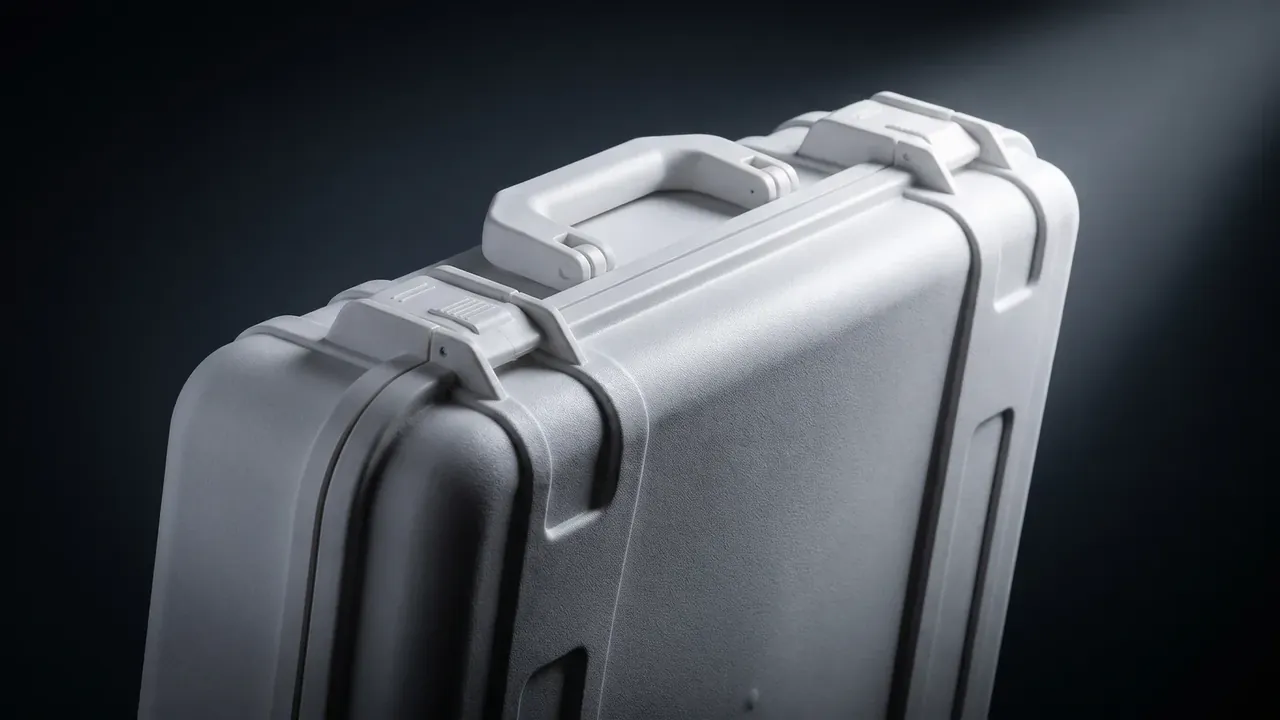
Minimum character height is 2 mm with a 0.15 mm stroke. At 1.5 mm the stroke falls to 0.1 mm, which is twice the 0.05 mm spot, and the seam between two passes breaks the stroke into dashes. Letter spacing needs 0.4 mm, otherwise a six-digit code prints as one dark block.
Polypropylene cuts to a pale grey read through roughness; ABS carbonises at the edge and shifts ΔE 3.4, like an oil smear. ABS needs 0.02 mm of white primer before marking and a clear coat after, which lifts 0.6 to 1.1 per case.
Irreversibility is the hard constraint. One wrong character leaves no material to rework: taking off 0.1 mm drops the wall from 3 mm to 2.9 mm. Programmes still editing numbering rules should hold the laser step until the code freezes.
5. Salt spray, abrasion and the price gap
Neutral salt spray for 96 h, 5% sodium chloride at 35 ℃. The anodised plate at 15 μm comes out clean after a rinse, characters crisp, no white rust; the engraved sample shows a 0.05 mm pale fringe where filler has been eaten.
Rivets fail first on the plate design. Zinc-plated blind rivets show grade 3 white rust after 96 h, a grey ring around each head. Stainless rivets remove it but push 1.8 to 2.3 per case and need an insulating washer against galvanic coupling.
Abrasion runs 500 strokes of an alcohol swab at 1 kg. The engraved sample loses height from 0.1 mm to 0.08 mm and stays legible; the adhesive plate lifts at a corner around stroke 260 and stands 1.5 mm proud at 500. The riveted plate only drops gloss from 60 GU to 45 GU.
The price gap needs change frequency attached. Plates at 1.8 against engraving at 0.6 differ by 1200 on 1000 units, but two marking changes in three years at 30% of stock scrapped turn that into 40,800 for engraving against 3960 for plates. Small lots favour the plate; a frozen code with ten-thousand-unit runs is the only place the 1.2 saving is real.
| Check | Riveted plate | Laser engraving | Verdict |
|---|---|---|---|
| 96 h salt spray | no rust, rivets grade 3 | 0.05 mm pale fringe | both legible |
| 500 abrasion strokes | gloss −15 GU | height −0.02 mm | both legible |
| 48 h at −20 ℃ | no change | no glue to fail | adhesive fails |
| Change cost per case | 2.2 | 68 | plate wins |
Conclusion
The case nameplate question reduces to one test: will the marking change? If it will, buy the 0.5 mm plate and two rivets, and treat the 1.2 premium as insurance against a scrapped lot. If it will not, engrave 0.1 mm deep and keep the saving. Freeze the numbering rule first, choose the carrier second, argue price last; projects that invert the order pay twice, because one revision costs more than three years of plates.
| Dimension | Riveted plate | Laser engraving |
|---|---|---|
| Durability | clean after 96 h salt spray | lives with the shell, wear permanent |
| Serviceability | 10 min swap, holes pluggable | no repair, scrap only |
| Failure mode | rivet seepage, cold peel | groove silting, edge charring |
| Volume fit | from 300 units, frequent revisions | above 1000 units, stable code |
This article discusses container-side specifications and design implications only, and does not cover any handling, loading or use of the contents.
Related Reading
- Where to leave a nameplate area
- Hardware after 96 hours of salt spray
- CNC cutouts versus laser cutting
- Colour control for case hardware
Related Products
- 8 Series — Gun Cases; Military Equipment Cases; Camera Equipment Cases; Drone Cases; Watch Cases; Knife Cases; First Aid Cases; Electronics Equipment Cases
- WL8-2812 PP Gun Case — model WL8-2812
- All protective cases and toolboxes: 7 series, 158 models