

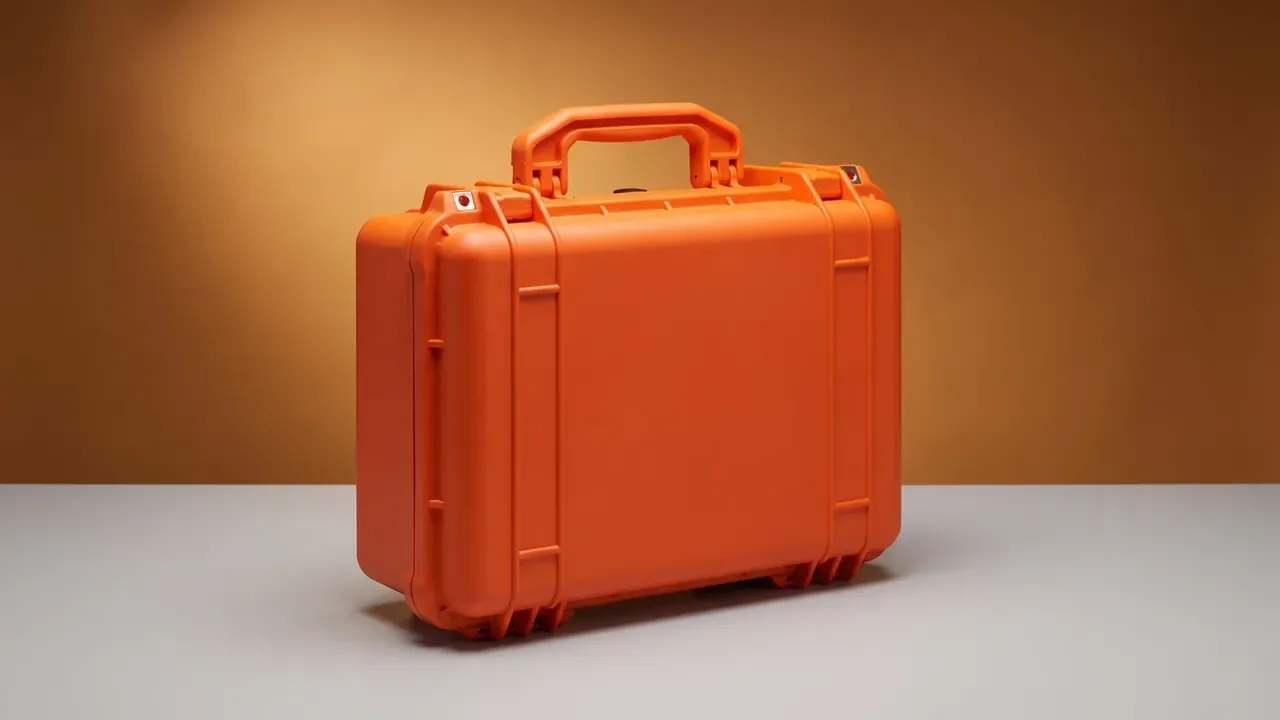
Quick answer: Case hardware colour is set by the process window, not one mixed shade: anodised film holds dye, plated zinc reflects off chromium. Two mechanisms, two tolerances, and both need the same lamp before a drawing is released.
Table of contents
- Where case hardware colour comes from
- Anodised aluminium: film, sealing and dye lots
- Plating on zinc and steel: thickness and chromium type
- Judging and accepting colour: light, standard, sampling
- FAQ
1. Where case hardware colour comes from
Mismatch is rarely one fault: different substrates, a drifting window, a viewing condition nobody agreed on.
The substrate is hardest to remove. A PP body takes its shade from masterbatch dispersed through the screw barrel, so colour lives in the material. An aluminium corner takes its colour from dye held in the pores of an oxide film. A chromium-plated pin is metal reflecting light through a passivation layer thinner than a wavelength.
The window comes next. A 1 µm shift in anodic film changes apparent depth by a visible step. Nickel under 6 µm lets porosity and cold shuts on a die casting show through, and bright chromium turns grey.
Light is the third source. The same case reads warm under a 4000 K fitting and cold at noon, so inspecting at 4000 K and accepting at 6500 K guarantees disagreement.
Wall thickness adds an offset: a 2.5 mm sidewall transmits more than a 4 mm base, so one masterbatch reads lighter where the wall is thin.
2. Anodised aluminium: film, sealing and dye lots
Aluminium corners, edge guards and latch plates are usually 6061 or 6063, and case hardware colour comes from four anodising stages: pre-treatment, anodising, dyeing, sealing.
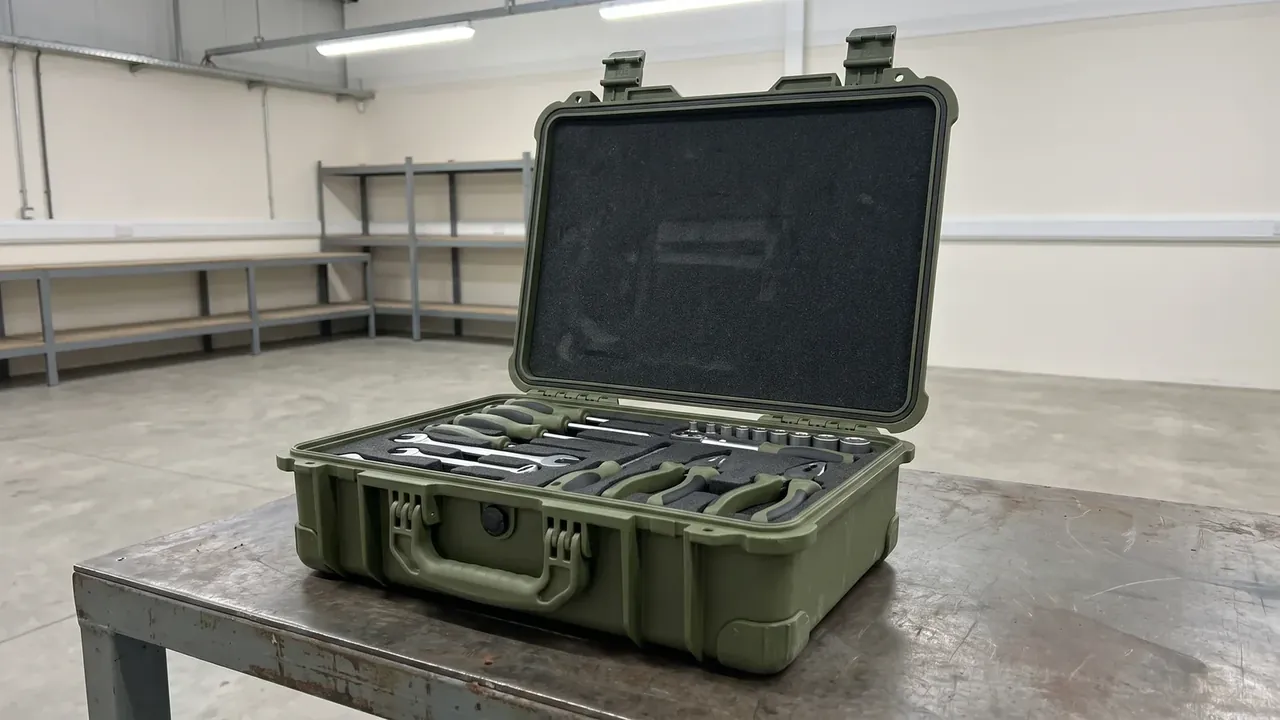
Pre-treatment sets the base tone. Degrease for 5 minutes, etch 3–5 µm to strip extrusion lines, neutralise, and the surface lands at Ra 0.8–1.2 µm. Dye uptake hangs on that roughness, so a lot holds etch time within ±30 seconds.
The bath is simple; holding it is not. Sulphuric acid at 180–200 g/L, 18–22 °C, 1.2–1.5 A/dm² for 30–40 minutes gives a 10–20 µm film. Too thin and the pores stay shallow, so dye will not hold. Past 25 µm the film embrittles and cracks at bends, lightening the colour.
Dye is where lot variation concentrates: drums drift, and an opened drum sitting 3 months drifts further. The countermeasure is one bath, one tank and one jig position per lot, jigs pitched at 200 mm, because current density differs top to bottom enough to shift film thickness by 1–2 µm.
Sealing decides whether the colour stays: boiling water for 30 minutes, or nickel-acetate cold sealing at pH 5.5–6.5. Under-sealed parts whiten at the edges after 3 months, a defect invisible at the factory gate.
The case hardware colour target is ΔE ≤1.5 within a lot and ≤2.5 between lots, sampled as 5 pieces per tank with 3 readings each and reported as a maximum.
| Stage | Normal window | Effect on case hardware colour |
|---|---|---|
| Etch | 3–5 µm at 40–50 °C | Roughness sets dye depth |
| Anodise | 10–20 µm at 18–22 °C | 1 µm shift is visible |
| Dye | 5–10 minutes, pH 4.5–5.5 | Jig position drives drift |
| Seal | Boiling water, 30 minutes | Poor seal whitens edges |
| Measure | D65, 45/0 | ΔE ≤1.5 within a lot |
3. Plating on zinc and steel: thickness and chromium type
Zinc die castings carry latch bases and brackets; steel carries hinge pins and studs. Both are plated through 8–12 µm of copper, 8–10 µm of semi-bright nickel, 5–8 µm of bright nickel and 0.1–0.3 µm of decorative chromium, and that stack sets the colour you can reach.
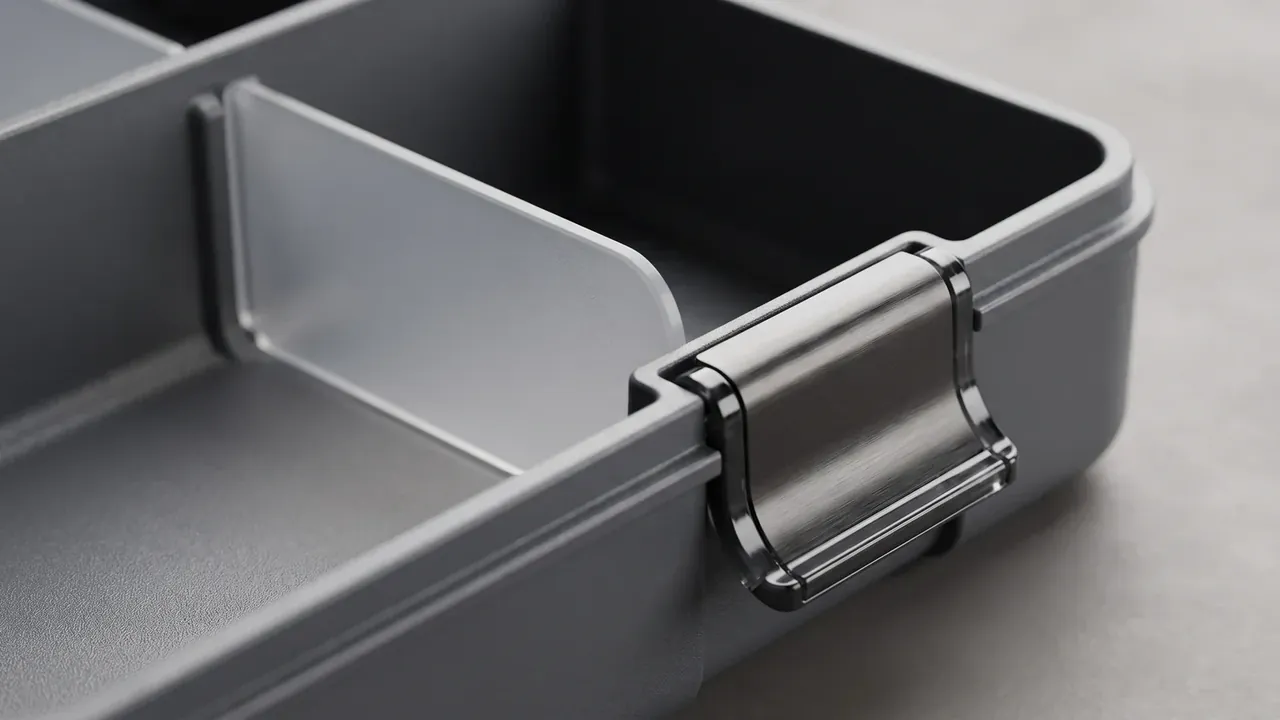
The chromium bath changes case hardware colour directly. Hexavalent chromium gives a cold blue-white; trivalent reads darker and one grade weaker in salt spray. RoHS caps hexavalent at 0.1%, so European shipments run trivalent plus a post-dip sealer.
Thickness is the variable that shows. Below 6 µm of nickel, porosity and flow marks come through as cloudy dark patches. Above 0.5 µm of chromium, stress opens microcracks and salt spray pits the surface at 48 hours, reading black.
Painting over the plate is the levelling tool. A zinc latch is nickel-plated, then coated with 25–35 µm of polyester: colour follows the paint and the gap to an anodised part closes to ΔE 2. Edges are radiused to R0.5, since that is where the paint chips.
| Route | Functional layer | Hue | Salt spray | ΔE vs PP body |
|---|---|---|---|---|
| Sulphuric anodising | 10–20 µm | Any dyed shade | 200 hours | 1.5–3 |
| Decorative chromium | 0.1–0.3 µm Cr | Cold blue-white | Pits at 48–96 hours | 2–4 |
| Nickel plus paint | 25–35 µm paint | Follows paint | 240 hours | 1–2 |
| PVD titanium | 0.5–1.5 µm | Gunmetal to gold | 300 hours | 2–3 |
4. Judging and accepting colour: light, standard, sampling
Judgement needs conditions that repeat, or the two sides talk past each other.
Light: D65, a colour rendering index of 90 or better, 1000–1500 lx, 45/0 geometry and a 10° observer. The formula is CIEDE2000, which tracks the eye better than ΔE*ab in the blue-violet region and is closer on navy and dark green.
A Pantone number is only a starting point. Paper and metal colour differently, so two chips sitting ΔE 0.5 apart can become ΔE 2 once one is anodised, and every colour needs a signed physical plaque.
Keep three retains: upper limit, lower limit and centre, stored away from light at 20±5 °C and 50±10% RH for 3 years, since a retain settles arguments a colour number cannot.
Visual assessment follows a fixed action: 45° in a booth, 300 mm away, 5 seconds per part, since the eye compensates beyond that.
Sampling follows GB/T 2828.1 at level II. Case hardware colour counts as a major defect at AQL 1.0; scuffs and dust specks are minor at AQL 2.5. A lot of 500 pieces maps to code letter H and a sample of 50, so 2 nonconforming parts send the lot back.
One boundary belongs in the acceptance document: case hardware colour is compared within one material only, so scoring an anodised bracket against a PP body means nothing.
Conclusion
Holding case hardware colour in tolerance means keeping three routes inside their windows, not blending three materials into one shade: anodising by film thickness, sealing and dye lot; plating by deposit thickness and chromium type; painting by film build and edge radius. Only when all three are stable does a ΔE figure carry meaning, judged under D65 at 45/0 with CIEDE2000, three retains and AQL 1.0. Written into the drawing, colour becomes a number anyone can re-check.
This article discusses container-side specifications and design implications only, and does not cover any handling, loading or use of the contents.
Related Reading
- Preparing raw material and masterbatch
- Surface and tolerance of injection moulded cases
- PP versus ABS case appearance
- Mould texture and routine maintenance
- Comparing hard shell case materials
Related Products
- 8 Series — Gun Cases; Military Equipment Cases; Camera Equipment Cases; Drone Cases; Watch Cases; Knife Cases; First Aid Cases; Electronics Equipment Cases
- WL8-2812 PP Gun Case — model WL8-2812
- All protective cases and toolboxes: 7 series, 158 models