

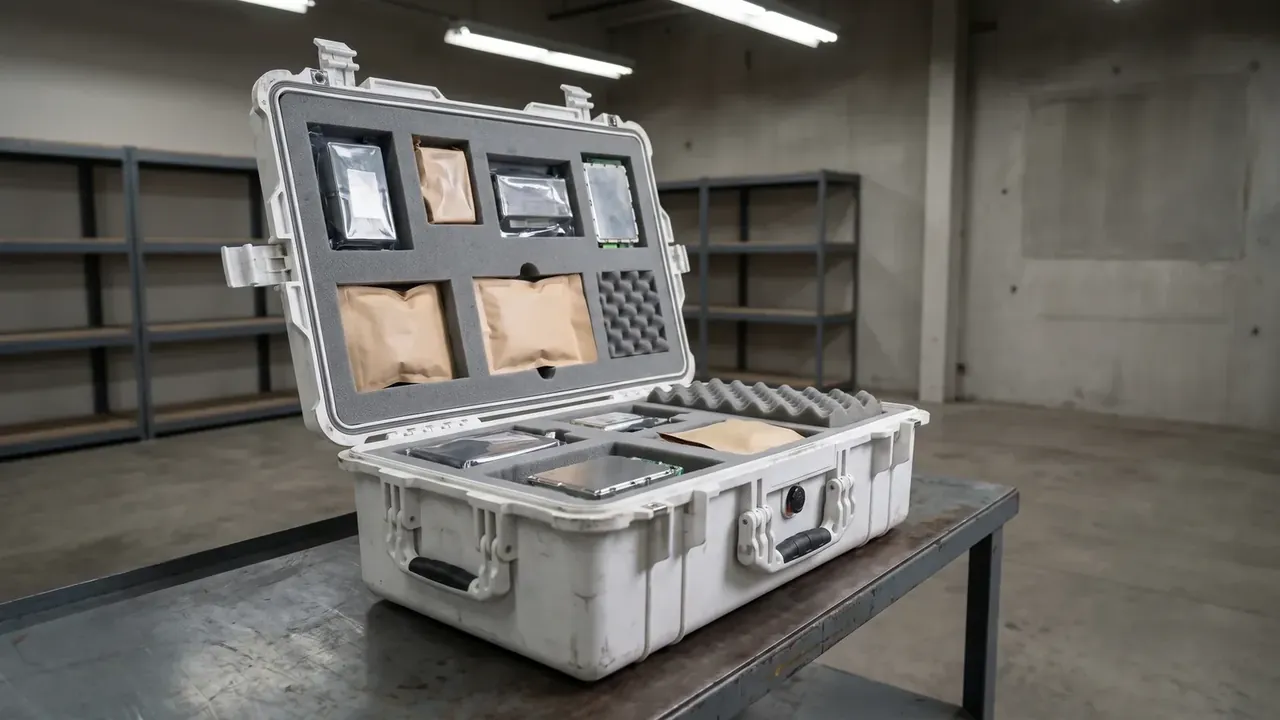
Quick answer: Case label area belongs on the flat where the draft angle breaks, about 180 by 95 mm on a 500 mm case after ribs and a 15 mm border.
Table of contents
- How Much Area a Case Label Gets
- Clearance from Ribs and Latches
- Flatness and Application Process
- Replacement and Layout Reserve
- FAQ
1. How Much Area a Case Label Gets
Where does a nameplate go without blocking structure? Measure the flat first. A 500 mm by 350 mm by 210 mm case shows 260 mm by 150 mm of lid flat, but ribs, latch seats and four corner radii take their share, leaving 180 mm by 95 mm.
That leftover carries the case label area: a 90 mm by 60 mm plate plus a 70 mm by 18 mm serial strip is 6 660 mm², or 39% of the usable flat. Past that, the structure changes, not the artwork.
Three steps do the calculation: flat projection, minus rib grooves and latch seats, then 15 mm on every edge. The margin is not cosmetic. Below 12 mm the curl rate climbs from 5% to 22% as mould shrinkage pulls the label edge.
When space runs short, shrink the plate, move it, shift the rib, then change the mounting surface. Shrinking has a floor: 4 mm characters read at 1 m, 3 mm characters force the eye to 0.7 m.
| Position | Typical size | Minimum edge distance | Use |
|---|---|---|---|
| Main plate | 90 mm by 60 mm | 15 mm | Model, batch, load marking |
| Serial strip | 70 mm by 18 mm | 15 mm | Unit number, close reading |
| Large model mark | 120 mm by 80 mm | 20 mm | Reading at 3 m |
| Warning block | 60 mm by 40 mm | 12 mm | Narrow side panel |
2. Clearance from Ribs and Latches
Ribs and latches are the two solids to avoid. A rib stands 6 mm off the inner wall and leaves a 4 mm to 6 mm groove on the lid face, so the plate bridges a gap. Above 15% unsupported area the adhesive fails and the edge lifts within about six months.
Latch seats are worse. A latch swings out 8 mm to 12 mm, so the plate needs 45 mm from latch centre, and under 30 mm every 1 000 cycles cuts a 0.2 mm groove along the edge.
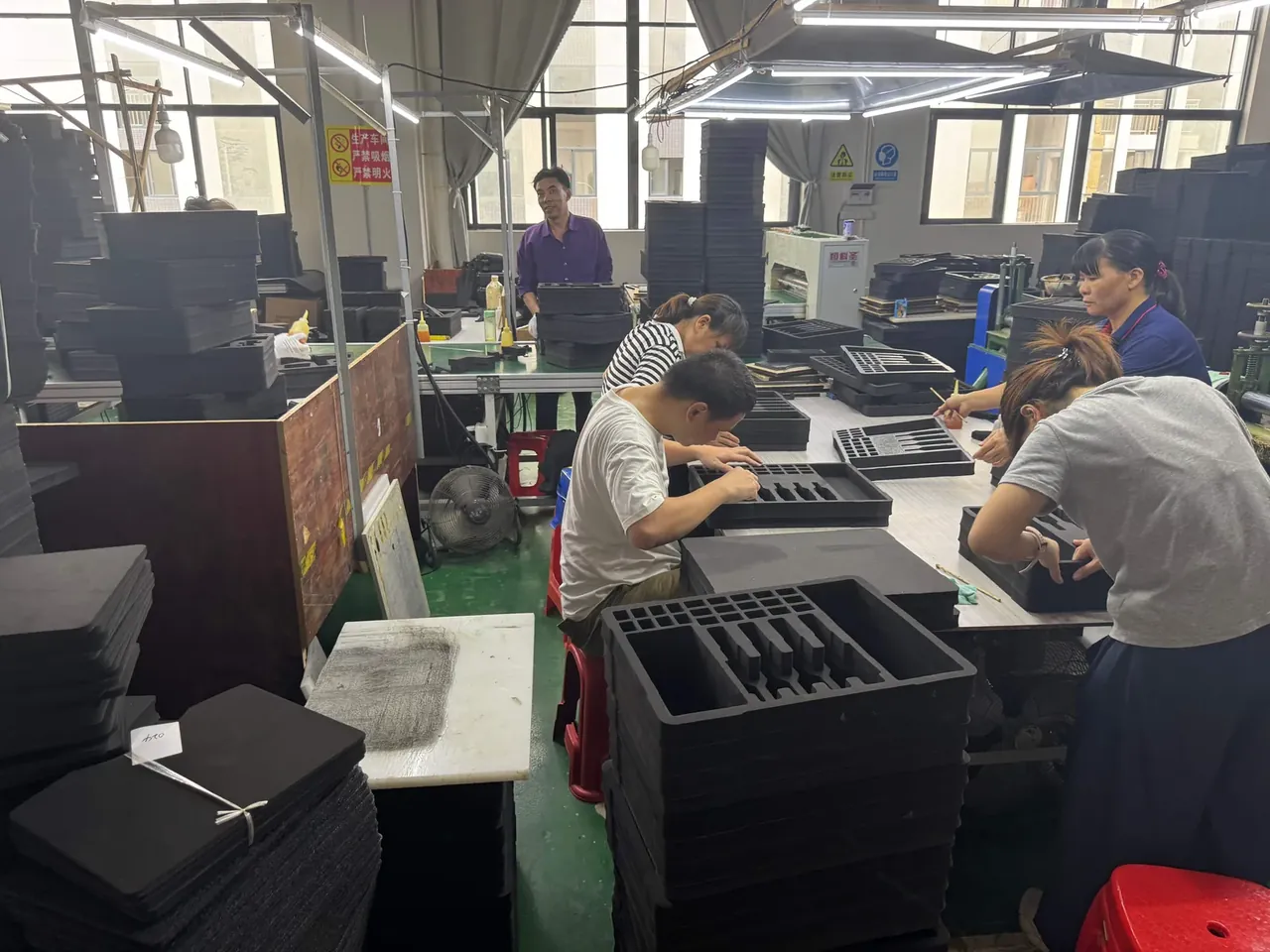
Clearance scales with case length: 45 mm above 500 mm, 38 mm from 350 mm to 500 mm, 30 mm below 350 mm. Small cases are already tight, so drop the plate to 70 mm by 45 mm rather than close the gap.
Keep-out zones can also merge. A latch seat beside a rib leaves a 70 mm by 30 mm dead patch, and the plate moves to the other side of the lid centreline.
Corner radii take another 25 mm per edge at a 30 mm radius, which drops usable width from 180 mm to 130 mm.
3. Flatness and Application Process
Flatness decides whether the label lies down. The lid carries 1° to 2° of draft, so a 500 mm face differs by 8.7 mm to 17.5 mm end to end, and hand pressure will not close that.
So the case label area belongs on the flat where the draft breaks, or the label needs 0.8 mm to 1.2 mm of acrylic foam adhesive. Keep compression between 20% and 30%: past 40% the glue squeezes out, below 15% nothing bonds.
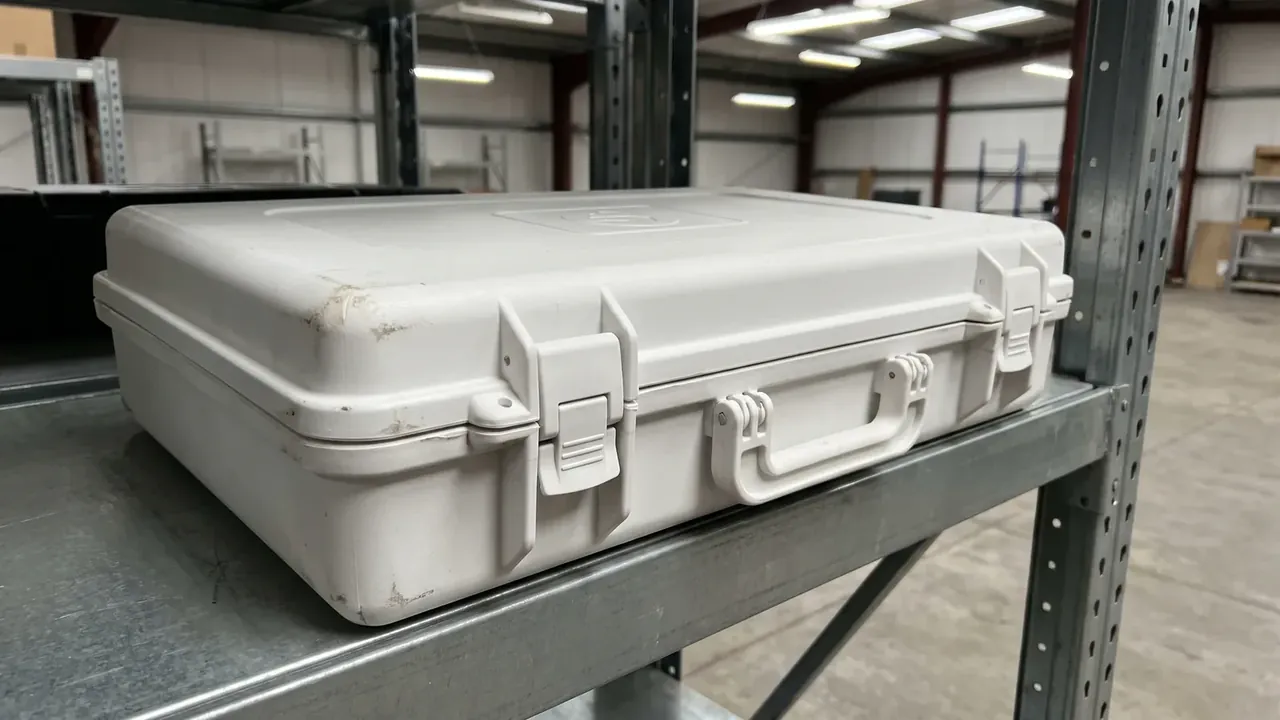
Surface energy must reach 38 mN/m, the label goes on within 30 min of an isopropanol wipe, and full strength arrives after 24 h. Below 10 ℃ initial tack drops 40%, and above 70% humidity wait 5 min after wiping.
Flatness limits are 0.3 mm per 100 mm and 0.5 mm of local dip. A 0.5 mm dip traps a bubble 8 mm to 12 mm across, and three thermal cycles open it.
Squeegee pressure sits at 0.2 MPa to 0.3 MPa. Under 0.15 MPa air stays trapped, and over 0.5 MPa a 1.0 mm foam layer collapses at the edge.
4. Replacement and Layout Reserve
Replacement is a design allowance. Labels last 3 to 5 years against a case life of 8 to 10, so one change is certain and outdoor use usually needs two.
Leave 3 mm to 5 mm of clear border with no step. A step traps residue, pushes removal from 4 min to 15 min, and peeling can take 0.1 mm of surface with it.
| Fixing method | Initial tack | Removal time | Residue |
|---|---|---|---|
| Acrylic foam adhesive | 20 min | 4 min | One isopropanol wipe |
| Removable pressure-sensitive | 5 min | 2 min | None |
| Screw-clamped plate | Immediate | 12 min | None, needs 2 holes |
| Recessed pocket with adhesive | 20 min | 6 min | Heat to 60 ℃ to 70 ℃ and scrape |
Hold the plate at one coordinate within 1 mm, or a second label over the old adhesive outline leaves a 0.3 mm step. A scraper enters at 15° to 20°, so the 3 mm border keeps the blade off the shell as well.
Cold service needs its own numbers. Acrylic shear strength falls 30% at -20 ℃ and 45% at -40 ℃, so those cases want an inner flat or a 0.2 mm metal backing plate with 20% more bond area.
Conclusion
The case label area should not be a single box on a drawing. Mark it in three layers: the outline of the usable flat with its corner radii, the keep-out distances to ribs and latch seats at 45 mm, 38 mm and 30 mm, then flatness at 0.3 mm per 100 mm with a 15 mm border. With those three layers, tooling and purchasing work from one rule and sampling stops being a negotiation. Bigger is not better: anything past 180 mm by 95 mm lands on the draft, and 1° of draft already puts 8.7 mm across a 500 mm face, which no label will follow. Put the plate where the draft breaks, run the label zone from the plate, and dimension both boxes from one datum line.
This article discusses container-side specifications and design implications only, and does not cover any handling, loading or use of the contents.
Related Reading
- English wording and layout for case labels
- Case labels and asset identification
- Latches and hardware selection
Related Products
- 8 Series — Gun Cases; Military Equipment Cases; Camera Equipment Cases; Drone Cases; Watch Cases; Knife Cases; First Aid Cases; Electronics Equipment Cases
- WL8-2812 PP Gun Case — model WL8-2812
- All protective cases and toolboxes: 7 series, 158 models