

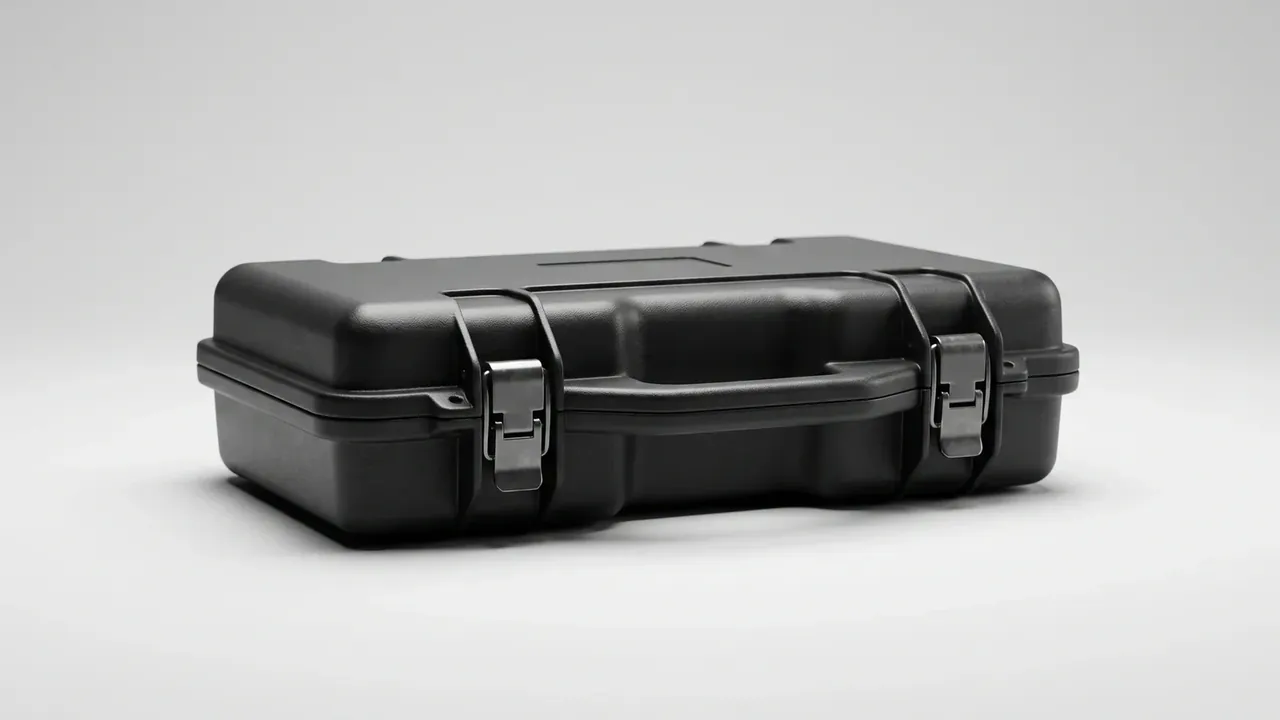
Quick answer: Ammo box civil use turns on three measurable lines: wall left after sanding, gasket compression, and stencil depth. Cross one and the box drops a class.
Table of contents
- Three Lines That Decide the Conversion
- Walls and Latches: Measure What Is Left
- Gaskets, Vents and the Pressure Drop
- Markings and Paint: Where to Stop Sanding
- Inserts: From Steel Dividers to EVA
- The Cost Sheet, and When to Buy New
- FAQ
1. Three Lines That Decide the Conversion
Surplus stock comes in two builds. The steel pattern is 1.2 mm cold-rolled sheet with a lock-seamed edge and a flat sealing flange; the moulded one is 4 mm to 6 mm of polyethylene, with latch and hinge seats grown from the same wall. In both, the load path is fixed: handle, side walls, four bottom corners. A conversion can touch fittings, lining and paint. It cannot touch that path and still call itself the same box.
| Item | As built | Limit | If crossed |
|---|---|---|---|
| Wall | 1.2 mm steel, 4–6 mm PE | 90% left after sanding | 2 mm bulge when stacked two high |
| Latch rivets | 6.0 mm holes | Growth ≤ 0.5 mm | 1.5 kN falls to 1.3 kN per latch |
| Gasket | EPDM cord, 8 mm, 25–30% | Old glue ≤ 0.2 mm | IP67 drops to IP54 |
| Vent | Cracks at 0.2 bar | Replace core and membrane | Pressure lifts the latches |
Markings are a separate question from margin: who may use the box, not how much box is left. Settle that before anyone lifts a sander.
2. Walls and Latches: Measure What Is Left
Sanding is the first step taken and the easiest to overdo. Powder coating runs 60 μm to 90 μm, and two passes at 120 grit take off 0.05 mm. Removing a laser etch plus primer costs 0.15 mm to 0.2 mm. Moulded walls already carry ±0.6 mm, so a nominal 4.0 mm may measure 3.4 mm; another 0.2 mm puts it under the line.
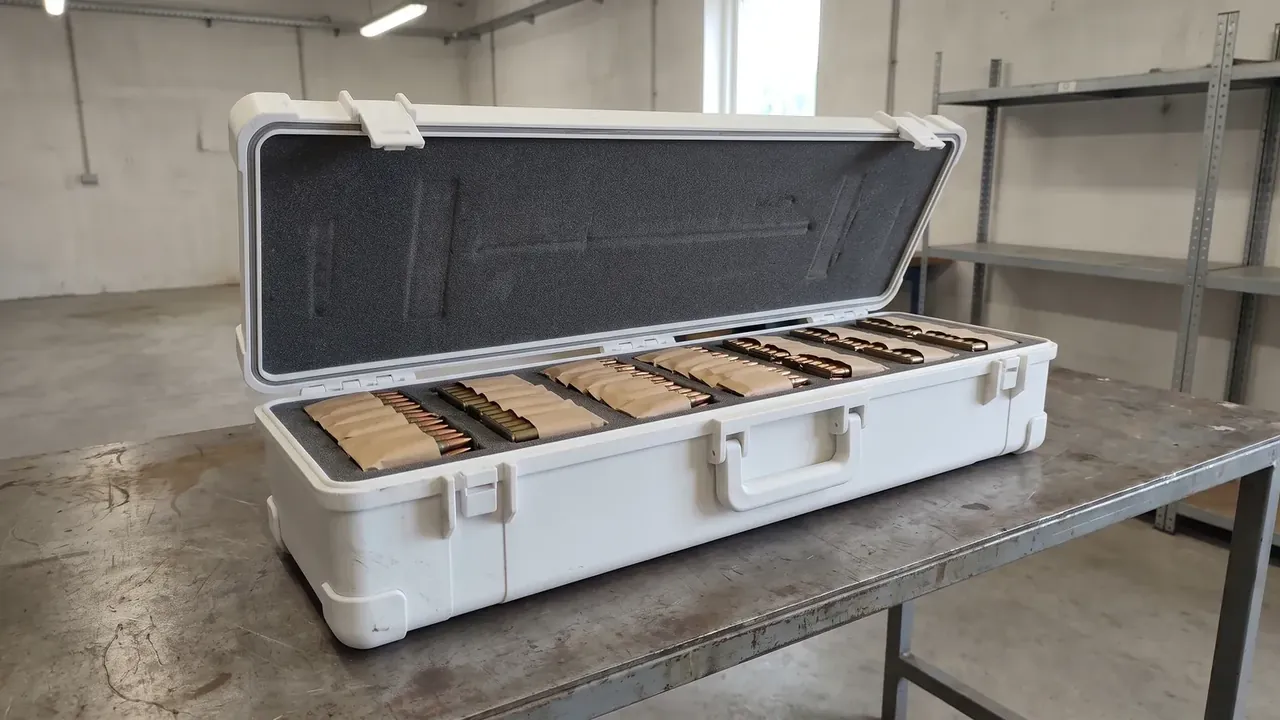
Steel keeps its margin in the lock seam. Three layers overlap there, giving 3.6 mm of local thickness that the flange rests on. Grind it flat and two thirds of that stiffness goes; the lid then sits 1 mm proud at one corner and the seal is finished.
Latches are a rivet calculation. Four at 1.5 kN give 6 kN, against roughly 1.2 kN on the lid of a lower box in a two-high stack at 22 kg each. Open a 6.0 mm hole to 6.5 mm and bearing area drops 15%, taking each latch to 1.3 kN. Add 0.14 bar of internal pressure and most of the margin is gone.
3. Gaskets, Vents and the Pressure Drop
Pressure decay beats a water dunk on the floor. Charge to 20 kPa, hold 60 s, pass anything under 1.0 kPa, which matches IP67 at 1 m for 30 min. A stored box reads 0.4 kPa at 28% compression.
| State | Compression | Decay in 60 s | Verdict |
|---|---|---|---|
| Original cord, untouched | 28% | 0.4 kPa | Pass |
| Relined, closed once | 26% | 0.6 kPa | Pass |
| Relined, 20 cycles | 21% | 1.4 kPa | Marginal |
| 0.3 mm glue in groove | 17% | 2.2 kPa | Fail |
Lining work is what disturbs it: 20 open-close cycles drop compression to 21% and decay to 1.4 kPa, and a 0.3 mm film of old adhesive pushes decay to 2.2 kPa because the new cord never seats.
The vent gets skipped because the box is not going to altitude. That forgets temperature. Seal at 30 °C, truck to -10 °C, and 40 K removes about 13.8 kPa by p·ΔT/T. On a 0.3 m² lid that is 4.1 kN, close to 70% of what four latches hold. The part costs 6 CNY.
4. Markings and Paint: Where to Stop Sanding
Stencils sit in one lid corner, 0.10 mm to 0.15 mm deep, read by the shadow in the recess. Three passes with 1500 grit take off 0.08 mm. The risk is going local: a 0.3 mm hollow at that corner means the gasket never reaches 25% and one corner decides the whole seal.
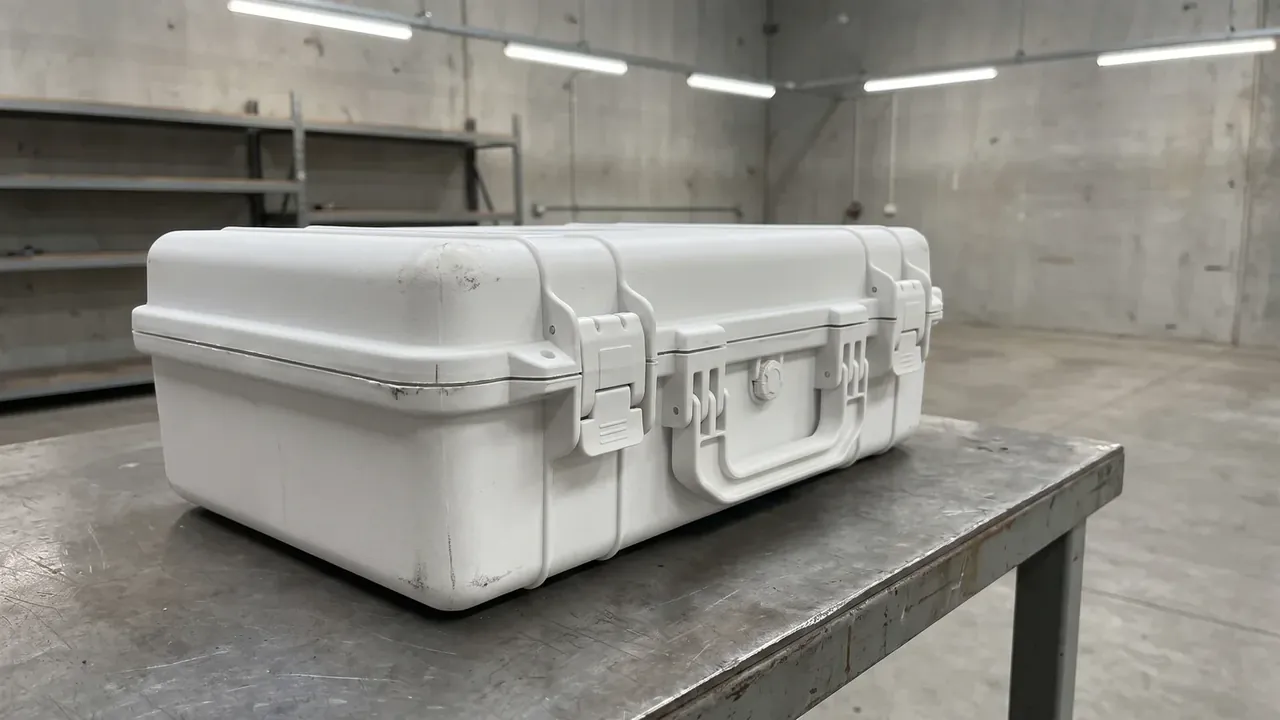
Paint is two coats: 40 μm epoxy primer, 40 μm polyurethane, 80 μm total, cross-hatch adhesion grade 1, and 96 h of neutral salt spray without red rust on steel. Polyethylene does not rust but does fade, so outdoor boxes need a hindered-amine grade and a colour difference inside ΔE 2.
5. Inserts: From Steel Dividers to EVA
Dividers are 1.0 mm steel on 42 mm centres, bracing the side walls as a side effect. Pull them for instruments and bulge under a two-high stack goes from 0.8 mm to 2.2 mm. The replacement is 30 kg/m³ EVA at 20 mm, routed to ±0.5 mm, a tenth of the weight but no brace at all, so a 5 mm PVC base plate sends stack load to the floor.
6. The Cost Sheet, and When to Buy New
| Operation | Cost | Labour | Note |
|---|---|---|---|
| Strip and sand | 35 CNY | 0.8 h | Seam left alone |
| Powder coat | 60 CNY | — | 80 μm at 180 °C |
| EPDM cord, 8 mm | 18 CNY | 0.3 h | Groove cleaned |
| CNC EVA, 20 mm | 120 CNY | 0.5 h | Routed to drawing |
| Four rivets | 12 CNY | 0.2 h | Holes checked |
| Total | 245 CNY | 1.8 h | — |
A new box lists at 320 CNY. Rebuilding saves 75 CNY, a fifth of the price, but leaves IP54 and two years against IP67 and five; per year it costs 40 CNY more. Three things must hold: 50 units or more, every reading above 90%, and a duty that never needs IP67.
Conclusion
The line for ammo box civil use is margin, not appearance. Keep 90% of the wall, 6.0 mm rivet holes and 25% compression, and the rebuild earns its 75 CNY; lose one and the repair bill lands inside two years.
This article discusses only the container (case body) side of specifications and design intent, and does not cover any handling, loading or use of the contents.
Related Reading
- How an ammunition box is built: seams, latches and flanges
- Steel ammunition boxes against moulded polyethylene
- Foam inserts for ammo boxes: density and routing tolerance
- When to replace a case gasket: compression, not age
Related Products
- 8 Series — Gun Cases; Military Equipment Cases; Camera Equipment Cases; Drone Cases; Watch Cases; Knife Cases; First Aid Cases; Electronics Equipment Cases
- WL8-2812 PP Gun Case — model WL8-2812
- All protective cases and toolboxes: 7 series, 158 models