

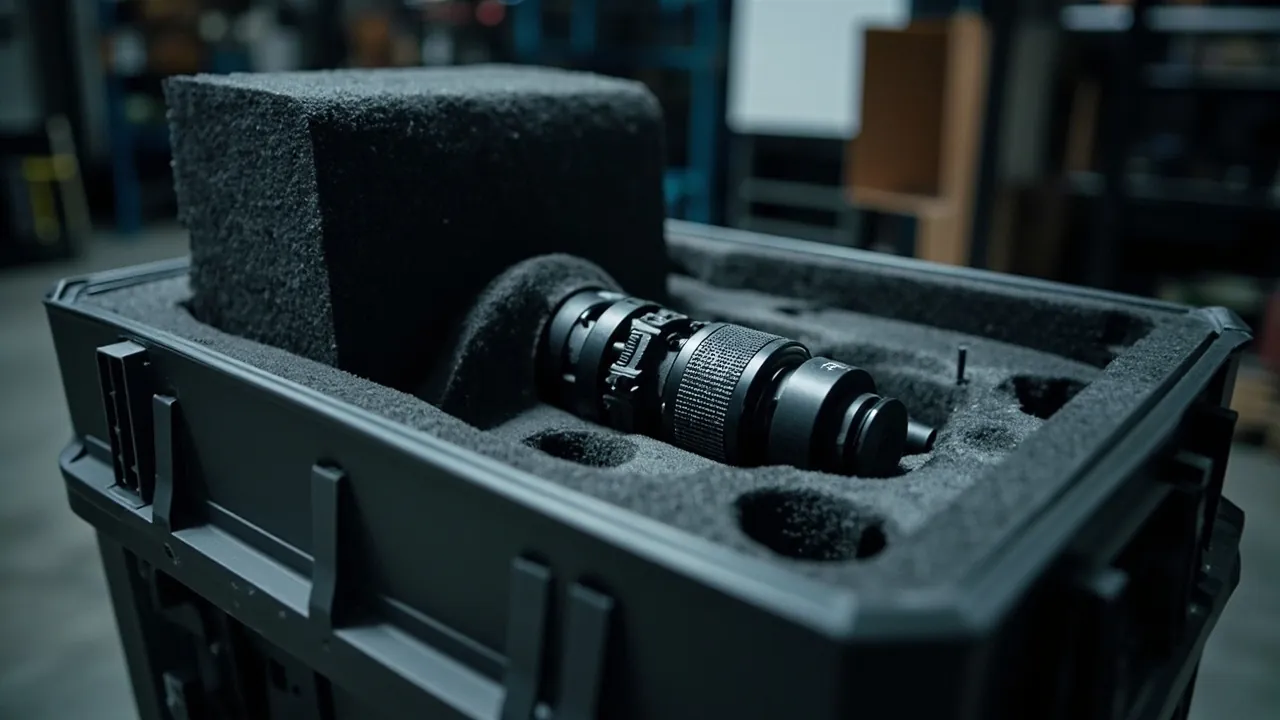
Bottom line first: a foam insert is not filler. It is a secondary structure outside the shell, and it determines the real survival rate of whatever sits inside the box. The core logic of customizing an insert is one sentence: identify the failure mechanism of the protected item first, then work backward to the foam material, density, structure, and thickness. Precision instruments fear shock acceleration, vibration fatigue, and positional drift, so they need multi-stage cushioning plus positional constraint. Ammunition, viewed here strictly as goods that must be stored against moisture, corrosion, and movement, fears humidity, salt fog, thermal cycling, and long-term mutual impact, so it needs closed-cell non-absorbing foam, anti-shift locating slots, and ESD and corrosion-control support. Pack both with the same open-cell sponge and one side gets shaken apart while the other gets ruined by moisture. A common selection error is looking only at density: two foams of equal density can differ several times over in rebound behavior and compression set, and those two properties decide whether the insert still grips the item after a long haul.
This article is written for procurement, structural, and packaging engineers. It separates insert customization into four layers: the object layer (how failure mechanisms differ between precision instruments and ammunitions-class goods), the material layer (six foam families and their trade-offs), the structure layer (layered design, forming processes, and tolerances), and the verification layer (how to test drop, vibration, compression set, and environmental aging, and against which standards). It provides parameters and acceptance items you can write into a technical agreement, with no discussion of the items themselves.
Table of Contents
- Bottom Line: An Insert Is a Secondary Structure Outside the Shell
- How Failure Mechanisms Differ Between the Two Classes of Protected Items
- Six Foam Families: EPE, EVA, PE, PU, XPE, and EPP
- Four Critical Physical Properties: Density, Hardness, Rebound, Compression Set
- Insert Design for Precision Instruments: Multi-Stage Cushioning and Positional Constraint
- Insert Design for Ammunitions-Class Goods: Moisture, Corrosion, and Anti-Shift
- Three Forming Processes: CNC Machining, Die Cutting, and Molding
- The Seven-Step Customization Process: From Measurement to Verification
- Layered Structure: Base Layer, Contour Layer, and Lid Layer
- Environmental Behavior: Temperature, Humidity, VCI, and Desiccant
- Material and Structure Selection Tables
- Verification and Testing: Drop, Vibration, and Shape Recovery
- Bulk Procurement and Customization: A B2B View
- Frequently Asked Questions
- Conclusion and Further Reading
Bottom Line: An Insert Is a Secondary Structure Outside the Shell
Many people treat a foam insert as padding that makes the case look tidy and keeps things from sliding. That badly underestimates its engineering role. The energy a case absorbs in transport must ultimately be absorbed and distributed by the insert: the shell resists external impact and ingress, while the insert holds the residual shock acceleration, vibration, and deformation within what the item can survive. The two are in series. If either fails, the other cannot compensate: a drop-proof case with a loose insert lets the item slam around inside, and a perfect insert in a cracked case still loses the contents.
From an engineering standpoint the insert carries four functions, none optional:
- Cushioning and energy dissipation: converting impact energy into heat through foam compression, lowering the acceleration peak transmitted to the item.
- Positional constraint: holding the item in a defined position and attitude, preventing sliding, rolling, and mutual impact.
- Environmental isolation: closed-cell foam itself does not absorb water and can interrupt moisture paths; combined with VCI and desiccant it further slows metal corrosion.
- Interface protection: preventing direct contact between item and rigid shell wall, which causes scratching, abrasion, and local stress concentration.
A key judgment. With a correctly designed insert, the acceleration peak reaching the item drops markedly after passing through the foam. If the foam is too hard, it cannot deform in time and the item effectively takes the impact directly. If the foam is too soft, it compresses to full density, and cushioning is again lost. Soft does not mean safe. Matched hardness does.
For how the insert sits within the overall case structure, see types of internal foam for protective cases and key factors in custom foam inserts.
How Failure Mechanisms Differ Between the Two Classes of Protected Items
The first step in customization is not choosing a material but listing the failure mechanisms of the protected item. Precision instruments and ammunitions-class goods fail along almost completely different paths, so the focus of insert design differs just as much.
| Failure dimension | Precision instruments | Ammunitions-class goods (storage packaging view) |
|---|---|---|
| --- | --- | --- |
| Primary threat | Shock acceleration, vibration fatigue, positional drift | Moisture, salt fog, thermal cycling, mutual impact |
| Sensitive parameters | Acceleration peak, resonant frequency, optical alignment | Relative humidity, seal integrity, stacking pressure |
| Failure evidence | Lost accuracy, loosened parts, shifted optical axis | Surface corrosion, packaging failure, label loss |
| Need for locating | High-precision location and attitude constraint | Anti-shift, anti-crushing |
| ESD sensitivity | Electronic types may be ESD sensitive | Some energetic goods are ESD sensitive |
| Cushioning focus | Multi-stage cushioning, staged energy dissipation | Moderate cushioning, focus on fixation and isolation |
| Environmental focus | Anti-condensation, anti-thermal-shock | Anti-moisture, anti-corrosion, anti-long-term-compression |
| Typical insert build | High-density EVA contour plus low-density cushion | Closed-cell PE or EVA locating slots plus VCI |
One important conclusion follows: precision instruments are a dynamic problem; ammunitions-class goods are a static problem. The former fear energy input during transport; the latter fear environmental attack and relative displacement during long storage. The priorities therefore differ completely:
- Precision instruments: cushioning first, then location, then environment.
- Ammunitions-class goods: sealing and moisture control first, then anti-shift, with adequate-but-not-maximal cushioning.
A common wrong combination. Using a hard, solid EVA contour for a precision instrument looks "tight and stable," but because EVA rebounds slowly and dissipates limited energy, it transmits energy under mid- and high-frequency vibration, and accuracy drifts after long transport. The right approach is to add a low-hardness cushioning layer outside the contour layer, forming a combination of hard constraint plus soft cushioning. That is why multi-stage cushioning is discussed below.
Six Foam Families: EPE, EVA, PE, PU, XPE, and EPP
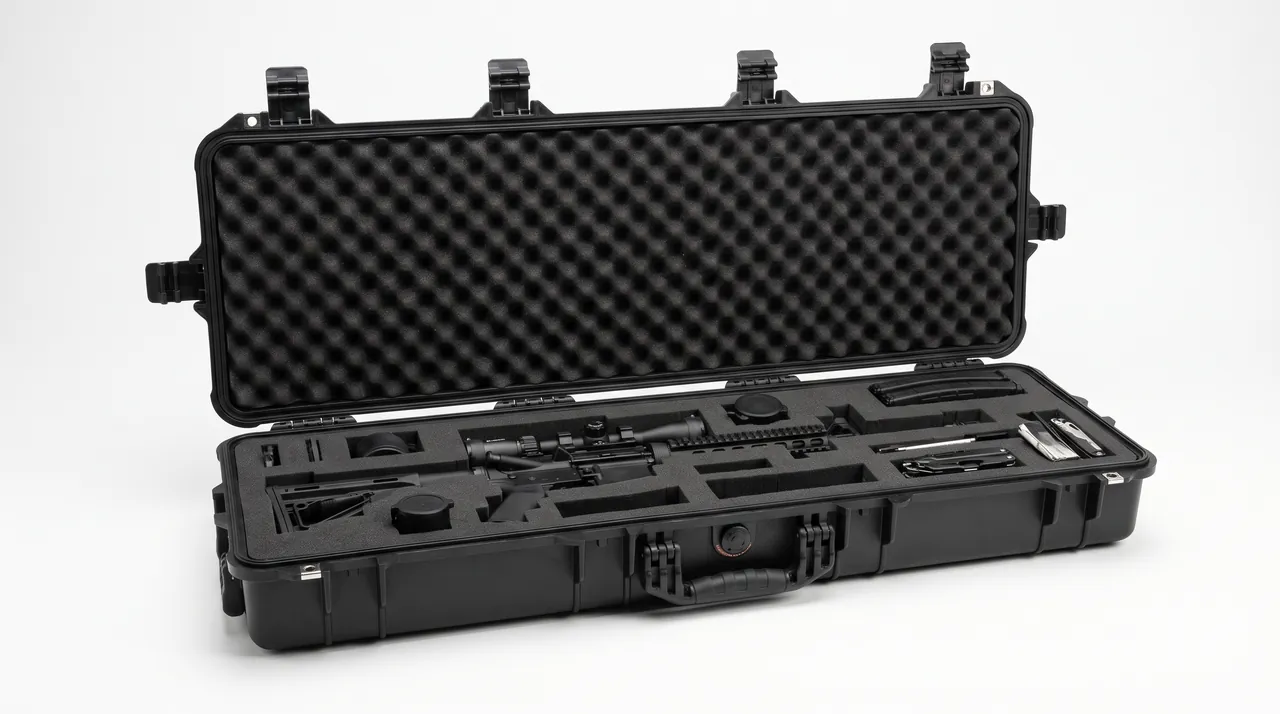
Material selection is a trade among six dimensions: cushioning, support stiffness, durability, environmental tolerance, machinability, and cost. The six common families profile as follows.
EPE (expanded polyethylene, often called pearl cotton). Closed-cell, non-absorbing, good rebound, strong cushioning at low to medium loads, low cost, and the most common general cushioning material. Its weakness is low support stiffness, making it a poor choice for contour slots that must hold shape precisely long term; it also creeps somewhat under sustained load.
EVA (ethylene-vinyl acetate copolymer). By adjusting VA content you get a whole range from soft to fairly hard, with slow rebound, a fine surface, and heat-formability, making it excellent for high-precision contour slots and visible parts. Its weaknesses are higher water and dust uptake than pure closed-cell PE and higher cost than EPE. Open-cell grades require caution in humid environments.
PE foam (including LDPE and HDPE foam). High closed-cell ratio, good stiffness, excellent chemical and weathering resistance, well suited to structural support layers and locating blocks. Its weakness is relatively high hardness and limited compression travel, so it is only moderate as a standalone cushion for precision instruments.
PU (polyurethane foam). Ester and ether types allow precise tuning of density and hardness and deliver excellent cushioning, making it the traditional mainstay of precision instrument packaging. Its weakness is an open-cell structure that absorbs water and moisture, and in long-term humid conditions it can mold and hydrolyze, with ester types notably weaker on hydrolysis resistance. Packaging PU foams may reference specifications such as MIL-PRF-26514.
XPE / IXPE (chemically and electronically cross-linked polyethylene foam). Closed-cell with fine, uniform cells, a smooth surface, and good rebound and weathering, making it a premium choice for high-end inserts and thin cushioning layers. Its weakness is higher cost, both in sheet supply and processing.
EPP (expanded polypropylene). Closed-cell, exceptionally tough, resistant to repeated impact, low density, and a wide temperature range, suited to reusable transport cases subjected to repeated drops. Its weaknesses are high cost, a coarser surface, and difficulty producing fine visible faces, with machining leaving a visible texture.
| Material | Structure | Cushioning | Support stiffness | Water/moisture uptake | Weathering | Machinability | Cost | Typical use |
|---|---|---|---|---|---|---|---|---|
| --- | --- | --- | --- | --- | --- | --- | --- | --- |
| EPE | Closed-cell | Medium to high | Low | Low | Good | Easy to cut | Low | General cushioning, lid layer |
| EVA | Mostly closed-cell | Medium | Medium to high | Medium | Good | Heat form / CNC | Medium | Precision contours, visible parts |
| PE foam | Closed-cell | Low to medium | High | Low | Excellent | CNC / die cut | Medium | Structural support, locating blocks |
| PU | Mostly open-cell | High | Medium | High | Fair | Die cut / molded | Medium | Traditional instrument cushioning |
| XPE / IXPE | Fine closed-cell | Medium to high | Medium | Low | Excellent | CNC / laminating | Medium-high | Thin cushioning, premium inserts |
| EPP | Closed-cell | High (repeated impact) | Medium | Low | Excellent | Mainly molding | High | Reusable transport cases |
Multi-material lamination is the norm. Real premium inserts are rarely a single material. The more common build is a three-layer laminate of low-density cushioning layer, high-density contour layer, and a wear-resistant surface layer: EPE or EPP at the bottom to absorb impact, EVA in the middle for precision contouring, and a surface of XPE or fabric to improve appearance and abrasion. This combination meets cushioning, support, and appearance requirements at manageable cost.
Four Critical Physical Properties: Density, Hardness, Rebound, Compression Set
The most common procurement mistake is asking only about density. Density is one of six dimensions, and two foams of equal density can perform very differently. The four properties that belong in a technical agreement are these.
Property one: apparent density. Mass per unit volume, usually in kg/m³. Test methods may reference ISO 845 (cellular plastics and rubbers, determination of apparent density) or the corresponding national standard GB/T 6343. Density influences cushioning capacity and support stiffness, but cannot stand alone as a quality proxy: at the same density, different cell structures perform noticeably differently.
Property two: compression or indentation hardness. This describes how hard the foam feels under load and is the core parameter for cushioning performance. Testing may reference ASTM D3574 (test methods for flexible cellular materials, slab, bonded, and molded urethane foams) or GB/T 10807 (flexible cellular polymeric materials, determination of indentation hardness). The core selection principle is matching hardness to the weight of the protected item: a heavy item with a small contact area needs higher hardness to avoid pressing through, while a light item with a large surface needs lower hardness to avoid stress concentration.
Property three: rebound or resilience. How fast and how completely the foam returns after compression. Slow-rebound materials, such as high-VA EVA, absorb more energy and suit cushioning; fast-rebound, stiff materials such as PE foam suit locating. Rebound behavior determines whether the insert dissipates energy or transmits it under repeated vibration.
Property four: compression set. The deformation that does not recover after sustained compression, and the single most important property for long transport and long storage. Testing may reference ISO 1856 (flexible cellular polymeric materials, determination of compression set) or GB/T 6669. An insert with high compression set loosens its slots after a few loads, the item starts to shift, and cushioning collapses.
| Property | Physical meaning | Reference standard | Effect in use | Selection advice |
|---|---|---|---|---|
| --- | --- | --- | --- | --- |
| Apparent density | Mass per unit volume | ISO 845 / GB/T 6343 | Influences cushioning and support | Judge together with other properties |
| Indentation hardness | Softness or hardness under load | ASTM D3574 / GB/T 10807 | Directly sets cushioning | Match to item weight |
| Rebound | Recovery speed and capacity | Relevant ASTM D3574 methods | Decides dissipation or transmission | Choose low rebound for cushioning layers |
| Compression set | Non-recovering deformation after load | ISO 1856 / GB/T 6669 | Sets insert service life | Control tightly for long-term use |
A practical alternative to numbers. Rather than agonizing over absolute values, run a physical benchmark: take supplier samples, fit the protected item, run one drop and one vibration test, then measure how the slots recover. Usable, recoverable, and reusable beats attractive numbers on a datasheet.
Insert Design for Precision Instruments: Multi-Stage Cushioning and Positional Constraint
The design goal for precision instrument inserts compresses into one sentence: attenuate the shock the shell receives through two or more cushioning stages, while holding the item's attitude within tolerance.
How multi-stage cushioning works:
- Stage one, outer cushioning: low-density EPE or EPP, thicker, absorbing most impact energy and deformation.
- Stage two, inner cushioning: medium-density PU or XPE, further attenuating the acceleration peak and isolating high-frequency vibration.
- Stage three, positional constraint: high-density EVA contour, locating the item and preventing displacement while providing local support.
Thickness ratio guidance. The outer cushioning must have enough compression travel that the foam "has time to deform" rather than compacting immediately. If the foam is compressed to full density, it transmits load rigidly, and that is the floor of cushioning design.
Four points on positional constraint:
- Give key datum faces definite support. Contact between item and insert should land on structurally strong areas, avoiding thin walls, lenses, and connectors.
- Distinguish constrained faces from free faces. Use a tight fit in directions requiring precision location, and leave small clearance in directions subject to thermal expansion or needing heat dissipation.
- Avoid over-constraint. Tight fits on all four sides cause assembly difficulty or even squeeze damage during temperature change or case deformation. The usual approach is location in two directions and elastic compression in one.
- Keep the access path workable. Contour slots should include a reasonable removal clearance, typically on the order of millimeters, together with finger recesses or pull tabs, so removing the item does not require prying.
An easily overlooked detail: resonance. Every combination of item plus insert has its own natural frequency. If transport vibration approaches that frequency, resonance amplifies it. The way to detect it is through vibration testing, watching for abnormal amplitude growth at specific frequencies, and correcting by adjusting foam hardness or adding constraint. This is why premium inserts must be vibration-verified rather than selected purely by experience.
For system-level design of precision instrument packaging, see design points for precision instrument protective cases and selecting cases for measuring instruments.
Insert Design for Ammunitions-Class Goods: Moisture, Corrosion, and Anti-Shift
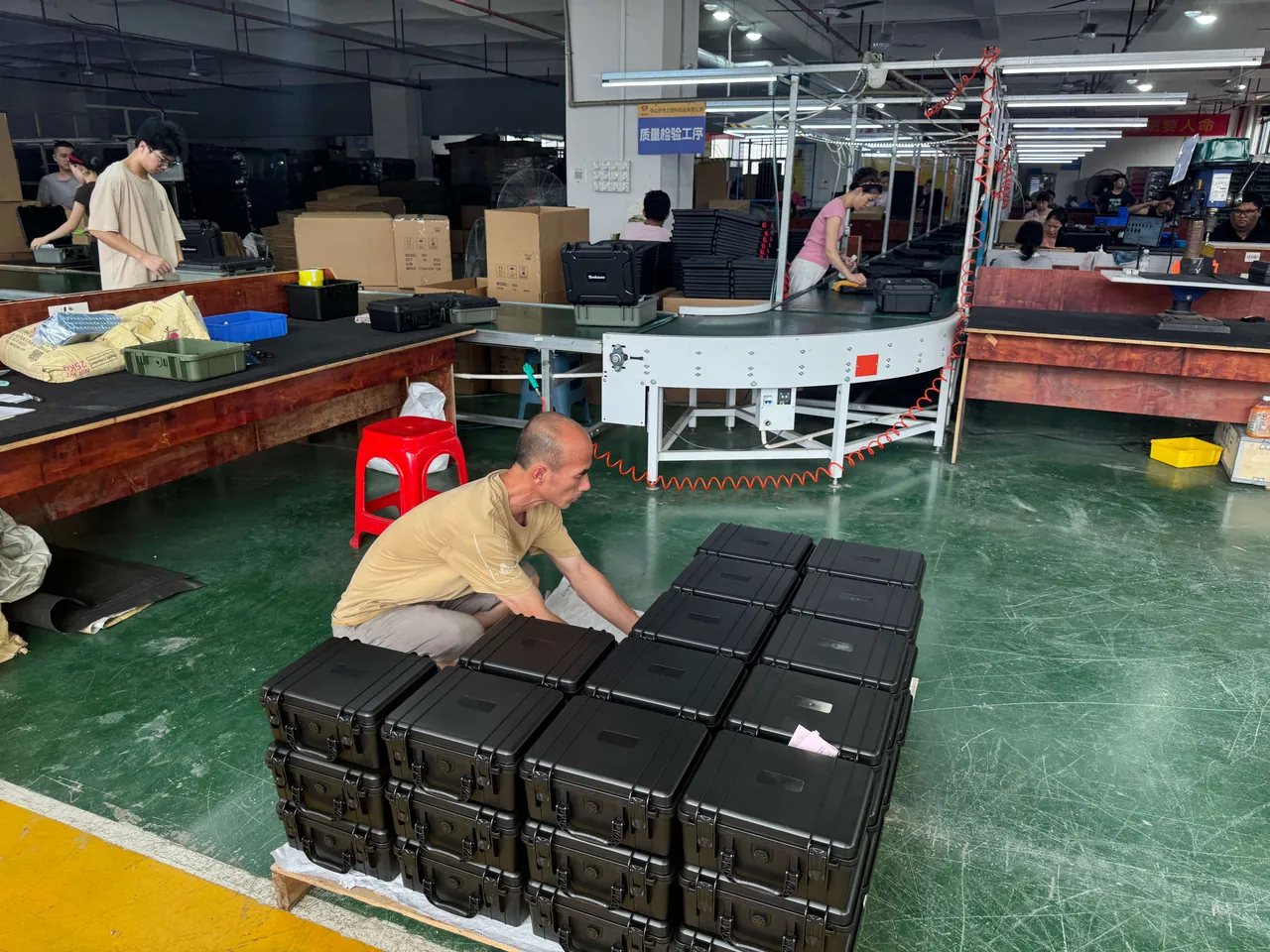
From the storage packaging viewpoint, ammunitions-class goods raise a problem entirely different from that of precision instruments: they do not demand maximum cushioning, they demand long-term stability, dryness, and non-contact between units.
Requirement one: moisture and corrosion control.
- Prefer closed-cell, low-absorption materials (PE foam, EPE, XPE, EPP) and avoid moisture-absorbing open-cell PU.
- Combine with VCI (vapor corrosion inhibitor) materials. VCI volatilizes an inhibitor that forms a protective layer on metal surfaces, and related packaging materials may reference specifications such as MIL-PRF-3420. VCI film, paper, or foam can be laminated into the insert.
- Place desiccant and a humidity indicator card inside the case, forming a triple barrier of case seal, VCI, and desiccant.
- A key point: open-cell foam that has absorbed moisture is itself a moisture source. In a humid environment, an open-cell PU insert absorbs water first and then releases vapor into the sealed case, which is worse than no insert at all.
Requirement two: anti-shift and anti-mutual-impact.
- Each unit should have its own locating slot to prevent friction and impact in transit.
- Slot depth and shape should keep the item from working free when the case is tipped or inverted.
- Stacking-direction compression design matters: long stacking imposes sustained load on lower items, so the insert should route load into the case structure rather than into the item.
Requirement three: ESD control. Some energetic goods are sensitive to electrostatic discharge, so the insert should use ESD-safe or conductive foam, with surface resistance held within a specified range. Packaging material selection for ESD-sensitive items may reference ANSI/ESD S541 (packaging materials for ESD-sensitive items) and IEC 61340-5-1. Note carefully: ordinary EPE and EVA are good insulators and readily accumulate static charge, so they must not be assumed suitable for ESD-sensitive scenarios.
Requirement four: temperature and long-term stability.
- In high heat, foam can soften and release volatiles that may migrate and contaminate item surfaces; pay attention to the material's temperature range and outgassing behavior.
- In cold, foam hardens and cushioning travel shrinks, making the combination of low temperature plus drop the most dangerous condition.
| Requirement | Precision instruments | Ammunitions-class goods |
|---|---|---|
| --- | --- | --- |
| Cushioning | Multi-stage, staged dissipation | Moderate, isolation is the priority |
| Locating | High-precision positional constraint | Dedicated slots, anti-shift |
| Material structure | Closed-cell plus open-cell hybrid is acceptable | Closed-cell and low-absorption preferred |
| ESD | Depends on electronics | Mandatory in some scenarios |
| Corrosion control | Mainly anti-condensation | VCI plus desiccant plus sealing |
| Standards of interest | MIL-STD-810H, ISTA, ASTM D3574 | MIL-PRF-3420, ANSI/ESD S541, ISO 9227 |
Three Forming Processes: CNC Machining, Die Cutting, and Molding
The forming process sets precision, cost, and batch suitability, and must be confirmed early.
CNC machining (routing and cutting).
- Strengths: high precision, no tooling cost, suited to small batches and complex three-dimensional contours, low change-over cost.
- Weaknesses: higher unit cost, limited price reduction at large volume, visible machining texture.
- Best for: prototypes, small batches, complex geometry, projects with frequent revisions.
Die cutting.
- Strengths: high batch efficiency, low unit cost, clean edges.
- Weaknesses: only planar outlines, no three-dimensional contouring, requires a die that must be remade on revision.
- Best for: sheets, gaskets, flat layers within a layered build, high-volume standardized inserts.
Molding (heat forming and tool molding).
- Strengths: complex three-dimensional structure in one step, excellent consistency, high surface quality, best batch cost.
- Weaknesses: high tooling cost, long development lead time, high revision cost.
- Best for: large volumes, stable structure, projects with appearance and consistency requirements.
| Process | Precision | Tooling cost | Small-batch cost | Large-batch cost | 3D capability | Revision cost | Suitable volume |
|---|---|---|---|---|---|---|---|
| --- | --- | --- | --- | --- | --- | --- | --- |
| CNC | High | None | Medium | Medium-high | Strong | Low | Prototype to mid batch |
| Die cutting | Medium | Yes (die) | Low | Low | None (2D) | Medium | High-volume flat parts |
| Molding | High | High | High | Low | Strong | High | High-volume complex parts |
A practical recommendation. Prototype with CNC, then evaluate molding or die cutting for production. This validates structure and dimensions quickly while avoiding premature tooling investment.
The Seven-Step Customization Process: From Measurement to Verification
Standardizing the process into seven steps sharply reduces rework:
- Define the protected item and its failure mechanisms: dimensions, weight, center of gravity, fragile areas, and environmental requirements including temperature, humidity, and ESD.
- Fix the case model and internal dimensions: design to the internal clear dimensions, not the external envelope; reserve space for latches, hinges, and seals.
- Select materials and layered structure: choose cushioning, contour, and surface materials using the tables in the previous sections.
- Build a 3D model and run simulation (optional): for high-value items, finite element analysis can give a first read on impact transfer and resonance risk.
- CNC prototype: machine the first article and verify by physical assembly that access is smooth and constraint is sensible.
- Verification testing: run drop, vibration, and environmental tests to the agreed standards, as described below.
- Freeze and produce: lock drawings, tolerances, material batch numbers, and inspection criteria, then move to volume production.
Working tolerance and fit guidance (for reference, adjusted by item precision):
- Locating slot clearance for precision instruments is typically on the order of fractions of a millimeter to about 1.0 mm; too tight makes assembly hard, too loose allows shifting.
- Finger access clearance is much larger, generally in the 10 mm range for a finger to enter.
- Layered builds should use locating pins or offset steps to prevent interlayer slip.
Layered Structure: Base Layer, Contour Layer, and Lid Layer
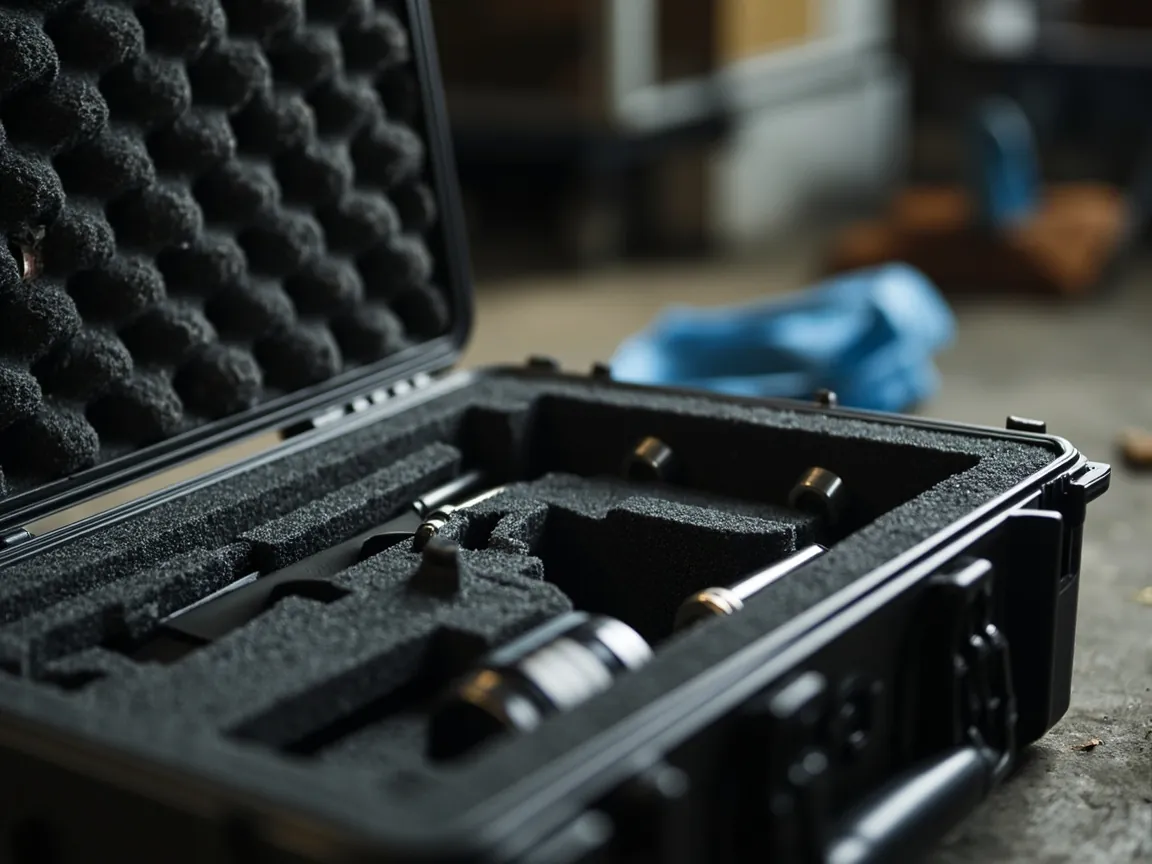
A standard premium insert is a three-layer structure with distinct functions.
Base layer.
- Role: load bearing, energy absorption, routing load into the case structure.
- Material: medium-to-high-density EPE, EPP, or PE foam.
- Design points: thick enough to provide compression travel; flat underside to mate with the case; a rigid support plate underneath if needed to spread load.
Contour layer.
- Role: locating the item precisely in position and attitude.
- Material: EVA (heat formed or CNC) or XPE.
- Design points: contour accuracy, slot wall perpendicularity, removal clearance, finger recesses or pull tabs.
Lid layer.
- Role: pressing the item from above to prevent vertical movement, and "catching" the item the moment the case opens.
- Material: low-density EPE or thin XPE sheet.
- Design points: thickness should slightly exceed the remaining space when closed, creating light preload, but not so much that closing becomes difficult or the case deforms.
| Layer | Role | Common material | Key parameter | Common problem |
|---|---|---|---|---|
| --- | --- | --- | --- | --- |
| Base | Load bearing, energy absorption | EPE / EPP / PE foam | Thickness, density | Too thin, compacts with no cushioning |
| Contour | Locating, constraint | EVA / XPE | Contour accuracy, clearance | Too tight to assemble, too loose to hold |
| Lid | Compression, vertical anti-shift | EPE / XPE sheet | Preload | Too thick, hard to close |
An advanced structure: removable modular inserts. Making the contour layer a separately removable inner tray allows changing the contents configuration without changing the case. This modular approach is very practical where multiple supply sets rotate; related ideas appear in pre-cut foam applications and dividers versus foam.
Environmental Behavior: Temperature, Humidity, VCI, and Desiccant
Performance decay during long storage is often more damaging than transport shock.
Temperature.
- High heat: foam softens, compression set worsens, and volatiles may be released that contaminate item surfaces. Confirm the material's maximum service temperature and avoid long storage in heat.
- Cold: foam hardens and cushioning travel shortens, so more shock reaches the item on a drop. Cold plus drop is the most dangerous combination and should be verified separately.
- Thermal cycling: repeated expansion and contraction create relative displacement between insert and item, leading to loosening over time.
Humidity.
- Closed-cell materials (PE, EPE, XPE, EPP) absorb almost nothing and are the first choice in humid environments.
- Open-cell materials (PU) may absorb moisture, mold, or hydrolyze, requiring desiccant or outright replacement.
- An underrated fact: the insert itself can become a moisture source. If it absorbs water in a humid environment and is then sealed into the case, it keeps releasing vapor. Ensure the insert is dry before loading.
VCI (vapor corrosion inhibitor).
- VCI materials volatilize an inhibitor within an enclosed space, forming a molecular-scale protective layer on metal surfaces, and suit lamination into closed-cell inserts.
- Note that VCI effectiveness depends on an enclosed space and adequate temperature; too much volume, too low a temperature, or frequent air exchange reduce performance.
- VCI may be incompatible with certain materials, including some plastics and non-metals, so confirm suitability with the supplier.
Desiccant.
- Silica gel is the common choice, with quantity tied to case volume, seal rating, and target humidity.
- Pair it with a humidity indicator card so opening the case immediately reveals whether replacement is due, avoiding both blind and forgotten replacement.
| Environmental factor | Effect on the insert | Countermeasure | Reference standard |
|---|---|---|---|
| --- | --- | --- | --- |
| High temperature | Softening, outgassing, contamination | Heat-tolerant material, avoid long hot storage | Material temperature data |
| Low temperature | Hardening, reduced cushioning | Verify cold drop separately | MIL-STD-810H |
| Humidity | Absorption, molding, hydrolysis | Closed-cell material plus desiccant | ISO 9227 |
| Salt fog | Metal corrosion | VCI plus sealing plus closed-cell insert | ISO 9227 |
| Thermal cycling | Relative displacement, loosening | Elastic compression, periodic recheck | MIL-STD-810H |
| Long UV exposure | Aging, chalking | Avoid long sun exposure, weather-resistant material | GB/T 16422 |
Material and Structure Selection Tables
Two lookup tables consolidate the discussion and speed up selection.
Table one: material combination by protected item.
| Protected item | Cushion layer | Contour layer | Surface / lid | Additional measures |
|---|---|---|---|---|
| --- | --- | --- | --- | --- |
| Optical / precision instruments | Low-density EPE | Medium-high-density EVA | XPE sheet | Anti-condensation, anti-resonance |
| Electronic equipment | Medium-density EPE | EVA or XPE | ESD-safe surface | ESD control, humidity indicator |
| Measuring tools and gauges | Low-density EPE | High-density EVA | XPE | Precision positional constraint |
| Metal parts and tools | EPE | PE foam locating blocks | EPE | VCI, rust prevention |
| Energetic goods (storage packaging) | Medium-density EPE / EPP | PE foam locating slots | EPE | VCI, ESD control, desiccant |
| Repeated-drop transport | EPP | PE foam | XPE | Durability first |
Table two: structure complexity by duty.
| Duty | Suggested structure | Layers | Verification |
|---|---|---|---|
| --- | --- | --- | --- |
| Indoor transfer | Single contour layer or dividers | 1 to 2 | Appearance and assembly |
| Routine transport | Base plus contour | 2 | Drop plus vibration |
| Long-haul transport | Base plus contour plus lid | 3 | Drop plus vibration plus environment |
| Long-term storage | Three layers plus VCI plus desiccant | 3+ | Environment plus sealing plus periodic recheck |
| Repeated reuse | EPP structural parts plus replaceable surface | 2 to 3 | Repeated drop cycles |
Verification and Testing: Drop, Vibration, and Shape Recovery
An unverified custom insert is only a craft object that looks reasonable. Executable verification comes in three tiers.
Tier one: assembly verification (every first article).
- Is the item stable after loading, with no obvious shifting?
- Is removal smooth, without prying?
- Does the lid layer apply sensible preload, and is closing easy?
- Does the insert fit the case, without lifted edges or gaps?
Tier two: mechanical verification (first articles and major changes).
- Drop test: may reference ASTM D5276, GB/T 4857.5, or the drop procedures in ISTA 2A/3A, with drop height and attitude (corner, edge, face) selected by weight class. Check item condition and insert recovery after the drop.
- Vibration test: may reference ASTM D999, GB/T 4857.7, or MIL-STD-810H vibration methods, simulating transport vibration and checking for resonance amplification and cumulative displacement.
- Stacking or compression test: verifying insert deformation and item loading after long-term stacking.
- Combined transport test: may reference ASTM D4169 or ISTA 3A, simulating a full distribution hazard sequence.
Tier three: environmental and long-term verification (long storage and harsh conditions).
- Check insert deformation, mold, and item corrosion after thermal and humidity cycling.
- Check metal parts after salt spray per ISO 9227.
- Check foam chalking, rebound loss, and surface contamination after accelerated aging.
- Measure compression set (ISO 1856 / GB/T 6669) to assess grip decay after repeated use.
| Tier | Test | Reference standard | Judgment criteria |
|---|---|---|---|
| --- | --- | --- | --- |
| Assembly | Stability, access, preload | Internal specification | No shifting, smooth access |
| Mechanical | Drop | ASTM D5276 / GB/T 4857.5 / ISTA 2A, 3A | Item intact, insert recovers |
| Mechanical | Vibration | ASTM D999 / GB/T 4857.7 / MIL-STD-810H | No resonance amplification, no cumulative shift |
| Mechanical | Combined transport | ASTM D4169 / ISTA 3A | Functional after the full sequence |
| Environmental | Thermal and humidity cycling | MIL-STD-810H | No deformation, no mold |
| Environmental | Salt spray | ISO 9227 | No functional corrosion of metal parts |
| Long term | Compression set | ISO 1856 / GB/T 6669 | Grip decay within allowance |
A pragmatic note. Not every project needs the full set. Tier the verification to the duty: indoor transfer needs assembly verification only; routine transport adds drop and vibration; long storage adds environmental verification. That balances cost against reliability.
Bulk Procurement and Customization: A B2B View
Bulk insert procurement carries risks quite different from one-off customization. Five points matter:
- Freeze drawings and tolerances. Fit dimensions must be frozen in drawings with key tolerances and inspection methods. "Make it like the sample" with no drawing loses control the moment you change suppliers.
- Lock material batches and properties. Require density, hardness, and compression set data with each delivery and retain batch records. Foam is a material whose differences are invisible, and the same grade can feel different across batches.
- Define process and revision cost. For molding or die cutting, specify tool ownership, revision flow, and cost responsibility, so a single dimension change does not force a new tool.
- Spares and interchangeability. Inserts are wear items; confirm separate supply capability and pricing so a box does not become unusable when its insert is discontinued.
- Verification and documentation. For important projects, agree on first-article verification, sampling ratios, and test standards, and require material and test documents that match the volume goods.
In wholesale, distribution, and OEM/ODM projects for protective cases and military-style storage and transport boxes, JUNZHJIA can provide insert material selection, layered structure design, CNC prototyping, and volume forming matched to the protected item and duty, together with VCI, desiccant, and humidity indicator accessories, plus the corresponding technical documentation, helping customers turn an insert from filler into a replicable, verifiable structural component.
Frequently Asked Questions
Q: Is softer foam always better for an insert?
A: No. Cushioning performance depends on whether the foam's hardness matches the protected item, not on absolute softness. If the foam is too hard, it cannot deform sufficiently under impact and the energy passes almost unchanged to the item, which is effectively no cushioning. If it is too soft, it compresses to full density under impact, at which point it is nearly incompressible and again transmits rigidly. The ideal state is that under the expected impact the foam deforms substantially without compacting, dissipating most of the energy. Soft is only one way to meet the condition, not the goal. Start by establishing the item's weight, contact area, and allowable acceleration limit, then work backward to indentation hardness and compression travel. Also weigh rebound behavior and compression set: slow-rebound materials dissipate well but support weakly, and materials with high compression set loosen after a few cycles. Use a physical fit plus one drop and one vibration test as the final criterion.
Q: Can precision instruments and ammunitions-class goods use the same insert?
A: Not advisable, because their failure mechanisms are nearly opposite. Precision instruments are threatened mainly by shock acceleration, vibration fatigue, and positional drift during transport, so the insert must focus on multi-stage cushioning and high-precision positional constraint, typically through a three-layer build of low-density cushion, high-density EVA contour, and lid layer. Ammunitions-class goods, from the storage packaging viewpoint, are threatened mainly by moisture, salt fog, thermal cycling, and mutual impact, so the focus is moisture control, corrosion control, and anti-shift, typically using closed-cell, low-absorption PE or EPP with dedicated locating slots plus VCI material and desiccant. Force one insert to serve both and the typical outcomes are: a hard solid EVA contour drifts a precision instrument's accuracy because rebound is slow and dissipation limited; an open-cell PU insert for metal goods becomes a persistent moisture source and accelerates corrosion. The right approach is to design separately by failure mechanism, or to adopt a replaceable modular inner tray.
Q: Why do two foams of the same density feel so different?
A: Because density only describes how much mass occupies a unit volume, not cell structure or mechanical behavior. Foam performance is set by base polymer type, whether cells are open or closed, cell size and uniformity, degree of cross-linking, and any modifying additives. A 30 kg/m³ EPE and a 30 kg/m³ EVA differ: the former is closed-cell polyolefin with fast rebound and weak support, while the latter, depending on VA content, can be soft or firm with distinctly slower rebound. At equal density, open-cell PU and closed-cell XPE are not even in the same order of magnitude on water absorption and compression set. So do not specify density alone. State the material type, cell structure, indentation hardness, rebound, and compression set, and require corresponding test data (methods may reference ISO 845, ASTM D3574, and ISO 1856). The most reliable check is a physical fit test judged on actual feel and measured shape recovery.
Q: Do foam inserts loosen over time, and how can I extend their life?
A: Yes, mainly through compression set: after sustained compression, the cell structure deforms irreversibly, thickness shrinks, slots widen, and grip falls. The extent depends on the material's compression set, the working compression ratio, temperature, and time. Five ways to extend life. First, avoid sustained over-compression; design the foam to work within its recommended compression ratio, and in long-storage scenarios reduce the ratio while supplementing constraint with mechanical locating. Second, choose low-compression-set materials, where closed-cell cross-linked types such as XPE and EPP generally outperform open-cell PU. Third, control storage temperature, since heat sharply accelerates deformation and aging. Fourth, release pressure periodically: open long-stored cases so the insert can recover. Fifth, manage inserts as consumables, with a defined replacement interval and spare stock. Measurement methods may reference ISO 1856 or GB/T 6669.
Q: Why does ESD matter for inserts used with energetic goods?
A: Because some energetic goods are sensitive to electrostatic discharge, while common foam materials are good insulators. EPE, EVA, and PE foam all have very high surface resistance and readily accumulate static charge through friction, peeling, or rapid separation. When charge builds to a sufficient level and discharges, it can pose a risk to sensitive goods. Such scenarios should use ESD-safe or conductive foam with surface resistance held within a specified range. Material selection may reference ANSI/ESD S541 and IEC 61340-5-1. Note carefully: do not assume ordinary foam is fine, and do not judge ESD performance by color, since pink and black are widely used on products that are not ESD-safe. Require surface resistance test data. ESD performance also changes with humidity, contamination, and aging, and should be rechecked periodically.
Q: Is open-cell PU foam still usable?
A: Yes, but its boundaries must be clear. Open-cell PU offers excellent cushioning and finely tunable density and hardness, and has long been the mainstay of precision instrument packaging, performing well in dry or controlled environments and on shorter transport cycles. Its main problem is water and moisture absorption: in a humid environment it takes on water and then releases vapor after sealing, potentially causing item moisture damage, mold, and under some conditions hydrolysis and chalking. Using open-cell PU therefore requires one of the following: a controlled relative humidity environment; a case seal high enough with adequate desiccant and a humidity indicator card; or a hybrid structure in which the open-cell PU handles cushioning only and does not contact the item or the moisture directly. If none is possible, switch to closed-cell materials such as PE foam, EPE, XPE, or EPP. Ester-type PU is generally weaker than ether-type on hydrolysis resistance, so confirm the type carefully for long humid storage.
Q: What information is needed to customize an insert?
A: Five categories. First, complete information about the protected item: three-dimensional dimensions, weight, center of gravity, fragile areas such as lenses, connectors, thin walls, and precision faces, and whether a specific attitude must be maintained. Second, environmental and transport conditions: rain exposure, possible submersion, transport mode by air, sea, or land, temperature range, salt fog or chemical contact, and ESD sensitivity. Third, case information: model, internal clear dimensions, latch and hinge footprints, and sealing structure and protection rating, because the insert must be designed to the internal clear dimensions. Fourth, usage pattern: whether access is frequent, whether multiple supply sets rotate, whether serial numbering and labeling are required, and whether one person must carry it. Fifth, standards and acceptance requirements: which standards apply, such as ISTA 2A/3A, MIL-STD-810H, or ISO 1856, plus drop height and attitude and sampling ratio. The more complete the input, the fewer the prototypes and the lower the rework risk. The worst case is asking for "an insert" with no dimensions or conditions, which guarantees repeated revisions.
Q: What most often goes wrong in bulk insert procurement?
A: Five things. First, no frozen drawings, producing only from a sample or a verbal description, after which dimensions and feel lose control the moment you change supplier or batch. Second, material batch variation: foam is a material whose differences are invisible, and the same grade can differ in density and hardness between batches, so require batch property data and retain records. Third, unclear tool ownership: with molding or die cutting, if tool cost and ownership are not spelled out, later revisions bring high fees or lock you out of changing suppliers. Fourth, spare supply drying up: inserts are consumables, and if the supplier cannot supply them separately or discontinues them, the whole batch of cases becomes unusable for lack of an insert. Fifth, documentation that does not match the goods, most commonly endorsing a custom unit with base-model or similar-model test data; any difference in material, structure, or process warrants separate confirmation. Write these items into the framework agreement and require first-article verification plus sampling.
Conclusion and Further Reading
Back to the original question: how do you customize foam inserts for an ammo box? The answer is not to pick a "good foam" but to identify the protected item's failure mechanism first and then work backward to material and structure. Precision instruments fear dynamic shock and positional drift, needing a multi-stage build of low-density cushion, high-density contour, and lid layer validated by measured drop and vibration results. Ammunitions-class goods, from the storage packaging viewpoint, fear moisture, corrosion, and shifting, needing closed-cell low-absorption materials, dedicated locating slots, and VCI plus desiccant. Four properties decide the outcome: apparent density, indentation hardness, rebound behavior, and compression set. Asking only about density is the most common wrong starting point in insert customization.
Three executable recommendations. First, write the failure mechanism list before choosing materials, confirming shock, vibration, humidity, corrosion, and ESD item by item. Second, prototype with CNC and evaluate tooling only at production scale, validating structure at the lowest cost. Third, manage the insert as a structural component: freeze drawings and tolerances, lock material batches and properties, and define spare supply and verification standards. In wholesale, distribution, and OEM/ODM projects for protective cases and military-style storage and transport boxes, JUNZHJIA can provide insert material selection, layered structure design, CNC prototyping, and volume forming matched to the protected item and duty, together with VCI, desiccant, and humidity indicator accessories and the corresponding technical documentation, helping customers turn an insert from filler into a replicable, verifiable structural component.
Further Reading