

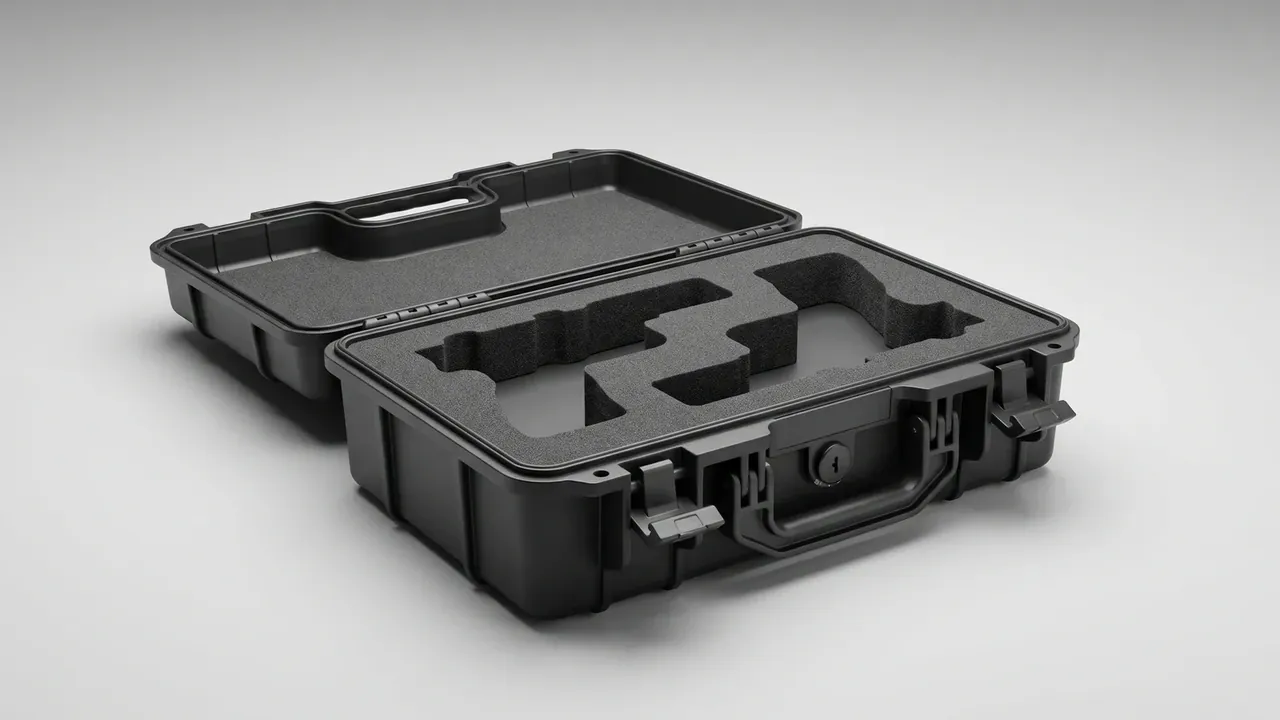
Quick answer: An ammunition storage container is one rotomoulded hollow shell, and three numbers decide its strength and stacking: wall thickness, lid depth and the flatness of the stacking face, not the outside footprint. Ask for the thinnest measured wall, the gasket compression, and whether the base springs back after four loaded units.
Table of contents
- Where the wall thickness comes from
- Lid and base do different jobs
- Choosing the insert: three foams, two layouts
- Three dimensions that decide fit
- What the spec sheet will not tell you
- FAQ
1. Where the wall thickness comes from
An ammunition storage container is often imagined as a steel box made in plastic. It is not: a steel box resists bending with folds and ribs, a rotomoulded shell with one continuous wall. One millimetre of wall difference roughly doubles dent depth under a four-high stack.
| Step | Parameter | What it decides |
|---|---|---|
| Charging | Powder 300–500 µm, charge by surface area | Where wall thickness starts |
| Heating | Oven at 300 °C, biaxial rotation, 25 minutes | Whether the wall is even |
| Cooling | 12 minutes air, then water | Internal stress and warpage |
| Assembly | Gasket, latches, pressure valve | Seal quality and opening force |
Both axes must turn together, usually at 4:1. Turn one only and powder piles at one end: 9 mm there, just over 4 mm opposite. The thin side is where a crack begins, and no visual check finds it, because it opens from the inner wall.
2. Lid and base do different jobs
The lid and base of an ammunition storage container are not symmetric halves. The base carries load, so it gets a perimeter rib and two cross ribs; the lid takes only stacking pressure, so it can run thinner, but its rim carries the gasket groove. Design the lid as the other half and the unit gains twenty per cent in weight.
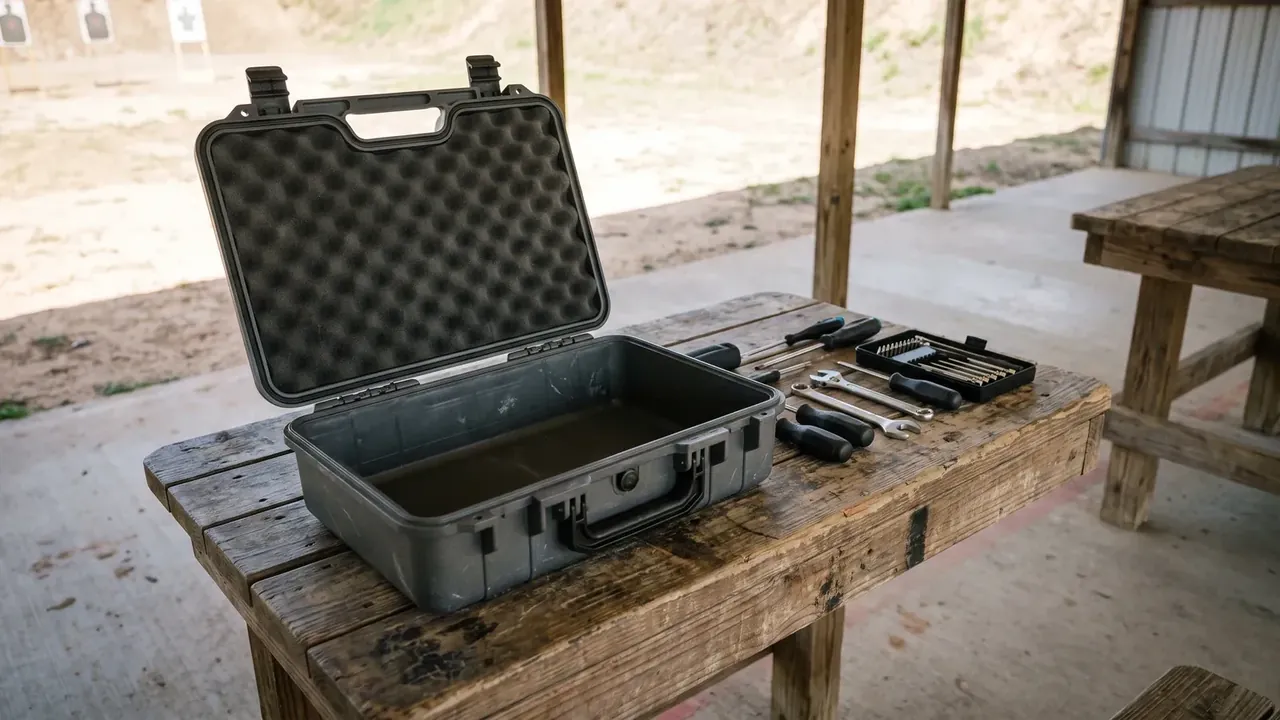
The gasket sits in the lid groove and is compressed about thirty per cent at closure, then springs back against the base rim; too little leaks, too much and it takes a permanent set within two years. Latches hold that compression but do not seal by themselves. Two latches plus one central lock is the common layout, spaced near 0.6 times the body width; bases are torqued to 2.5 N·m, more cracks them, less works loose in the cold. The pressure valve is what everyone forgets: move a closed unit from a 30 °C store to a 5 °C yard and the lid sticks, cracking at a 0.05 bar differential that one finger can release.
3. Choosing the insert: three foams, two layouts
The insert decides whether the load shifts inside an ammunition storage container; it has nothing to do with shell strength. Choose by unit weight and allowed movement, then by how often the box is opened, and last by cost:
- EPE: 25–35 kg/m³, slow rebound, fine below 2 kg per unit, cheapest.
- EVA: 60–80 kg/m³, clean cut, no dust, best for pockets opened daily.
- PU: 30–45 kg/m³, best conforming fit, but rebound falls with moisture.
Two layouts exist. A single block cut with cavities holds position precisely, because a pocket wall cannot shift in transit; changing the load means a new die. A modular grid costs nothing to change, but blocks work loose and dust collects in the gaps.
Below 8 kg per unit, 25 mm of foam is the floor.
4. Three dimensions that decide fit
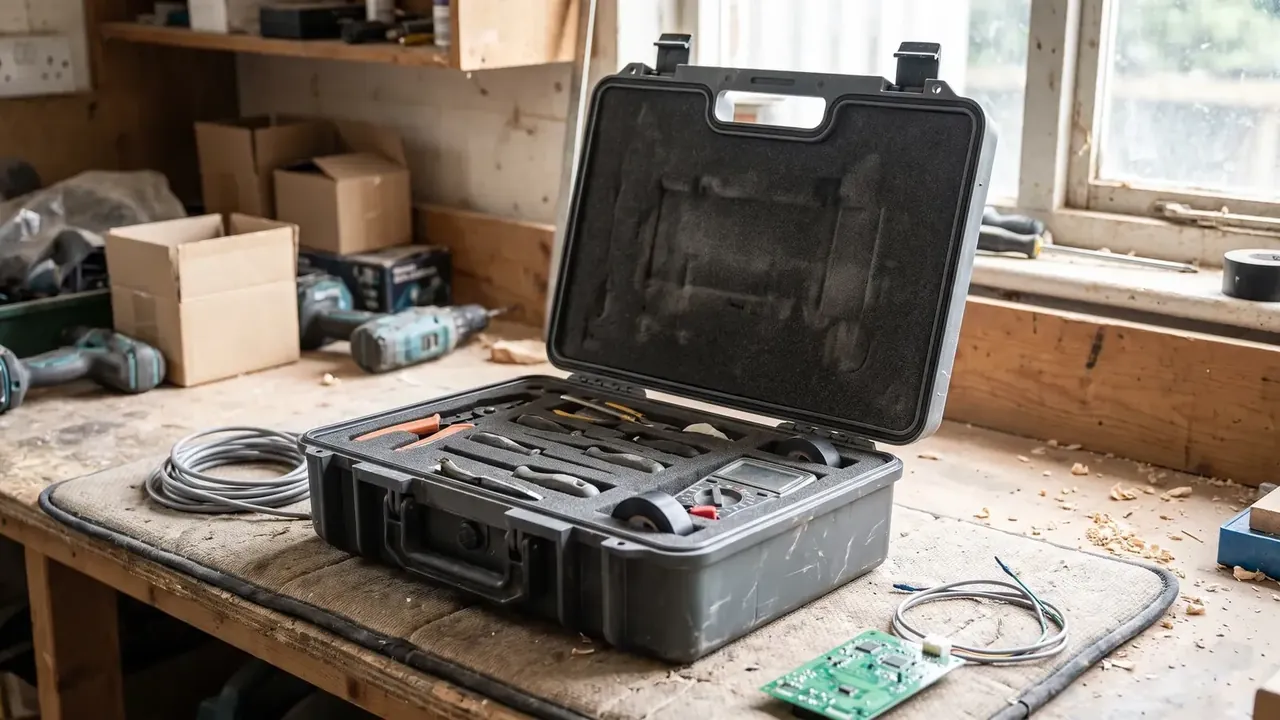
The most mis-specified number is internal clear width. Catalogues quote the mould dimension; subtract two walls and a rib and usable width is 15 to 20 mm less, enough for an insert cut to the printed figure to jam.
| Dimension | Typical mid-size value | What goes wrong |
|---|---|---|
| Internal clear width | Nominal minus 18 mm | Insert cut oversize, will not seat |
| Lid depth | 45–70 mm | Tall items foul the lid, gap at the rim |
| Stacking face flatness | Under 3 mm over 2 m | Lean at four high |
| Base rib height | 12–18 mm | Forks will not enter, or a rib crushes |
Lid depth is the second number people skip: at 45 mm only flat loads fit, standing items need 70 mm, and extra depth raises overall height. The stacking face is the third, since a ribbed base contacts only on rib crowns, and past 3 mm of flatness error four units lean.
A 40 kg unit stacked four high leaves 120 kg on the bottom shell, year round.
5. What the spec sheet will not tell you
First, wall thickness is an average. A 6.5 mm figure is the mean of six to eight readings; the thinnest may be 5.4 mm, so ask for the minimum wall.
Second, an IP rating is not a humidity rating. It covers short spray or immersion, not months at 80 per cent relative humidity.
Third, drop height is tied to unit mass: two units both rated at 1.2 m, one at 6 kg and one at 9 kg, will not behave alike.
Conclusion
The quality of an ammunition storage container is not printed on the catalogue cover; it sits in three numbers — thinnest measured wall, gasket compression, stacking face flatness. Those decide how long it stands in a store room and whether the insert fits first time. Settle them before price.
This article discusses only the container (case body) side of specifications and design intent, and does not cover any handling, loading or use of the contents.
Related Reading
- Rotomoulded shells against fibre-reinforced shells
- Splitting the job between transit and storage
- Gasket and latch check intervals
- From box type to internal cavity layout
Related Products
- 8 Series — Gun Cases; Military Equipment Cases; Camera Equipment Cases; Drone Cases; Watch Cases; Knife Cases; First Aid Cases; Electronics Equipment Cases
- WL8-2812 PP Gun Case — model WL8-2812
- All protective cases and toolboxes: 7 series, 158 models