

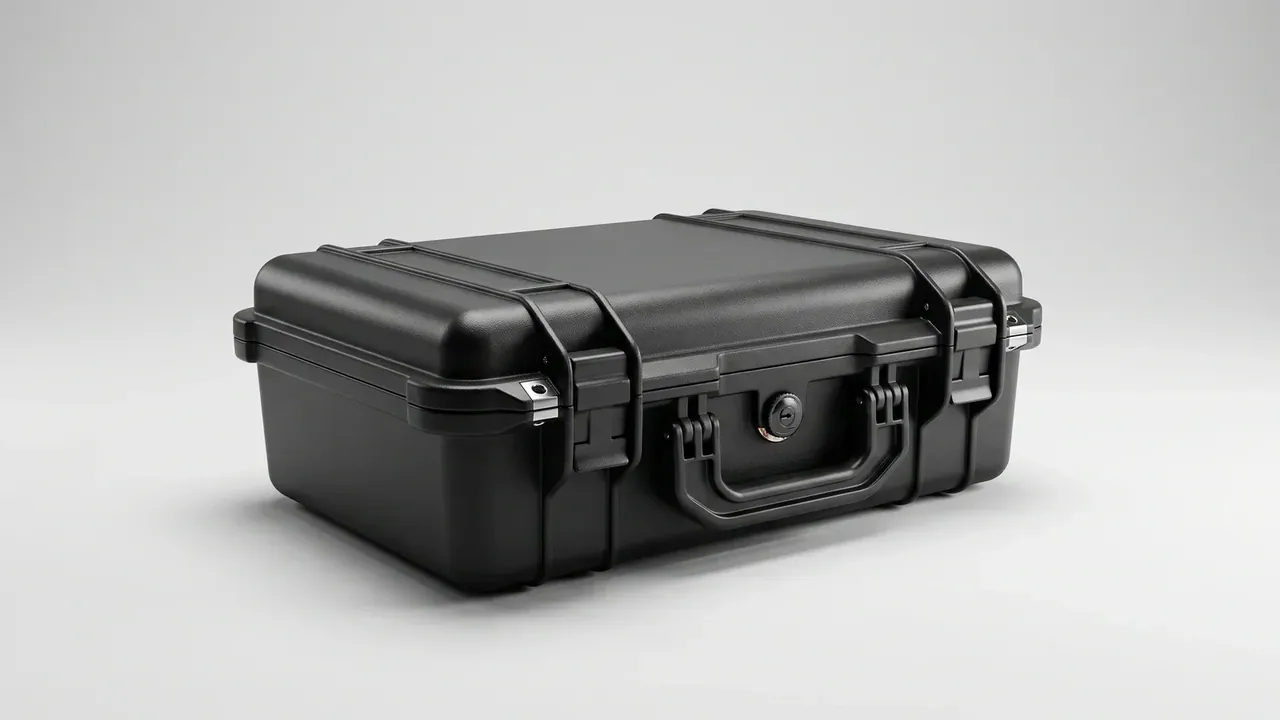
Quick answer: Do not let a supplier set the specification for an ammunition storage container. Work backwards: payload and stack height give the design load, that gives the cavity, and cavity plus allowable deflection gives wall and rib. Then price every change, 10.35 per millimetre of wall, 3.00 per two millimetres of rib.
Table of contents
- Starting from payload and stack height
- Wall thickness comes from deflection
- How ribs buy back thickness
- Latch, gasket groove and lifting eye margins
- One millimetre in unit cost
- FAQ
1. Starting from payload and stack height
The chain starts with three numbers, not with the ammunition storage container: gross weight, tiers, and what the bottom tier carries. Everything else follows.
Real figures: 28 kg gross, five tiers, so the bottom case carries 112 kg from the four above, about 1,100 N. A truck ride adds vertical acceleration, and at two g the design load for the ammunition storage container becomes 2,200 N.
The cavity follows the payload. At a density near 1.2 g per cubic centimetre, 28 kg needs 0.023 cubic metres; add 15 percent clearance and it lands at 720 by 480 by 300 mm.
| Derived item | Value | Source |
|---|---|---|
| Gross per case | 28 kg | loading list |
| Tiers | five | 2.7 m clearance |
| Static at bottom | 1,100 N | four above |
| Design load | 2,200 N | two g vertical |
| Cavity | 720 x 480 x 300 mm | volume plus 15% |
Fix the cavity first. Pick the wall first and tooling eats the material saving.
2. Wall thickness comes from deflection
Deflection governs the wall on an ammunition storage container, not strength. Across a 720 mm span, with 3 mm of allowable sag and 700 MPa for rotomoulded polyethylene, a 4.5 mm wall with ribs sags 2.1 mm; 5 mm without ribs sags 3.4 mm.
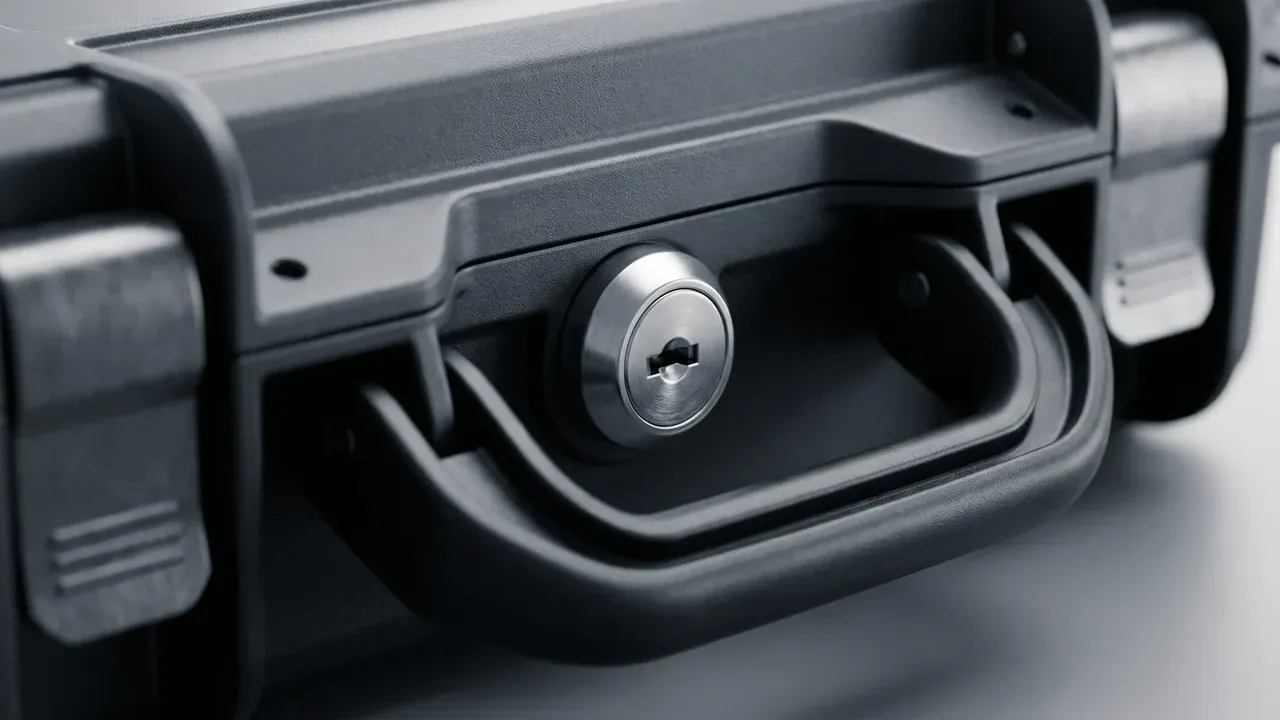
One millimetre of sag is felt in use. At 2.1 mm the lid stays flat underfoot; at 3.4 mm it dishes under two stacked cases and the groove distorts.
There is also a process floor. Below 4.5 mm the powder will not flow evenly, corners thin to 3.2 mm, and a nominal 5 mm that measures 3.2 mm fails.
| Wall and ribs | Deflection | Weight | Material |
|---|---|---|---|
| 4.5 mm ribbed | 2.1 mm | 5.6 kg | 54.90 |
| 5 mm plain | 3.4 mm | 6.1 kg | 59.80 |
| 5 mm ribbed | 1.7 mm | 6.2 kg | 60.80 |
| 6 mm ribbed | 1.2 mm | 7.4 kg | 72.50 |
Thicker is not the only answer: 4.5 mm ribbed sags 1.3 mm less than 5 mm plain and costs 4.90 less.
3. How ribs buy back thickness
A rib carries load to the corners; it does not make the panel thicker. That idea sets the layout of every rib on an ammunition storage container.
- Rib height 12 mm; higher and powder bridges at the top, leaving a thin spot.
- Rib pitch 90 mm; wider and the panel bulges, tighter and powder misses the root.
- A base grid with corner gussets carries floor load to the feet.
- Vertical ribs only on the side walls; horizontal ribs take an imprint from above.
- A 3 mm fillet at the root, because a sharp corner is a stress riser.
With the layout right, a 4.5 mm wall matches a 5 mm plain wall and saves 4.90 per case. Changing ribs also leaves the mould cavity untouched.
4. Latch, gasket groove and lifting eye margins
Latch choice is a holding-force question. Split 2,200 N across two latches, 1,100 N each, and specify 1,800 N for a 60 percent margin.
The gasket margin lives in groove depth. A 6 mm groove with a 7 mm cord gives 14 percent compression and still rebounds at minus twenty-five; a 5 mm groove gives 29 percent, and three cycles take the spring out of it.
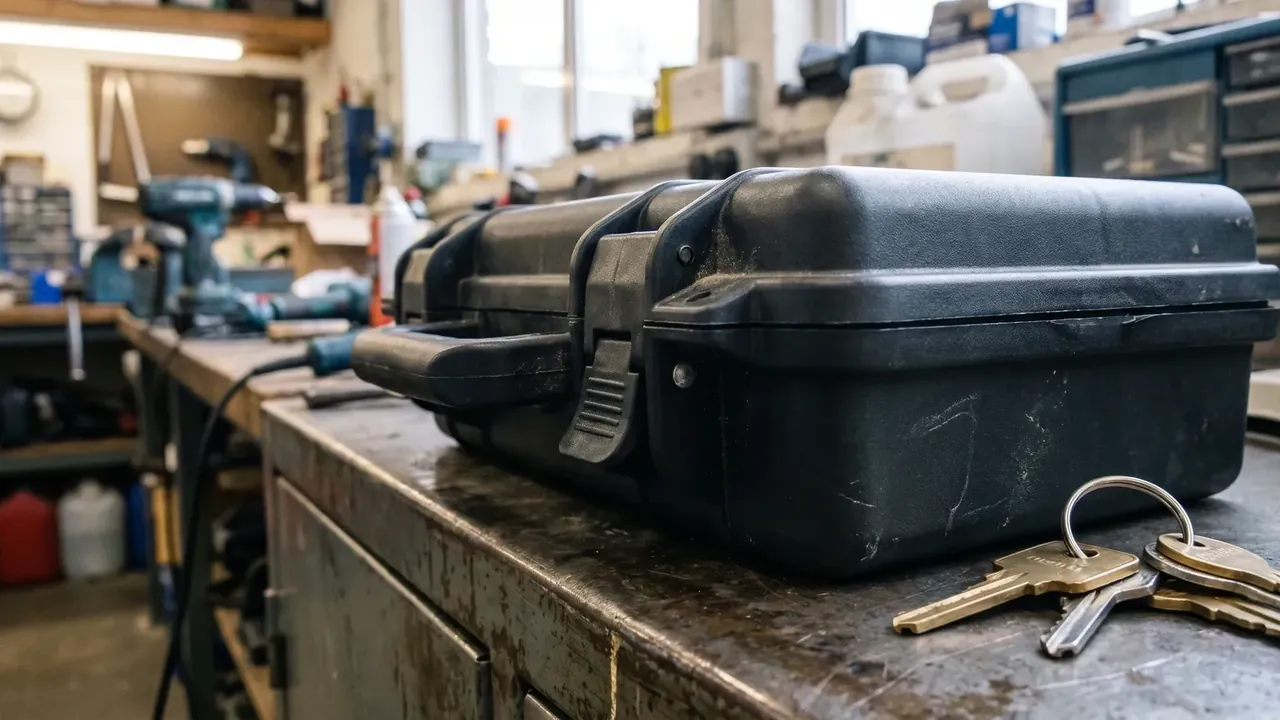
Lifting eyes are where margins get cut. A 28 kg ammunition storage container at four g needs 1,100 N per eye; build to 3,000 N, thicken the root to 7 mm, and torque to 8 N·m.
Groove and eye together save under two of material. One failure costs a whole case.
5. One millimetre in unit cost
Turn every change into money. Polyethylene at 9.80 per kg means one millimetre adds 0.95 kg, so 9.30 of material; the cycle grows 18 seconds, which at 210 per hour is 1.05.
| Change | Material | Machine | Per case | Tooling |
|---|---|---|---|---|
| Wall plus 1 mm | +9.30 | +1.05 | +10.35 | none |
| Rib plus 2 mm | +2.40 | +0.60 | +3.00 | none |
| Cavity plus 50 mm | +6.20 | +0.80 | +7.00 | 12,000 |
| Section change | +11.00 | +2.00 | +13.00 | 36,000 |
Need stiffness, add rib: 3.00 buys 1.2 mm of deflection. Wall is the last resort at 10.35 for half a millimetre.
The rework side settles it. A thin wall dishes the top, the batch is remoulded, and each case costs 3.2 hours at 60 an hour, 192, the price of eighteen millimetres of wall.
Conclusion
The specification is a one-way chain: payload gives the design load, the load gives the cavity, cavity and deflection give wall and rib, and each change prices back into unit cost. Every link has a number: 4.5 mm, 12 mm rib, 6 mm groove, 10.35 per millimetre. Run it and the ammunition storage container is specified by arithmetic.
This article discusses only the container (case body) side of specifications and design intent, and does not cover any handling, loading or use of the contents.
Related Reading
- Gasket and latch service intervals
- Turning duty into parameters
- Ammunition container specification table
- Shipping and storage container dimensions
Related Products
- 8 Series — Gun Cases; Military Equipment Cases; Camera Equipment Cases; Drone Cases; Watch Cases; Knife Cases; First Aid Cases; Electronics Equipment Cases
- WL8-2812 PP Gun Case — model WL8-2812
- All protective cases and toolboxes: 7 series, 158 models