

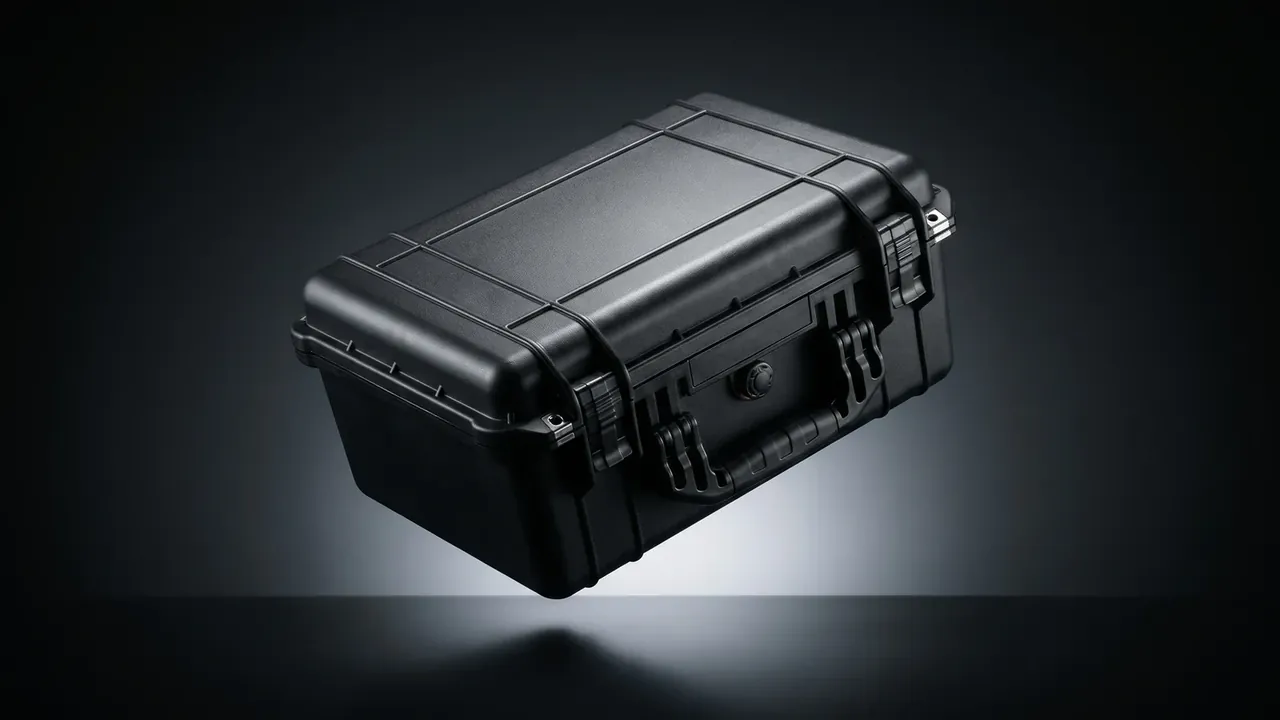
Quick answer: A build log of one ammunition transit case with a 620 × 420 × 230 mm cavity, from trial shot to signed first article: the thickness points, decay limit and drop criteria that decided it.
Table of contents
- Where the Ammunition Transit Case Started
- Five Wall Thickness Points, Not One
- Sealing Starts With a Pressure-Decay Curve
- Stacking and Drop Test Answer Different Questions
- Six Lines Worth Signing on the First-Article Sheet
- FAQ
1. Where the Ammunition Transit Case Started
The customer brought no sample, only a cavity drawing: 620 × 420 × 230 mm clear, twelve cartons, 18 kg loaded, three tiers on his rack.
We tabulated the inputs before arguing about structure; nothing was estimated.
| Input | Value | Source |
|---|---|---|
| Internal cavity | 620 × 420 × 230 mm | Packing list |
| Loaded weight | 18 kg | Twelve cartons weighed |
| Stacked tiers | 3 | Rack upright spacing |
| Trips per year | 40 | Warehouse logbook |
The line people skip is 40 trips a year: 320 closures over eight years, each pushing the latch through one elastic cycle. Prototypes obsess over wall thickness; the latch boss fails first.
2. Five Wall Thickness Points, Not One
The drawing gives one thickness. The mould gives five.
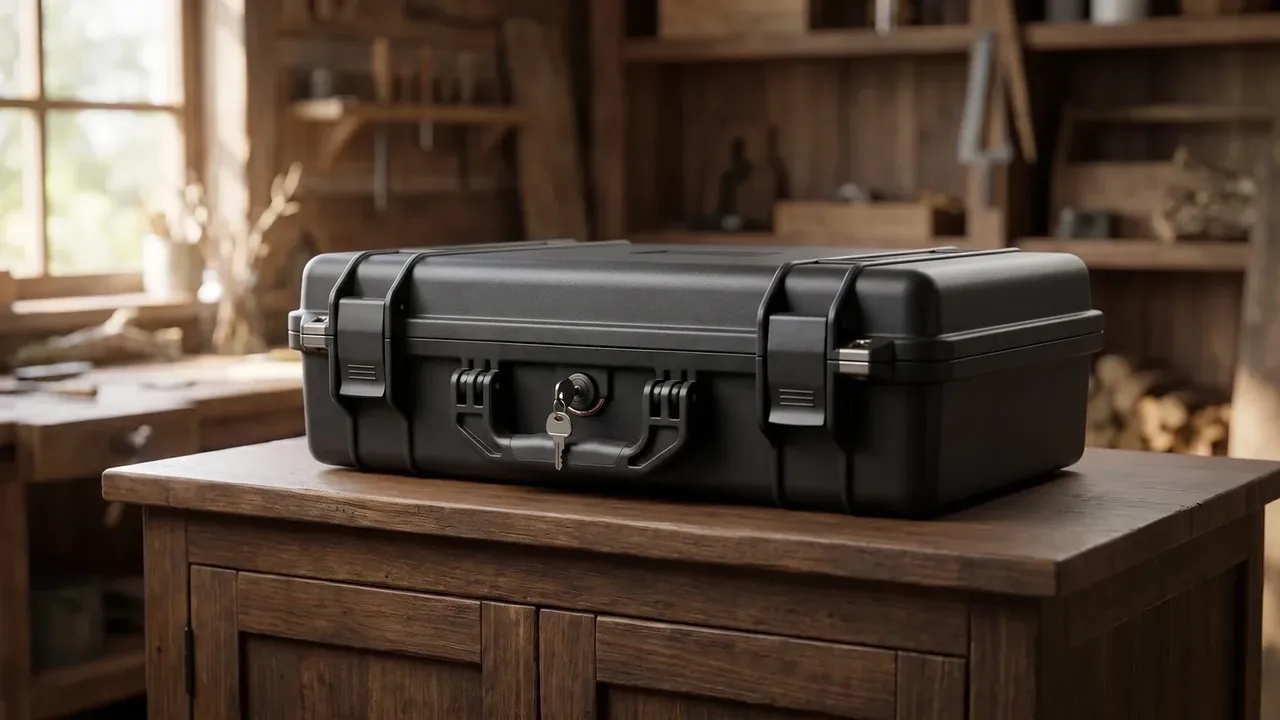
The first article came off a 1250-tonne press, cooled 38 seconds and rested 24 hours before gauging. Five readings per face; a 0.4 mm spread points to a difference between the two tool halves.
| Point | Measured | Drawing | Carries |
|---|---|---|---|
| Centre of base | 6.0 mm | 6.0 mm | Vertical load when stacked |
| Mid side wall | 5.5 mm | 5.5 mm | Side squeeze, forklift knocks |
| Latch boss | 9.0 mm | 8.5 mm | Repeated closure |
| Rib root on lid | 7.2 mm | 7.0 mm | Spring-back after a drop |
Only the latch boss missed: 8.5 specified, 9.0 measured. That looks like strength but is the front edge of a sink mark, a hollow daylight never shows but a 300 mm steel rule will.
The fix was a 1.5 mm relief groove behind the boss, splitting one thick zone into two 4.5 mm ones that cool alike; the second shot read 8.6 mm.
Thickness on an ammunition transit case is not about more being better. Every zone has to cool at one speed, because a step in thickness becomes a crack two years later.
3. Sealing Starts With a Pressure-Decay Curve
A seal is not about pressing harder, but pressing just enough.
Charge the closed case through the valve to 3 kPa, shut it, wait 30 seconds. Our limit is 0.3 kPa; the first article read 0.15, meaning the gasket held a continuous ring with no ongoing leak. For an ammunition transit case the groove is the root: 6 mm wide, 4 mm deep, 7 mm gasket, about 30 percent compression. Under 20 percent, rain climbs the groove floor; over 45 percent, the gasket takes a set and never seals again. After a cold test at -30 °C pushed closure force from 180 N to 260 N, needing two hands, we deepened the groove from 4 mm to 4.5 mm, and force fell to about 200 N. That change never reached the customer drawing.
4. Stacking and Drop Test Answer Different Questions
Stacking and dropping are separate tests, and neither substitutes for the other.
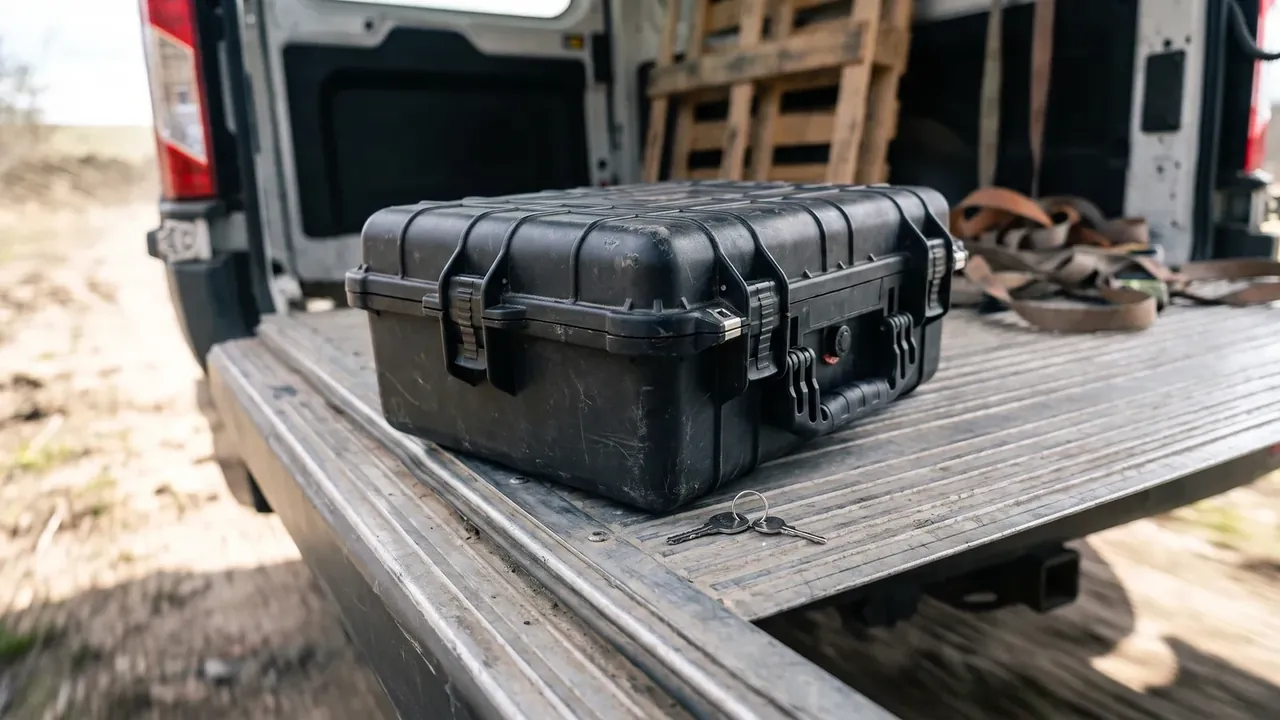
For stacking, 300 kg rests on the lid for 24 hours. Residual deflection at the centre must stay under 3 mm, and the first article read 1.8 mm. That figure is derived: three tiers means the bottom case carries two above, 18 kg doubled twice for margin.
The drop test on this ammunition transit case runs on concrete from 1.2 m, eight orientations, at the full 18 kg. No shell crack, no latch popping, no white stress line through the cavity. On the fourth corner the latch popped, because the hook had a 25-degree lead-in that the impact ramp lifted straight out. At 35 degrees with a throat 0.8 mm deeper, eight repeats passed.
5. Six Lines Worth Signing on the First-Article Sheet
Six lines on the sign-off sheet carry real weight.
- Cavity clearance in three axes, 620 × 420 × 230 mm, tolerance ±2 mm
- Five thickness points, spread within 0.4 mm on any face
- Pressure decay from 3 kPa, no more than 0.3 kPa in 30 seconds
- Latch retention above 300 N once engaged
- 300 kg for 24 hours, lid deflection under 3 mm
- Eight drops from 1.2 m, no crack and no popped latch
The rest is process record: mould curves, trial counts, why each change was made. Round three is the one to remember. A fixed handle instead of a folding one, because gloves could not grip the fold, pushed weight from 6.83 kg to 7.1 kg, over the 7 kg ceiling, until the handle rib went from 4 mm to 3.2 mm and weight returned to 6.95 kg.
The serial number is moulded into the right rear corner of the lid at 8 mm character height, matching the ledger digit count, because a label is gone by the third handling.
Conclusion
Only three things changed shape in fourteen days: the relief groove behind the latch boss, half a millimetre of groove depth, and a latch hook opened to 35 degrees. Together they decide whether this ammunition transit case still closes tight after 320 openings and 40 trips a year.
This article discusses only the container (case body) side of specifications and design intent, and does not cover any handling, loading or use of the contents.
Related Reading
- What a transit case is: structure and use
- Four generations of ammunition boxes
- How ordnance and nuclear equipment cases differ
- Transit cases in depot transfer and forward delivery
Related Products
- 8 Series — Gun Cases; Military Equipment Cases; Camera Equipment Cases; Drone Cases; Watch Cases; Knife Cases; First Aid Cases; Electronics Equipment Cases
- WL8-2812 PP Gun Case — model WL8-2812
- All protective cases and toolboxes: 7 series, 158 models