


Quick answer: A Lockable Anti-Theft Jewelry Display Case runs 180 gsm flocking, 500 abrasion cycles, grade 4 rub fastness, under 5 ppm sulphur and a 3 mm window.
Table of contents
- Velvet wear and shedding
- Cavity depth: watches versus jewellery
- Powering and routing the LED strip
- Combination lock versus viewing window
- Opening rhythm at the counter
- Securing the case at pack-down
- FAQ
1. Velvet wear and shedding
Two failures end a counter lining: the pile stands up under repeated rubbing, and the fibre root lets go so a customer lifts a watch and takes fluff with it. A Lockable Anti-Theft Jewelry Display Case chosen on colour looks fine for three months, then marks every white cuff that passes.
Base cloth weight decides whether the pile stands. 180 gsm is the counter norm; below it the pile is short, backlight shows the base colour, and dark linings suffer first.
| Check | Target | How to judge on the floor |
|---|---|---|
| Base cloth | 180 gsm | Slow rebound, base visible |
| Abrasion | 500 cycles | Pilling or bare patches |
| Peel strength | 2 N/25 mm minimum | Edge lifts as a sheet |
| Rub fastness | Grade 4 on dark shades | White cloth shows grey |
Peel strength is the bonding test. Below 2 N/25 mm the lining lifts from the edge in one piece, and corners curl after two trips. Press 3M tape down and strip it: the cloth must survive 10 cycles without shedding.
Lining rule: visible shedding or a bare patch after 500 cycles is a reject, and tarnish on a silver contact face sends the batch back. A Lockable Anti-Theft Jewelry Display Case has to hold reactive sulphur under 5 ppm, because sulphides in foam blacken silver within a fortnight. Formaldehyde under 75 ppm, azo dyes under 30 ppm and an extract at pH 5.5 to 7.5 are the limits for metal contact.
2. Cavity depth: watches versus jewellery
Watches stand; necklaces lie flat. A watch pocket must clear the case and lugs, so a shallow one lets the crystal press on the lid while an over-deep one leaves fingers short of the strap. Necklace wells sit barely thicker than the chain, and extra depth lets it slide into a knot.
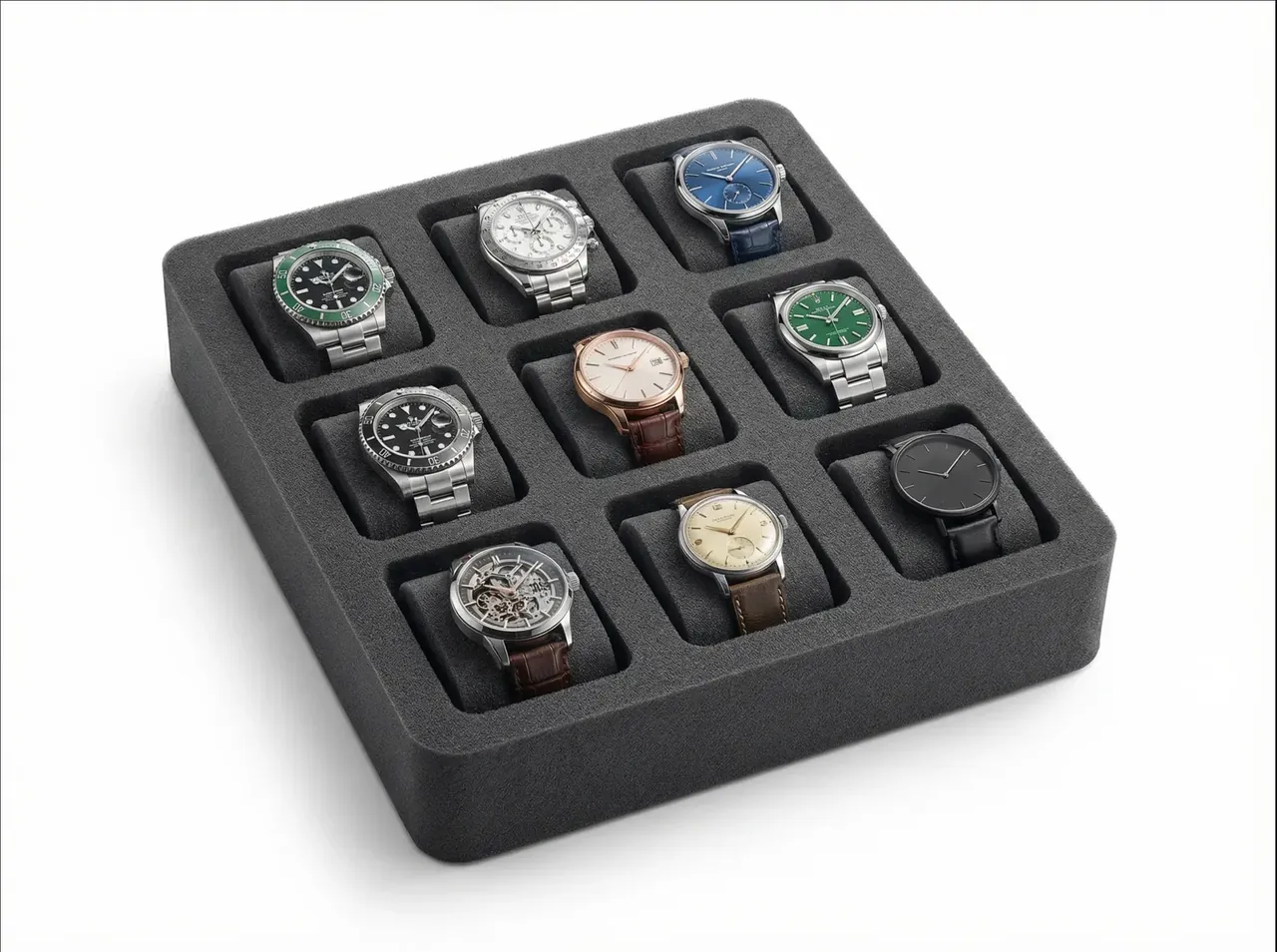
Watch pockets in a Lockable Anti-Theft Jewelry Display Case are lipped wells, lined with velvet, with a narrow slot at the bottom so the body hangs at the mouth and fingers lift from below. Jewellery wells are shallow trays with dividers, necklaces split by diameter, studs in paired holes.
Mixing both in one shell needs a step between depths. Without it the velvet cannot pull tight across the height change, wrinkles appear within a fortnight, and dust settles where no wipe reaches. Hold colour to ΔE 2.0 and cut both depths from one batch, or raking light draws a seam.
3. Powering and routing the LED strip
The strip exists to show fire in a stone, not to light the counter. In a Lockable Anti-Theft Jewelry Display Case it hides under the lining turn-down so light reaches the pieces at an angle and no diode shows. Exposed diodes turn the display into a lamp demo.
Power takes one of two routes: a 3×AAA holder or a USB 5 V feed. A holder sits in the lid sandwich and needs the lid open to change cells, which suits travelling shows. USB suits a fixed counter, with the lead leaving the back and unplugging at pack-down.
| Supply | Runtime and upkeep | Where it fits |
|---|---|---|
| 3×AAA holder | Cell swap, carried along | Travelling shows |
| USB 5 V feed | Counter power, lit all day | Mall counters |
| Dual feed | Either source, no gap | High-value cabinets |
Routing causes most faults here. Run the lead against the lid frame, through a grommet near the hinge, and sleeve the hole so a thousand openings do not wear the insulation. Keep a gap between strip and velvet; pressed close, the pile yellows with heat.
4. Combination lock versus viewing window
Lock and window pull against each other. A larger window shows more, yet every square cut from the lid removes stiffness, and latch load lands on the remaining frame. A Lockable Anti-Theft Jewelry Display Case keeps the window inside a third of the lid area, leaving solid margin so the panel does not flex under a thumb.
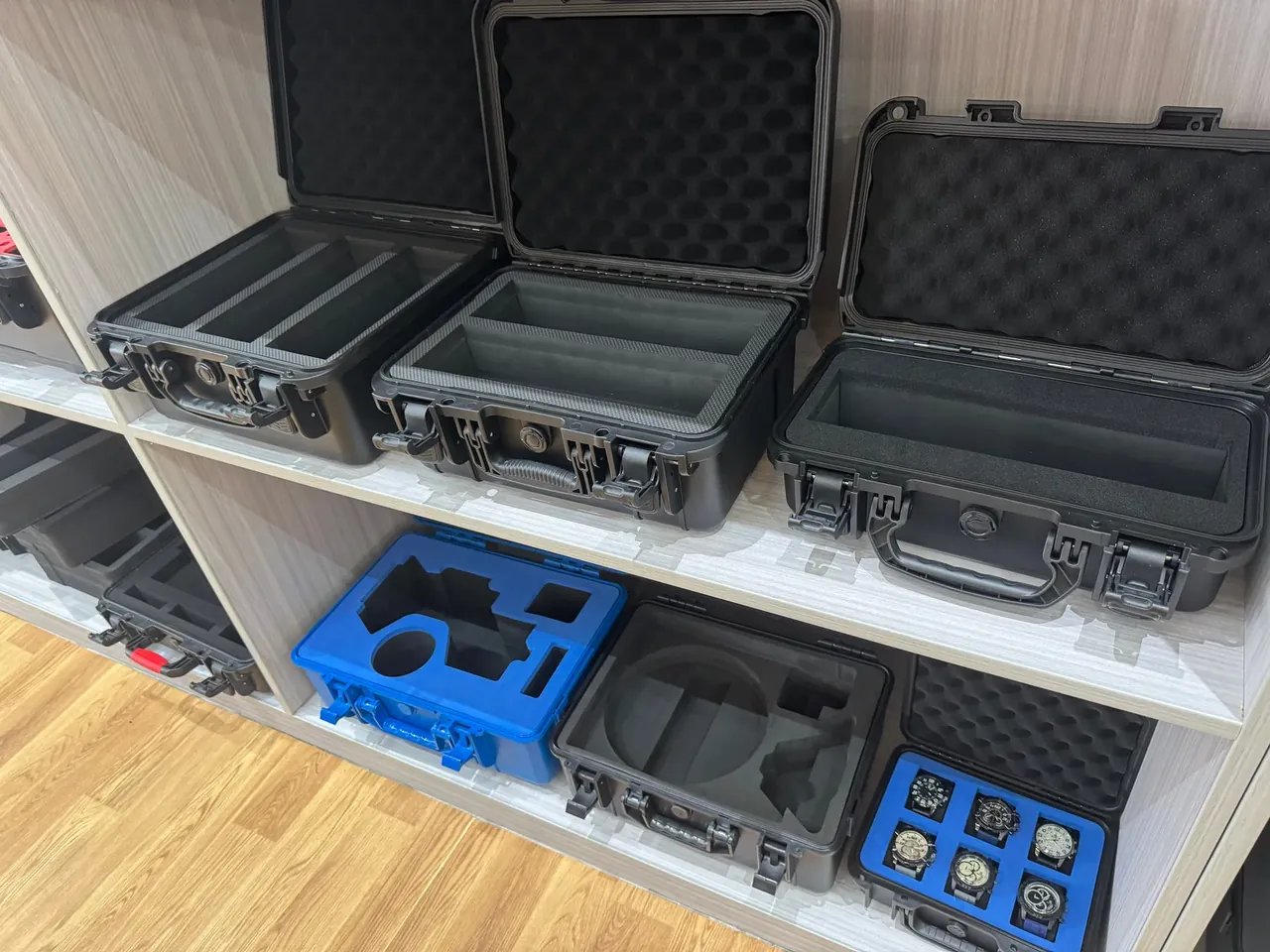
The window is 3 mm acrylic, chamfered and set into a rebate, with a trim frame over it. Bonded flat, the two materials move apart with temperature, the adhesive shears and the edge fogs. A rebated pane also swaps one scratched piece instead of a whole lid.
Three digits is enough for counter work; redundancy is the real question. The lock body needs a key override so a forgotten code does not scrap the case. In a Lockable Anti-Theft Jewelry Display Case the body sits at the front, the bolt enters a keeper in the lid, and a plate behind the keeper takes the prying load.
5. Opening rhythm at the counter
Staff open a Lockable Anti-Theft Jewelry Display Case dozens of times a day, and an awkward motion gets the unit disliked fast. The lid must hold an angle that lets a standing assistant see every cavity; a lid that will not stay up gets pinned with one hand while the other lifts goods, which is when watches drop.
Hinges on a Lockable Anti-Theft Jewelry Display Case carry a detent so the lid rests at working angles. Sequence matters: release the lock, raise the lid, then lift the loose insert layer. Reverse it and the insert rides up with the lid and drags pieces out.
Durability follows counter frequency. Forty openings a day across 300 days is five figures a year, and hinge pin and bolt loosen first. A metal hinge pin rather than plastic is the minimum here; plastic goes brittle in the cold and can snap on the first winter opening.
6. Securing the case at pack-down
Pack-down tests a case harder than set-up. Watches return to their pockets at close, the velvet carries a day of fingerprints, and wiping before stowing stops a film forming in the cavity floor. The lining of a Lockable Anti-Theft Jewelry Display Case lifts out as one sheet, so dust comes off outside the shell.
Transport security rests on two fits: lining to shell, and cavity to item. An edge standing 2 mm proud widens to the full side over a few hundred kilometres. A cavity slightly larger than the piece lets it shift, and the velvet polishes a bright patch that cannot be brushed back.
Cut the strip before a move and take cells out of the holder. Leakage does more damage than a dead strip: electrolyte runs down the routing hole into the velvet and the lining is scrap. Stow an empty case with the lid resting closed rather than latched, because a loaded bolt deforms and will not catch.
Conclusion
The order of choice is velvet, cavity depth, strip, window, lock body, then colour. The first three decide whether the counter stays clean and handling stays smooth, and no finish can repair them later.
Related Reading
- Laying out cavities in a jewelry display case
- How a jewelry transport case differs
- Running a flocking abrasion test
- Lock options for cases
JUNZHIJIA
Related Products
- 8 Series — Gun Cases; Military Equipment Cases; Camera Equipment Cases; Drone Cases; Watch Cases; Knife Cases; First Aid Cases; Electronics Equipment Cases
- WL8-2812 PP Gun Case — model WL8-2812
- All protective cases and toolboxes: 7 series, 158 models