

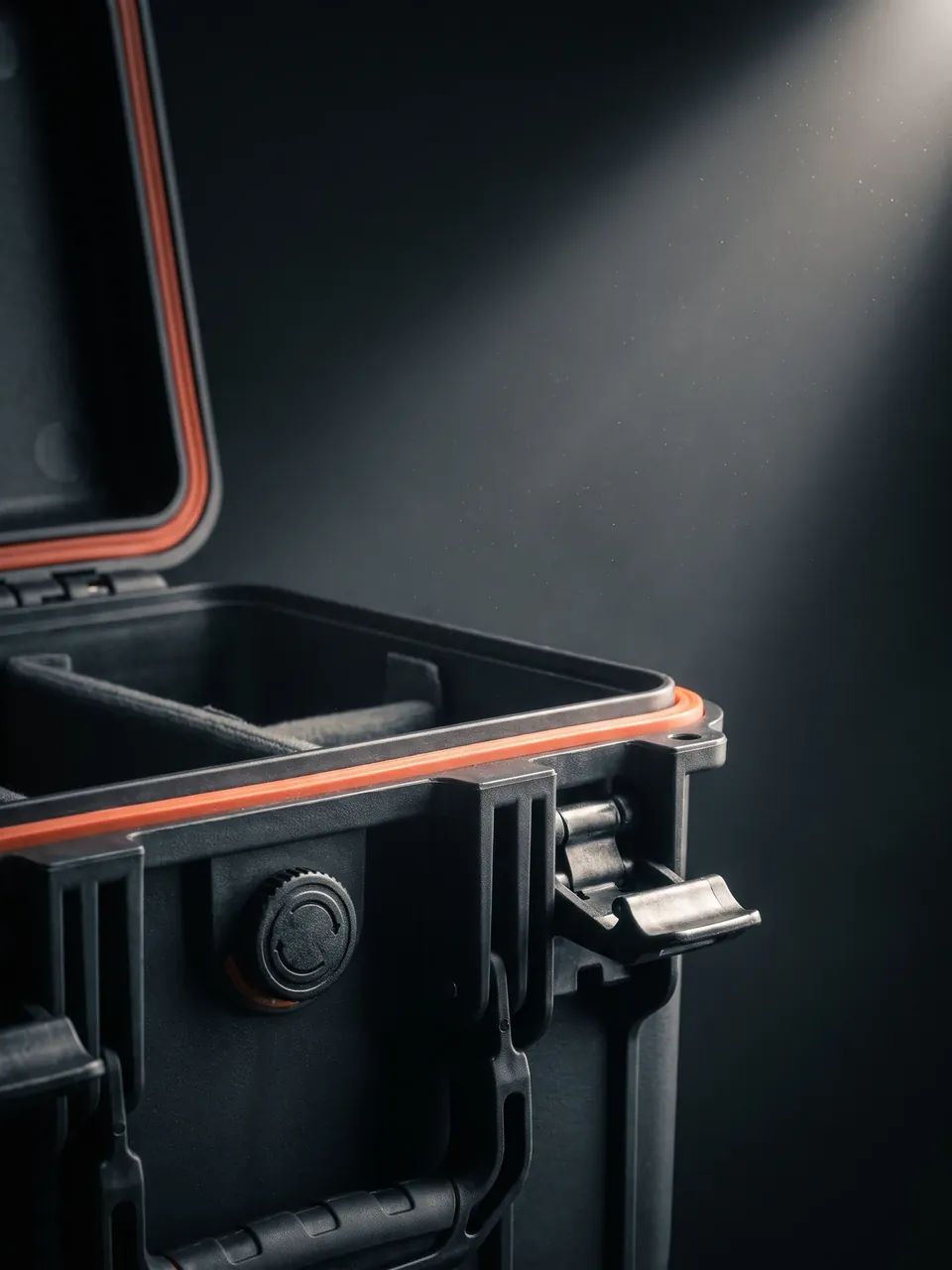
Quick answer: An Army field emergency rescue equipment box survives 100 L/(m²·h) rain for 30 min, with a 105 degree lid and 9 cells sized for gloved reach.
Table of contents
- One rim carries both rain and blind reach in an Army field emergency rescue equipment box
- What each of the two gasket loops blocks during 30 min of rain
- A 105 degree lid and 9 cells turn blind reach into cell dimensions
- The retest order for 2 mm or more compression after a 1.2 m drop
- Splitting 420 N handle loads and rim loads on a 29.2 kg unit
- FAQ
1. One rim carries both rain and blind reach in an Army field emergency rescue equipment box
Rain and blind reach share one lid rim on an Army field emergency rescue equipment box. The 700 by 480 by 340 mm outer size fixes rim length, and the 635 by 415 by 275 mm cavity minus the 4.6 mm wall leaves little room for 9 cells.
Fix positions first, and the rain rate, lid angle and cell count all gain a measurable reference.
| Field condition | Seal and reach | Acceptance value |
|---|---|---|
| Driving rain | Two gasket loops | 100 L/(m²·h) for 30 min, no seepage |
| Blind reach | Lid opens 105 degrees | 9 cells found in one motion |
| Drop | Rim compression | 2 mm or more |
| Lifting | Two handles | 420 N each |
Three field conditions of an Army field emergency rescue equipment box thus fold into one set of rim values.
2. What each of the two gasket loops blocks during 30 min of rain
Two loops are not one strip doubled: the outer stops the direct wash, the inner catches lid-wall creep, and a drainage channel leads water to the rim edge.
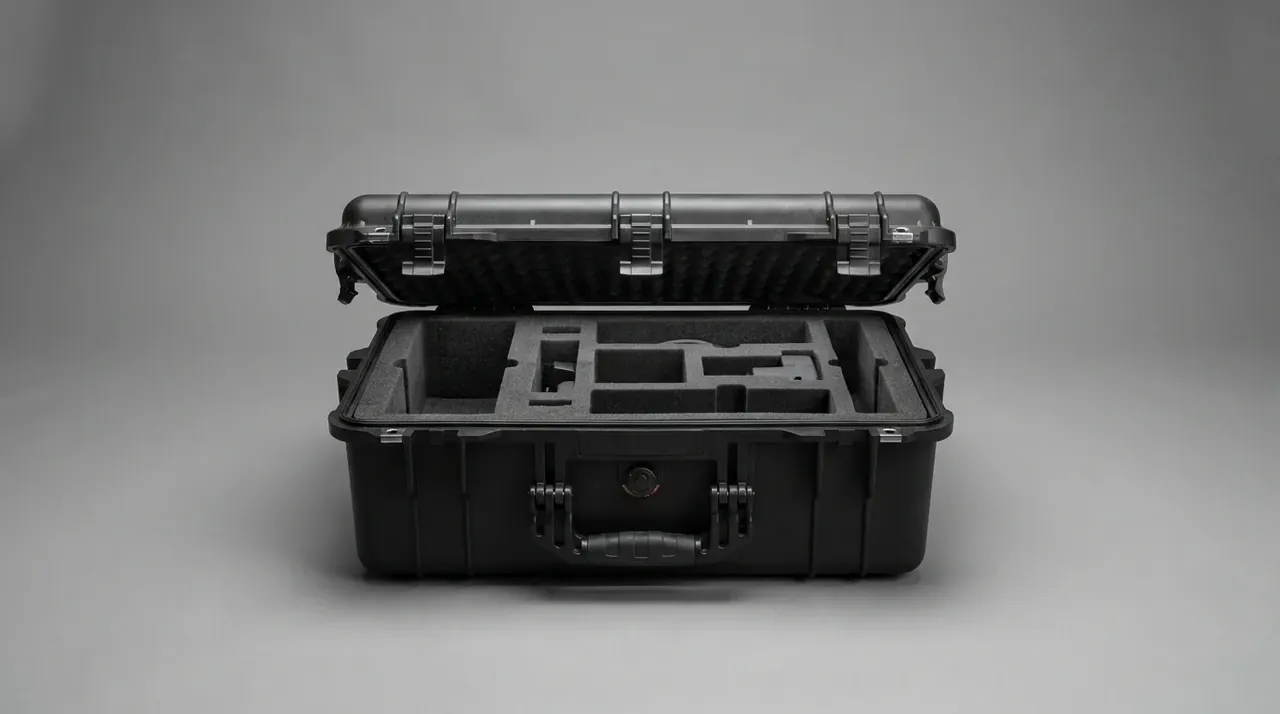
A 30 min rain run fixes the outer loop's compression. Water runs to the latch seats, so the strip must reach design height when closed. The inner loop clears the 105 degree hinge arc, or a turning hinge scrapes it from its groove. Outer uses a harder compound, inner a softer one. The 4.6 mm wall sets the groove depth: too shallow loses compression, too deep cracks the root under a 1.2 m drop. An Army field emergency rescue equipment box draws both sections on one sheet. Benchmarked to the IP67 method, each loop must still read 2 mm or more after the drop.
Outer takes the wash, inner takes the creep.
3. A 105 degree lid and 9 cells turn blind reach into cell dimensions
The 105 degree opening is hand clearance: a smaller angle hangs the lid over the cells, a larger one lets a 1.2 m drop throw it past the stop. An Army field emergency rescue equipment box moulds stop and hinge boss together.
| Seal and reach | Structural part | Value |
|---|---|---|
| Lid stop | Hinge boss | 105 degrees |
| Cell division | Moulded floor partition | 9 cells |
| Cell edge | Partition top | Rounded transition |
| Lid lining | Egg crate foam | Clear of cell boundaries |
The 9 cells run along the short side of the 635 by 415 by 275 mm cavity, with mouths sized for one-motion gloved location and rounded partition tops. An Army field emergency rescue equipment box leaves room near the latch and one common depth. Change the count and the rim and stop must be recalculated together.
4. The retest order for 2 mm or more compression after a 1.2 m drop
After a 1.2 m drop both loops must still hold 2 mm or more; one permanent set lets the next 100 L/(m²·h) rain seep through that loop.
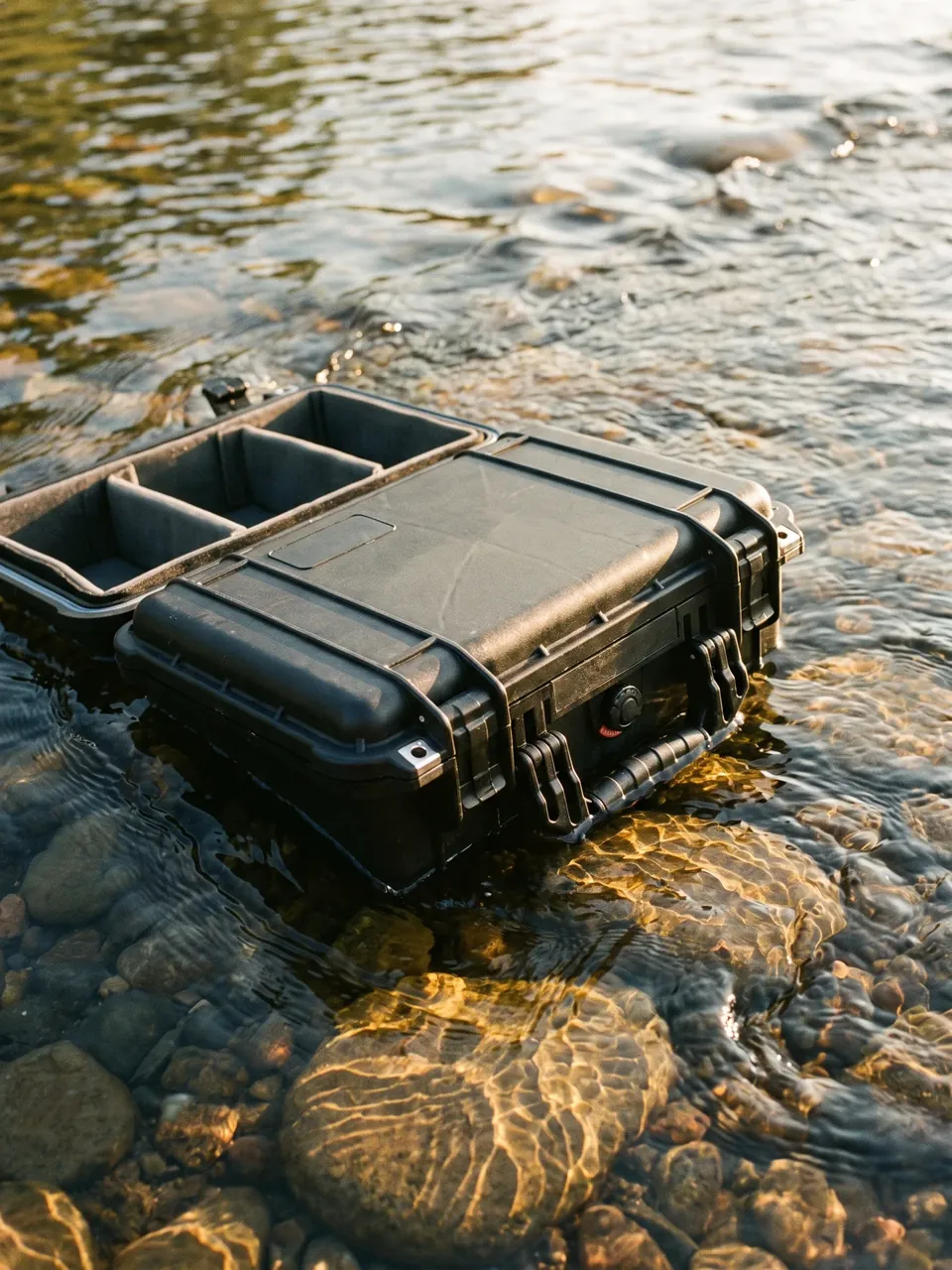
The order cannot reverse. Read starting compression closed, do the 1.2 m drop, check latches and rim, close and confirm 2 mm or more, then repeat the 100 L/(m²·h) rain for 30 min. Rain before the drop is wasted, since impact shifts a strip. An Army field emergency rescue equipment box writes this onto the retest card. The 29.2 kg drop energy is taken by the 4.6 mm wall and four corner guards; the empty 9.2 kg state is not the condition, and only the 20 kg load is used.
5. Splitting 420 N handle loads and rim loads on a 29.2 kg unit
An empty 9.2 kg shell plus 20 kg gives a 29.2 kg unit, with two 420 N handles either side of the centre of gravity. An Army field emergency rescue equipment box seats the bosses on wall ribs, clear of the groove.
| Acceptance value | Corresponding part | Retest condition |
|---|---|---|
| 2 mm or more | Compression of both loops | After a 1.2 m drop |
| 420 N | Single handle | 29.2 kg unit |
| 105 degrees | Lid stop | 9 cells in place |
| Minus 25 to 60 degrees Celsius | Both ends of working range | Gasket hardness rechecked |
Both ends of minus 25 to 60 degrees Celsius push hardness to its limits. An Army field emergency rescue equipment box puts the IP67 benchmark, the 1.2 m drop and both temperature ends in one table: one rim.
Conclusion
An Army field emergency rescue equipment box folds rain and blind reach onto one rim: two gasket loops hold 100 L/(m²·h) for 30 min, a 105 degree lid with 9 cells sets cell dimensions, and 2 mm or more of compression after a 1.2 m drop is the final verdict. The 700 by 480 by 340 mm outer size, the 29.2 kg unit and both ends of minus 25 to 60 degrees Celsius take their values from that rim. Set the gasket and lid angle first, then the cells and handles; JUNZHIJIA drawings on the case side follow this order.
Related Reading
- Emergency supply cases: long-term storage meets instant deployment
- Emergency equipment case configurations by setting
- Emergency command case: modular compartment design
- Emergency supply case: zoning, single-case weight, labels and rotation
Related Products
- 8 Series — Gun Cases; Military Equipment Cases; Camera Equipment Cases; Drone Cases; Watch Cases; Knife Cases; First Aid Cases; Electronics Equipment Cases
- WL8-2812 PP Gun Case — model WL8-2812
- All protective cases and toolboxes: 7 series, 158 models