

Quick answer: Army specialized foam-cut shockproof box pairs 38 mm base foam with 18 mm lid foam at 48 kg/m3 EVA, keeping transmitted acceleration under 3.5 g.
Table of contents
- Army specialized foam-cut shockproof box: milled slot depth layering
- Base pad density and compression set
- Transmitted acceleration across the sweep band
- Lid hold-down frame and slot-mouth clearance
- Slot recheck after cycle life
- FAQ
1. Army specialized foam-cut shockproof box: milled slot depth layering
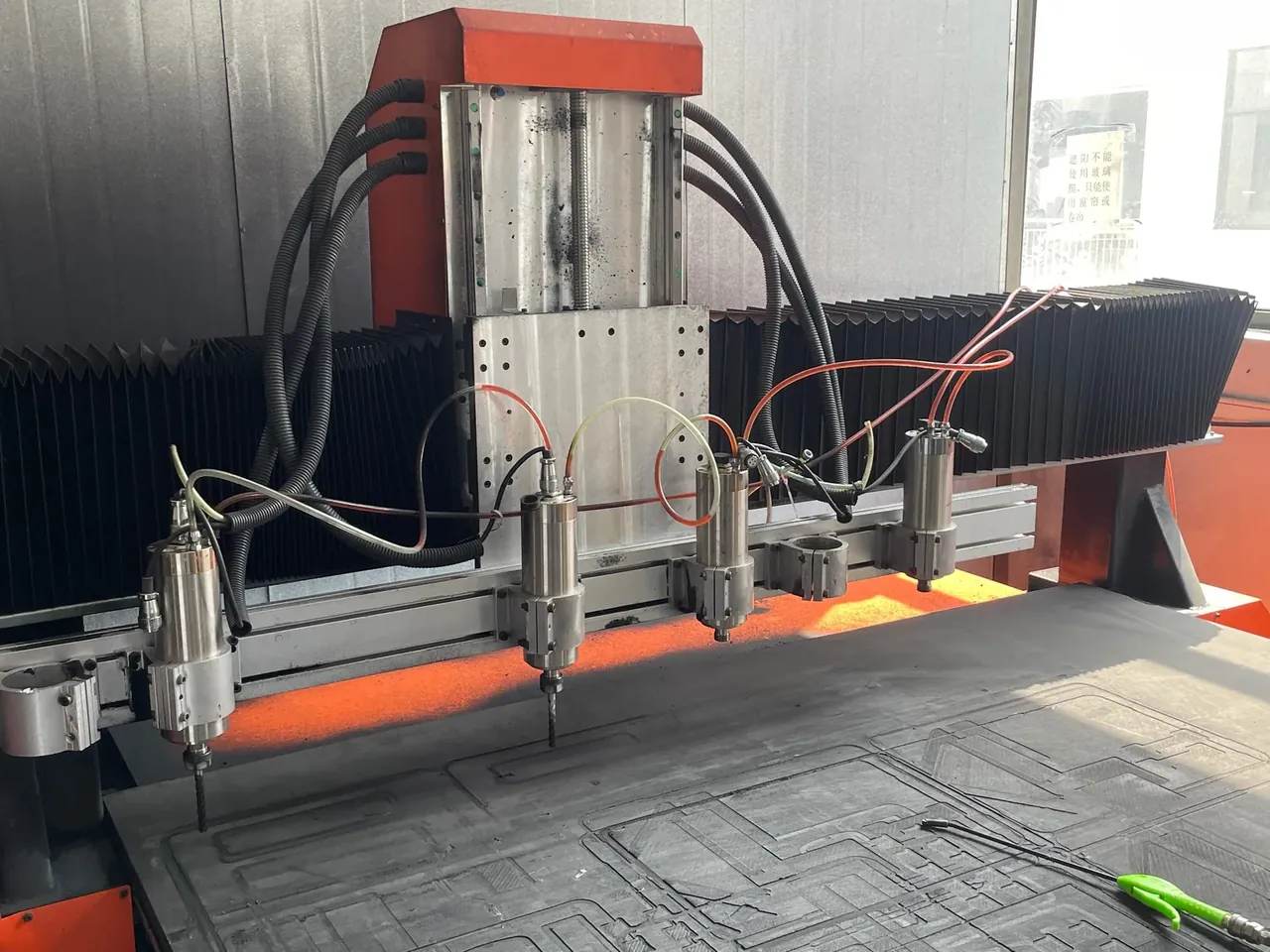
The Army specialized foam-cut shockproof box measures 590 × 420 × 260 mm outside, with a 525 × 355 × 195 mm cavity, a 4.0 mm wall, 6.1 kg empty and 12 kg loaded. A 38 mm base pad and 18 mm lid foam split the 195 mm height: the pad carries static load and drop inertia, the lid foam limits the upper rim. Slots are milled in two depth steps, with the ±0.6 mm tolerance held between them on one tooling sheet so floors stay level across batches.
Layering splits isolation into two readings. The 38 mm pad sits on the case floor for low-frequency travel; the 18 mm lid foam presses the rim to limit vertical rebound. The Army specialized foam-cut shockproof box writes ±0.6 mm into the milling card and re-checks each step with a depth gauge.
| Liner part | Spec | Role |
|---|---|---|
| base pad | 38 mm | static load, inertia |
| slot-wall rib | by step | side restraint |
| lid foam | 18 mm | rim frame |
| slot-floor | ±0.6 mm | prevent bottoming |
2. Base pad density and compression set
A compression set of ≤2.8% decides whether the base pad keeps supporting. EVA at 48 kg/m3 under a sustained 12 kg load that fails to recover its thickness makes the slot shallower, so the ±0.6 mm tolerance loses meaning. The Army specialized foam-cut shockproof box presses a sample to a set thickness at constant temperature, holds it, unloads and reads residual compression; above 2.8% the batch is rejected, with the shell wall as rigid backing.
Density and set share one sheet. The 48 kg/m3 figure sets the rebound baseline, ≤2.8% sets long-load retention; one governs transmitted acceleration in a sweep, the other whether slots stay true after 4000 open-close cycles. The Army specialized foam-cut shockproof box puts both on one liner card.
| Slot depth spec | Part | Check |
|---|---|---|
| deep step | base load zone | compression set ≤2.8% |
| shallow step | lid zone | ±0.6 mm tolerance |
| transition | rib separator | rebound rate |
| mouth step | rim frame | clearance recheck |
3. Transmitted acceleration across the sweep band
A transmitted acceleration of ≤3.5 g is the acceptance line. The sweep runs from 5 Hz to 200 Hz at 12 kg and measures the ratio of case-table input to liner response, not foam hardness. Across this band the Army specialized foam-cut shockproof box uses the 38 mm pad for low-frequency travel and ±0.6 mm to pin the resonance point, while 48 kg/m3 shapes the ratio curve.
Readings are logged band by band. Sweep once at 6.1 kg empty and once at 12 kg loaded to confirm the loaded state governs. Then climb from 5 Hz to 200 Hz in octave steps, recording input and response acceleration at each step. If it sits near the base pad's natural frequency, retune the density step of the 38 mm pad. Merge every 5–200 Hz step into one table and log any step above 3.5 g as an exception. That closes the measurement loop.
4. Lid hold-down frame and slot-mouth clearance
The 18 mm lid foam is not laid across the whole lid; the frame is a continuous perimeter with an open centre, pressing on rib tops rather than above slot mouths. The Army specialized foam-cut shockproof box back-calculates clearance from slot depth and frame thickness: too little lets the frame hit the slot-wall rim and eats ±0.6 mm, too much lets the liner ride up in a 1.2 m drop and inflates the transmitted acceleration read.
Clearance follows one line: the margin left after the 18 mm lid foam is compressed.
The closed state is rechecked too. After 4000 open-close cycles, re-read frame flatness and clearance; only if the lid frame has not sunk is the 5–200 Hz transmitted acceleration still judged against ≤3.5 g. Dust and spray referenced to IP66 stay as box-side environmental records, not a certification conclusion.
| Acceleration reading | Band | Verdict |
|---|---|---|
| 2.1 g | 5–20 Hz | pass |
| 3.0 g | 20–80 Hz | pass |
| 3.4 g | 80–200 Hz | pass |
| 3.8 g | 80–200 Hz | recheck |
5. Slot recheck after cycle life
4000 open-close cycles triggers a slot recheck. The Army specialized foam-cut shockproof box counts each cycle as one rise and fall of the frame, with foam pressed at the slot mouth, and ≤2.8% compression set holds that drift in check. Stop the rig at 4000 cycles, measure the 38 mm pad's residual thickness first, then check slot by slot whether ±0.6 mm has been over-pressed, and compare the 18 mm lid foam's press marks to the baseline; all three must stay in band.
A 1.2 m drop and cycle life are two independent rechecks. The Army specialized foam-cut shockproof box folds both into one delivery sheet, with 590 × 420 × 260 mm outside, 525 × 355 × 195 mm cavity, 4.0 mm wall, 6.1 kg empty and 12 kg loaded as fixed box-side items in the header, and the 5–200 Hz sweep with ≤3.5 g in the footer. JUNZHIJIA delivers this shockproof box with structure and inspection items only, never with handling items for goods inside.
Conclusion
The Army specialized foam-cut shockproof box builds a layered liner from a 38 mm pad, 18 mm lid foam and 48 kg/m3 density, using ±0.6 mm to pin the resonance point so transmitted acceleration at 12 kg across 5–200 Hz lands within ≤3.5 g and compression set within ≤2.8%. The 590 × 420 × 260 mm envelope, 4.0 mm wall, 1.2 m drop and 4000 cycles shape the isolation reading together. JUNZHIJIA delivers against box-side structure and inspection items only.
Related Reading
- Foam cutting methods compared: precision, batch size and minimum order
- Die-cutting, CNC and hot-wire foam cutting processes
- Pre-cut foam insert slots and clearance
- Custom foam insert density and slot layout factors
Related Products
- 8 Series — Gun Cases; Military Equipment Cases; Camera Equipment Cases; Drone Cases; Watch Cases; Knife Cases; First Aid Cases; Electronics Equipment Cases
- WL8-2812 PP Gun Case — model WL8-2812
- All protective cases and toolboxes: 7 series, 158 models