

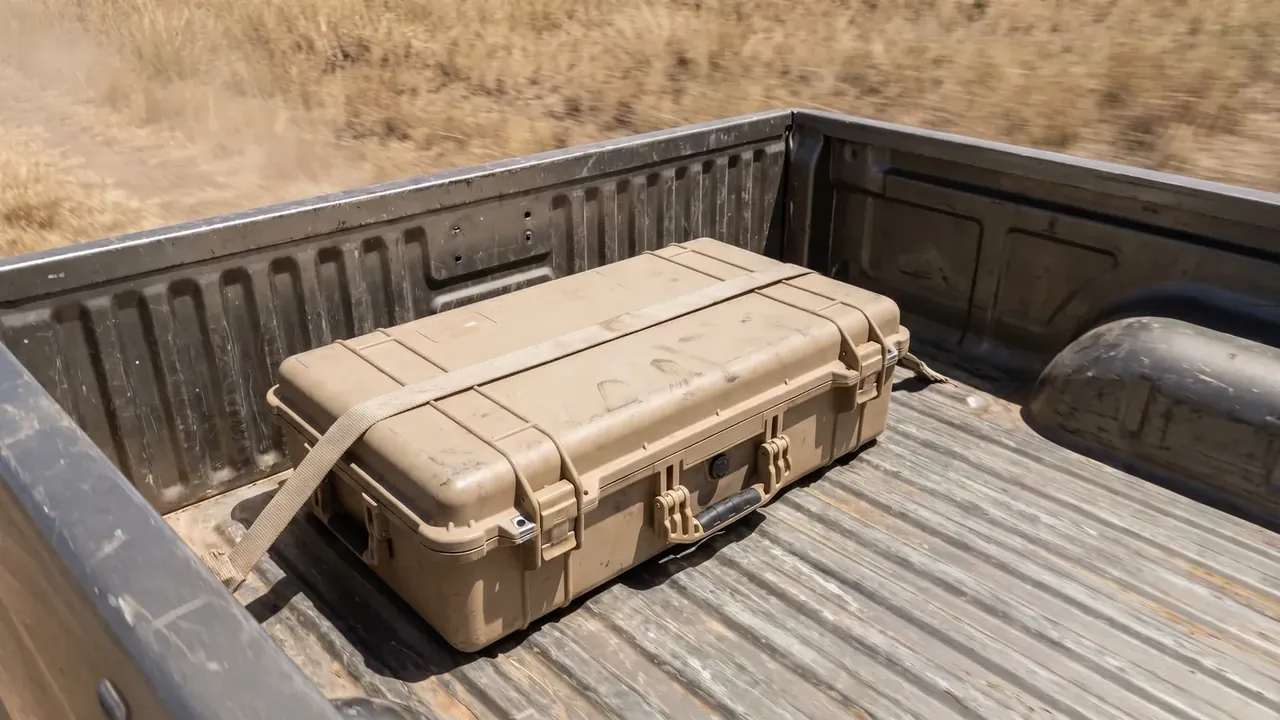
Quick answer: Five points decide how an artillery shell storage container behaves: the moulding process caps wall thickness, ribs turn that wall into a stiff shell, the seal and relief valve control moisture, the latch and hinge set service life, and the internal grid carries the shells upright.
Table of contents
- Five Structural Points in an Artillery Shell Storage Container
- Moulding: Rotational or Injection
- Wall Thickness and Ribs
- Sealing and Pressure Relief
- Latches, Hinges and Internal Dividers
- FAQ
1. Five Structural Points in an Artillery Shell Storage Container
Start with structure, not price. An artillery shell storage container is judged on five items that pull against each other: process, wall and ribs, seal and relief, latch and hinge, internal grid. The process fixes the wall, which fixes rib pitch and whether the gasket groove can run flat.
| Item | Target | If it is skimped |
|---|---|---|
| Process | Rotational, 6 mm wall | Injection caps near 4.5 mm |
| Wall | 6.0 mm, ±0.5 mm | Soft at 5.5 mm |
| Ribs | 5 × 12 mm at 180 mm | Sink marks, cracked roots |
| Seal | 9.5 mm cord, 25–30% | Leaks at corners |
| Latch | 320 N retention | Pops open in a drop |
The first three are frozen when the mould is cut.
2. Moulding: Rotational or Injection
Rotational moulding charges powder into a tool, spins it on two axes at 340 degrees Celsius for 22 minutes and fuses it layer by layer; wall thickness comes from the charge, ±0.5 mm at 6.0 mm. Injection fills a cavity in one shot, and on a 1,600 tonne machine the limit here is about 4.5 mm.
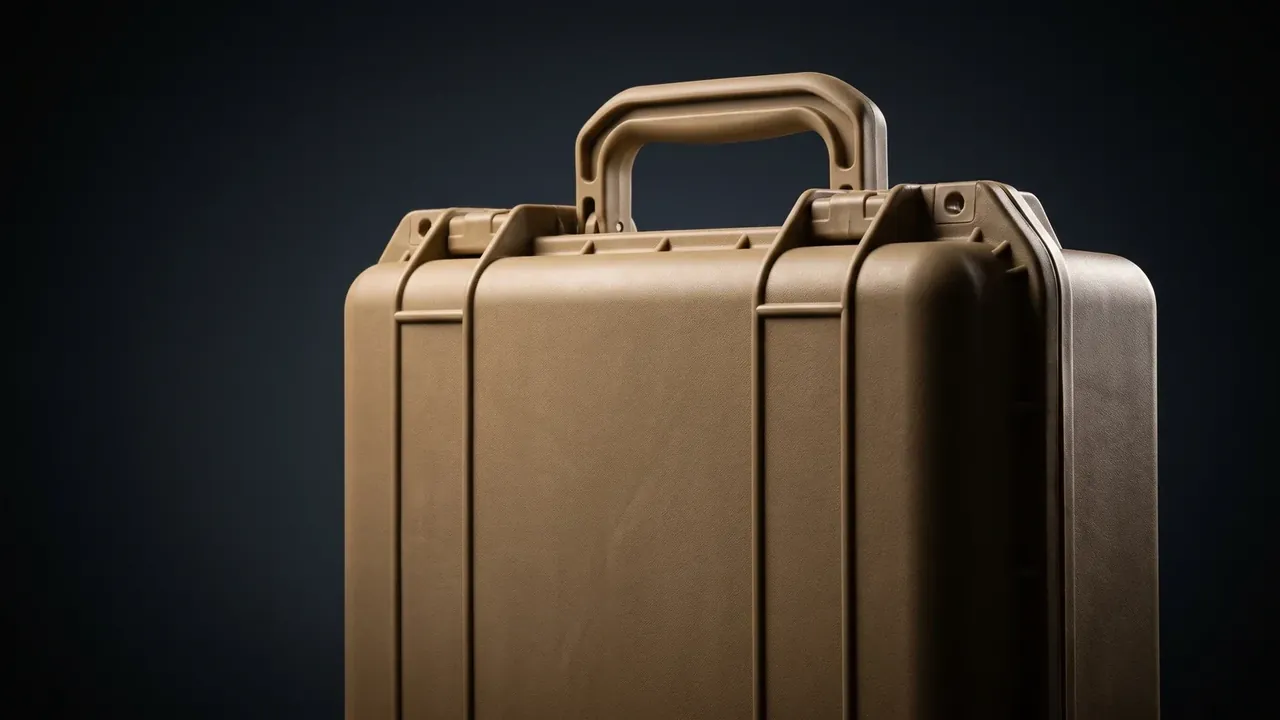
That gap decides the structure. Thick walls, keepers moulded in, small batches — rotational, on a welded aluminium tool at about 68,000 CNY. One size at a hundred thousand units — injection, at roughly 150,000 CNY.
3. Wall Thickness and Ribs
A 6 mm wall does not carry load by thickness alone; ribs cut the panel into small fields. Pull rib pitch from 240 mm to 180 mm and deflection falls sharply. Ribs run 5 mm thick and 12 mm high, and the tool needs 1.5 degrees of draft.
Two rules matter: close the rib loop, since an open end is a stress riser, and radius the root at R3. Line the four side ribs up with the latch and hinge bosses.
Thickness is read at four points around the mid-wall and judged on the lowest. Under 6.0 mm, a stack two high bulges the side and pulls the gasket out of contact.
4. Sealing and Pressure Relief
Sealing on an artillery shell storage container is about compression, not cord diameter. A double-lip EPDM cord at 55 Shore A, 9.5 mm across, sits in an 8 mm groove so closure lands at 25 to 30 per cent compression. Under 25 it never seats; over 30 it takes a set.
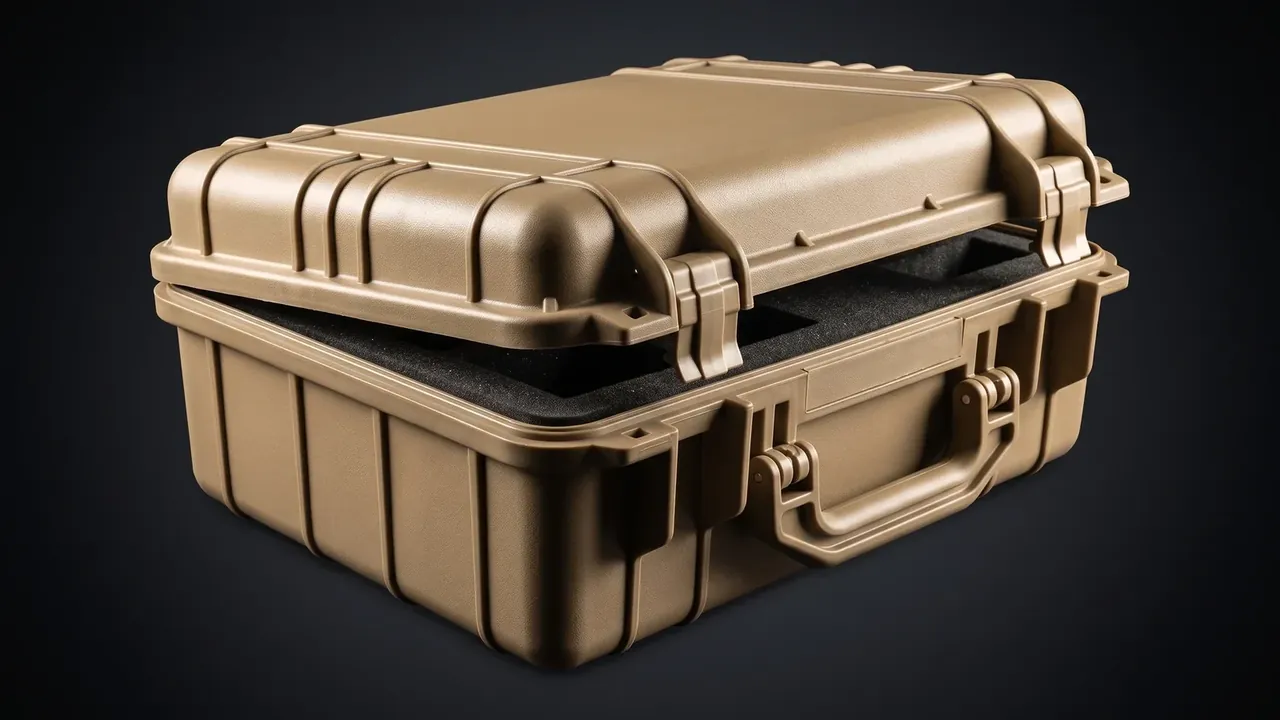
The relief valve is the other half. A 45 degree day and a 10 degree night leave the inside at lower pressure, and the atmosphere holds the lid shut. A valve at 0.35 bar flowing 12 L/min equalises first.
Keep the groove floor continuous at the corners, with no parting line across it. Leak test by pressure hold: 0.2 bar in, three minutes, 5 per cent decay at most.
5. Latches, Hinges and Internal Dividers
A latch presses the lid onto the gasket and must stay shut in a drop. At 320 N each, two give 640 N, enough for stable compression on a 6 mm lid; an over-centre design passes a dead point before releasing.
Hinges take the other half: a 304 pin of 6 mm in a boss thickened to 8 mm holds bore clearance under 0.3 mm after 5,000 cycles. A bore in a thin wall elongates after a few drops.
| Part | Value | Check |
|---|---|---|
| Latch | 320 N retention | Peak on a tensile gauge |
| Hinge | 6 mm pin, 5,000 cycles | Bore clearance |
| Base pad | 20 mm EPE | No dent after a drop |
The grid decides how shells stand. Holes at 165 mm pitch, 3 to 5 mm over shell diameter, leave 1.5 to 2.5 mm clearance. A 20 mm EPE pad underneath absorbs the drop before the grid sees the peak; each cell is rated at 45 kg.
Conclusion
The structure of an artillery shell storage container is not mysterious: five points, each tied to a measurable number. Process sets the wall, ribs set stiffness, seal and relief set airtightness, latch and hinge set life, the grid sets support. Write the five into the drawing and an artillery shell storage container behaves as promised.
This article discusses only the container (case body) side of specifications and design intent, and does not cover any handling, loading or use of the contents.
Related Reading
- Load path and base design
- Sizing an artillery shell box
- How rotational moulding works
- Mould maintenance and repair cycles
Related Products
- 8 Series — Gun Cases; Military Equipment Cases; Camera Equipment Cases; Drone Cases; Watch Cases; Knife Cases; First Aid Cases; Electronics Equipment Cases
- WL8-2812 PP Gun Case — model WL8-2812
- All protective cases and toolboxes: 7 series, 158 models