

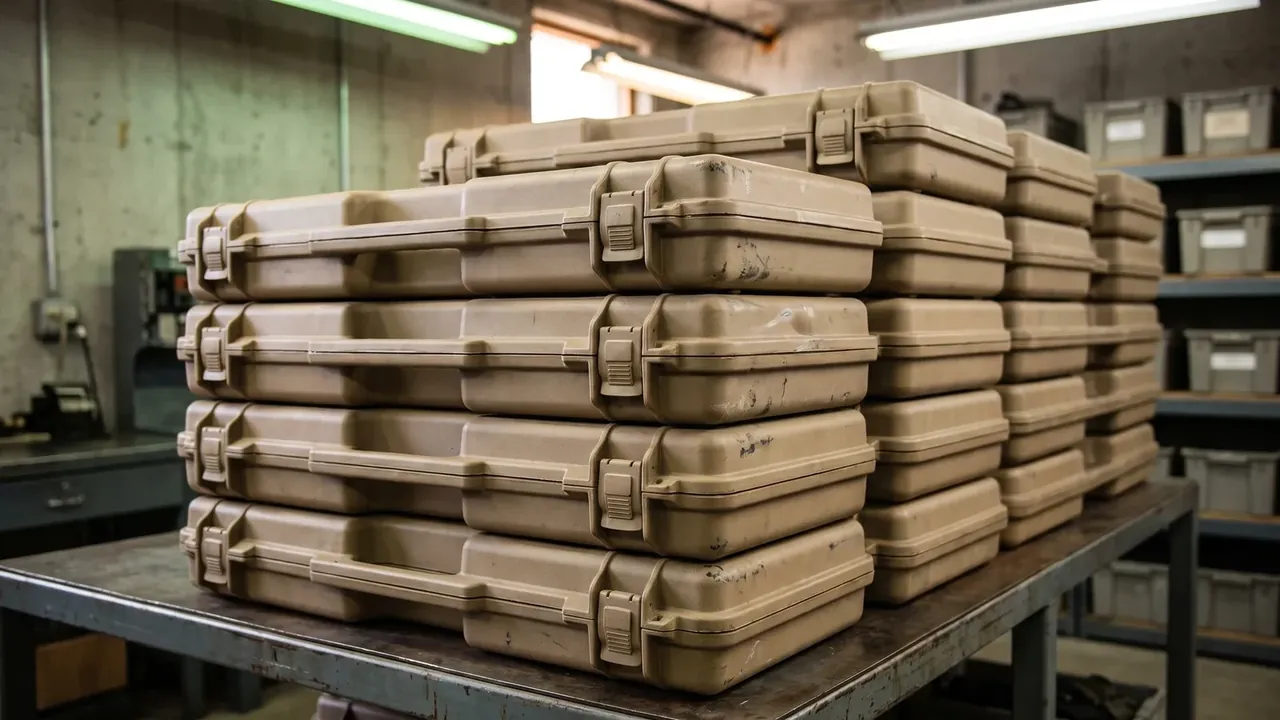
Quick answer: Run five criteria in order: shell fit, interior support, sealing with relief, stacking and handling, marking. If the first fails, no Artillery Shell Storage Container specification saves the design.
Table of contents
- The First Criterion Is Shell Fit
- Criterion Two: How the Interior Supports the Shell
- Criterion Three: Sealing and Pressure Relief as a Pair
- Criterion Four: Stacking and Handling Interfaces
- Criterion Five: The Minimum Marking Set
- FAQ
1. The First Criterion Is Shell Fit
Choose an Artillery Shell Storage Container by running five criteria in order: shell fit, interior support, sealing with relief, stacking and handling, marking. The first has veto power: no wall thickness rescues a cavity that cannot take the shell.
| Criterion | Question | Parameter | Common mistake |
|---|---|---|---|
| Shell fit | Which shell, how many | Cavity length, width, depth | Outer size, not cavity |
| Interior support | What locates, cushions | Support type, foam density | One insert for all |
| Sealing and relief | Water and pressure | Gasket squeeze, crack point | Seal only, no relief |
| Stacking and handling | How high, who lifts | Lid load, forklift openings | Empty weight as loaded |
| Marking | What, when, who | Label recess, code content | Label on a curve |
Start with three dimensions: body diameter, overall length with the fuze, and any fin or driving band that stands proud. Two shells of one calibre can differ by 300 mm, so one cavity cannot serve both; mixed loading needs a diameter gap under 8 mm.
Payload follows the lift: two people under 50 kg, one near 25 kg. At 45 kg per shell, two shells reach the limit; heavier loads need forklift pockets, settled before the Artillery Shell Storage Container brief is frozen.
2. Criterion Two: How the Interior Supports the Shell
Support locates the shell and absorbs the road. Locate without cushioning and shock reaches the wall; cushion without locating and the shell migrates in the cavity.
| Support type | Location | Access | Shell change | Best for |
|---|---|---|---|---|
| Moulded foam | High, follows shell | Slow | Poor, new tool | One shell |
| Carved EVA | High, controlled | Medium | Good, new insert | Mixed types |
| Dividers plus foam | Medium, cell by cell | Fast | Fair, new dividers | Fast access |
| Timber battens | Low, batten stops | Fast | Good, on site | Short runs |
Keep the figures measurable: EVA near 45 kg per cubic metre, compression set under 5% after 24 hours at 70 °C, 1.5 mm clearance per side, 30 to 60 N of extraction force.
Rib pitch above 120 mm lets foam sag, so the shell rests on two ribs. On an Artillery Shell Storage Container that question beats any wall thickness claim.
3. Criterion Three: Sealing and Pressure Relief as a Pair
Sealing and relief only work together. A case sealed but not vented sees roughly 8 kPa after a 40 °C swing, opens with two people pulling, and leaves the gasket distorted.
Hold gasket compression between 25% and 30%: below that the corners leak first, far above it the cord loses rebound fast. Make the groove 0.3 mm narrower than the cord.
Crack the relief valve between 6 and 10 kPa. Verify with a pressure hold at 3 kPa for 60 seconds, accept a 5% drop, and check that the seal on an Artillery Shell Storage Container opens at 8 kPa and closes as pressure falls.
4. Criterion Four: Stacking and Handling Interfaces
One load rating blurs two questions: what the lid carries, and where a forklift takes hold.
A 60 kg loaded case stacked four high leaves the bottom unit carrying 180 kg plus its own 60 kg, so 240 kg. At a safety factor of two, the static test runs at 480 kg for 24 hours, with residual deformation under 2 mm.
Handles on an Artillery Shell Storage Container take twice the loaded weight. Forklift openings of at least 90 mm by 200 mm need metal liners, and a 100 mm base clearance keeps ground moisture off the floor.
5. Criterion Five: The Minimum Marking Set
Marking lets the next custodian answer what is inside, when it was packed and who handled it: one label recess, one in-mould code, one card.
The recess runs 120 by 80 mm at 0.8 mm deep, so a stacked case cannot rub the label off. Specify UV print or lamination rated to 480 hours of salt spray and -40 to 70 °C.
The 12-digit code holds 2 digits of mould, 4 of year and month, 1 of shift, 5 of serial. With the mould inside the code, a fault returns to one tool, and the Artillery Shell Storage Container stays traceable.
Conclusion
Shell fit sets the cavity, the cavity the insert; insert and gasket decide whether the case stores for years, stacking and marking whether anyone finds it again. Put the five criteria into the enquiry in order, and the Artillery Shell Storage Container stops being a guess.
This article discusses only the container (case body) side of specifications and design intent, and does not cover any handling, loading or use of the contents.
Related Reading
- artillery-shell-storage-container-applications
- Load-bearing structure of the case body
- artillery-shell-storage-container-explained
- Another route to shell box selection
Related Products
- 8 Series — Gun Cases; Military Equipment Cases; Camera Equipment Cases; Drone Cases; Watch Cases; Knife Cases; First Aid Cases; Electronics Equipment Cases
- WL8-2812 PP Gun Case — model WL8-2812
- All protective cases and toolboxes: 7 series, 158 models