

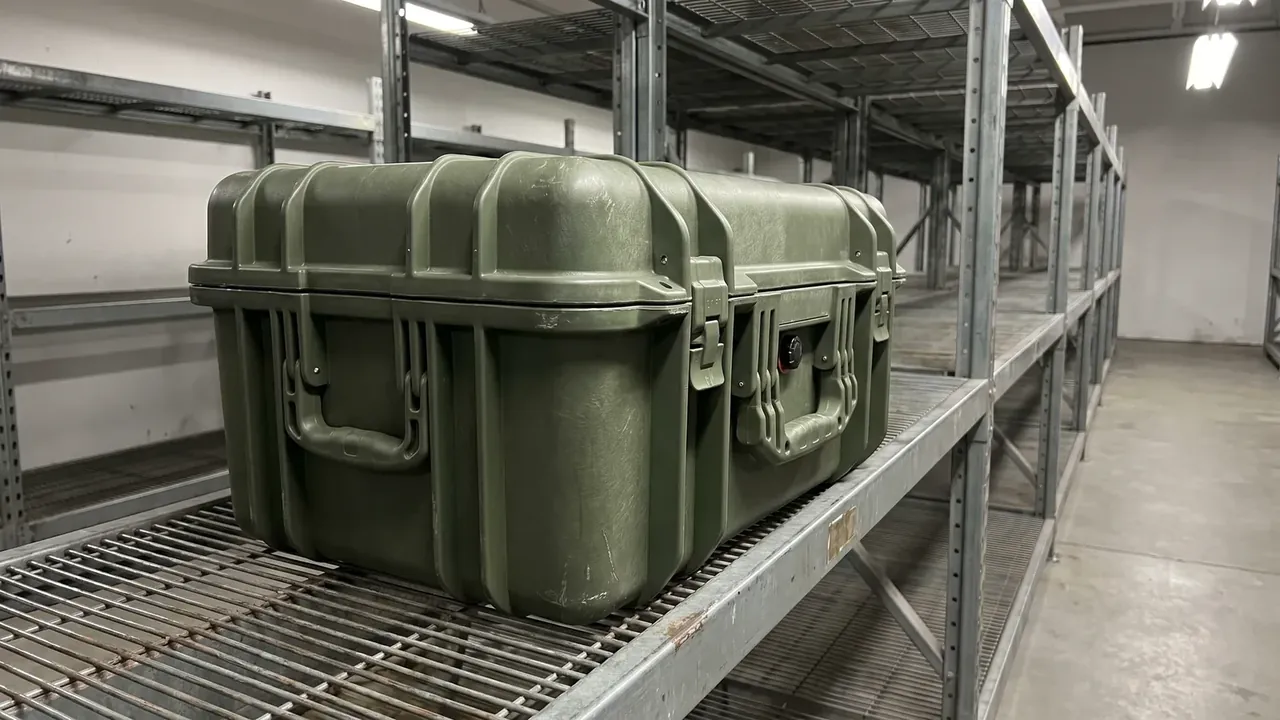
Quick answer: An audio recordist professional equipment case is defined by four numbers: a shell wall around 4 mm, a clamp force of 150 to 250 N per latch, a 55 mm foam stack, and a loaded weight held under 18 kg. Those four decide whether the lid still seats after a 1.2 m drop and six hours on a tour truck.
Table of contents
- Which Forces the Case Has to Absorb
- Latch Count and Clamp Force
- Foam Layers: Thickness and Density
- Gasket, Vent Valve and Humidity
- Handles, Wheels and the Weight Budget
- Incoming Check and Batch Consistency
- FAQ
1. Which Forces the Case Has to Absorb
A shoot wraps at dusk, the case comes off a 1.2 m tailgate faster than the grip expects, and the shell sees an inertial load close to eight times its own mass. Strapped at the back of a tour truck, it then rides 5 to 500 Hz of random vibration for six hours. In the warehouse it sits at the bottom of a four-high stack, with roughly 300 kg pressing on the lid.
Those four loads pull the design in different directions. Drop resistance wants a wall that flexes and recovers; vibration wants latches that stay clamped and a liner that does not creep; stacking wants bending stiffness across the lid; damp heat wants a gasket that does not harden. Reading them one at a time is the only way to tell a realistic spec sheet from a decorative one.
| Load case | Order of magnitude | Shell-side response |
|---|---|---|
| Single drop | 1.2 m, peak around 300 g | 4 mm wall, R8 corner, ribbed base |
| Random vibration | 5 to 500 Hz for 6 h | preloaded latches, 2 mm foam interference |
| Stack load | 300 kg on top, 30 days | 6 mm lid crown, 1° side draft |
| Damp heat | -25℃ to 55℃ at 85% RH | 55A gasket, 0.35 bar vent |
2. Latch Count and Clamp Force
Latch count follows case length. Up to 600 mm gets two, 800 mm gets three, 1200 mm and above gets four. Keep the centres within 420 mm of each other; past that the middle of the lid lifts about 0.4 mm off the gasket and the seal is gone.
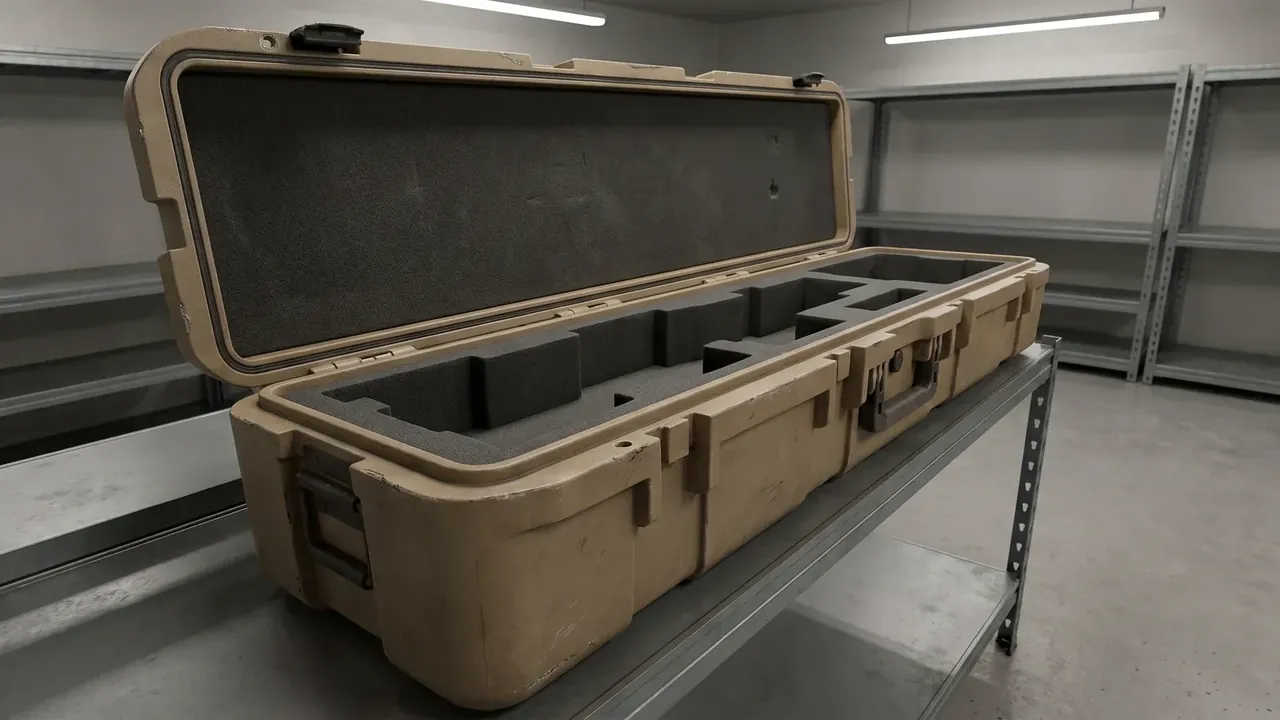
Per-latch clamp force sits comfortably between 150 and 250 N. Below 150 N the latch walks open within two hours of road time. Above 250 N a gloved hand cannot work it, and someone reaches for a flat screwdriver, which cracks the keeper before it releases. The number worth measuring on the bench is opening effort, 60 to 90 N at the peak of the flip, not the static hold.
Gasket compression needs a target too. An 8 mm cord closed to 5.5 or 6 mm gives 25% to 30% compression. Less than that leaks; much more and the cord takes a permanent set within six months and returns at only 60% of its original height. During trial assembly, feeler-gauge the four side midpoints and keep the readings within 0.2 mm of each other.
3. Foam Layers: Thickness and Density
Three layers are the least fussy arrangement. A 15 mm convoluted pad in the lid presses on the faceplate; a 30 mm EVA mid layer is cut to the outline with 1.5 mm interference against the shell; a 10 mm soft pad underneath takes the residual high-frequency energy. That totals 55 mm and fills a 130 mm internal height, which is the most common cavity depth for this kind of case.
| Layer | Material and density | Reference thickness |
|---|---|---|
| Lid | convoluted foam, 25 kg/m³ | 15 mm |
| Mid | EVA, 45 kg/m³ | 30 mm |
| Base | soft foam, 20 kg/m³ | 10 mm |
Higher density is not automatically better. EVA at 45 kg/m³ stiffens by roughly 20% at -10℃ and loses stroke exactly when the foam is needed; dropping to 30 kg/m³ cuts transmitted peak acceleration by about 15% in the same drop, at the cost of cavity walls that round over after 200 load cycles. A finger scallop is the cheap fix: a 25 mm half-round notch in the long edge lets a hand pinch the body and lift, and it saves three process steps compared with sewing in a nylon pull tab.
4. Gasket, Vent Valve and Humidity
Sealing is one rubber cord plus one step. A 55A cord sits in a groove 3 mm deep and 6 mm wide, stands 5 mm proud when fitted, and flattens to the right thickness when the lid closes. If the case will be opened outdoors in rain, this groove tolerance matters more than the cord compound.
Pressure difference is the part people forget. Seal the case at sea level, drive to a site at 2000 m, and about 0.2 bar pushes the lid up until the latches feel tight. Carry it back down and the inside goes negative, the gasket is drawn into its groove, and the lid opens with a dull pop. A vent rated to crack between 0.3 and 0.4 bar releases that differential before anyone touches a latch.
Humidity can be budgeted. Put 20 g of desiccant inside, close the case, leave it at 85% RH for 72 hours, and the interior settles below 40%. Keep the sachet in a mesh pocket in the lid rather than under the equipment, or it will be crushed within a few load cycles. Replace the gasket every 12 months, and wipe the groove while the old cord is out; that wipe matters more than the new part.
5. Handles, Wheels and the Weight Budget
Eighteen kilograms loaded is the dividing line. Below it, one hand and 200 m of walking is tolerable. Above it, someone drags the case, and the root of the handle jumps from 180 N to over 400 N. Fit a 3 mm doubler at each handle root, use M5 self-tapping screws into brass inserts at 1.2 N·m, and the joint survives 30 teardown cycles without stripping.
Wheels should be at least 60 mm in diameter and 25 mm wide so a door sill spreads its shock into the axle instead of the shell corner. A three-stage trolley handle reaching 1050 mm is enough for a tall user, and it should retract to within 5 mm of the lid plane so stacking does not bend it. Keep the four feet within 0.5 mm of each other in height, otherwise the case rocks on a mixing desk.
6. Incoming Check and Batch Consistency
Three measurements at goods-in cover most of the risk. Feeler-gauge the lid gap at the four side midpoints and accept anything under 0.3 mm. Pull five latches on a force gauge and expect 60 to 90 N. Compare shell colour against a card and hold ΔE at 1.5 or below. If any of the three drifts, park the whole batch before the line.
Batch consistency lives in the retention sample. Keep three units from each run, compare gasket hardness and shell colour against new stock six months later, and investigate any hardness shift beyond 5 Shore A. Store the samples with the shell and hardware only, tagged with the run number on the base, away from shipping stock.
Related Reading
- How foam lining bonds to a case shell
- Internal height against foam thickness
- Depth and centre of gravity when carrying
- Documents for an air freight declaration
Related Products
- 8 Series — Gun Cases; Military Equipment Cases; Camera Equipment Cases; Drone Cases; Watch Cases; Knife Cases; First Aid Cases; Electronics Equipment Cases
- WL8-2812 PP Gun Case — model WL8-2812
- All protective cases and toolboxes: 7 series, 158 models