

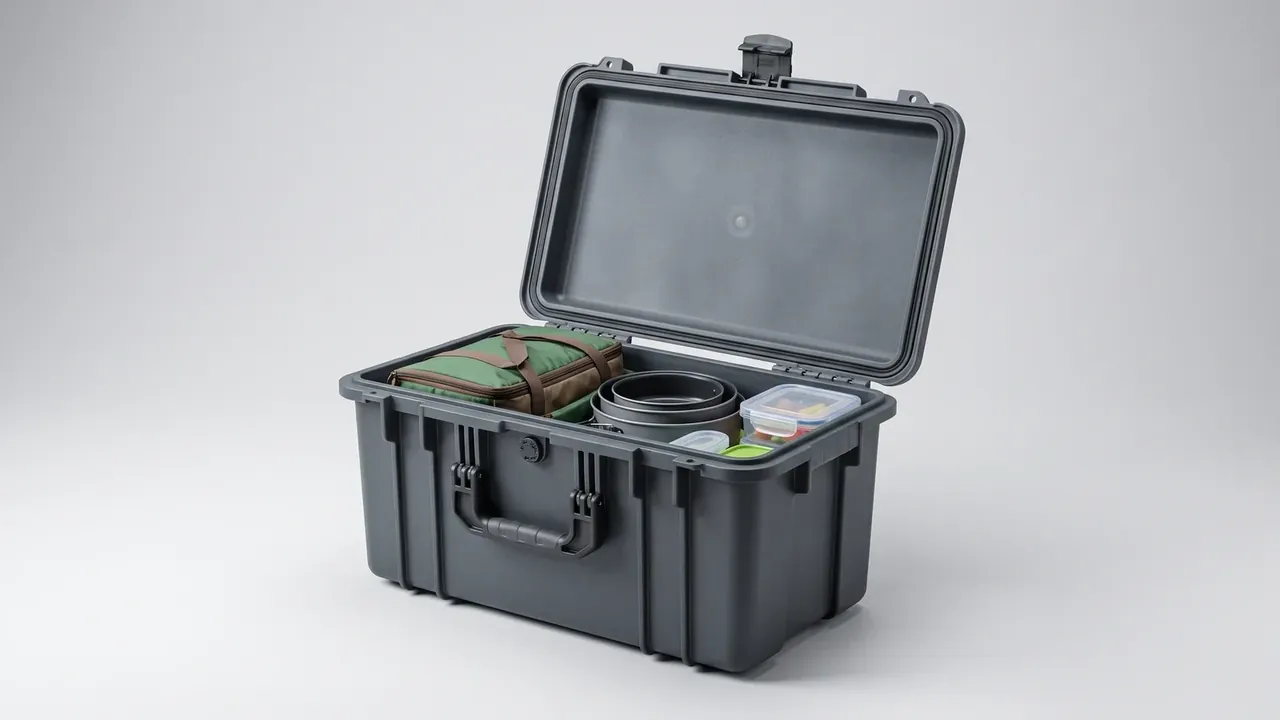
Quick answer: Screen the best portable boxes with four gates first, then sort on bonuses. Ingress rating, drop height, latch opening force and stacking deflection decide who stays in the comparison; wheels, pressure valves and foam only reorder units already at the same price.
Table of contents
- Where the gates come from: MIL-STD-810H and IEC 60529
- Drop height by weight: 48 inches is for light cases
- Latches, seals and stacking: three repeatable tests
- Accessories: wheels, valves and foam
- FAQ
1. Where the gates come from: MIL-STD-810H and IEC 60529
The two documents are often quoted in the same purchase requirement, yet they do different jobs. MIL-STD-810H describes how to run a test and offers no pass line; IEC 60529 defines what an IP code means and does not say which level a product needs. Hanging acceptance clauses on a standard number without writing the actual criterion is the most common vagueness in this category.
The first step in comparing the best portable boxes is not price, it is drawing the gates. A unit that misses one does not enter the ranking, however cheap it looks.
| Dimension | Gate (fail means out) | Bonus (sorting only) |
|---|---|---|
| Ingress | IP65 minimum; IP67 for outdoor use, meaning 1 m immersion for 30 minutes | IP68, with depth and duration stated |
| Drop | 26 drops at the weight tier, no through-crack at corners | Third-party report naming the impact surface |
| Latch | Opening force still 250 N or less after 500 cycles | Metal latch with a secondary safety catch |
| Seal | 0.15 mm feeler gauge blocked all round the lid | Replaceable gasket with spares supply |
| Stacking | 200 kg on the lid for 24 hours, deflection 2 mm or less | Corner locating posts so three tiers do not slide |
Ingress is where the wording slips most. IP65 is water jets, IP67 is 1 m immersion for 30 minutes, and an X in the second position means that test was never run. A case marked IP66 and one marked IPX6 differ not in the number but in whether dust was tested at all. For the best portable boxes holding batteries or desiccant, dust matters more than water.
Draw the gates first, and prices finally become comparable.
2. Drop height by weight: 48 inches is for light cases
Drop height is not a universal number; it follows total mass. The 48-inch figure in MIL-STD-810H belongs to man-portable equipment in the low tens of pounds. Demand it from an 18 kg case and the supplier can only answer with thicker walls.
| Total weight | Drop height | Drops | Surface |
|---|---|---|---|
| Up to 4.5 kg | 1.22 m | 26 | Concrete |
| 4.5 to 9 kg | 1.07 m | 26 | Concrete |
| 9 to 18 kg | 0.76 m | 26 | Concrete |
| 18 to 32 kg | 0.61 m | 26 | Steel plate |
The 26 drops are not arbitrary: four corners, eight edges and six faces, plus three corner drops at low temperature. A report covering only six faces never shows a corner crack.
Three readings decide pass or fail. No crack longer than 0.8 mm at a corner, and none running through to the cavity; latches neither released nor with broken teeth; lid gap unchanged after the series.
Reports for the best portable boxes also need the condition stated: ambient, minus 20 degrees Celsius, and loaded. A report at ambient alone covers a third of the case.
3. Latches, seals and stacking: three repeatable tests
None of the three needs a laboratory. A bench, a force gauge, a feeler gauge and a few ballast bags are enough.
- Latch cycling: open and close 500 times, then measure opening force, which should land between 120 and 200 N; nylon with 30 percent glass fibre holds that band best, while plain POM starts stiff and ends loose
- Seal check: run a 0.15 mm feeler gauge around the closed lid, and any section that admits it fails; then hold 30 kPa of vacuum for 30 seconds, with decay under 0.5 kPa
- Stacking: 200 kg spread over the lid for 24 hours, mid-span deflection under 2 mm, recovering to within 0.5 mm an hour after unloading
Stacking is the test most often softened. An empty case and a loaded one behave differently, because the loaded walls take side load and deflect roughly 40 percent more at mid-span.
One detail matters on the best portable boxes: the latch body needs about 0.3 mm of preload against its keeper, enough to give a dull click when closed. Without preload, vibration opens the latch on its own.
4. Accessories: wheels, valves and foam
Accessories are not gates, but they alter base performance, so each carries a cost.
| Accessory | Gain | Cost |
|---|---|---|
| Wheels | Real relief above 20 kg; 65 mm wheels clear a 15 mm threshold | 0.35 kg of dead weight, 40 mm of cavity at the base |
| Pressure valve | Easier opening after temperature swings, cracking at 0.35 bar | One more hole and one more path to leak |
| Foam liner | 33 kg per cubic metre polyethylene rebounds most predictably | Soaks water, gains weight, crumbles with long damp storage |
| Inner tray | Layered access, fewer lid openings | 12 mm of height, which hurts small cavities |
Keep three accessory types at most. A unit carrying all four runs 22 percent heavier than its class and loses a tenth of its volume, the trap most buyers of the best portable boxes fall into.
Valves deserve one note. The further from the gasket the better: a valve near a corner takes load first in a drop, and once the diaphragm deforms it never seals again.
Conclusion
Comparison of the best portable boxes runs in one order: reject first, rank second. Ingress rating, drop tier, latch force and stacking deflection earn a place in the price round; accessories act only afterwards.
Turn the standard numbers into ones you can measure on a bench: 1.22 m, 26 drops, 250 N, 0.15 mm, 200 kg, 2 mm. When those agree, the best portable boxes stop being a slogan.
This article discusses only the container (case body) side of specifications and design intent, and does not cover any handling, loading or use of the contents.
Related Reading
- Material trade-offs for a portable tool box
- Portable tool box configurations by scene
- Portable tool box against the alternatives
- How a portable tool box is put together
- Maintenance checks for a portable tool box
Related Products
- 8 Series — Gun Cases; Military Equipment Cases; Camera Equipment Cases; Drone Cases; Watch Cases; Knife Cases; First Aid Cases; Electronics Equipment Cases
- WL8-2812 PP Gun Case — model WL8-2812
- All protective cases and toolboxes: 7 series, 158 models