

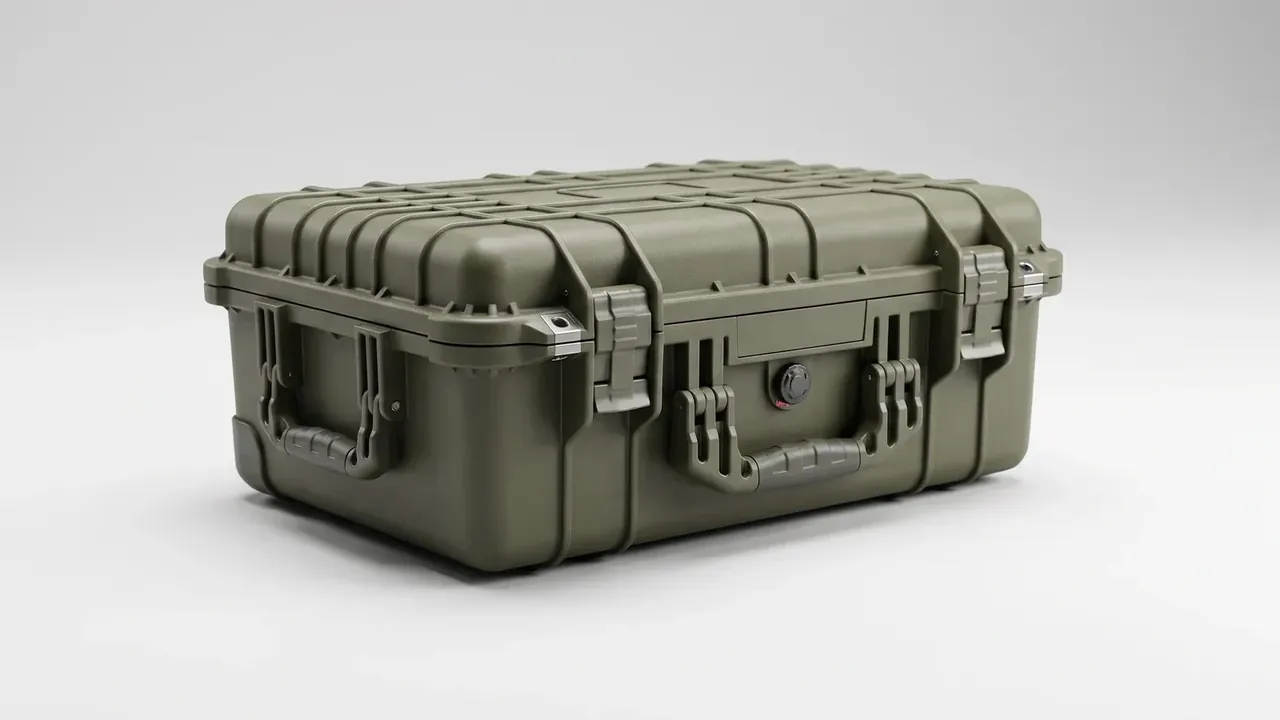
Quick answer: A box, packing, ammunition spec is derived, not drawn. Standards fix the environment, the load list fixes the cavity, the bending moment fixes wall thickness, and dimensions come last.
Table of contents
- From the load list to the cavity
- Wall thickness and ribs follow the bending moment
- Three force numbers behind latches and seals
- Stacking temperature and salt fog limits
- Writing the spec sheet as acceptance clauses
- FAQ
1. From the load list to the cavity
Most drawings open with outside dimensions, which treats the answer as the input. A box, packing, ammunition specification starts with a load list and environmental clauses.
MIL-STD-810H Method 501.7 covers heat, 502.7 cold, 516.8 shock and 509.7 salt fog, and the buyer supplies the numbers. IEC 60529 packs protection into two digits, where IP67 is one metre for thirty minutes. Together: no cracking from -40 °C to 60 °C, no penetration after a 1.2 m drop.
Those clauses land on the cavity. A 720 × 420 × 260 mm interior covers most mid-calibre rounds: six cells, 28 kg each, 168 kg per case. Cell count follows footprint, and 30 mm of off-centre gravity is enough for two carriers to feel the tilt.
| Clause | Limit | Spec it drives | Value |
|---|---|---|---|
| MIL-STD-810H 501.7 | Heat | Creep | 60 °C, 4 h |
| MIL-STD-810H 516.8 | Shock | Walls, corners | 1.2 m, six faces |
| MIL-STD-810H 509.7 | Salt fog | Plating | 96 hours |
| IEC 60529 IP67 | Immersion | Gasket squeeze | 28%, 5.9 mm groove |
The outside is the cavity plus increments: 4.2 mm wall, 12 mm cushion, 2.4 mm ribs, 6 mm at the latch bosses, about 28 mm per side, putting the envelope at 776 × 476 × 316 mm.
2. Wall thickness and ribs follow the bending moment
Once the cavity is fixed, thickness is constrained: it resists stacking bending and drop impact. On a simply supported base, mid-span moment scales with span squared and falls with thickness squared, and the 720 mm span will not shrink.
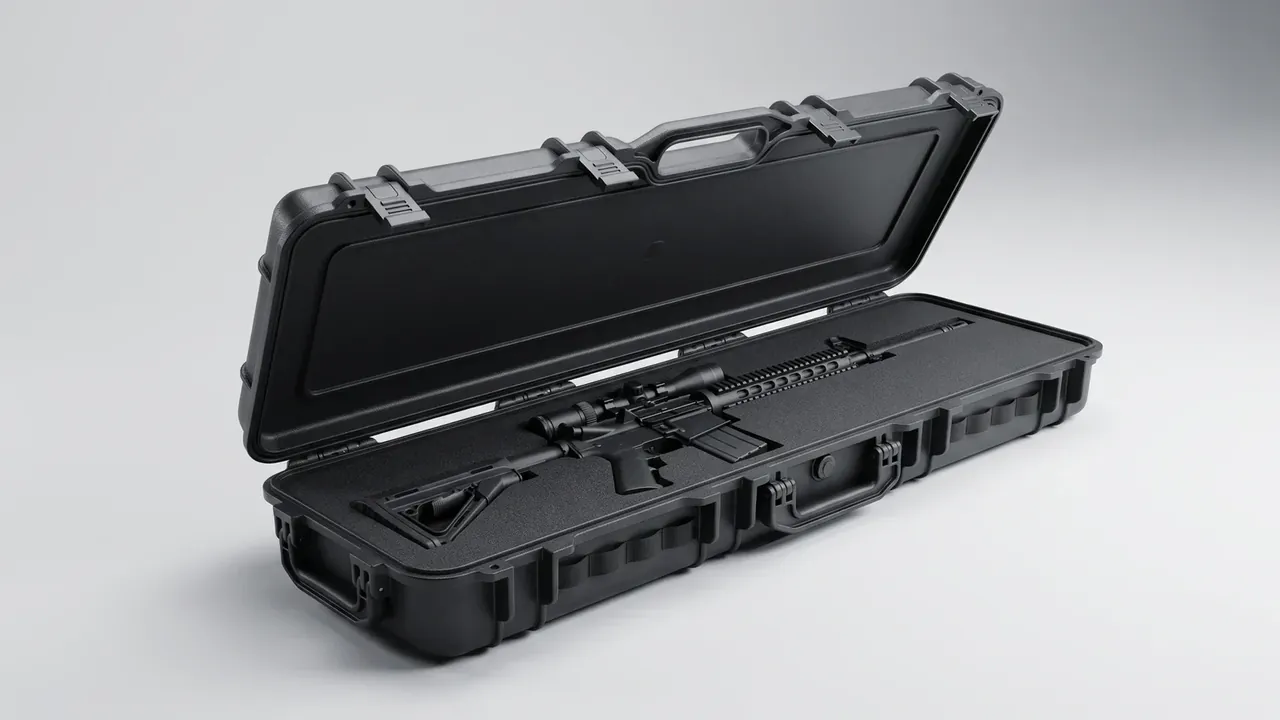
On a box, packing, ammunition shell, walls at 4.2 mm, base at 6.0 mm and lid at 4.5 mm answer three load cases. The base carries 168 kg plus the stack, the walls take knocks, and the lid borrows stiffness from its arch.
| Zone | Wall | Rib | Load |
|---|---|---|---|
| Side | 4.2 mm | 2.4 × 10 vertical | Side impact |
| Base | 6.0 mm | 2.4 × 16 grid, 70 mm | Stacking |
Ribs get waved through more than any other detail. At 2.4 mm thick, 16 mm high and 70 mm apart the ratio is 3.8, inside the no-draft range; past four times, the tool needs 1.5° of draft, or the root whitens on ejection.
3. Three force numbers behind latches and seals
A latch figure is worked out three times: closing feel, transit retention, drop peak.
- Retention: 320 N per latch, 512 N for a pair.
- Opening: 150 N by hand, or two gloved hands and double cycle time.
- Hinge: 8 mm pin, 0.15 mm clearance; past 0.3 mm the gasket loads unevenly.
- Seal: 8.5 mm cord in a 6.4 mm groove, squeezed to 6.1 mm, 28%.
- Valve: 0.35 bar per temperature swing.
The gasket is the only part that changes with time. Under 20% squeeze it will not seat and the case weeps when inverted; over 35% the latches stay preloaded.
4. Stacking temperature and salt fog limits
The line most often written into a box, packing, ammunition spec sheet is that the case meets transport requirements. That line cannot be inspected.
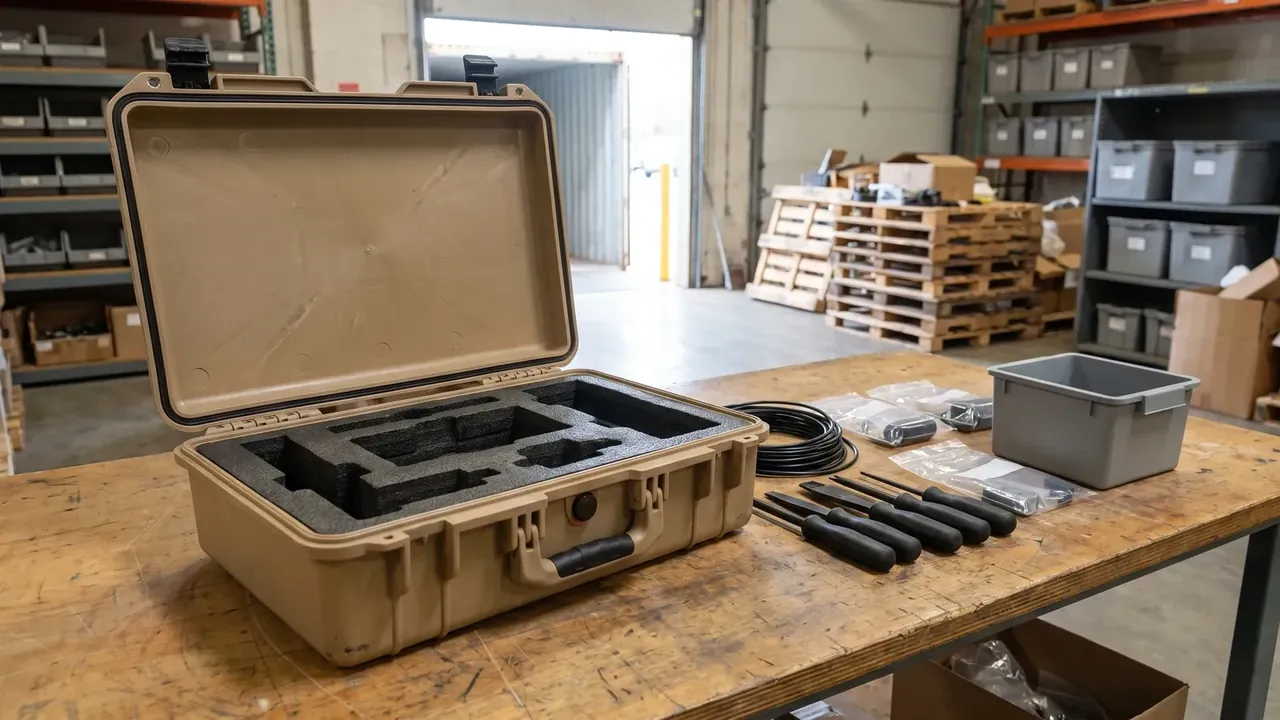
Inspectable conditions read: six-high stacking, 380 kg static on the bottom case, 24 hours, 2.5 mm deflection. That 380 kg is five cases plus a 1.5 safety factor, not the case weight. A 4.5 m rack allows eleven layers in theory, six in practice.
Temperature belongs in a cycle, not a point. Freeze at -40 °C for four hours, drop 1.2 m onto six faces within five minutes, and no latch may crack; at 60 °C for four hours, allow 1.5 mm of shrinkage. Salt fog runs 96 hours, where a 304 pin costs 8% more and saves a re-pinning job later.
5. Writing the spec sheet as acceptance clauses
A box, packing, ammunition spec sheet needs four columns: item, nominal, tolerance, test method. Drop the fourth and every delivery becomes an argument. The same case can be rained on by the supplier and immersed by the buyer. Neither side is lying. The clause was never closed, so responsibility lands nowhere. Add the method and the dispute has a target.
Sealing reads: IP67, IEC 60529, one metre for thirty minutes, no visible water in the cavity. Stacking reads: six high, 380 kg, 2.5 mm deflection.
Tolerances get cut first: cavity length and width at ±1.5 mm, depth at ±1.0 mm, wall thickness as a minimum.
Then read every line back and ask whether a third party could measure it.
What cannot be measured gets rewritten until it can. Rib and latch-boss positions need a datum within 1.0 mm of the base centre.
Conclusion
The numbers run one way: clauses set the environment, the load sets the cavity, the moment sets wall thickness, the forces set latches and seals, the envelope falls out last. Each link carries a figure a third party can re-measure. Read that way, a box, packing, ammunition spec answers awkward questions before the first sample is moulded.
This article discusses only the container (case body) side of specifications and design intent, and does not cover any handling, loading or use of the contents.
Related Reading
- Inspection items and pass lines for these cases
- Wood, corrugated or plastic: material trade-offs
- How small-arms ammunition boxes differ
- What an ammunition box actually is
Related Products
- 8 Series — Gun Cases; Military Equipment Cases; Camera Equipment Cases; Drone Cases; Watch Cases; Knife Cases; First Aid Cases; Electronics Equipment Cases
- WL8-2812 PP Gun Case — model WL8-2812
- All protective cases and toolboxes: 7 series, 158 models