

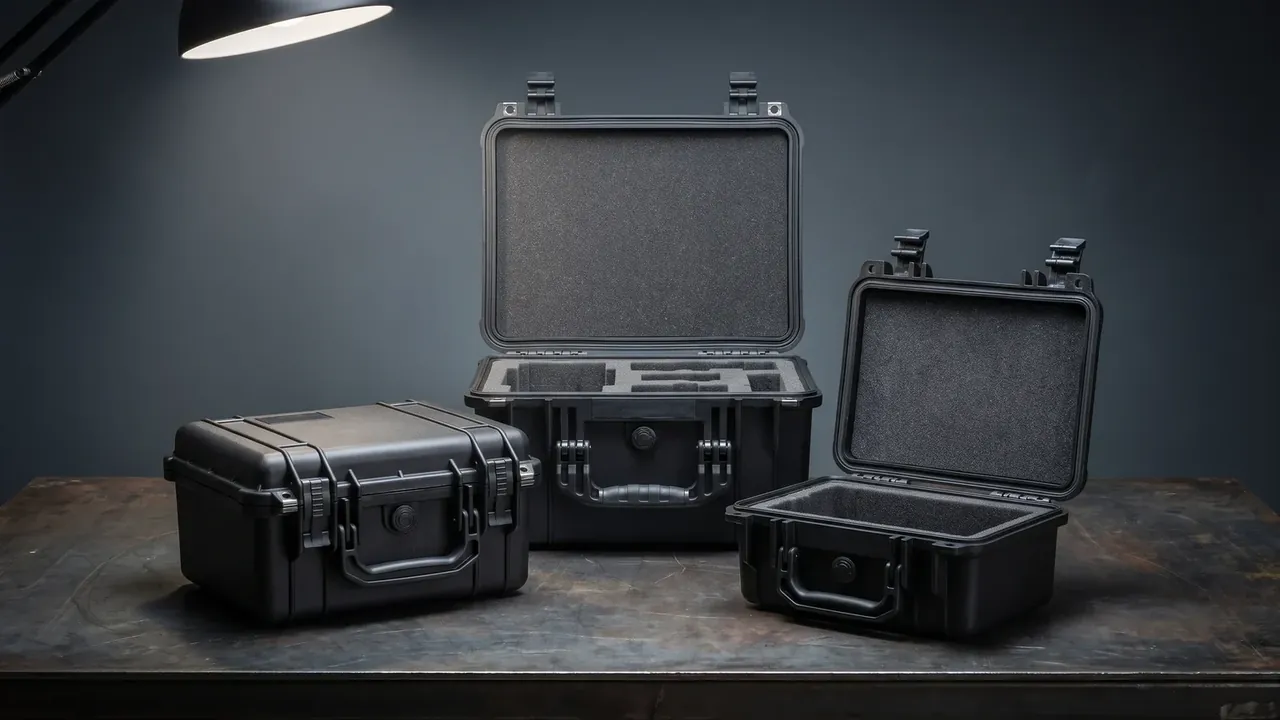
Quick answer: Boxes, small arms ammunition are built from steel coil, not drawn around a round count. Six forming steps set the case mouth, three tolerances hold it there, and the round count is simply interior volume divided by the space one cartridge occupies.
Table of contents
- What the case is and is not
- Six forming steps from coil to shell
- Three tolerances that decide the outcome
- Sealing, coating and stacking numbers
- Where the round count comes from
- FAQ
1. What the case is and is not
Boxes, small arms ammunition are reusable steel outer cases. Three features define them: a lid that opens and closes repeatedly, a gasket that can be replaced, and a body that carries load in a stack. Lose one and the item drops back to single-trip packaging.
They are not safes: protection comes from wall thickness and latch count, never from an electronic lock, and mixing the two roles yields two sets of numbers fighting each other.
Capacity runs 500 to 1,500 rounds and unit weight four to eight kilograms. A carton or tin goes in first, so clear interior is that pack plus five millimetres a side.
| Format | Unit weight | Seal | Reopening | Typical stack |
|---|---|---|---|---|
| Steel case | 4–8 kg | replaceable rubber gasket | hundreds of cycles | 3 high |
| Wooden crate | 6–11 kg | none, liner only | once | 2 high |
The column usually ignored is reopening: a crate falls apart at the first opening, while a steel case travels several issue cycles with the same lot.
2. Six forming steps from coil to shell
The body of a small arms ammunition box is continuous, not assembled from panels. Cold rolled strip at 1.2 mm is cut to the developed length, then one longitudinal seam plus two end caps close it into a rectangular shell.
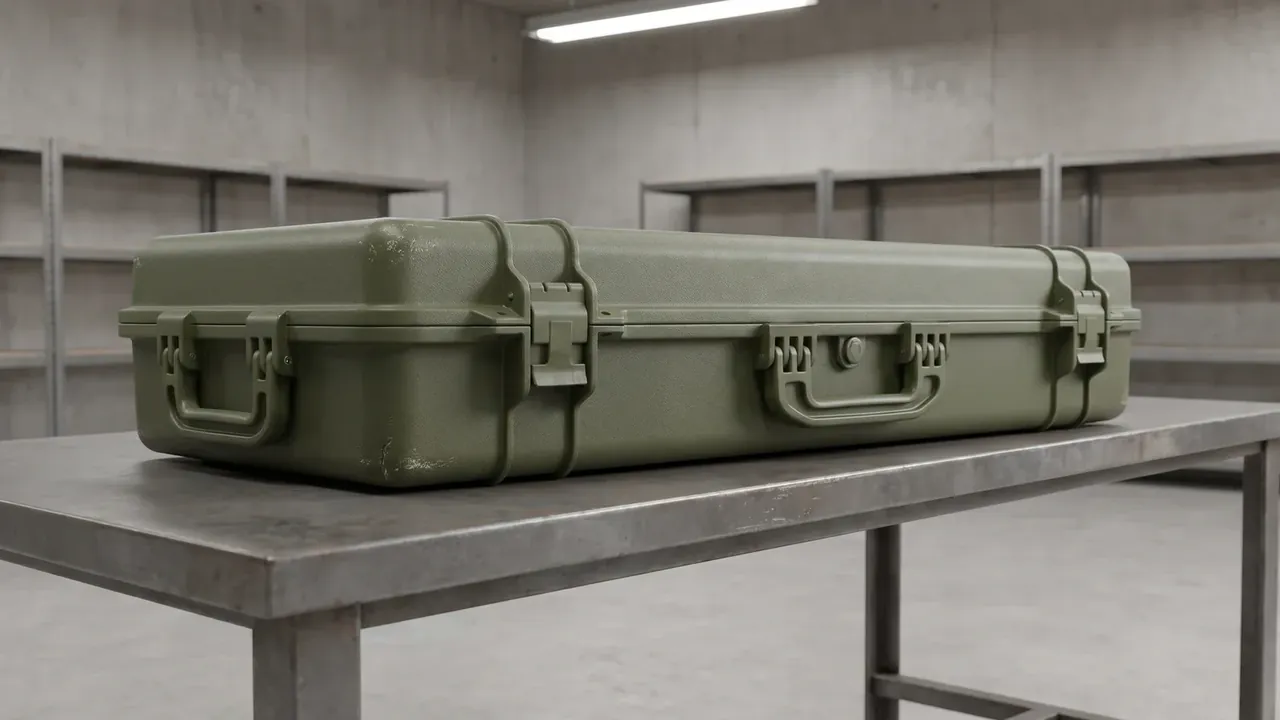
The line runs in six steps:
- Decoiling and blanking: strip is cut to length, burrs held under 0.05 mm.
- Forming: four sides are folded into a U, corners radiused at R3.
- Seam welding: one straight seam, 0.8 mm penetration, ground flush.
- End caps: pressed in, spot welded at 40 mm pitch, continuous at the corners.
- Straightening: the mouth is pulled flat on a fixture to 0.6 mm.
- Finishing: degrease, phosphate, powder coat, then gasket and latches.
Only step five is inspected on every unit; deviation from the first four accumulates at the mouth, and a wavy mouth defeats any gasket.
3. Three tolerances that decide the outcome
The first is mouth flatness. At 0.6 mm the gasket still presses everywhere; beyond it compression falls under 15 percent in patches and moisture enters past a lid that looks shut.
The second is latch travel against catch clearance: 1.5 mm of clearance, 8 mm of travel. Under 1 mm the latch will not close after coating; past 2 mm it walks open under vibration, and no service adjustment exists.
The third is handle position: holes within 1 mm of nominal, coaxial within 0.8 mm. At 45 kg, misalignment puts one side in tension until a crack runs along the fold and the handle tears out.
The three interact: a wavy mouth forces the latch to be pulled hard, which eats travel, and short travel invites swinging by the handle.
4. Sealing, coating and stacking numbers
Sealing is done by the gasket, not by force. A nitrile gasket sits in a 6 mm groove, 8 mm thick, compressed 30 percent at closure, leaving 2.4 mm to absorb build variation.
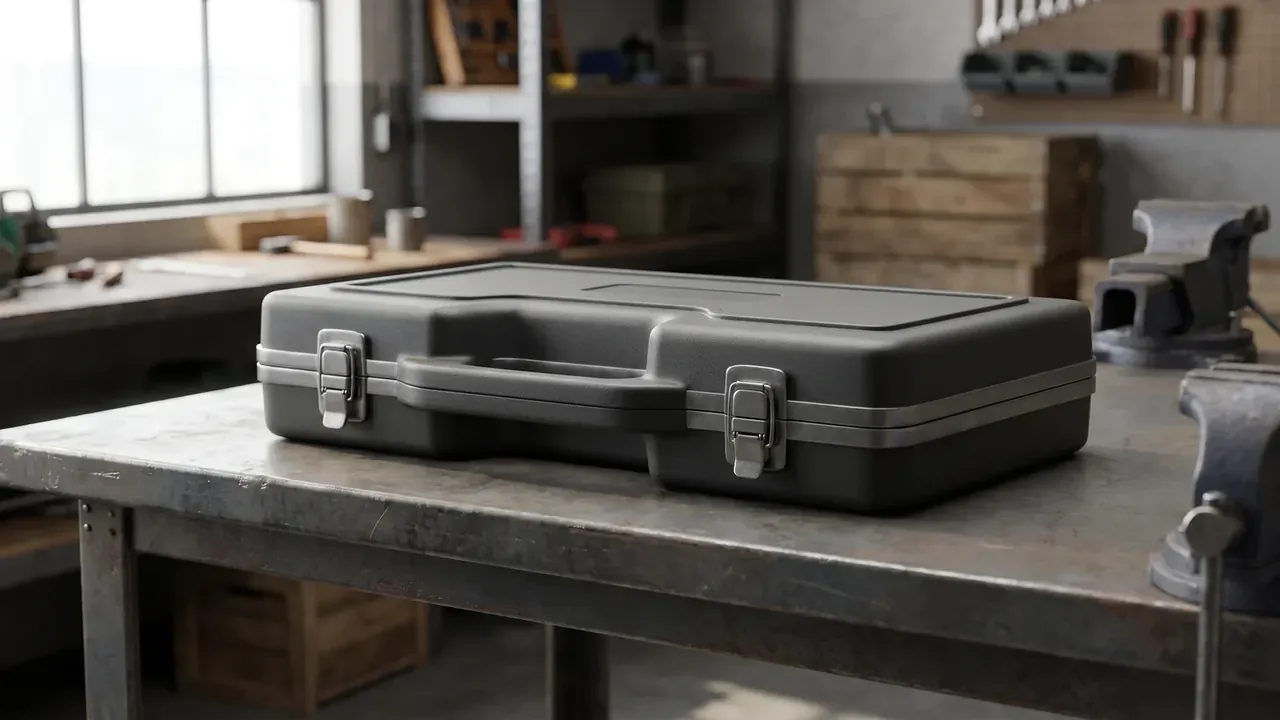
Coating is accepted at 96 hours of salt spray without red rust, film at 60 microns. Stacking runs three high at 80 kg per unit, 240 kg total, held 24 hours before the mouth diagonals are checked against 1.5 mm.
| Parameter | Value | Check | Failure |
|---|---|---|---|
| Gasket compression | 30% | feeler gauge will not enter | moisture past the mouth |
| Film thickness | 60 µm | five magnetic readings | salt spray under 96 hours |
| Stacking | 3 high, 240 kg | diagonals after 24 hours | mouth collapse, latches offset |
Stacking measures permanent set at the mouth: grow the diagonals by 2 mm and the lid never sits flat again.
5. Where the round count comes from
The count is calculated, never stamped first. Multiply clear interior volume by a loading factor of 0.72 and divide by the space one cartridge occupies, and the result moves whenever the inner pack changes. Take a 380 × 180 × 150 mm interior: 10.26 litres, times 0.72 gives 7.39 litres usable. With 20-round cartons of 90 × 60 × 35 mm, each cartridge takes 9.45 cm³, so the case holds about 780 rounds. Switch to 30-round cartons of 120 × 70 × 40 mm and the figure per cartridge rises to 11.2 cm³, leaving 660 rounds. Nothing on the case changed. The count fell 15 percent because the inner pack did.
Conclusion
The order runs forming first, tolerances second, round count last. How the strip is folded decides whether the mouth stays flat, and a flat mouth decides whether the gasket works. Build the count backwards into the shell and the boxes, small arms ammunition will show the error at the third tier.
This article discusses only the container (case body) side of specifications and design intent, and does not cover any handling, loading or use of the contents.
Related Reading
- Compartment, count and marking design for the same case
- Packaging and transport marking requirements
- How the ammunition box evolved
- Tooling and sampling for small batch runs
Related Products
- 8 Series — Gun Cases; Military Equipment Cases; Camera Equipment Cases; Drone Cases; Watch Cases; Knife Cases; First Aid Cases; Electronics Equipment Cases
- WL8-2812 PP Gun Case — model WL8-2812
- All protective cases and toolboxes: 7 series, 158 models