

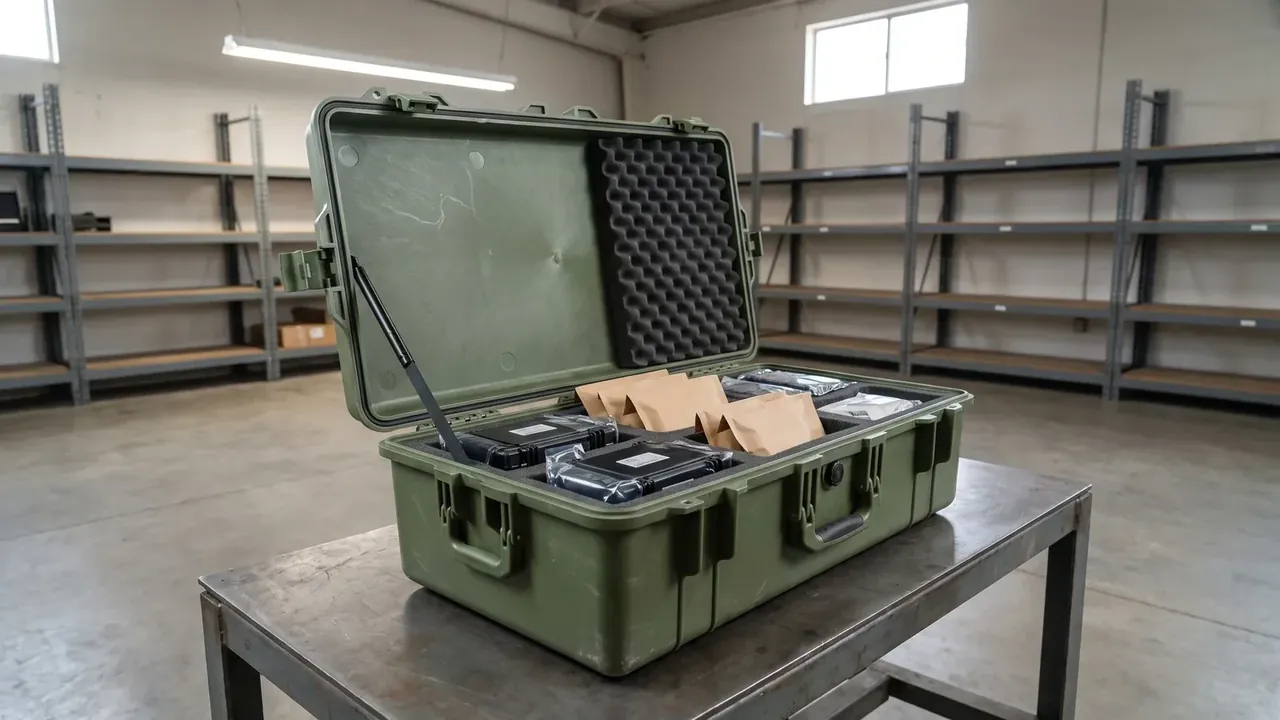
Quick answer: A Buoyant waterproof box for water sports keeps 1.6 kg net buoyancy from 14.2 L displacement after a 3.6 kg shell and 9 kg load, proven by a 30 min float.
Table of contents
- Net Buoyancy and Displacement Volume of a Buoyant Waterproof Box for Water Sports
- Compression Margin of the Twin Lid Seals
- Reading and Pass Criteria of the Fully Loaded Float Test
- Stress Spread Between Tether Rings and Case Walls
- Leak Inspection After Opening Following Immersion
- FAQ
1. Net Buoyancy and Displacement Volume of a Buoyant Waterproof Box for Water Sports
Whether the whole case floats comes down to how much water the outer envelope pushes aside. A Buoyant waterproof box for water sports measures 480×350×190 mm outside and 420×290×145 mm inside, the gap taken by a 3.6 mm wall plus the ribs of lid and shell. Once the lid is latched the case body is a closed solid, and fresh water at 1 kg/L turns a 14.2 L displacement into 14.2 kg of lift.
The empty shell weighs 3.6 kg and the rated payload 9 kg, together 12.6 kg. Subtract that from 14.2 kg and 1.6 kg of net buoyancy remains, a figure fixed by the outline, the wall and the hardware: thin the shell until it dents and 14.2 L no longer holds. JUNZHIJIA rechecks the 14.2 L displacement at 9 kg during sampling.
| Float condition | Displacement | Shell plus load | Net buoyancy |
|---|---|---|---|
| Empty, latched | 14.2 L | 3.6 kg | 10.6 kg |
| Half load 4.5 kg | 14.2 L | 8.1 kg | 6.1 kg |
| Full load 9 kg | 14.2 L | 12.6 kg | 1.6 kg |
| Lid unlatched | Derate by measurement | 12.6 kg | Retest |
2. Compression Margin of the Twin Lid Seals
Staying afloat and keeping water out are separate gates. A Buoyant waterproof box for water sports seals its mouth against 1.0 m of head with two gasket rings where the lid meets the shell: the outer blocks standing water, the inner catches seepage past the first.
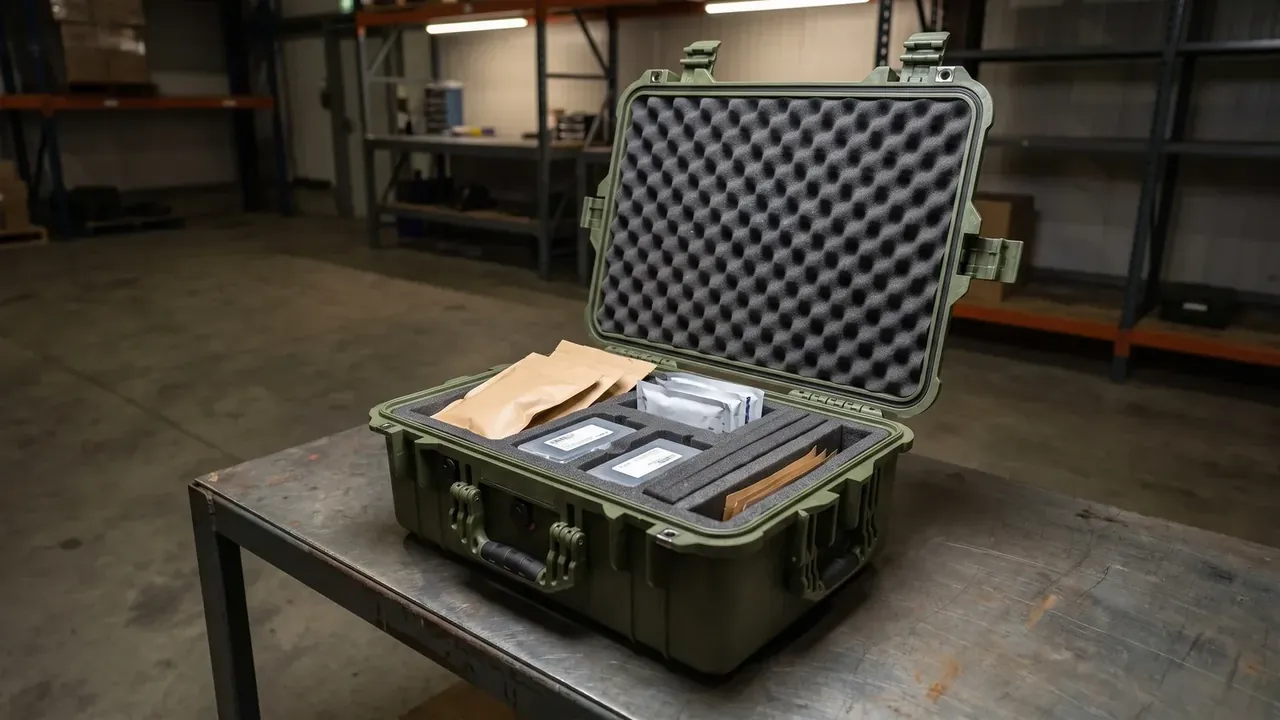
Compression is set at 22%, the share of the gasket section squeezed in its groove. Too shallow and water at 1.0 m / 30 min tracks through a lifted lid; too deep and the two latches run out of travel and bow the lid frame instead. Two latches at 340 N each clamp both rings around the mouth, and a lid that bows at mid-span drops below 22% where leaks start.
| Seal location | Rings | Compression | Benchmark |
|---|---|---|---|
| Outer lid ring | 1 ring | 22% | 1.0 m / 30 min soak |
| Inner mouth ring | 1 ring | 22% | 30 min fresh-water float |
| Latch overlap | Local | By measurement | 340 N per point |
| Corner transition | Local | Not below 18% | 1.2 m drop retest |
Ingress protection is benchmarked against IP67 soak conditions at 1.0 m for 30 min.
3. Reading and Pass Criteria of the Fully Loaded Float Test
The float test for a Buoyant waterproof box for water sports runs in still fresh water with the lid latched, 9 kg aboard and no pull on the rings. The case is timed for 30 min; not sinking is the pass, with the lid face above water as an added condition, and readings fall at 1 min, 15 min and 30 min.
| Displacement reading | Sampling time | Threshold | How recorded |
|---|---|---|---|
| Waterline position | 1 min in | Mouth above water | Scale against the wall |
| Case attitude | 15 min | No steady sinking | Sight the lid plane |
| Net buoyancy reserve | 30 min | 1.6 kg | Back-calculate from weight |
| Continuous bubbles at mouth | Full 30 min | None allowed | Walk the mouth perimeter |
The float verdict applies to the whole case, not one seal point. Dent the shell and the displacement moves with it.
4. Stress Spread Between Tether Rings and Case Walls
Two tether rings at opposite ends hand a concentrated pull to the walls. Tow a Buoyant waterproof box for water sports at a 9 kg floating load and the ring mount carries single-point tension; anchor it into a 3.6 mm wall and the wall blushes or cracks.
The load path spreads from ring to metal insert, to local ribs on the inner wall, to a wider shell area, and finally to the whole case body. A 3.6 mm wall with radiating ribs keeps the mouth from gaping, since a gap loses the 22% compression locally. Symmetric rings also keep the case level.
5. Leak Inspection After Opening Following Immersion
After 1.0 m for 30 min the outside is wiped dry before opening, and the order runs outside in: check the inner lid edge for traces, both gasket rings for even rebound, then the cavity floor for droplets, covering the lid frame, gasket groove and shell rim.
At opening the two 340 N latches must release cleanly. A lid that does not bind and a frame that does not warp say the soak left the structure true. The 1.2 m drop sends the sequence round again. Check the shell envelope for a dent. Latch the lid and measure compression. Repeat the 30 min float. Open up and look for leaks. All four steps must pass before this Buoyant waterproof box for water sports stands on both buoyancy and sealing.
Conclusion
A Buoyant waterproof box for water sports splits the job into two measurable lines. A 14.2 L displacement minus a 3.6 kg shell and a 9 kg load leaves 1.6 kg of net buoyancy, enough for a 30 min fresh-water float at full load; two gasket rings at 22% compression, clamped by two 340 N latches, benchmark a 1.0 m / 30 min soak without ingress. Check outline, wall and the open-after-soak sequence in that order.
Related Reading
- Dry bag versus waterproof case sealing
- Marine protective case shell structure
- Case gasket materials and compression rates
- Protective cases benchmarked to IP67 conditions
Related Products
- 8 Series — Gun Cases; Military Equipment Cases; Camera Equipment Cases; Drone Cases; Watch Cases; Knife Cases; First Aid Cases; Electronics Equipment Cases
- WL8-2812 PP Gun Case — model WL8-2812
- All protective cases and toolboxes: 7 series, 158 models