

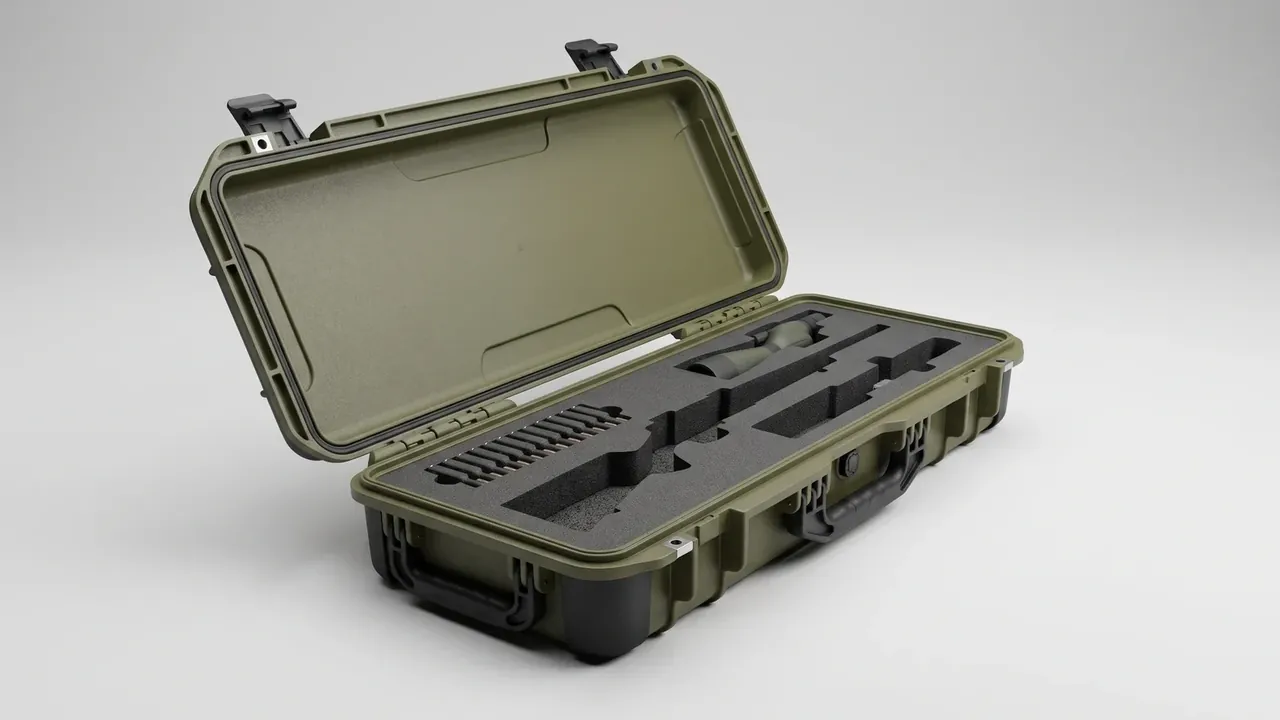
Quick answer: One body and three lenses become five bays, four numbers and three moves inside a camera equipment hard case. The bays hold body, lenses, batteries and cards; the numbers are thread size, bay diameter, clearance and humidity; the moves are open-and-lift, swap a lens, pack at dusk.
Table of contents
- Bay count starts from one body and three lenses
- Lens bays: 77 mm thread and vertical clearance
- Separate bays for batteries, cards and the body
- Humidity at 40 to 50 percent RH
- Shoulder strap, handle and anchor points
- FAQ
1. Bay count starts from one body and three lenses
On a shooting day the lid opens more than twenty times, and every opening is a lift-out and a put-back. Inside a camera equipment hard case the bay count follows the hand, not the list.
One body plus three lenses plus batteries and cards comes to five bays. The body lies flat in one. Each lens takes its own. Batteries and cards share the fifth. Filters and a blower go into the lid mesh, never a working bay. Four bays force two lenses to stack; six push the shell up a size and the shoulder pays.
| Bay | Contents | Internal size |
|---|---|---|
| 1 | body with vertical grip | 190 × 150 × 120 mm |
| 2 | wide zoom | 82 mm diameter, 135 mm deep |
| 3 | standard zoom | 82 mm diameter, 135 mm deep |
| 4 | telephoto zoom | 82 mm diameter, 210 mm deep |
| 5 | two batteries and a card wallet | 90 × 70 × 60 mm |
Work backwards from the longest lens: a telephoto measures around 200 mm collapsed, and a shallow bay forces a diagonal lie.
2. Lens bays: 77 mm thread and vertical clearance
Vertical is the default attitude inside a camera equipment hard case. It takes less floor area, the barrel gives the fingers a grip, and the lens drops back without hunting for an angle.
Clearance is set per side. A lens with a 77 mm filter thread measures about 80 mm across the mount and close to 90 mm with the hood reversed, so an 82 mm bay leaves 4 to 5 mm per side: snug without pinching. Squeeze it under 2 mm and there is no room for a fingertip in winter gloves.
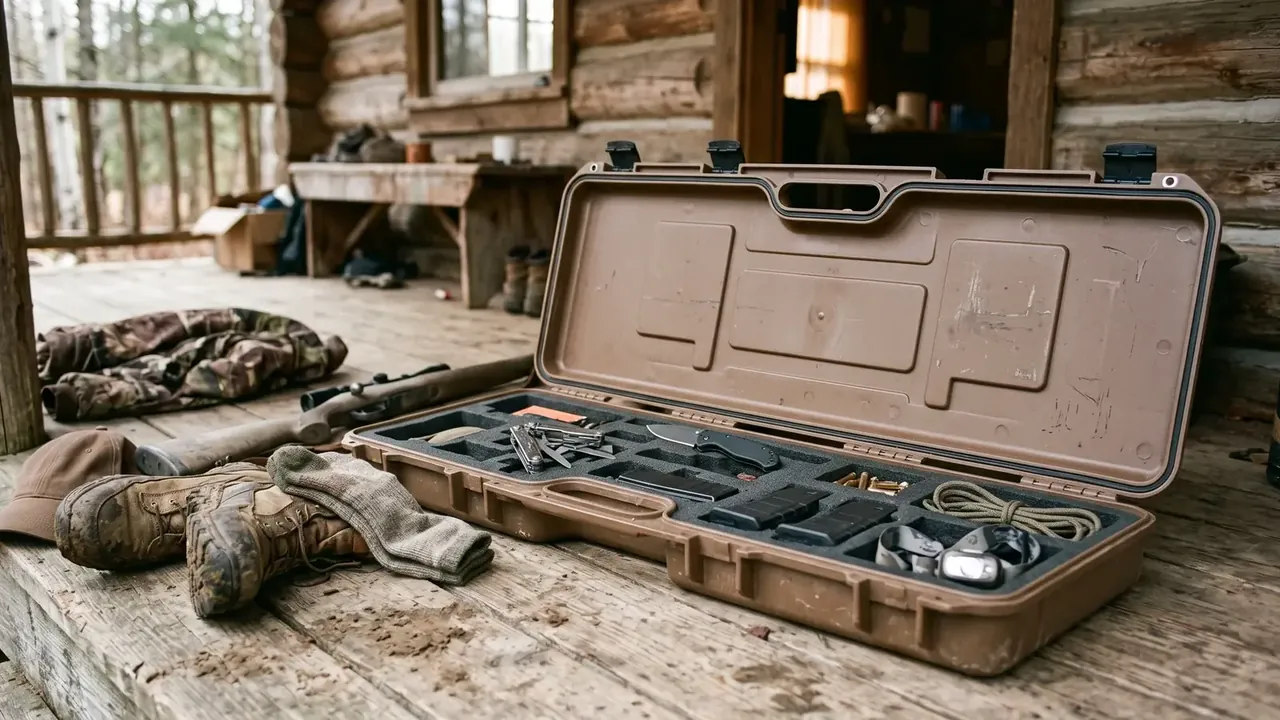
Depth runs 15 mm longer than the lens. That margin belongs to the fingers and to the hood; too little and the front element rests on the foam, too much and the lens travels on every bump.
The bay mouth needs a 5 mm chamfer to centre the barrel as it drops in.
3. Separate bays for batteries, cards and the body
In a camera equipment hard case a list beats a table: the rules run in parallel.
- Batteries get their own bay, never against the body; a closed shell traps the warmth of a full pack.
- Two packs per bay, same polarity, since reversed contacts find metal.
- Cards live in a wallet, never loose; one loose card costs ten minutes in the seams.
- The body bay is never shared; screen and mount pick up scratches from anything hard.
- Store spare packs at 30 percent charge; a full pack left for months swells.
Put the battery bay low and near the handle so the load hangs steady.
4. Humidity at 40 to 50 percent RH
Lens fungus grows above 60 percent RH, while below 35 percent the rubber and lubricant dry out. Hold the inside of a camera equipment hard case between 40 and 50 percent.
Two things keep that band: a seal that closes flat and desiccant changed on time. An 18 L case takes 50 g of indicating silica, 80 g in a wet season, and the colour turns from blue to pink when spent.
| Internal volume | Desiccant | Change interval |
|---|---|---|
| 12 L | 30 g | 3 months |
| 18 L | 50 g | 3 months |
| 30 L | 80 g | 2 months |
| 45 L | 120 g | 2 months |
Hang the desiccant in the lid mesh, never on a lens; a covered sachet stops working. After a rainy shoot, air the case for half an hour, or the silica saturates in two days.
5. Shoulder strap, handle and anchor points
A loaded camera equipment hard case runs 13 kg, and a full day of carrying rests on the strap and anchors, not the handle.
Size the handle for twice the loaded mass, 26 kg and above, and use 5 mm stainless D-rings rated at 25 kg. Four anchors work best: two beside the handle, two diagonally opposite, for a long and a short rig.
Anchor placement decides sway: all four on one side and the case rolls outward; split diagonally, the mass sits along the spine.
The common mistake is hanging a strap on the handle: its pins are built for lifting, and a loaded sideways pull loosens them within six months.
Conclusion
Packing one body and three lenses into a camera equipment hard case is a translation of moves into dimensions. Five bays answer what goes where; the 77 mm thread, the 82 mm bay and the 4 to 5 mm clearance answer whether it sits still; the 40 to 50 percent RH answers whether it lasts. Get the moves right and twenty lid openings a day cost nothing.
This article discusses only the container (case body) side of specifications and design intent, and does not cover any handling, loading or use of the contents.
Related Reading
- Three uses of a camera case: location, transit and storage
- Selection criteria for camera equipment cases
- Equipment case configurations by industry
- Protection and zoning for electronic equipment cases
Related Products
- 8 Series — Gun Cases; Military Equipment Cases; Camera Equipment Cases; Drone Cases; Watch Cases; Knife Cases; First Aid Cases; Electronics Equipment Cases
- WL8-2812 PP Gun Case — model WL8-2812
- All protective cases and toolboxes: 7 series, 158 models