

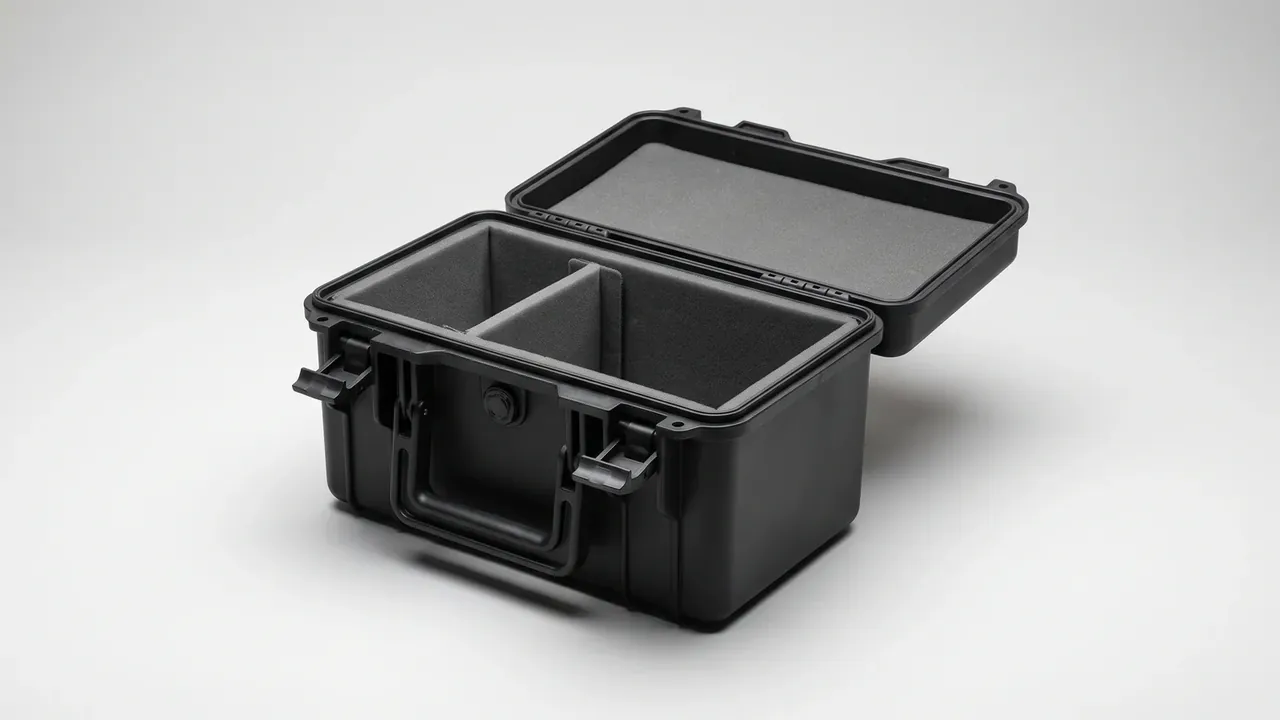
Quick answer: Wedding work, multi-camera studio days and field shoots each ask something different of a camera equipment plastic hard case — fast opening, numbered compartments, or a shell that survives a pressure drop — and the wrong choice shows up on the first job.
Table of contents
- Sort the Job Before the Case
- How the Foam Gets Cut and the Gear Sits
- On Location: Six Moves from Parking to Repack
- Studio Days: Numbering, Lens Changes, Quick Expansion
- Transit and Check-in: Wheels, Latches, Pressure Valve
- Six Failures You Will See on Set
- FAQ
1. Sort the Job Before the Case
The same box behaves differently for a wedding crew and an advertising studio. A wedding shooter opens it forty times a day and judges it on whether the body comes out one-handed in three seconds. A studio opens it twice a day and judges it on whether six camera positions each have a fixed home for batteries and cards. Freight only cares whether the case stays shut when it falls off a tailgate.
Sort the job first, then talk about cavity size. That sounds obvious, yet most mismatched cases were bought from someone else's packing list.
| Job | Main actions in a day | What the case needs | What goes wrong otherwise |
|---|---|---|---|
| Wedding and events | One-hand carry, constant opening, lens swaps | Two latches, flat lid, body bay near the edge | Gear shifts in the bay, mount scraped on the way out |
| Multi-camera studio | Short moves, numbered returns, battery rotation | Many bays, label space, removable dividers | Batteries mix between bays, one goes missing at wrap |
| Field and documentary | Rough tracks, dust, rain and snow | Pressure valve, reinforced corners, gasket | Lid sucked shut by pressure, pried open on landing |
| Air check-in | Thrown by handlers, cold hold | Reinforced corners, latches past dead centre | Latch pops, lid opens on the belt |
A useful size to anchor on: 445 × 330 × 175 mm inside, 500 × 385 × 205 mm outside, 4 mm wall, 3.4 kg empty. That holds two mirrorless bodies, three lenses, a battery case and a 14-inch laptop, which is why wedding crews keep reordering it.
2. How the Foam Gets Cut and the Gear Sits
There are three ways to line a case, and the choice depends on whether the kit changes. Pluck foam is cheap and re-layouts in minutes, but the cell edges start shedding after about three months. A divider system of 10 mm PP board faced with 3 mm EVA on both sides suits crews whose lens count moves. CNC-routed foam follows a drawing and holds best, yet it is the least forgiving: change one lens and the insert is scrap.
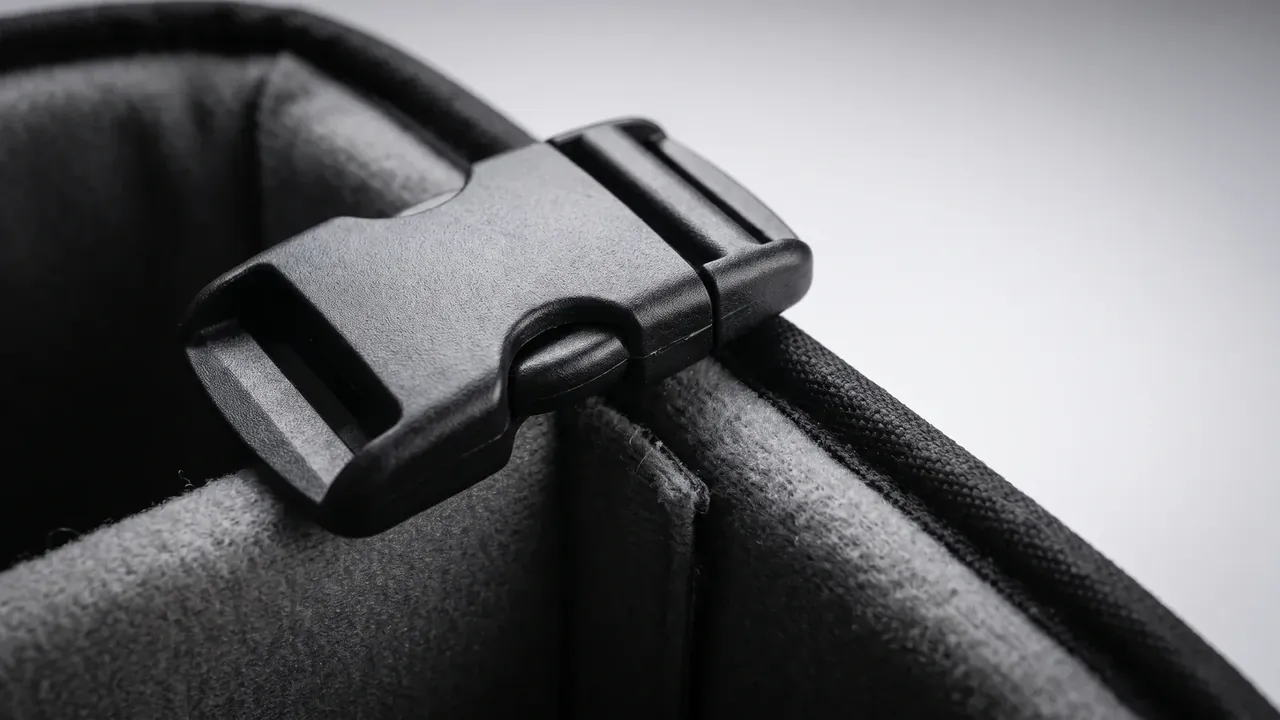
Most wedding teams end up on the second option, because lenses change and the shell does not.
There is a rough rule for pocket depth: take the gear thickness, multiply by 0.55, add 2 mm of interference. A 75 mm body gets a 41 mm pocket, so the foam compresses 2 mm when the lid closes. Too deep and the body rattles; too shallow and the latches stay preloaded, which softens the dead-centre click month after month.
| Item | Pocket size | Foam density | Clearance per side |
|---|---|---|---|
| Mirrorless body | 150 × 105 × 75 mm | 30 kg/m³ PE | 2 mm |
| Zoom lens, standing | 92 mm dia × 130 mm | 30 kg/m³ PE | 1.5 mm |
| Battery case | 90 × 70 × 55 mm | 45 kg/m³ PE | 2 mm, contacts facing down |
| Body with grip | 175 × 110 × 85 mm | 30 kg/m³ PE | 2.5 mm |
Dividers have to reach the floor. In the first sample they only engaged the top lip, and when the case went on its side a lens slid down a 20 mm gap to the bottom; the crew returned it the next day. Routing a floor slot 10.4 mm wide for a 10 mm board fixed it, with enough drag to stay put after ten teardowns.
3. On Location: Six Moves from Parking to Repack
On a shoot the case lives on a step, in wet grass or on the boot lid of the wedding car, not on a shelf.
Six moves, in order: press the valve for two seconds, release both latches, lift the lid to 100 degrees so it stands on its hinge, take the body, swap the lens, close and press the latches home. Get the order wrong and every following step fights you.
At minus 15 degrees the PP latches stiffen and need about 25 N to pass dead centre, which is not a one-handed job in a thick glove. Ten minutes near a warm air vent beats forcing them in the wind.
In blowing sand, do not change a lens outside the case.
When it rains, use the lid as a roof: body out and straight back in, lens changed inside the open bay, lid held half open as a shield. Water runs off the rim to the ground instead of into the foam.
4. Studio Days: Numbering, Lens Changes, Quick Expansion
A studio case barely moves, but it opens a dozen times a day as different positions call for parts, so everything depends on positional memory.
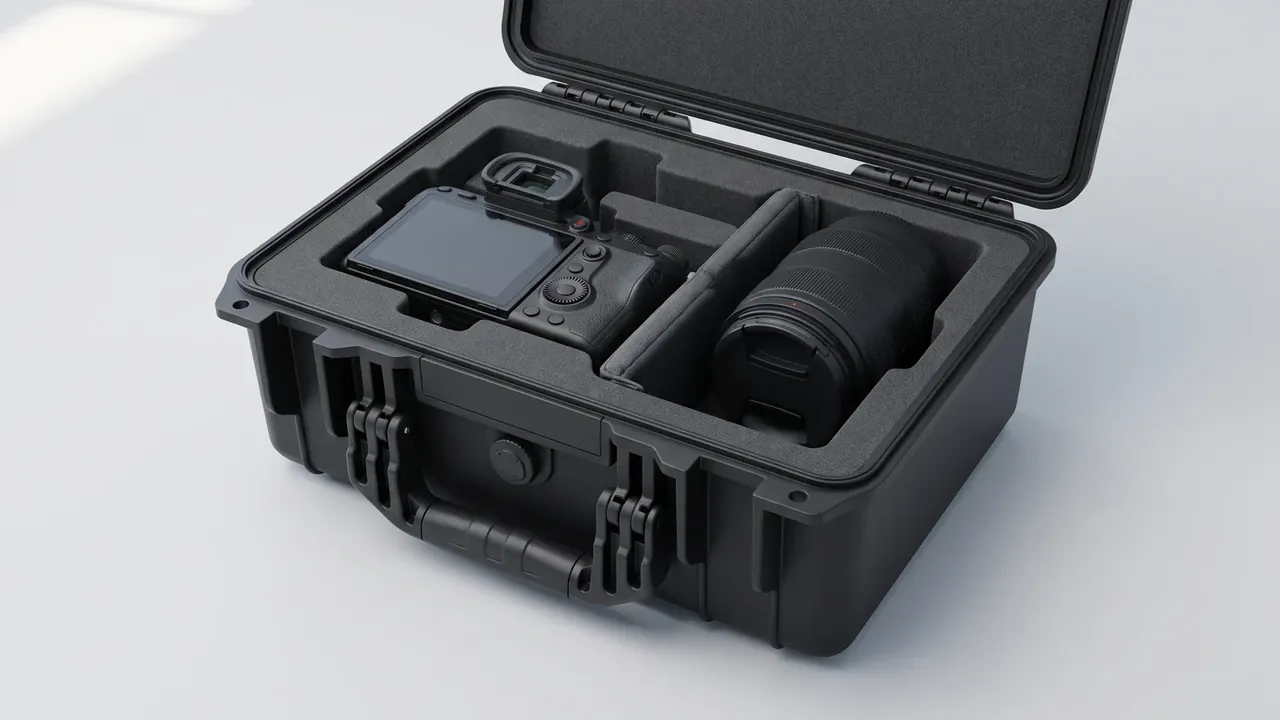
Put labels on the bay walls, not on the floor of each pocket. A label under the gear is pressed flat and half gone within a year; a 20 mm strip on the wall reads at a glance.
Change lenses with the body standing in its bay rather than on a table. Studio surfaces look clean, but most of the grit on them came off a tripod spike on the last location day.
Expansion comes from pulling a divider. Remove the middle board and 105 mm opens up, enough for a 70-200 mm laid flat. Stow the board under the lid foam so it is there when you need it back.
5. Transit and Check-in: Wheels, Latches, Pressure Valve
In transit the case takes loads that never occur during use.
The pressure valve is not decoration. Cabin pressure and ground pressure can differ by 0.6 bar, and a well-sealed case lands with the lid sucked down hard enough to need prying. Press the valve before check-in to equalise, then again on arrival.
A latch is only closed once it passes dead centre. Two latches share the load, each lands with a sharp click, and the body sits flush against the rim; a latch that is merely hooked pops the moment the handle takes weight. The latches are rated for 10,000 cycles, and in practice the click starts feeling soft around 6,000, which is a reasonable replacement signal.
Read the surface before you tow it. A 50 mm wheel rolls freely on terminal floors, but on gravel keep it under 3 km/h; dragging it sideways at an angle bends the axle, and after that it tracks off-centre for good.
Do not force a tripod in. A 480 mm folded tripod will not fit a 445 mm cavity, and laying it diagonally presses it against the lid foam, right where the body sits when the lid comes down.
6. Six Failures You Will See on Set
- Lens stowed without a rear cap: the mount rubs the foam and the pocket floor furs up, so line the pocket with 3 mm EVA
- Body placed screen-down: the display takes the load, so turn it screen-up and let the lid foam limit travel
- No foam in the lid: gear is pushed up and the latches need force, so add 15 mm egg-crate
- Wet case closed on location: water is trapped inside, so wipe the gasket groove before latching
- Handle lifted before the latch passes dead centre: the lid shifts, so press until it clicks and then walk
- Valve left unpressed at check-in: the lid has to be pried on arrival, so make the valve the first line of the pack-out list
The first three are fixed in the case; the last three are fixed in the habit, and a habit costs one sticker on the lid.
Conclusion
A camera equipment plastic hard case earns its price by matching the actions of the job, not by wall thickness. Wedding work wants speed, studio work wants order, transit wants pressure tolerance, and each maps to a different cavity and accessory set. Write down the daily opening count, the kit list and the way the case travels, and the specification mostly writes itself.
This article discusses only the container (case body) side of specifications and design intent, and does not cover any handling, loading or use of the contents.
Related Reading
- Camera case configurations for aerial and live-event work
- How to sequence a camera case selection
- The order of fitting foam inserts into a case
- Dimensions and tolerances for custom foam inserts
Related Products
- 8 Series — Gun Cases; Military Equipment Cases; Camera Equipment Cases; Drone Cases; Watch Cases; Knife Cases; First Aid Cases; Electronics Equipment Cases
- WL8-2812 PP Gun Case — model WL8-2812
- All protective cases and toolboxes: 7 series, 158 models