

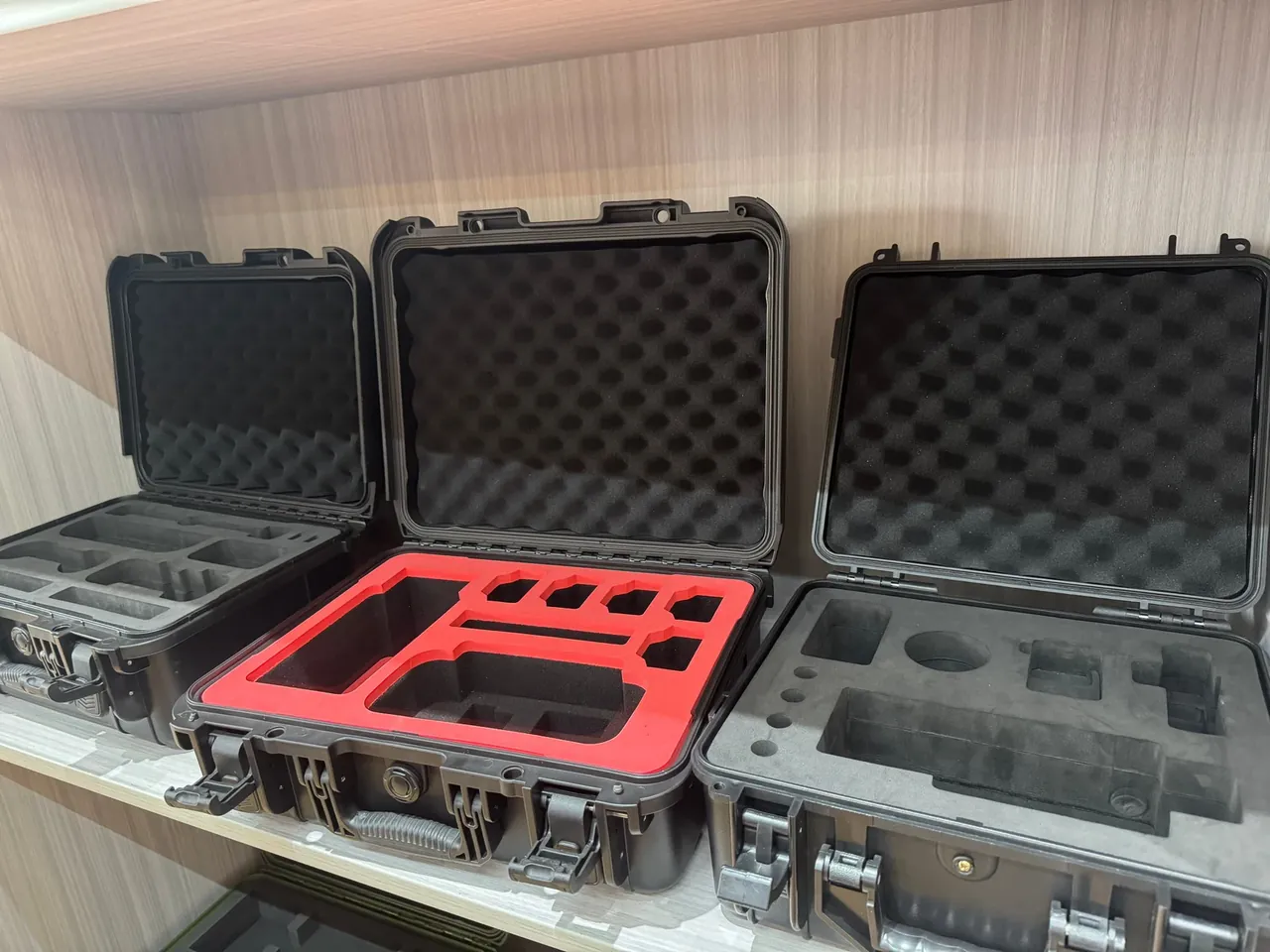
Quick answer: A camera jib arm control box protective case is judged at three contact points, the panel face, the joystick shaft and the connector block.
Table of contents
- Why a jib control box suffers more vibration than the camera
- How the joystick and fader sit in the foam
- Three cable routes through the connector zone
- Lining up the unpacking sequence on set
- Seals, condensation and the damp inside
- FAQ
1. Why a jib control box suffers more vibration than the camera
Jib arms travel in sections, and the camera jib arm control box protective case carries the one item with only a panel facing out. Joysticks and faders stand proud of that plate, so anything resting on it drives force down the shaft.
Arm lengths run 3–12 m and the matching boxes weigh 2.5–6 kg. Mass is not the trouble: the centre of gravity sits 20–30 mm behind the panel, so a hard brake puts 6 kg through a joystick cap 12 mm wide, near 5 MPa.
| Control box part | How force arrives | What the shell must do |
|---|---|---|
| Panel face | Flat pressure from stacked cases | Support the whole face |
| Joystick, fader | Point load plus shear | Wells with clearance |
| Connectors | Pulling, bending | Port square to the plug |
| Corners, latches | Drop impact | Ribs and thicker pads |
Vibration and impact fail the unit differently. Road vibration holds 30–80 Hz for hours and wears a flat on a carbon track, so the fader jumps at centre. A 1.2 m drop bends an unsupported panel 0.3 mm, enough to shift the mechanical zero.
Displacement comes first, not impact: 2 mm of slack lets the box slide 30 mm, and the panel meets the wall anyway.
2. How the joystick and fader sit in the foam
The panel is a flat plate, so the camera jib arm control box protective case insert supports all of it instead of four corner blocks. Spread over 300 mm by 220 mm, the same drop load falls to a tenth per unit area.
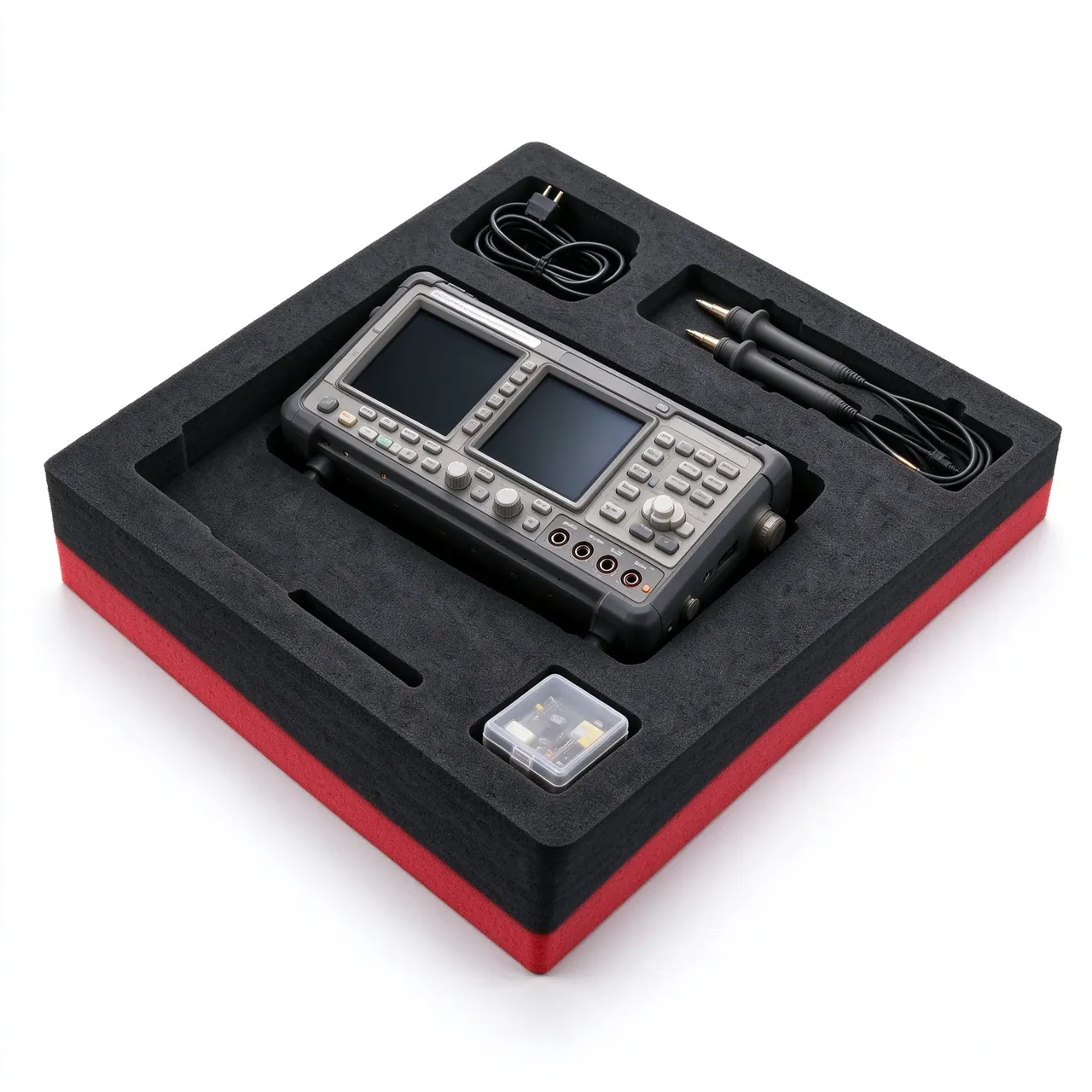
EVA at 45–65 kg/m³ holds up here. Under 45 kg/m³ the cell walls collapse at a cavity base, and over 65 kg/m³ it acts like a block. Cavities cut 0.4–0.6 mm undersize give about 12 N of grip, enough to keep the unit seated upside down.
The joystick gets its own well: 8–10 mm wider than the cap, 5 mm deeper than the exposed height, 3 mm more at the floor. A fader well is a racetrack on the travel axis, 6 mm clear on the short side.
One rejection line belongs on the drawing of any camera jib arm control box protective case: a joystick more than 1.5 mm off centre goes back for rework. At the slowest speed that becomes 40 mm of frame drift at the end of a 3 m front arm.
3. Three cable routes through the connector zone
With a plug inserted the cable is a 1.5 m lever, so movement loads solder joints rather than the panel, and a cracked joint is harder to fix than a bent plate.
| Cable route | Where it fits | What it costs |
|---|---|---|
| Panel exit, wall slot | Daily use, cable left plugged | Slot breaks the seal |
| Bulkhead gland | Cable stays with the case | 20 s per threading |
| Coiled inside | Long haul, air freight | 30 mm lid cavity, 8% of volume |
The slot is quickest to live with: cut it 2 mm wider than the cable, chamfer the lower edge at 15 degrees, and accept that IP67 immersion at 1 m for 30 min no longer holds.
A bulkhead gland fixes the connector and the inner cable length, so the plug never leaves its socket. Threads and an O-ring keep the case watertight, at the cost of a hole that cannot be redrilled.
Coiling inside a camera jib arm control box protective case is the conservative route. Plugs face the interior, the cable loops at a bend radius of ten times its diameter, and the block carries nothing. A 450 mm by 350 mm by 200 mm shell holds about 31 L, and a 30 mm lid cavity takes that to 28 L.
4. Lining up the unpacking sequence on set
Swap time is arithmetic. Stop the van, land the case, open the lid, pull the cable, power up, check the centre: a practised pair finishes those six moves inside 90 seconds.
The lid is the first wasted move. Release the rear latches of a four-latch case first and the foam holds the lid down. Open the two on the working side, lift to 100 degrees until the egg-crate lets go, then clear the rest.
Cable access is the second. Leads stored under the unit mean the unit comes out first. A two-level camera jib arm control box protective case keeps the box above and the cables in a tray beneath.
Checks on a camera jib arm control box protective case run on a clock too: 30 seconds for the gyro, then one sweep of the fader to each end, watching for lag on the return. Skip it and a bias found mid-take costs 6–8 minutes of recalibration.
Temperature is the forgotten variable. Bring a case from -5 °C outdoors into a 20 °C stage and the shell needs 25–35 minutes to come up; open early and condensate settles on the pins.
5. Seals, condensation and the damp inside
The tighter the seal, the harder it is for moisture to leave, so a camera jib arm control box protective case manages humidity rather than simply blocking water.
IP67 means dust tight plus immersion in 1 m of clean water for 30 min, under the method shared by GB/T 4208 and IEC 60529. Holding it takes a double-lip gasket compressed 30%–40% and latches rated 200–400 N, with no more than 15% spread across four, or one corner crushes while the other opens.
A sealed camera jib arm control box protective case also traps vapour caught at closing. The unit warms the air slightly in use, and the measured rise stays under 8 °C, so moisture drifts to the coldest surface, the inner wall, and beads there overnight.
Sizing the desiccant matters. 50–100 g of colour-indicating silica in a breathable bag, set into the lid foam, covers 25–35 L without taking cavity space, and beads turn blue to pink every 6–8 weeks in a wet season.
A pressure valve covers the rest. Airtight shells find their own leak when cabin pressure drops, so a breathable expanded PTFE valve high on the wall balances up to 10 kPa without letting water past.
Related Reading
- Rolling storage for a motorised slider controller
- Hard shells that carry camera and glass together
- Usable volume after corners take their cut
- How flight cases damp differently from hard shells
JUNZHIJIA
Related Products
- 8 Series — Gun Cases; Military Equipment Cases; Camera Equipment Cases; Drone Cases; Watch Cases; Knife Cases; First Aid Cases; Electronics Equipment Cases
- WL8-2812 PP Gun Case — model WL8-2812
- All protective cases and toolboxes: 7 series, 158 models