

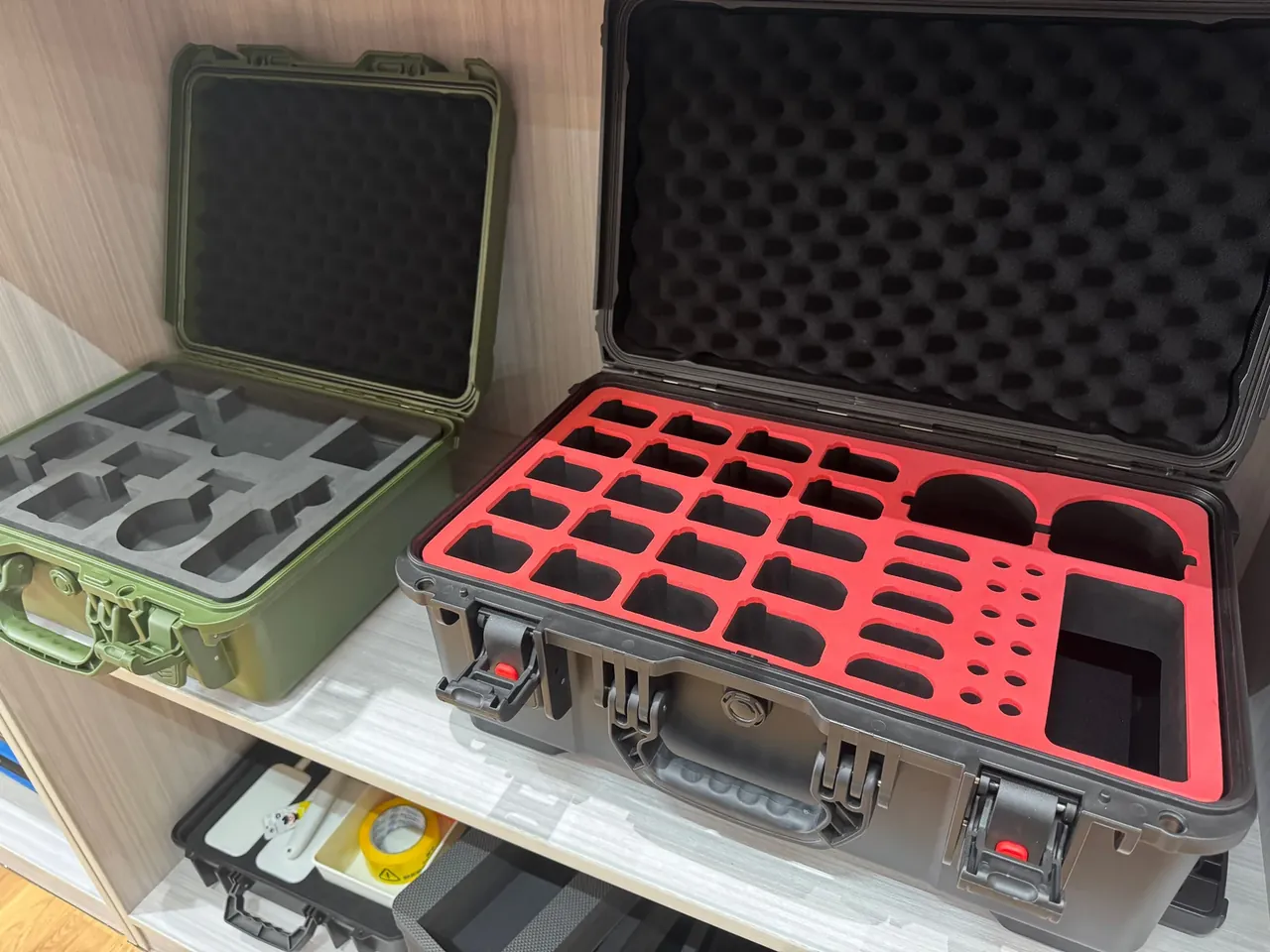
Quick answer: A car mount rig accessories protective case keeps 25–40 kg of cups, arms, counterweights and release heads apart through four moves a day, bay by bay.
Table of contents
- Why Metal-on-Metal Contact Ruins Rig Parts
- Layering Suction Cups and Arms
- Protecting Threads and Quick Release Heads
- Why Weights Get Their Own Bay
- Counting in Five Minutes at Each Move
- FAQ
1. Why Metal-on-Metal Contact Ruins Rig Parts
Most rig damage happens inside the box, not on the car. A van over a speed bump throws the case up 20–50 mm, then everything lands at once, heavy parts first, all into the same corner. A cup is a 150–200 mm aluminium disc with a thin rim, an arm a 0.5–2.0 m tube at 2 mm wall, a counterweight 2–10 kg of iron, and a release head holds a latch plate only millimetres thick.
The shell of a car mount rig accessories protective case absorbs only so much. What decides the outcome is a divider between two parts. Two metal items in one bay have no travel in which to lose energy, so impact passes straight through; a moulded divider gives that travel back.
Damage shows at the mating face, never in the paint. A dent in a latch plate opens a 0.2–0.5 mm gap once locked and the body rocks on the head. A rolled cup rim leaks air. A tube knocked oval will not take its connector.
2. Layering Suction Cups and Arms
The first rule is mass, not order of use: heavy parts on the base, light parts above, a divider between levels. If the insert of a car mount rig accessories protective case only follows outlines and ignores height, every part competes for one plane each time the case lands.
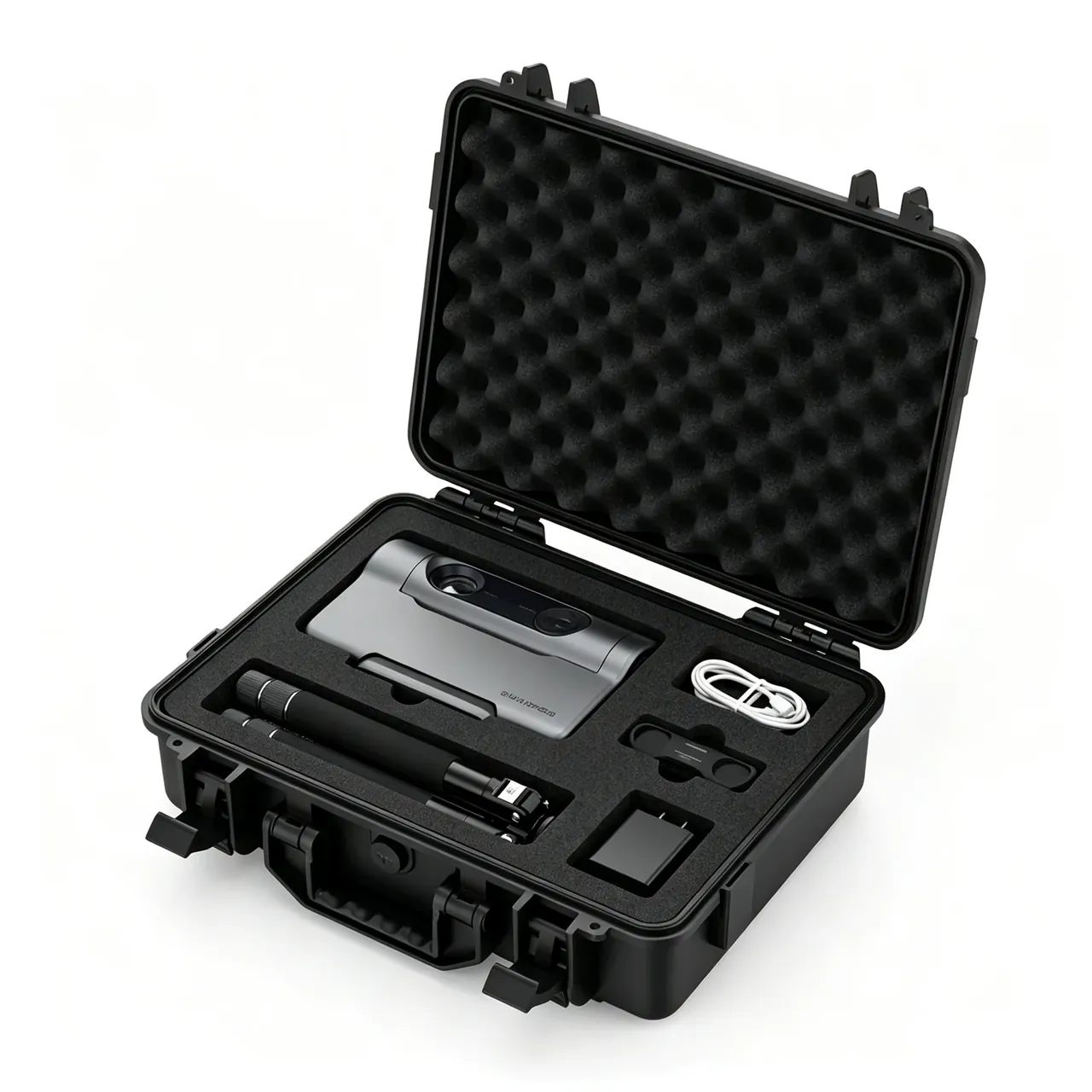
Cups take the lowest level, face down with the starter pin up so the pin carries nothing, and 10 mm of foam rib between neighbours so rims cannot bite. A 150 mm cup weighs about 340 g, light until its rim meets an arm.
Arms take the middle level of the car mount rig accessories protective case. Two 0.5 m arms sit side by side; a 2.0 m arm runs alone on the diagonal with 20 mm at each end for the caps, and a 5 mm EVA strip cut 30 mm long keeps one tube off the next.
Small parts take the top, one type per bay, where nothing carries weight and the count stays visible without unloading what is below.
| Part | Weight or size | Layer |
|---|---|---|
| Suction cup | 150–200 mm, about 340 g | Base, face down |
| Arm | 0.5–2.0 m tube | Middle, long side or diagonal |
| Counterweight | 2–10 kg | Base, own bay near centre |
| Quick release head | 100–200 g | Top, one per bay |
| Adapter screws | 1/4 and 3/8 mixed | Top, lidded box |
3. Protecting Threads and Quick Release Heads
Threads are the one part of a rig that cannot be repaired. The two in use are 1/4-20 UNC and 3/8-16 UNC, at pitches of 1.27 mm and 1.5875 mm, both fixed in ISO 1222. Once a crest deforms, no tap brings it back.
A car mount rig accessories protective case protects threads three ways: no contact, no load, no grit. Threads face up, threaded parts never sit under a weight, and each bay ends in a 3 mm debris channel so swarf falls clear.
Engagement is counted in threads. Three on 1/4-20 is about 3.8 mm; anything shorter concentrates stress on a few crests and the thread strips within a dozen cycles. Torque stays in the 8–15 N·m band, because above it the aluminium yields first.
The rule is blunt: a visible mark on a thread crest fails that bay, since a crest mark means the profile has already yielded and will pass damage to whatever goes in next.
Release heads get a cavity of their own, latch up and lever out, with 2 mm of interference to hold the part when the lid turns over. In a car mount rig accessories protective case a head never shares with a spanner, the one bare metal item allowed on that level.
4. Why Weights Get Their Own Bay
A counterweight is the densest item in the box. A 2–10 kg block is no bigger than a hand, and at equal drop height its energy scales with mass, so whatever it hits absorbs the difference. The bay wall runs 10 mm or more, with no shared wall against a neighbour.
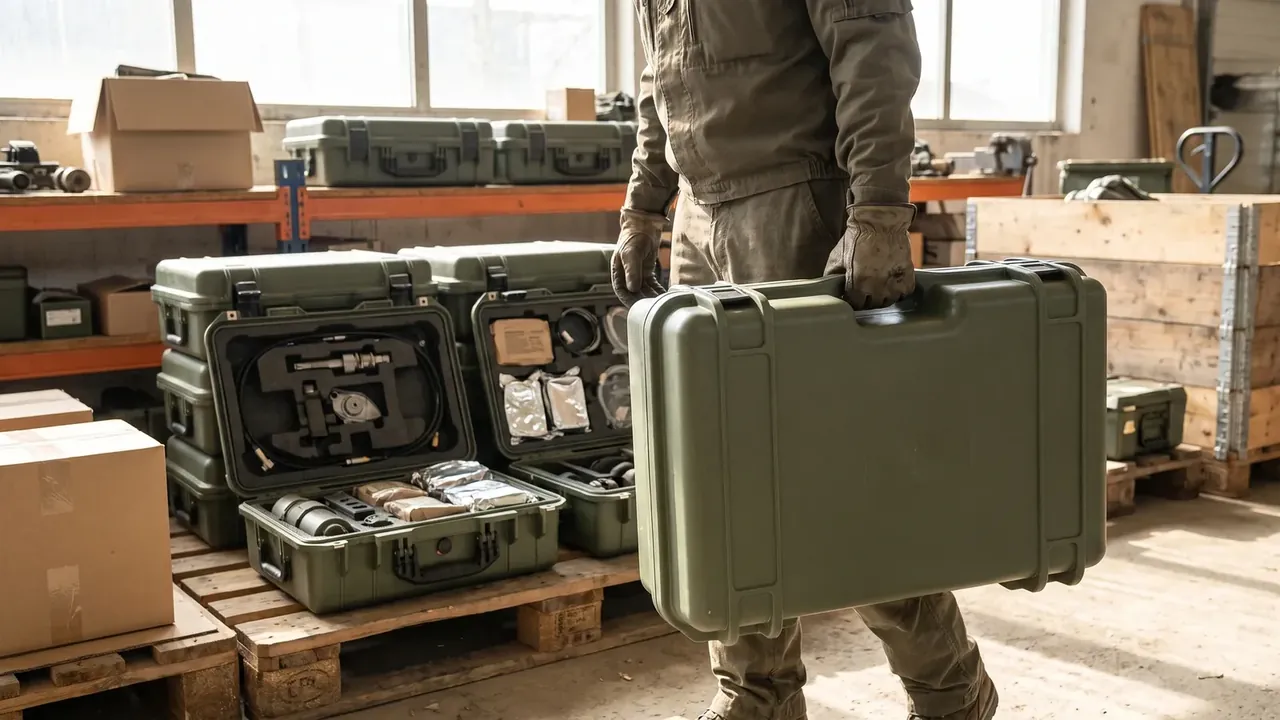
Position matters as much as thickness inside a car mount rig accessories protective case. The bay sits low and near the middle, so the mass hangs under the hand and the case does not swing. In a corner the same block loads one point, and a corner is where a moulded shell cracks first.
In a car mount rig accessories protective case, handles and base carry the load in one line. At 25–40 kg, with the weight making a quarter to a third, a handle fixed only to the lid twists the shell. It belongs on the side wall in line with the bay, which matters at three-high stacking.
5. Counting in Five Minutes at Each Move
A short route beats fast hands. Four moves a day at 5 min each is 20 min daily, and at 25 working days that passes 8 h a month. Number the bays of a car mount rig accessories protective case by row from one and the count becomes a read-down rather than a memory test.
Numbers go on the front wall of each bay at 8 mm minimum, white on dark foam, with a list in the same order inside the lid. A gap then tells the counter what is missing without tipping the case out.
| Count step | Who does it | Time |
|---|---|---|
| Open the lid, read bay numbers | Camera assistant | 60 s |
| Count cups and arms, check caps | Camera assistant | 45 s |
| Weigh the blocks, log the total | Rigging lead | 40 s |
| Check every release head latch | Rigging lead | 70 s |
| Photograph the open case | Camera assistant | 25 s |
The five steps total 4 min, leaving 1 min to log what needs logging: bay number, damage location, person responsible. Five minutes hold only when bay order, list order and count order agree.
Related Reading
- Choosing a shockproof trolley for slider motors on location
- Bay layout and cable routing for a motorised slider controller
- Plastic cases against timber crates for a camera truck
- Where the damping actually sits in a flight case
JUNZHIJIA
Related Products
- 8 Series — Gun Cases; Military Equipment Cases; Camera Equipment Cases; Drone Cases; Watch Cases; Knife Cases; First Aid Cases; Electronics Equipment Cases
- WL8-2812 PP Gun Case — model WL8-2812
- All protective cases and toolboxes: 7 series, 158 models