

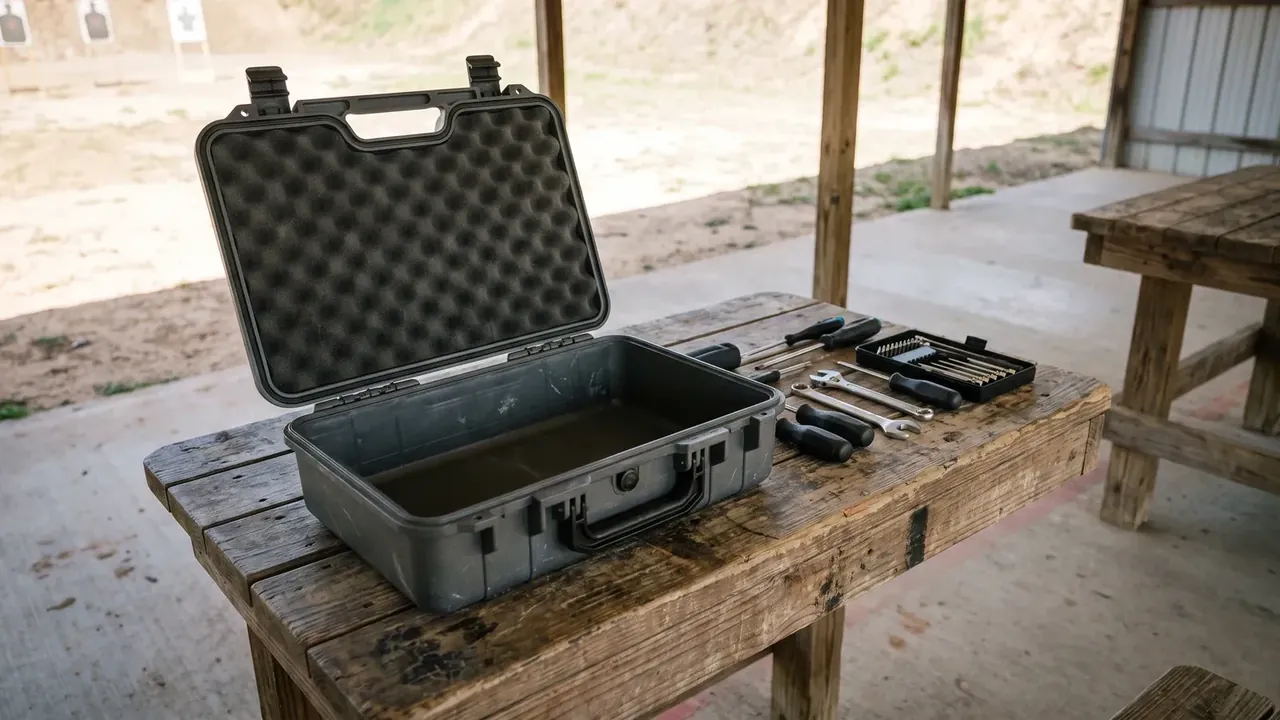
Quick answer: A cartridge box protects through five layers that act in order: how the shell is moulded, how wall thickness is spread, how the rim meets the gasket, how hinges and latches are fixed, and how the liner holds an item. A weak shell cannot be rescued by a better gasket. Each layer is broken down below with figures you can measure.
Table of contents
- Five Structural Layers of a Cartridge Box
- Material and Wall Thickness
- Moulding and Wall Evenness
- Sealing from Gasket to Pressure Valve
- Hinge, Latch and Foam Liner
- FAQ
1. Five Structural Layers of a Cartridge Box
A cartridge box does not protect by thickening one place. The shell gives shape and puncture resistance, the wall decides where a stack load collapses, the rim decides whether moisture enters, the hardware decides how many closings it survives, and the liner decides how far an item moves. A cracked shell makes a soft gasket irrelevant.
| Layer | Made of | Decides | Usual weak point |
|---|---|---|---|
| Shell | Injection or rotomoulded | Puncture, distortion | Thin corners, weld cracks |
| Wall | Wall and rib profile | Stack load, weight | Thin base, dished at three high |
| Seal | Rim flatness and gasket | Moisture and dust | Warped rim, no contact mid-span |
| Hardware | Hinge, latches, handle | Closing cycles | Worn pin bore, latch creep |
| Liner | Foam density, slots | Positioning | Shallow slots, item shifts |
Read it from outside in: close the box, look for light along the rim, press the base.
2. Material and Wall Thickness
PP keeps notch impact strength to minus 20 °C but marks; ABS holds a harder surface and cracks at corners in cold. Thickness is not strength: a mid-size body runs a 3.5 mm wall, 1.8 mm ribs and 8 mm rib height, and raising the wall to 5 mm adds 30 percent weight for about 10 percent stiffness, while two diagonal ribs add 40 percent for 8 percent.
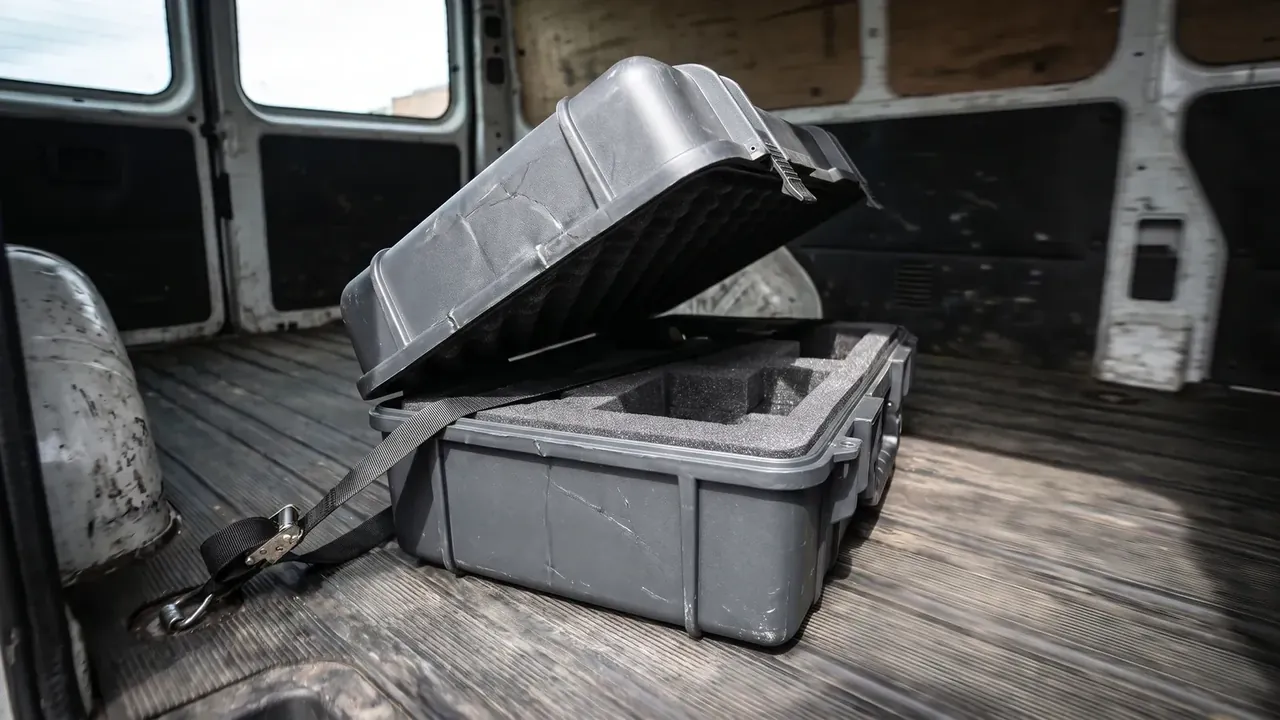
Measure with an ultrasonic gauge at nine points on the base and four on the walls, keeping the thinnest above 90 percent of nominal; thin spots sit opposite the gate and inside corners, where stress marks appear first.
3. Moulding and Wall Evenness
Injection moulding forces melt into a closed cavity at 60 °C tool temperature on a 110-second cycle, giving tight repeatability at volume. Rotomoulding tumbles powder for about 25 minutes, starts at 6 mm wall and suits large or short runs.
Evenness comes from gating and cooling: multi-point gates let melt reach the far end together, and waterways 12 to 15 mm from the cavity hold shrinkage uniform.
| Item | Injection moulding | Rotomoulding |
|---|---|---|
| Typical wall | 3.0–4.0 mm | 5.0–8.0 mm |
| Cycle | About 110 seconds | About 25 minutes |
| Economic run | Above 1000 pieces | 100–800 pieces |
4. Sealing from Gasket to Pressure Valve
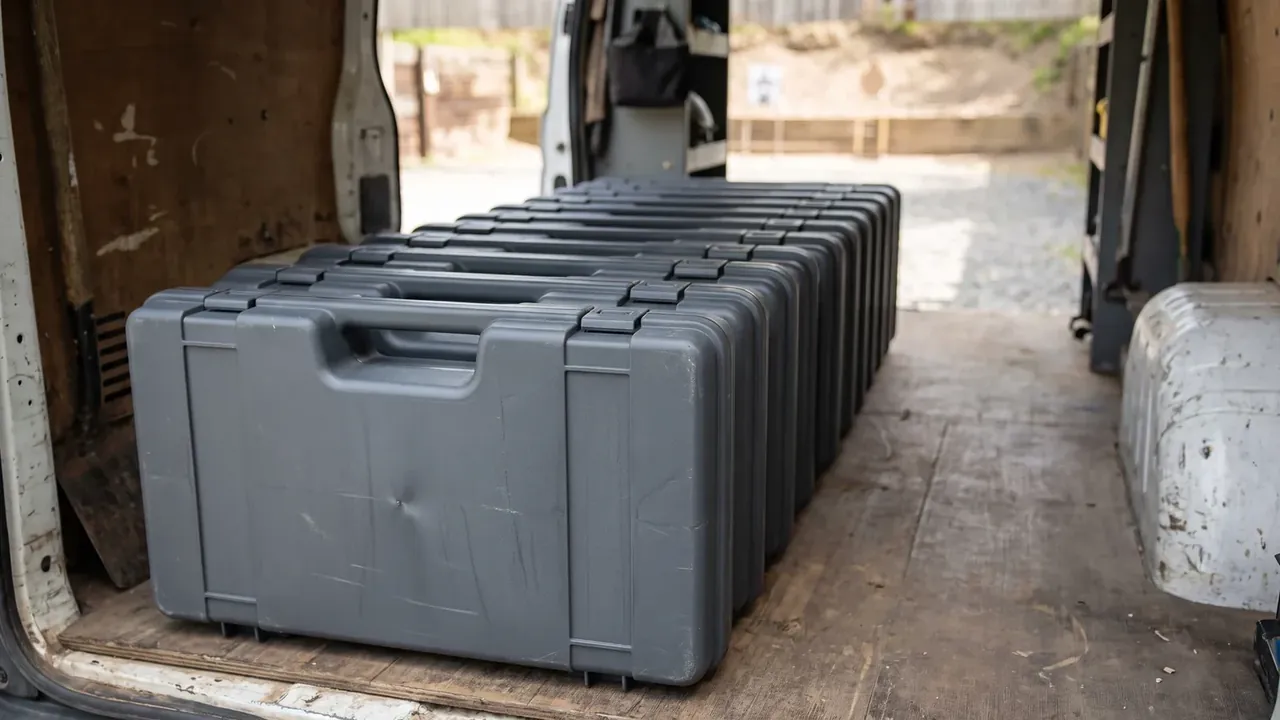
On a cartridge box, sealing depends on rim flatness within 0.5 mm, gasket compression near 25 percent on a Shore A70 nitrile ring, and latch pressure spread. Pressure is the overlooked part: move a box from a 30 °C store to minus 10 °C and the cavity goes negative, so a valve at 0.35 bar balances it without letting rain in.
| Failure point | Symptom | Cause |
|---|---|---|
| Rim mid-span | Light visible when shut | Flatness beyond 0.5 mm |
| Gasket joint | Local seepage | Poor splice bond |
| Latch seat | Loosens with use | Thin seat wall |
| Hinge bore | Lid sags | Excess pin clearance |
5. Hinge, Latch and Foam Liner
The hinge sets lid attitude: a PP living hinge lasts about 10,000 flexes, while a separate hinge runs a 3 mm stainless pin in a bore held within 0.1 mm; 0.2 mm lets the lid sag. Two latches give about 60 percent of end pressure at mid-span, so long bodies need three or four, and roughly 60 N opening force works.
The liner is not better for being softer: closed-cell PE at 45 kg/m³, slots 2 mm shallower and 1 mm narrower than the item, and a 10 mm cushion under the slot floor.
Conclusion
A cartridge box is not mysterious once the five layers are separated: the shell gives shape, the wall load capacity, the seal isolation, the hardware cycles, the liner position. Write those figures into the drawing and the inspection sheet and the box behaves predictably. Read any cartridge box that way and the judgement lands on one layer.
This article discusses only the container (case body) side of specifications and design intent, and does not cover any handling, loading or use of the contents.
Related Reading
- Shell materials compared: PP, ABS, PC and composites
- How to write dimensions and tolerances for a protective box
- Foam liner installation and how fit is judged
- Injection machine and clamp force: the equipment side
Related Products
- 8 Series — Gun Cases; Military Equipment Cases; Camera Equipment Cases; Drone Cases; Watch Cases; Knife Cases; First Aid Cases; Electronics Equipment Cases
- WL8-2812 PP Gun Case — model WL8-2812
- All protective cases and toolboxes: 7 series, 158 models