

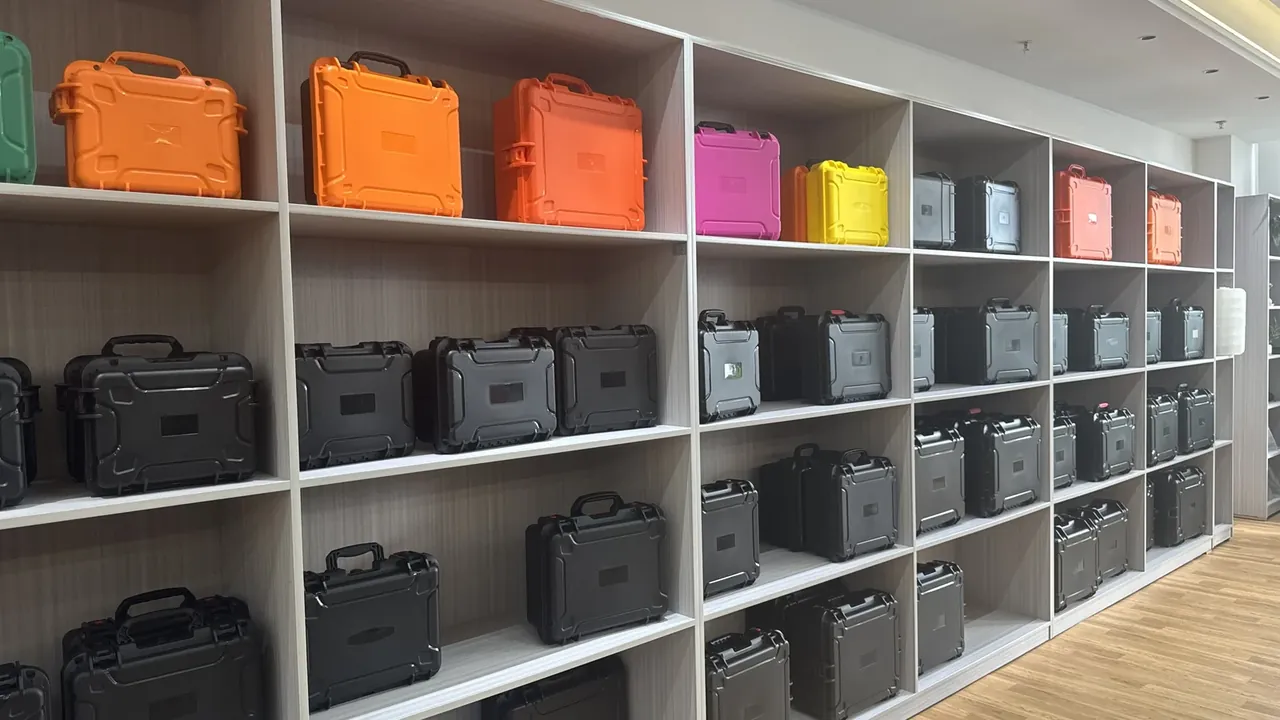
Quick answer: A cartridge safety case works in five settings: range carry, store room bins, agency issue, retail display and transport. Each one pulls capacity, empty weight, insert style and latch design in a different direction, so name the scene first and let dimensions follow.
Table of contents
- Cartridge Safety Case Scenarios and How Fittings Follow
- Range Carry: Truck to Firing Point
- Store Room Binning by Lot and Calibre
- Agency Issue and Humid Storage
- Retail Display versus Transport Stacking
- FAQ
1. Cartridge Safety Case Scenarios and How Fittings Follow
A range hut and a store room ask different things of one box: whether the handle cuts the hand, or how many units fit a shelf and whether the label reads at standing height. Name the scene, then derive capacity, weight and insert.
Five settings differ on four lines: who carries it, how far, how often it opens, and the climate. Past 50 m, each 0.5 kg of empty weight must be paid back in handle width; past 20 cycles a day, latch life outranks wall thickness.
| Setting | Capacity | Empty weight | Insert | Key fitting |
|---|---|---|---|---|
| Range carry | 12–18 L | 2.2–2.8 kg | Tray | Lid stop |
| Store bins | 25–40 L | 3.4–4.2 kg | Grid | Label slot |
| Agency issue | 8–12 L | 1.8–2.4 kg | 6 cells | Two-action latch |
| Retail display | 6–10 L | 1.6–2.0 kg | Clear liner | Window |
| Transport | 30–45 L | 3.8–4.6 kg | Divider | Corner guards |
Insert space comes out of internal volume: a liner takes 12–18 mm per side and 8 mm in height, so a cartridge safety case sold as 15 L delivers 12 L.
2. Range Carry: Truck to Firing Point
The sequence is fixed: lift from the truck, walk 30–60 m, set the case right of the firing point, open, take one cell, close.
A 28 by 12 mm handle with a 110 mm grip lets a loaded 18 kg case travel 50 m without a hand change. A lid opening to 105 degrees, with two ribs acting as a stop, will not fall back. Each cartridge safety case on site stacks no more than three high, because the fourth tier loads the latches instead of the walls. Sand detail: 12 mm feet that clear grit, and 30 percent gasket squeeze recovering in two seconds.
3. Store Room Binning by Lot and Calibre
In the store the keyword is find it once. Once a cartridge safety case is shelved, retrieval follows the label, not memory, so rack, position and cell numbers sit on one label 15 mm above the front lower edge.
At a 450 mm shelf pitch, six units per level and three levels form a lot column of 18. Labels run 60 by 40 mm, and 25 mm divider steps keep calibres apart in 120 by 90 by 60 mm cells.
| Store parameter | Value | Why |
|---|---|---|
| Shelf pitch | 450 mm | 60 mm lid clearance |
| Units per level | 6 | Within one-arm reach |
| Lot column | 18 units | Matches a stocktake line |
| Label | 60 by 40 mm | Readable at 2 m |
| Divider step | 25 mm | Covers three calibres |
Counting 18 units by cell takes 15 minutes, a barcode pass about 4.
4. Agency Issue and Humid Storage
An issued case travels with a person, so it answers two questions: whose is it, and can it open by accident. Two units per vehicle, six cells of 15 rounds, 4.2 kg loaded, and a two-action latch needing 35 N plus an 8 mm slide, workable through a glove.
Identification sits on the body: an eight-digit laser mark on the lid, matching a handover card in an 85 by 55 mm pocket inside. Humid storage adds 30 days at 40 degrees Celsius and 90 percent humidity, 30 g of desiccant, a 40 percent indicator card, and lids open under 3 minutes. Treating the case as a dry cabinet is the usual error: the gasket blocks outside moisture, but desiccant still handles what is inside, swapped when the card turns.
5. Retail Display versus Transport Stacking
Display and transport pull opposite ways: display wants a case that shows its contents, transport wants one that resists five tiers of load. A cartridge safety case covers both through lid and base.
A sample carries a 2 mm polycarbonate window and 3 mm dust lip, with colour difference within Delta E 1.5 under 400 to 600 lux. Shipping swaps that window for a closed lid and eight corner guards, and 60 units per pallet take 90 kg static for 24 hours with deflection under 2 mm. Sample life counts 5,000 cycles a year, shipping life counts drops: never merge the ledgers.
Conclusion
Scene first, fitting second, dimensions last; reverse that order and every choice is a compromise. Put the scene in the purchase order, and a cartridge safety case follows it.
This article discusses only the container (case body) side of specifications and design intent, and does not cover any handling, loading or use of the contents.
Related Reading
- How a cartridge safety case is built
- Fitting differences across cartridge case applications
- Sizing a cartridge transport box
- Common problems with cartridge storage boxes
Related Products
- 8 Series — Gun Cases; Military Equipment Cases; Camera Equipment Cases; Drone Cases; Watch Cases; Knife Cases; First Aid Cases; Electronics Equipment Cases
- WL8-2812 PP Gun Case — model WL8-2812
- All protective cases and toolboxes: 7 series, 158 models