

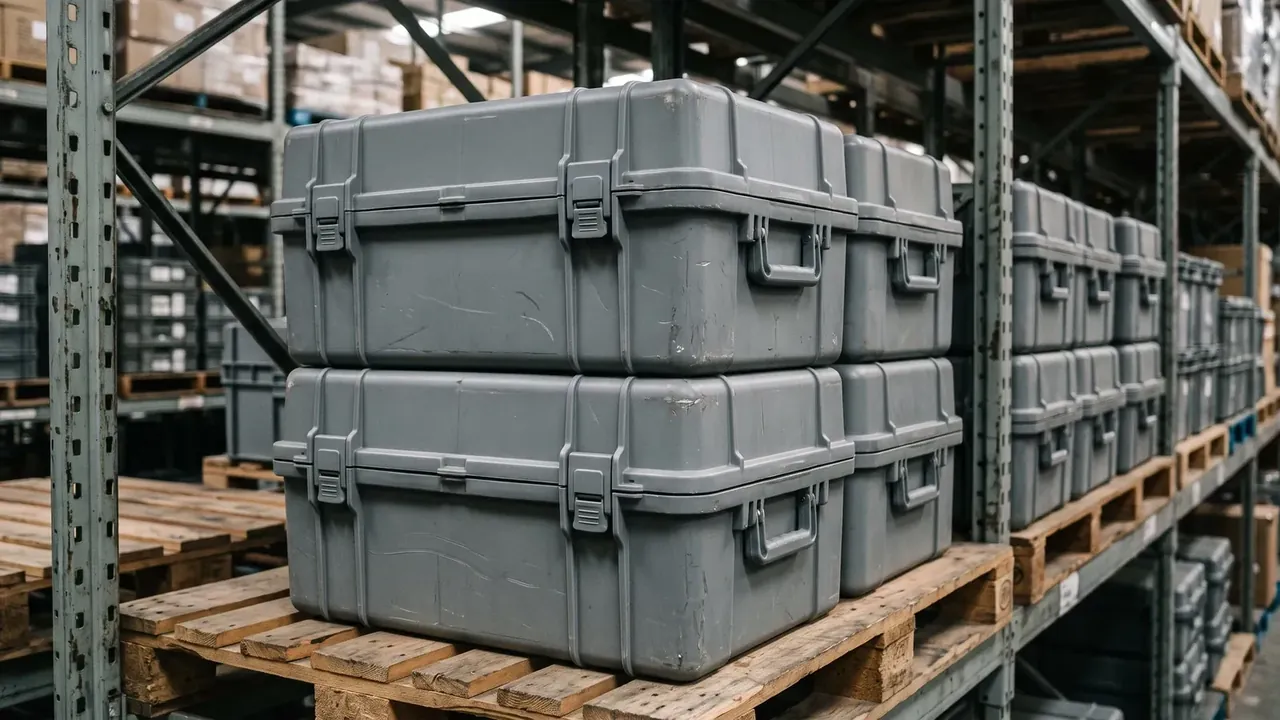
Quick answer: The gap to steel cases, cartons, soft bags and timber crates is not one number. It is four trades: mass against impact margin, sealing against moisture, cycles against cost per trip, and moulded interfaces against dock time.
Table of contents
- How It Compares with Four Alternatives
- Impact and Rebound Against Steel
- Moisture and Stacking Against Corrugated
- Fixing and Weight Against Soft Bags and Wood
- Cost and Replacement Rhythm
- FAQ
1. How It Compares with Four Alternatives
Put a cartridge transport box beside four common answers and price is not the first column. At 38 litres it weighs 5.4 kg, steel 9.8 kg, aluminium 6.9 kg, a five-wall carton 1.6 kg and a plywood crate 8.2 kg. Per pallet of 12, that gap becomes payload.
Cycles pull prices onto one scale: 3000 openings for a cartridge transport box, 800 before steel corners deform, 500 before an aluminium hinge loosens, one trip for corrugated, six for plywood.
| Option | Mass, 38 L | Stacking | Sealing | Cycles |
|---|---|---|---|---|
| Moulded box | 5.4 kg | 4 high | IP65 | 3000 |
| Steel case | 9.8 kg | 5 high | IP65 | 800 |
| Aluminium case | 6.9 kg | 4 high | IP54 | 500 |
| Five-wall carton | 1.6 kg | 3 high | None | 1 |
| Plywood crate | 8.2 kg | 3 high | None | 6 |
Interfaces never reach the table: fork pockets and strap grooves are moulded in one shot, where steel needs welding and cartons need film.
2. Impact and Rebound Against Steel
Steel is stiff, and stiffness cuts both ways. Dropped 1.2 m on a corner, a steel case peaks near 95 g and leaves a 6 mm dent, while a cartridge transport box peaks near 60 g and rebounds 18 mm against 42 mm, so the steel shell bounces twice and the straps work loose.
A dent is not cosmetic: once a steel wall moves 6 mm the cavity changes, the insert stops fitting, and the next trip needs panel work and three days. Moulded corners take four screws and twenty minutes.
Heat differs too: steel conducts at 45 W per metre kelvin against 0.2 for polymer, so a steel skin beads water within minutes of leaving a minus 10 Celsius truck.
3. Moisture and Stacking Against Corrugated
Carton arithmetic goes wrong most often. A five-wall board rates about 7.5 kN per metre in edge crush when dry, enough for five high. At 85 percent humidity for 30 days 65 percent remains, and collapse starts near day 22, bottom corners first. The shell of a cartridge transport box absorbs under 0.01 percent and stays dry after a 30 minute spray.
Stack height follows: in a 4.5 m warehouse cartons stop at three high for a moisture margin, while a cartridge transport box built for four reaches 3.2 m, about 30 percent more stock per square metre.
Cartons still earn a place: they fold down 80 percent for the return leg. That fits one-way, dry routes; on repeated trips the saving is repaid at the second reorder.
4. Fixing and Weight Against Soft Bags and Wood
Soft packaging fails on predictability, not strength. A woven bag punctures at 12 N, and once roped it shifts up to 40 mm, so a stack leans. A cartridge transport box has four locating recesses that hold movement within 3 mm, so nobody climbs down to straighten a load.
Timber brings paperwork: an export plywood crate needs 30 minutes at 56 Celsius, or an ISPM15 mark, adding 24 hours, and at 8.2 kg it eats payload.
Payload ratio lands it for a cartridge transport box: 60 kg on 5.4 kg of shell, one to eleven; steel 80 kg on 9.8 kg, one to eight; plywood 45 kg on 8.2 kg, one to five.
5. Cost and Replacement Rhythm
Unit price covers only the first payment. Divide it by cycles: a cartridge transport box costs 260 over 3000 trips, 0.09 each; steel 470 over 800, 0.59; plywood 120 over 6, twenty; a carton 32 for one.
| Option | Price | Cycles | Per trip | Disposal |
|---|---|---|---|---|
| Moulded box | 260 | 3000 | 0.09 | Regrind |
| Steel case | 470 | 800 | 0.59 | Scrap weight |
| Plywood crate | 120 | 6 | 20 | Burn or landfill |
| Five-wall carton | 32 | 1 | 32 | Paper recycling |
Maintenance shapes the rhythm: latches at 6 and gaskets at 9, swapped in ten minutes, against panel work from 40 upward. Over five years moulded repairs stay under a tenth of the purchase price, steel nearer a third.
Conclusion
The question is not which option is toughest, but where each puts its cost. Steel buys stiffness with mass, cartons buy price with one trip, bags buy shape with uncertainty, timber buys reliability with paperwork. A cartridge transport box trades mass for cycles, and that is the lane to buy it for.
This article discusses only the container (case body) side of specifications and design intent, and does not cover any handling, loading or use of the contents.
Related Reading
- Routine checks and replacement lines
- Buying a cartridge transport box
- How cartridge box materials differ
- Storage boxes against the alternatives
Related Products
- 8 Series — Gun Cases; Military Equipment Cases; Camera Equipment Cases; Drone Cases; Watch Cases; Knife Cases; First Aid Cases; Electronics Equipment Cases
- WL8-2812 PP Gun Case — model WL8-2812
- All protective cases and toolboxes: 7 series, 158 models