

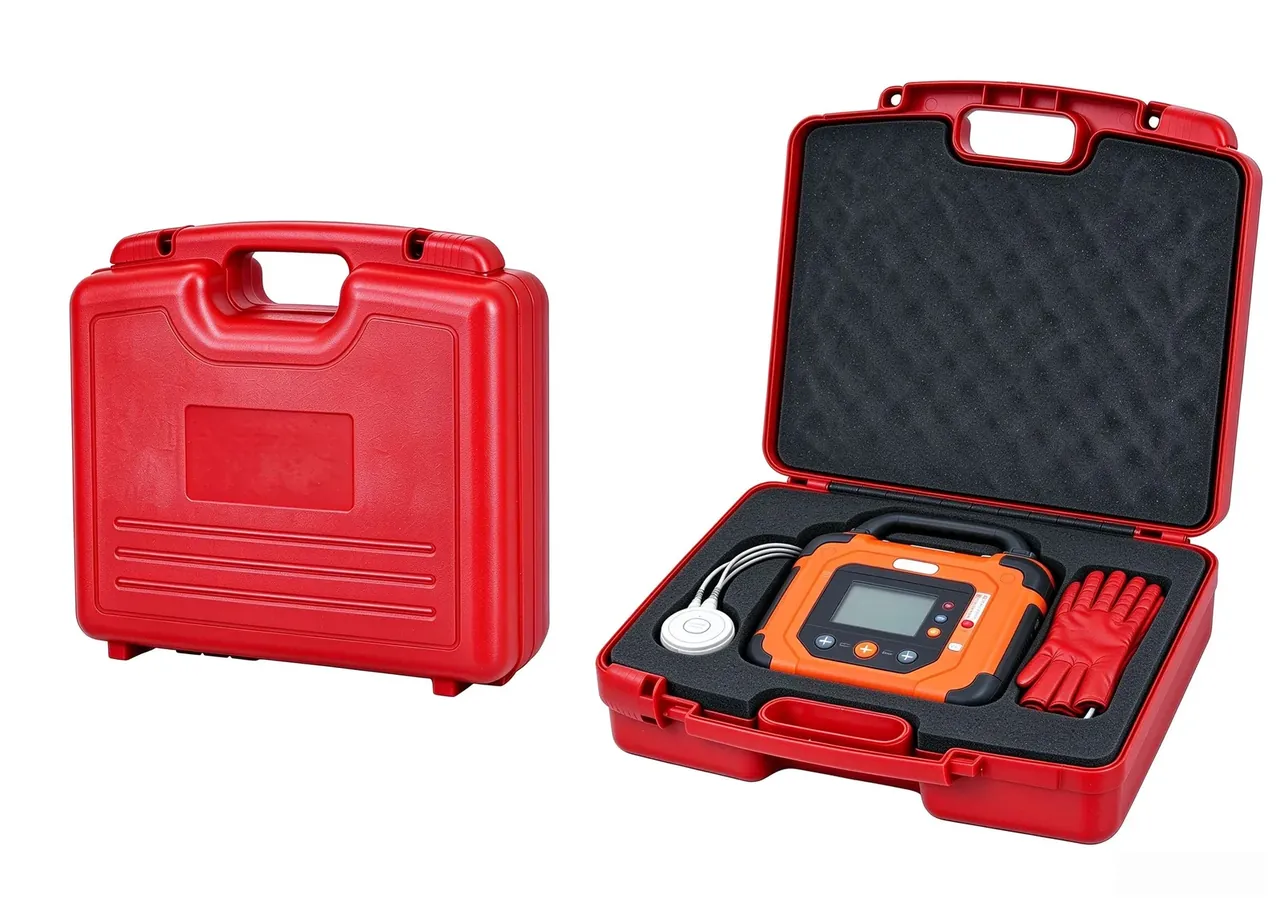
Quick answer: At 1 mm a case anti slip pattern gives 0.31 wet friction, at 2 mm 0.46, so push-off rises from 76 N to 113 N. The price is a base wall cut from 2.2 mm to 1.2 mm and a wash time from 25 s to 45 s.
Table of contents
- A Chilled Dock Teaches the First Lesson
- Grip on Dry, Wet and Frosted Floors
- Standing Water, Trapped Dirt and Ice
- Demoulding, Etching Cost and Base Thickness
- FAQ
1. A Chilled Dock Teaches the First Lesson
A hosed dock holds a 0.5 mm water film. Push two 25 kg samples with 40 N sideways: the 1 mm case slides 0.24 m, the 2 mm case stops at 0.16 m.
Those 8 cm come from drainage: the 1 mm grooves fill and the crests ride water, while 2 mm grooves still shed it.
A 3.2 mm base wall leaves 2.2 mm under 1 mm and 1.2 mm under 2 mm, so extra grip comes out of the floor.
| Depth (mm) | Dry friction | Wet friction | Frost friction | Residual water (mL) | Wall left (mm) |
|---|---|---|---|---|---|
| 0.5 | 0.52 | 0.26 | 0.14 | 6 | 2.7 |
| 1.0 | 0.58 | 0.31 | 0.18 | 11 | 2.2 |
| 2.0 | 0.64 | 0.46 | 0.27 | 18 | 1.2 |
| 3.0 | 0.66 | 0.51 | 0.33 | 27 | 0.2 |
2. Grip on Dry, Wet and Frosted Floors
Dry concrete barely separates them: 0.58 against 0.64 at 2 mm. Wet, the spread opens to 0.15 — 0.31 against 0.46 — and 0.30 is the line below which a case creeps.
Frost is harder. Outside a −18 ℃ freezer the 1 mm pattern reads 0.18 against 0.27, close to the 0.10 of bare ice.
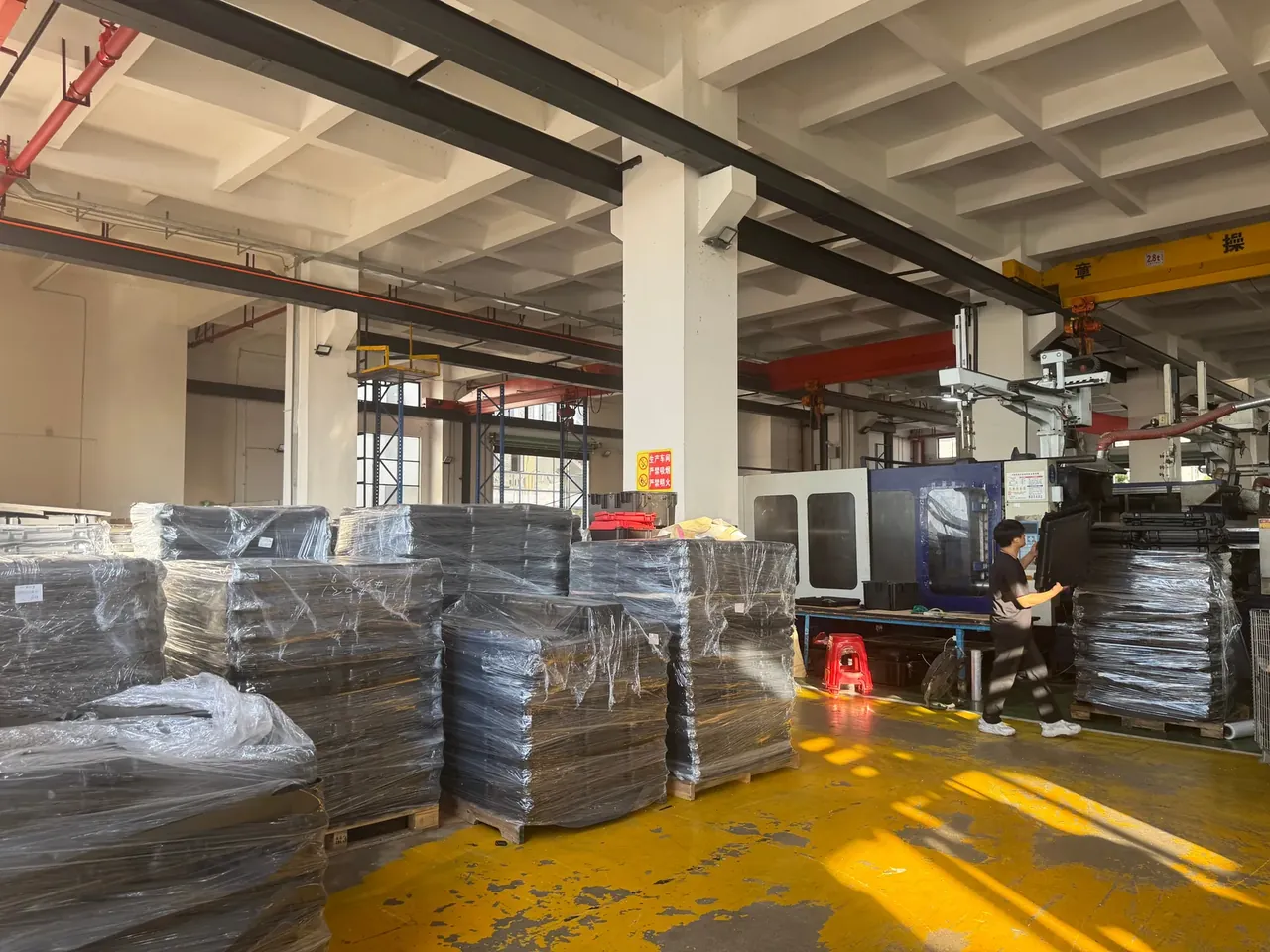
Depth stops paying past 2 mm: 1 to 2 mm adds 0.15 wet, 2 to 3 mm adds 0.05 and leaves 0.2 mm of wall.
Layout matters: straight grooves along the push give 0.38 wet at 2 mm, a 45-degree grid 0.46.
Contact area explains it: 1.2 mm crests at 6 mm pitch touch 32% of the floor, while 2 mm narrows crests to 0.8 mm at 8 mm pitch, cutting contact to 22% and raising point pressure from 0.28 MPa to 0.42 MPa.
3. Standing Water, Trapped Dirt and Ice
A 1 mm pattern leaves 11 mL and 2 mm leaves 18 mL; the extra 7 mL rides into the freezer.
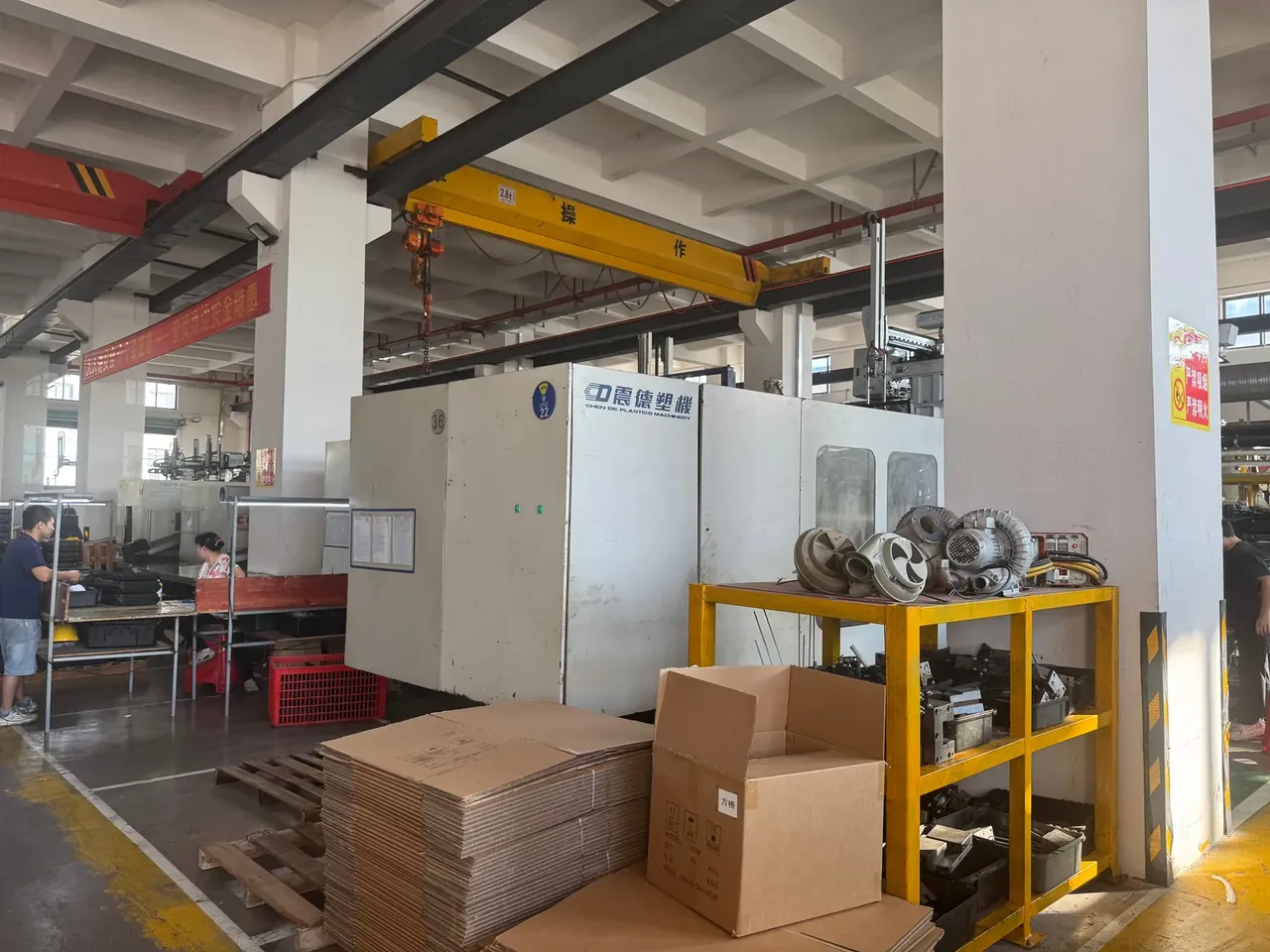
Dirt is worse: a 1 mm groove clears in 25 s with a 3 mm brush, while 2 mm needs a 5 mm head for 45 s.
At 800 cases a day that 20 s becomes 4.4 labour hours, 56,000 CNY a year at 35 CNY an hour.
Sludge dries in the grooves, so 2 mm needs a 0.8 MPa nozzle blowing 3 s before packing.
Ice is the hidden cost: 18 mL freeze into 0.4 mm within 40 minutes outside a −18 ℃ store, dropping wet friction from 0.46 to 0.22; 11 mL builds 0.2 mm and holds 0.35.
Groove radius decides whether mud leaves: R0.5 lets a brush reach 90%, R0.2 leaves a 0.6 mm band, and 2 mm at R0.5 cuts wash time from 45 s to 36 s.
4. Demoulding, Etching Cost and Base Thickness
Depth lives in the tool. A 1 mm pattern is etched with the cavity; 2 mm needs 1.2 mm channels roughed into the core first, adding 6,800 CNY per tool. Etching goes from two passes at 2,400 CNY to three at 4,100 CNY, so tooling is 8,500 CNY heavier, or 0.17 CNY a case across 50,000 units.
| Item | 1 mm pattern | 2 mm pattern |
|---|---|---|
| Core roughing (CNY) | 0 | 6,800 |
| Etching (CNY) | 2,400 | 4,100 |
| Ejection force (kN) | 14 | 19 |
| Ejector pins | 6 | 9 |
| Wash per case (s) | 25 | 45 |
| Added weight (g) | 0 | 180 |
A 2 mm groove undercuts the pull: ejection rises from 14 kN to 19 kN, pins go from 6 to 9, and a 0.15 mm white mark shows inside.
Draft grows with it: 1 mm releases at 1.5 degrees of groove wall, 2 mm needs 3 or the wall traps a vacuum and pulls a 0.2 mm streak; the wider channel adds 8% to drainage, so grip holds.
Thickness is most often skipped: 2 mm in a 3.2 mm wall leaves 1.2 mm, and a 1 kg ball from 1 m cracks it in three hits. Restoring 2.4 mm means a 4.4 mm base, 180 g and 0.9 CNY of material.
The 1.5 mm middle setting leaves 1.7 mm of wall, 0.40 wet friction, 13 mL residual, 32 s of washing and 3,200 CNY of tooling.
Conclusion
Depth in a case anti slip pattern settles on wet friction and wash time. 0.30 is the safety line and 0.46 the comfortable one, a span that costs 0.5 mm of depth. Wash cost climbs from 25 s to 45 s, and 56,000 CNY a year never shows on a tooling quote. Cold stores want 2 mm on a 4.4 mm base; warehouses are served by 1 mm at 0.58 dry, saving 8,500 CNY and half the wash hours; unclear cases land at 1.5 mm, 0.40 and 32 s.
This article discusses container-side specifications and design implications only, and does not cover any handling, loading or use of the contents.
Related Reading
- Anti-slip feet for protective cases
- Wall thickness and impact strength
- Where tooling cost sits in the case price
- How to lay out base ribs
Related Products
- 8 Series — Gun Cases; Military Equipment Cases; Camera Equipment Cases; Drone Cases; Watch Cases; Knife Cases; First Aid Cases; Electronics Equipment Cases
- WL8-2812 PP Gun Case — model WL8-2812
- All protective cases and toolboxes: 7 series, 158 models