

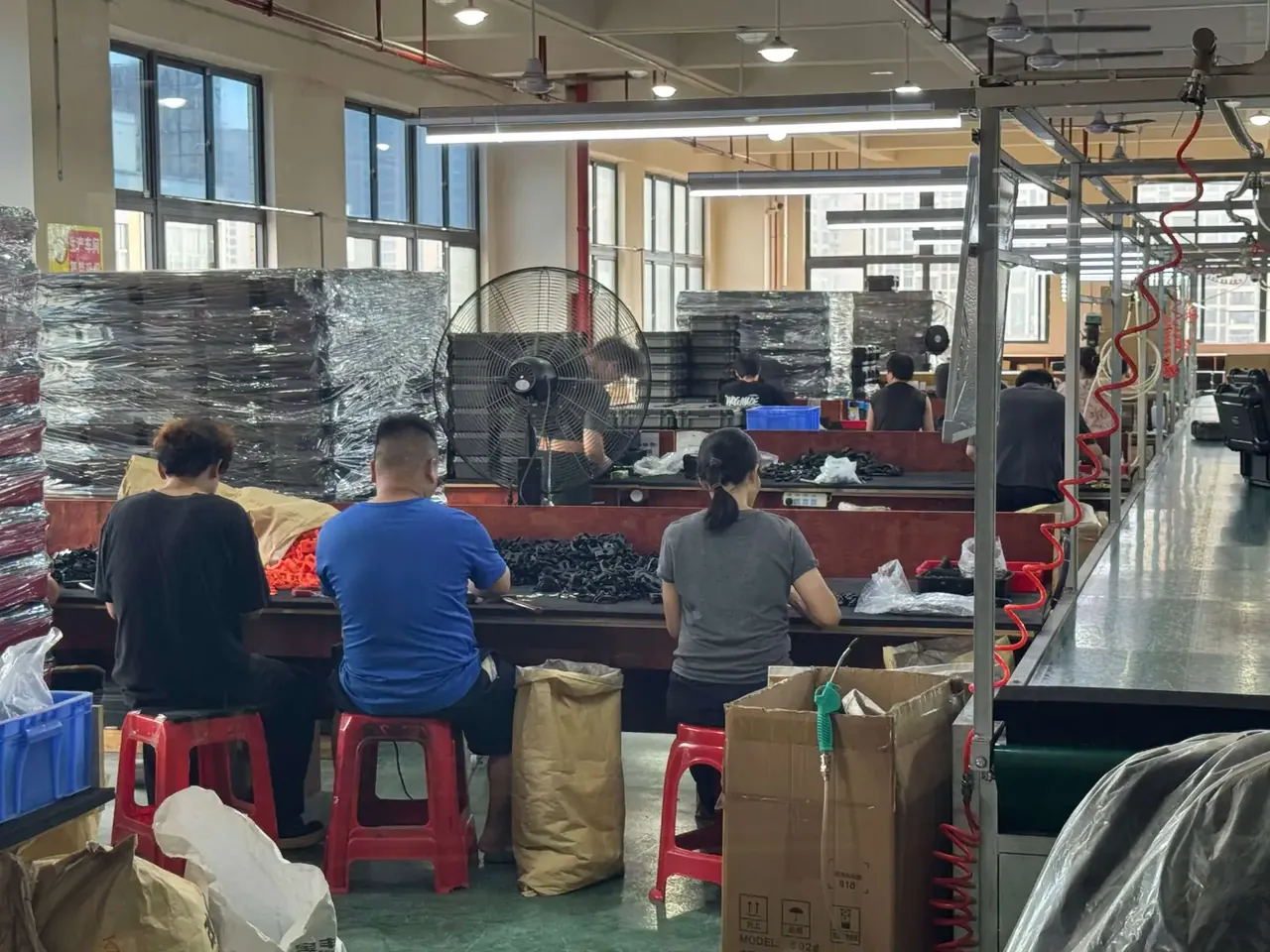
Quick answer: A case spends 396 seconds at a Case Assembly Workstation, and about 75 of them go to three motions that add no value: picking, flipping and self-check.
Table of contents
- The Takt of a Case Assembly Workstation Hinges on Three Motions
- Picking: Turn a Reach into a Hand-Off
- Flipping: Count the Turns, Watch the Centre of Gravity
- Self-Check: Turn Judgement into a Motion
- Recalculating Takt: Where the Saved Time Goes
- FAQ
1. The Takt of a Case Assembly Workstation Hinges on Three Motions
One case takes 396 seconds across five stations. Only 214 seconds change its state; the other 182 go to handling, waiting and three motions that repeat most: 18 picks, four flips, three checks, 75 seconds.
Assembly skill cannot be squeezed much further, but each of those 25 motions has a path worth shortening. Film 20 cycles at the Case Assembly Workstation and multiply each motion by its time.
| Motion | Each | Per case | Total | Recoverable |
|---|---|---|---|---|
| Picking | 1.4 s | 18 | 25.2 s | 9 s |
| Flipping | 6.5 s | 4 | 26 s | 19 s |
| Self-check | 8 s | 3 | 24 s | 12 s |
| Assembly | 12 s | 18 | 214 s | Limited |
2. Picking: Turn a Reach into a Hand-Off
At a Case Assembly Workstation, distance decides the motion. Material 600 mm away makes the operator lean and pull back, 1.4 seconds a pick; inside 300 mm in a tilted bin it needs only a lift, 0.9 seconds. Half a second, eighteen times, is nine seconds a case.
Feeding sets the distance, not operator speed. A sequenced cart holds parts in assembly order, so the hand lands on the next part; a chute loaded from the back keeps replenishment off the bench. Past six part numbers, wrong-part risk climbs from 0.4 to 1.8 percent, and a wrong pick costs three minutes.
| Feeding | Pick time | Wrong-part risk | Replenish |
|---|---|---|---|
| Tilted bin | 1.2 s | Medium | Every 45 min |
| Gravity chute | 1.0 s | Low | Every 2 h |
| Sequenced cart | 0.9 s | Lowest | Every 4 h |
3. Flipping: Count the Turns, Watch the Centre of Gravity
A 620 × 460 × 230 mm shell weighs 4.2 kg empty and 5.6 kg with hardware, centre of gravity toward the lid. Four manual turns cost 6.5 seconds each, 26 seconds in total, and each one presses finished parts into the bench.
Four turns come from scattered operations: feet, hinges, latches, upright. Merge the two side operations into one posture and the count drops to two. A single-axis fixture on the Case Assembly Workstation does it: a 200 mm bench slot, two bearing blocks, a clamp collar, detent pins. Clamping under 150 N leaves no mark, and two turns take 7 seconds instead of 26. Above 12 kg, a two-axis table removes it but adds 0.4 square metres.
4. Self-Check: Turn Judgement into a Motion
Self-checks are slow because each is a decision, and decisions depend on how tired the operator is. Replace the decision with a comparison and time falls at once.
Rim flatness takes a 0.3 mm feeler gauge; if it enters, the case is out. Latches are trial-closed four times, counting two positive clicks. The liner is pressed at four corners with the palm, listening for a hollow tap. Three checks fall from eight seconds to six, not by hurrying but by giving each motion a visible result.
Keep the points few: three per case is remembered, seven turns the last three into theatre. Rework drops from 3.5 to 1.2 percent, which beats adding an inspector at the end of the Case Assembly Workstation.
5. Recalculating Takt: Where the Saved Time Goes
Add the savings at a Case Assembly Workstation: 9 seconds from picking, 19 from flipping, 12 from checking. The case drops from 396 to 356 seconds, the bottleneck from 88 to 78, and takt follows it.
At 7 effective hours, 25200 seconds divided by 78 gives 323 cases instead of 280; walking falls from 1008 to 336 metres. The 40 seconds do not convert on their own: keep work in process unchanged and the faster station builds a pile, so cap the buffer at two cases.
| Item | Before | After |
|---|---|---|
| Direct time per case | 396 s | 356 s |
| Bottleneck | 88 s | 78 s |
| Daily output | 280 | 323 |
| Walking per day | 1008 m | 336 m |
Conclusion
Efficiency at a Case Assembly Workstation lives in three repeated motions, not in assembly technique. Picking shortens by feeding, flipping by fixture, checking by tool, and together they return 40 seconds. That margin is what a Case Assembly Workstation is timed for.
This article discusses only the container (case body) side of specifications and design intent, and does not cover any handling, loading or use of the contents.
Related Reading
- Batch incoming inspection for cases
- Case cost structure and labour share
- QR code tracking on cases
- How to audit a case factory
Related Products
- 8 Series — Gun Cases; Military Equipment Cases; Camera Equipment Cases; Drone Cases; Watch Cases; Knife Cases; First Aid Cases; Electronics Equipment Cases
- WL8-2812 PP Gun Case — model WL8-2812
- All protective cases and toolboxes: 7 series, 158 models