

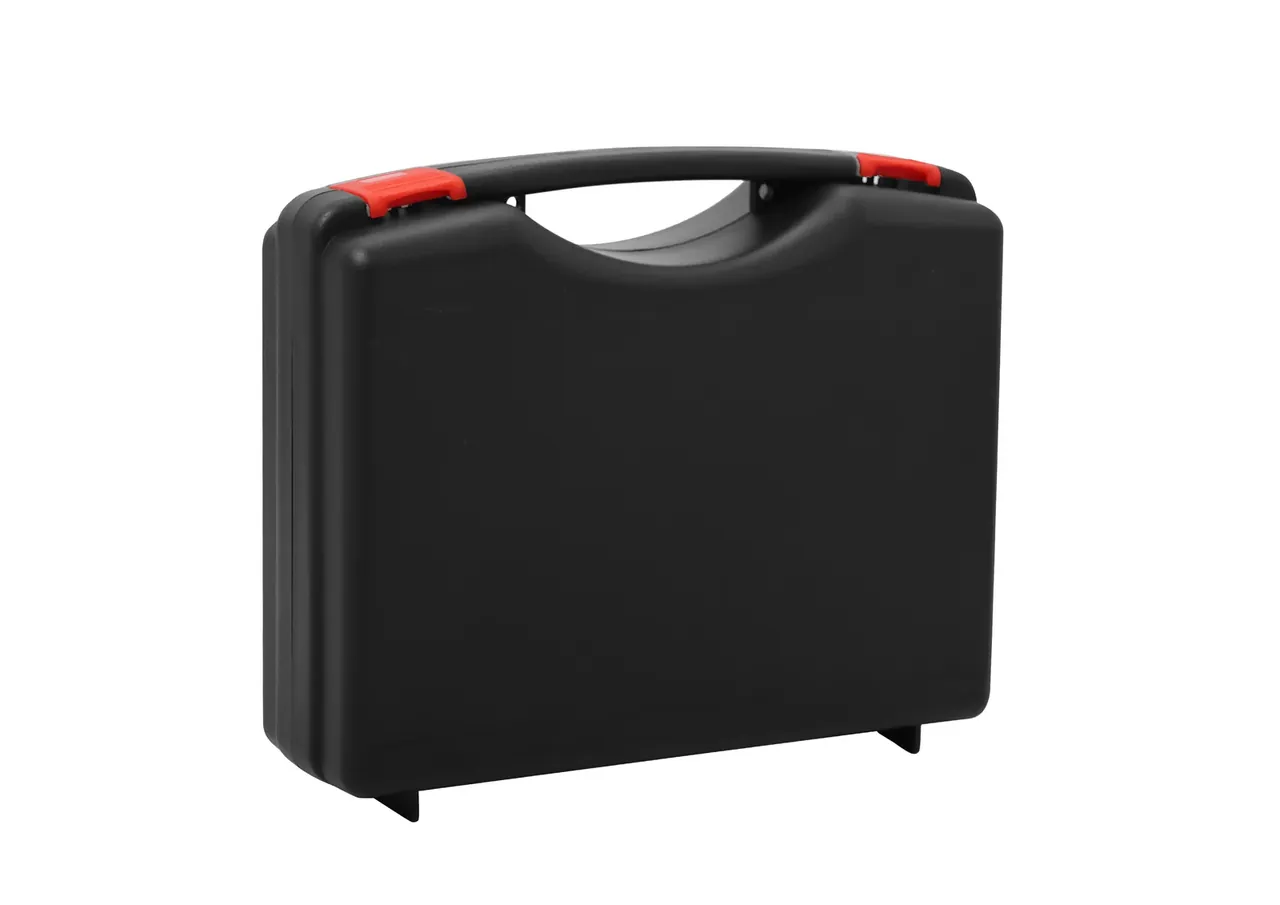
Quick answer: Case cleaners are safe only between pH 3 and 11, with no chlorine or aromatics; neutral detergent at 1%–2% and 70% IPA for 60 s clear the gasket test.
Table of contents
- Three Lines a Case Cleaner Must Not Cross
- Cleaner Chemistry Against Gasket Material
- pH and Contact Time at the Bench
- Rinsing, Drying and Residual Pressure Drop
- Frequency Caps and Two Alternatives
- FAQ
1. Three Lines a Case Cleaner Must Not Cross
Case cleaners are chosen from the ingredient list, not the claim on the bottle. Sodium hypochlorite ends the argument first, because it keeps oxidising after the surface looks dry. Xylene, white spirit and solvent naphtha end it second, since those fractions swell rubber rather than lift dirt. A pH strip above 11 or below 3 ends it third, and the gasket should never see that bottle.
The margin is thinner than users assume. A gasket is silicone, EPDM or TPE, and all three tolerate oxidisers, non-polar solvents and extreme pH far worse than the PP shell around them. A scratched shell is cosmetic; a lip eaten back 0.2 mm ends the seal.
Chlorine fails by residue. A 5% sodium hypochlorite solution sits near pH 12, and 30 s on the lip shows nothing; damage starts later, as chloride in the groove releases chlorine whenever moisture returns. Soak an EPDM specimen for 24 h, run ASTM D395 at 70 °C for 24 h, and set climbs from 22% to 38%, one step short of the 40% replacement line.
Aromatics swell instead: silicone gains 15%–25% by volume in 24 h of xylene, and a swollen lip no longer fits a 6.9 mm groove. Acid and alkali break chains, taking 30% off TPE tensile strength after 48 h at pH 2.
2. Cleaner Chemistry Against Gasket Material
One bottle rarely gives the same verdict on three gaskets, so read the matrix down a column. There are three answers: usable, usable with a time limit, and banned. A time limit means 60 s or less plus an immediate rinse; banned means irreversible at any duration.
| Chemistry | Silicone VMQ | EPDM | TPE (SEBS) | Why |
|---|---|---|---|---|
| 5% sodium hypochlorite | Limited, 30 s | Banned, surface cracks | Banned, +8 Shore A | Chloride residue |
| Xylene | Banned, +15%–25% volume | Banned, over +40% volume | Banned, softens | Aromatics hit all three |
| White spirit | Limited, 60 s | Banned, +60% volume | Banned, oils leach out | Petroleum suits silicone only |
| 70% isopropanol | Usable | Usable | Usable | Evaporates, little residue |
| 75% ethanol | Usable | Usable | Usable | Within ±3% mass |
| Neutral detergent 1%–2% | Usable | Usable | Usable | The workhorse wash |
| Sodium hydroxide, pH 12 | Limited, dulls surface | Usable | Limited, hydrolyses | Alkali plus heat |
| Ethyl acetate | Usable | Usable | Banned, +12% mass | Esters attack TPE |
White spirit is the row most often misread: merely limited on silicone, it tempts a short wipe on every gasket, yet EPDM gains 60% by volume in 24 h and stops sealing that afternoon. Caustic soda is the second trap: EPDM tolerates alkali while silicone and TPE do not.
One class sits outside the table: abrasive cream. Grit of 20–50 μm turns a mirror lip matte, taking roughness from Ra 0.8 μm to Ra 3.2 μm, and that matte finish holds dirt and moisture.
3. pH and Contact Time at the Bench
Both case cleaner checks take under a minute. Dip 0–14 universal paper for 1 s: 6 to 8 is usable, 9 to 10 means a 60 s limit, and 11 or above goes down the drain. Universal paper resolves one unit, which covers that band; telling 10.5 from 11.5 needs 0.2 grade paper.
Contact time is the limit you can count: isopropanol at 70% gets 60 s, neutral detergent 5 min, soapy water 10 min, and anything longer is a soak.
Heat steals time from that schedule. The figures hold at 20–30 °C and reaction rate roughly doubles per 10 °C, so a 40 °C wash turns 60 s into 120 s. A bucket left in the sun for 2 h reaches 45 °C in summer, and the time-limited verdict quietly becomes a ban.
| Cleaner | Dilution | Contact limit | Liquid temperature | Where |
|---|---|---|---|---|
| Neutral detergent | 1%–2% | 5 min | 20–30 °C | Shell, groove |
| 70% isopropanol | Neat | 60 s | 20–25 °C | Gasket lip, hardware |
| Soapy water | 5% | 10 min | 20–30 °C | Large shell areas |
| Clean water | Neat | No limit | 35 °C max | Rinsing |
| 75% ethanol | Neat | 60 s | 20–25 °C | Small spot wipe |
Work dry wipe first, wet wipe second, rinse last. A gritty cloth on the lip is a 400-grit sanding pass.
4. Rinsing, Drying and Residual Pressure Drop
Rinsing is the step most often skipped in case cleaner work, and it decides the leak test. Neutral detergent is still a surfactant after dilution: left in the groove it draws moisture and forms a film that the first closure pushes aside. Rinse twice with deionised water, blot with a lint-free cloth and run a cotton bud around the corners.
Residue is measurable. Leave 0.05 mL of detergent on the sealing face and the 60 s pressure drop moves from 0.8 kPa to 2.4 kPa, past the 2 kPa failure line. A quarter of a water drop is invisible, so blotting and rinsing stay separate.
Drying means 6 h below 45 °C. A face in sun reaches 70 °C, gasket and shell expand by a factor of 3 apart, and the lid springs open; an oven above 60 °C softens TPE.
5. Frequency Caps and Two Alternatives
One wash a month is the ceiling, twelve a year; every wash is a swell-and-dry cycle that pushes set upward. After twelve cycles, silicone moves from 22% to 38% at 70 °C for 24 h, EPDM from 24% to 41% and TPE from 30% to 52%.
When frequency cannot drop, changing the method beats changing the case cleaner. Compressed air at 0.2 MPa, nozzle 50 mm off the sealing face, plus a dry cloth clears grit but not oil film. Spot wiping with 70% isopropanol, blotted within 60 s, covers the rest, and both keep liquid out of the groove.
Frequency follows duty: an indoor case needs a wash every 3 months, a weekly site case is over-served by a monthly wash.
Conclusion
Case cleaners pass on three words: neutral, brief, rinsed. Chlorine, aromatics and out-of-range pH never reach the groove; neutral detergent at 1%–2%, 70% isopropanol for 60 s and soapy water for 10 min are the working lines; and 6 h below 45 °C follows every rinse, because 0.05 mL on the sealing face lifts a 60 s drop from 0.8 kPa to 2.4 kPa. Cap washing at once a month, since twelve cycles push silicone set to 38%.
This article discusses only the container (case body) side of specifications and design intent, and does not cover any handling, loading or use of the contents.
Related Reading
- Cleaning a Protective Case: From Dry Wipe to Air Dry
- Case Seal Ageing: From Compression Set to Leak Failure
- Gasket Material for Cases: Silicone, EPDM and TPE
- Salt Spray Testing and Case Hardware: Where Rust Starts
Related Products
- 8 Series — Gun Cases; Military Equipment Cases; Camera Equipment Cases; Drone Cases; Watch Cases; Knife Cases; First Aid Cases; Electronics Equipment Cases
- WL8-2812 PP Gun Case — model WL8-2812
- All protective cases and toolboxes: 7 series, 158 models