

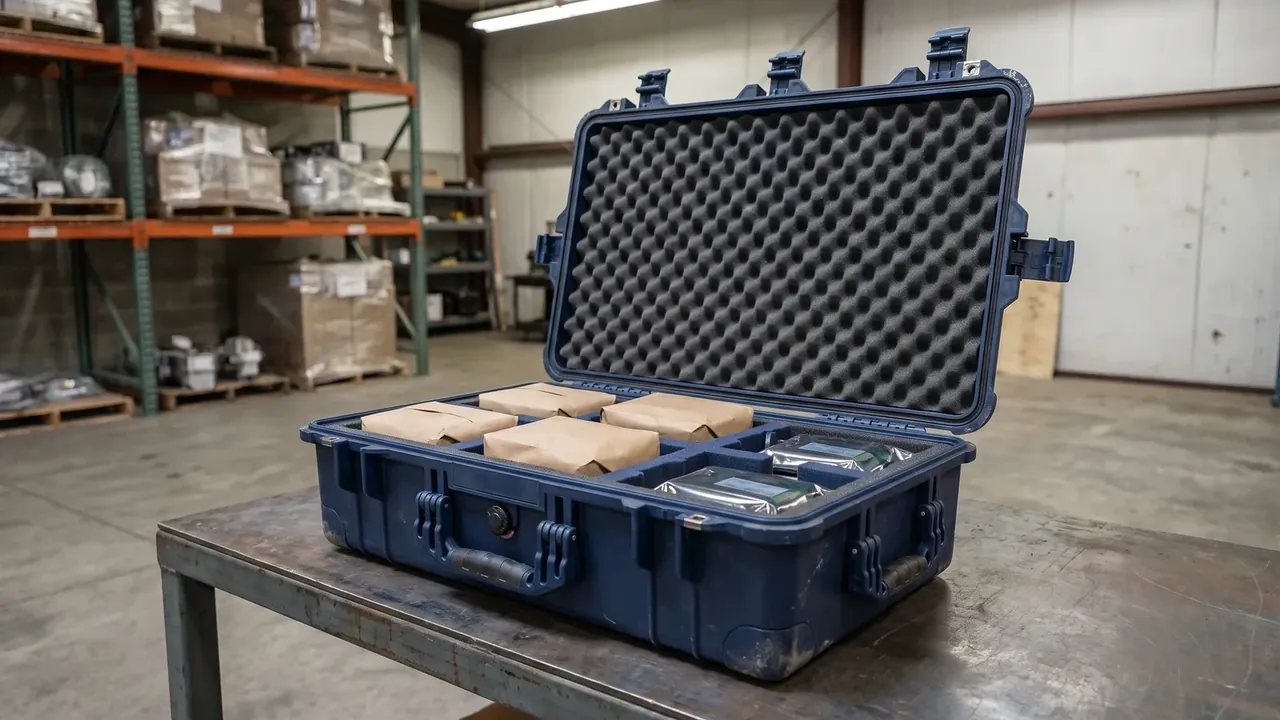
Quick answer: At 35 °C and 900 W/m² a navy lid hits 66 °C against 51 °C on light grey, so case colour masterbatch decides heat, internal rise and fading.
Table of contents
- Fifteen kelvin at noon
- Weathering grades in test hours
- Infrared reflectance and two kinds of black
- Internal temperature rise
- Fading and chalking limits
- FAQ
1. Fifteen kelvin at noon
At 35 °C ambient under 900 W/m², an empty navy lid reads 66 °C on a bonded thermocouple while a light grey lid of the same size reads 51 °C, a 15 K spread. Black reaches 71 °C and white 46 °C in the same run, so case colour masterbatch turns straight into temperature.
The method has to be fixed: thermocouple at the geometric centre of the lid, clear of ribs, case empty, pyranometer facing the sun, read after 10 minutes of stability. Move the probe or add dust and the number shifts by 3 K.
Orientation matters as much. The same case measured facing south and facing north differs by 6 K, so a pair of samples must sit the same way round.
Fifteen kelvin decides whether a lid is too hot to handle, and something else entirely inside the case.
2. Weathering grades in test hours
Case colour masterbatch grades are quoted in xenon hours and judged on colour shift and chalking. A standard grade reaches ΔE 8–12 and chalk grade 3 at 500 hours, a weathering grade holds ΔE 3–5, and a high-weathering grade sits under ΔE 3 at 1000 hours. The three differ by 6%–14% in price.
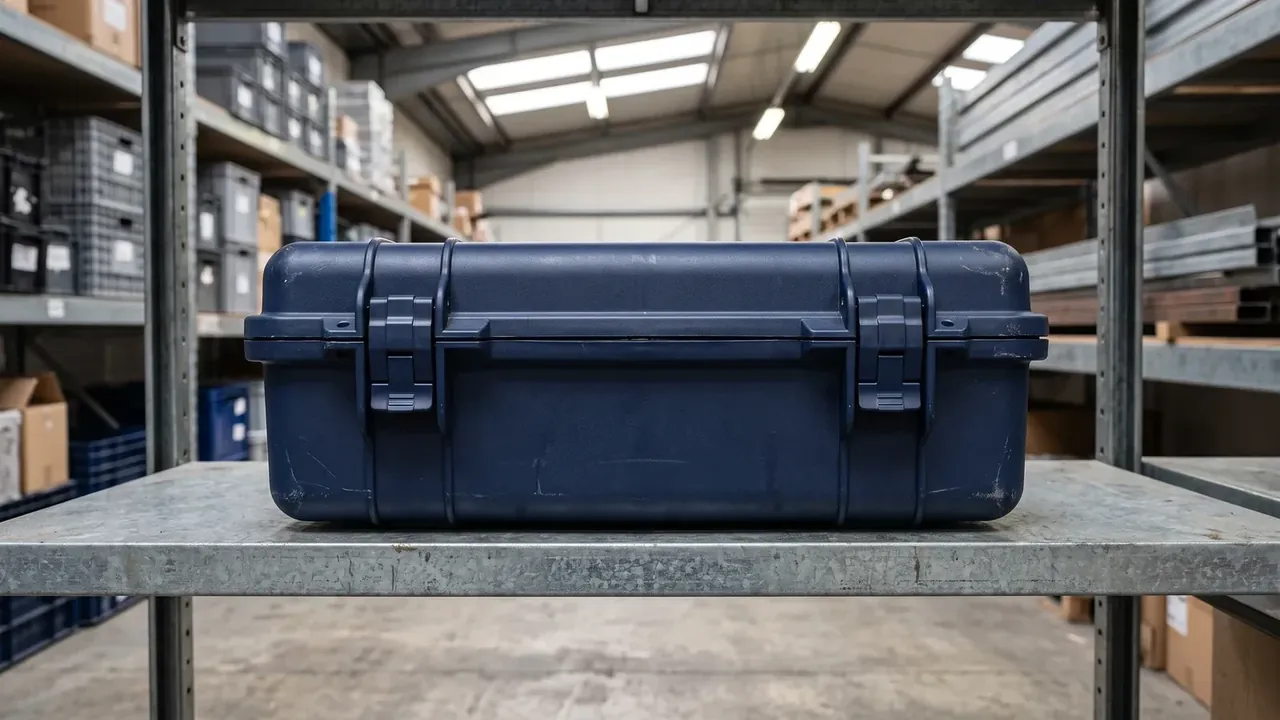
The pigment sets the ceiling: iron oxide and rutile titanium dioxide stay under ΔE 3 at 500 hours, while phthalocyanine blue and azo red drift to ΔE 6–9, and a dark shade needs more pigment, loading the polymer harder.
Deeper colour means higher pigment loading, and that rule holds for masterbatch as well.
Stabilisers form the second layer. Adding 0.3% hindered amine light stabiliser with 0.2% UV absorber pulls one navy compound from ΔE 9.6 to 4.1 at 500 hours and from chalk grade 3 to grade 1. Doubling the dose to 0.6% buys another 0.4 of ΔE, where the return flattens.
Titanium dioxide grade is the detail most often missed. Rutile chalks at grade 1 after 500 hours against grade 3 for anatase, and anatase carries photocatalytic activity that attacks the surrounding resin, so a pale case using it frosts within two years.
3. Infrared reflectance and two kinds of black
Near-infrared carries 52% of solar energy. Conventional carbon black reflects 0.05 of that band, while infrared-reflective pigment reaches 0.35, which is 12 K cooler at 900 W/m² for a surface that still looks black.
| Shade | Solar reflectance | Surface at noon, °C | Internal rise, K |
|---|---|---|---|
| White | 0.80 | 46 | 8 |
| Light grey | 0.62 | 51 | 11 |
| Olive drab | 0.35 | 59 | 15 |
| Navy | 0.18 | 66 | 19 |
| Black | 0.05 | 71 | 22 |
The last column is the centre-of-case excess over ambient after four closed hours under the same conditions. Navy and light grey differ by 15 K outside but 8 K inside, because wall-to-air exchange is slow.
Reflective pigment costs 18% more, so shade decides whether it pays: a pale case already at 0.62 gains 2 K, while a dark case gains 10–12 K, six of them on the thirty hottest days.
4. Internal temperature rise
At 35 °C ambient and 900 W/m², four closed hours leave a white case at 43 °C inside and a navy one at 54 °C. The probe sits 20 mm under the lid at the centre, the hottest point in a sealed body.
Case colour masterbatch only changes how much heat enters, not how fast it leaves. Heat arrives by conduction and gap convection: a 3 mm wall of 0.22 W/(m·K) is a thin barrier, and once the gasket seals, convection stops, so the curve climbs for 90 minutes and flattens.
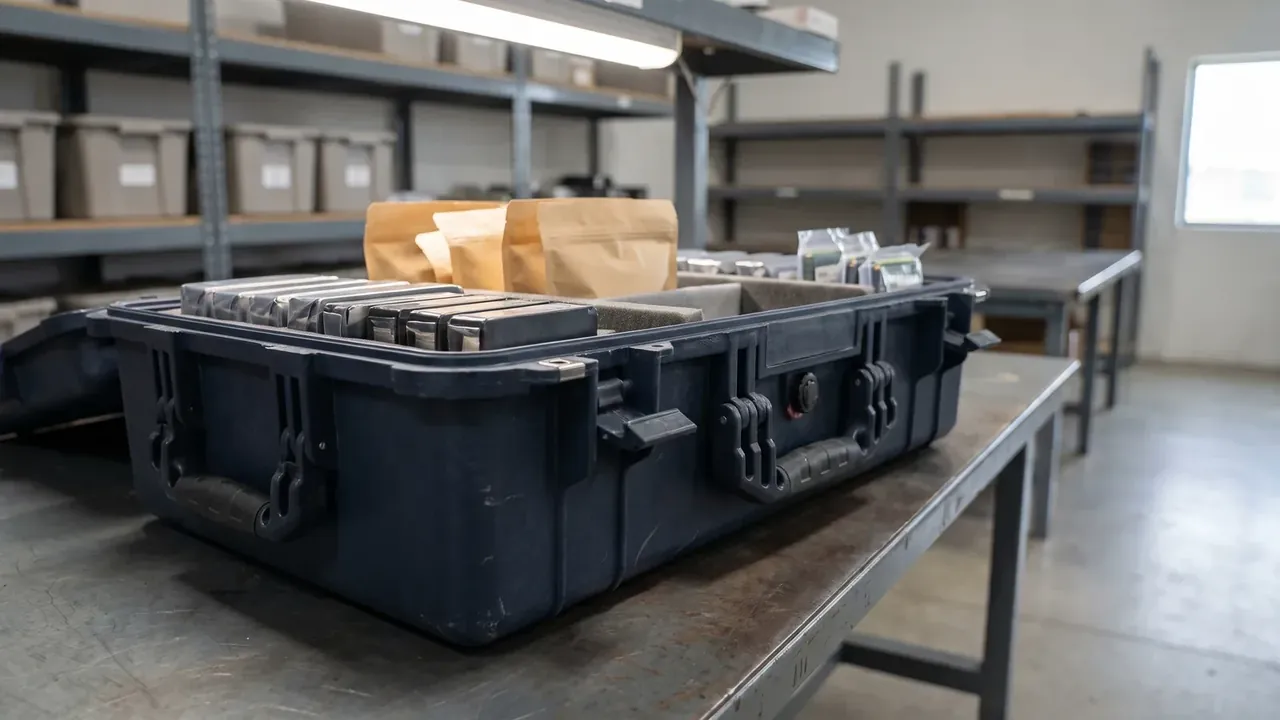
Lining changes that curve. A 20 mm closed-cell foam layer pulls the navy case from 19 K to 15 K and the white one from 8 K to 6 K, narrowing the gap from 11 K to 9 K as the foam absorbs part of the shade effect.
What the rise actually stresses is the seal, not the shell.
EPDM gasket compression set at 70 °C runs 2.4 times the value at 23 °C, and 30 days at 70 °C leaves 78% recovery. A dark case in a southern summer sits exactly in that band under its own lid, so the wrong masterbatch ages the gasket first.
5. Fading and chalking limits
There are two acceptance limits: colour shift no greater than ΔE 3, chalking no worse than grade 2. ΔE 3 is the point where a difference is visible but hard to name; grade 2 is a clear white mark left by a finger. Passing both is what makes a batch acceptable.
The same ΔE reads differently by shade: a black case at ΔE 3 greys out and looks mismatched from 5 m, while light grey merely looks dull, which is why dark parts fail inspection more often without being less durable.
Chalking is the second line and it does not reverse.
Field judgement uses tape: apply 20 mm × 20 mm of tape, press for 10 seconds, lift, and call the white powder grade 2 above 30% coverage and grade 3 above 60%.
| Grade | Pigment and stabiliser | ΔE at 500 h | Chalk grade | Outdoor life |
|---|---|---|---|---|
| Standard | Organic pigment, no stabiliser | 8–12 | 3 | 1–2 years |
| Weathering | Organic + 0.3% HALS + 0.2% UVA | 3–5 | 1 | 3–5 years |
| High weathering | Inorganic + 0.6% HALS | ≤3 | 0.5 | 6–8 years |
| Reflective dark | NIR pigment + 0.6% HALS | ≤3 | 0.5 | 6–8 years |
Lifetimes convert from southern China exposure, where a year outdoors equals about 1500 xenon hours, so 500 hours covers four months.
Conclusion
The choice between dark and pale is a trade of appearance against heat. A dark case hides dirt and reads clearly at distance, and pays 15 K on the surface, 11 K inside and 2.4 times the gasket ageing; a pale case runs cooler and loads its case colour masterbatch less, yet every mark shows on it. Neither is wrong, but the two need separate specifications. Three actions settle it: specify near-infrared pigment together with 0.6% HALS for dark parts, accept internal rise only as measured over four closed hours at no more than 15 K, and split the colour tolerance by shade at ΔE 2.5 for dark and 3.5 for pale, so a batch is judged against the case it is meant to become.
This article discusses container-side specifications and design implications only, and does not cover any handling, loading or use of the contents.
Related Reading
Related Products
- 8 Series — Gun Cases; Military Equipment Cases; Camera Equipment Cases; Drone Cases; Watch Cases; Knife Cases; First Aid Cases; Electronics Equipment Cases
- WL8-2812 PP Gun Case — model WL8-2812
- All protective cases and toolboxes: 7 series, 158 models