

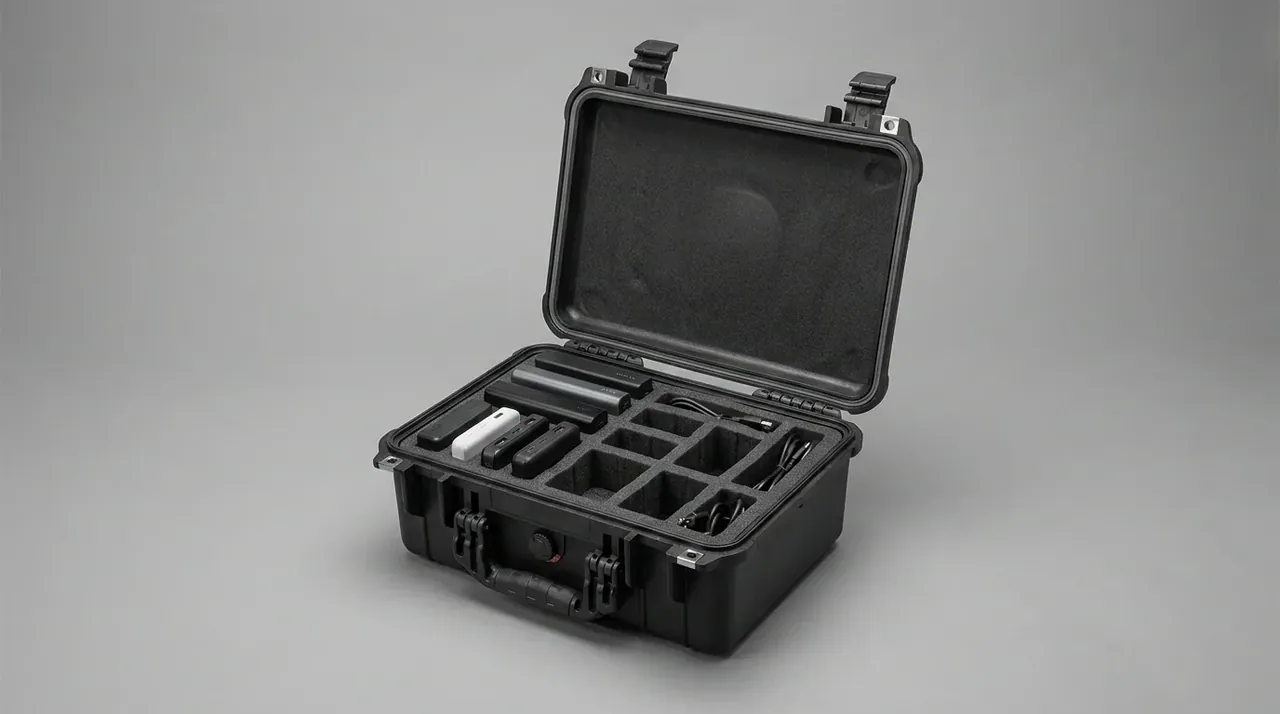
Quick answer: Case corner radius from R10 to R25 adds 15 mm to the outline but forces a new foam toolpath: 94 mm more arc, double the segments, 0.088 L less volume.
Table of contents
- Why R10 to R25 Redraws the Toolpath
- Cutting the Liner: Arc Length and Segments
- Volume Lost in Four Corners
- Appearance and Ejection on the Machine
- Seal Face Width at the Corner
- FAQ
1. Why R10 to R25 Redraws the Toolpath
Case corner radius moving from R10 to R25 leaves the outside untouched and still means a new foam toolpath. One 90° arc grows from 16.5 mm to 40.1 mm, four corners add 94.2 mm, path length rises from 4.82 m to 5.14 m and each part takes 16 s longer. The real problem is contour tolerance at the corner.
CAM approximates a 90° corner in 8 arc segments, and chord height equals R times 0.00482: 0.048 mm at R10, 0.121 mm at R25. With the liner held to 0.05 mm, R10 just passes and R25 does not, so the count doubles to 16 segments and the program grows from 2100 to 3400 lines. More segments slow the machine at the turn, dropping feed from 1200 to 840 mm/min.
The third cost lands on the blank. R25 pulls each corner in 15 mm and turns a 480 × 380 mm blank into 450 × 350 mm, 13.6% less foam, while module centrelines shift 7.5 mm.
2. Cutting the Liner: Arc Length and Segments
The toolpath is the cavity contour offset 0.5 mm outward, the interference left for foam spring-back. R10 becomes R10.5 and R25 becomes R25.5, a half millimetre that turns into a different curve.
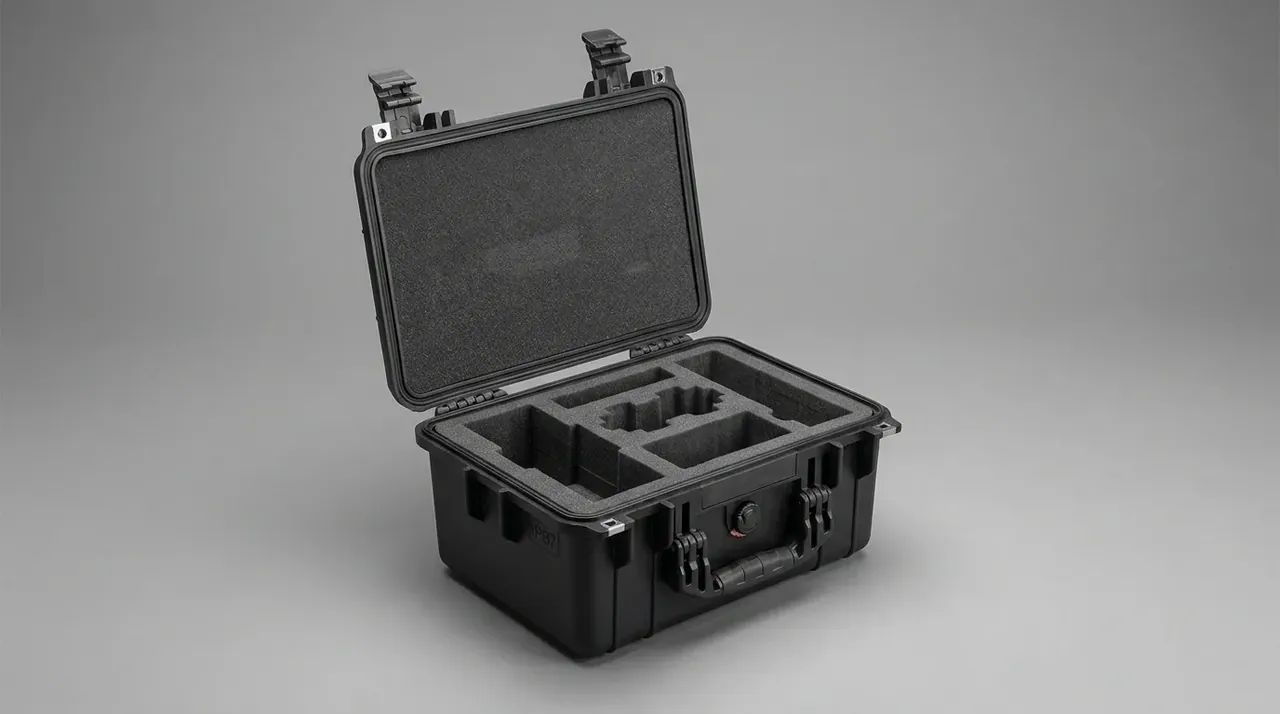
Arc length is πR/2: 16.5 mm at R10.5 against 40.1 mm at R25.5, a 23.6 mm gap per corner and 94.4 mm over four corners, 1.8% of path length. That share sits exactly where the cutter changes direction, which is where over-cuts and leftover material appear.
A 6 mm cutter needs inner corners above R3, so both versions cut in one pass and neither needs a clearing tool. What changes is segments and feed: R25 doubles segments and cuts corner feed 30%, adding 16 s per part and 4.4 hours over 1000 pieces.
Programming is unavoidable: 2.5 h to redraw and verify, one first article, 1.2 m² of scrap foam, plus an hour when a liner carries more than 12 cells.
3. Volume Lost in Four Corners
A corner eats the space between rectangle and sector, R² times 0.2146. That is 21.5 mm² per corner at R10 and 134.1 mm² at R25, which over 195 mm of height and four corners gives 0.017 L against 0.105 L.
The cavity holds 35.6 L, so 0.105 L is 0.29% and can be ignored. The liner cannot: clearing the arcs costs 2R per side, and usable flat area falls from 165600 mm² to 141900 mm², 14.3% less.
Over 12 instrument cells, 14.3% is 4 mm off every edge. A 62 mm module that sat flush now goes in diagonally, needs 3 mm more clearance, and the liner drops from 12 cells to 10.
| Radius | Area per corner mm² | Loss L | Share of cavity % | Usable flat mm² |
|---|---|---|---|---|
| R10 | 21.5 | 0.017 | 0.05 | 165600 |
| R15 | 48.3 | 0.038 | 0.11 | 157500 |
| R25 | 134.1 | 0.105 | 0.29 | 141900 |
| R35 | 262.9 | 0.205 | 0.58 | 127100 |
Those areas subtract 2R per side; relieving only the corners holds the loss to 450 mm² for two transition moves. The R35 row is reference only, since square cells stop fitting there.
4. Appearance and Ejection on the Machine
R25 is easier on the molding side: a blunter corner lowers flow resistance, injection pressure falls from 96 MPa to 91 MPa on the same 350 t machine, clamp demand drops 5%, and polishing time falls from 140 min to 100 min per mold.
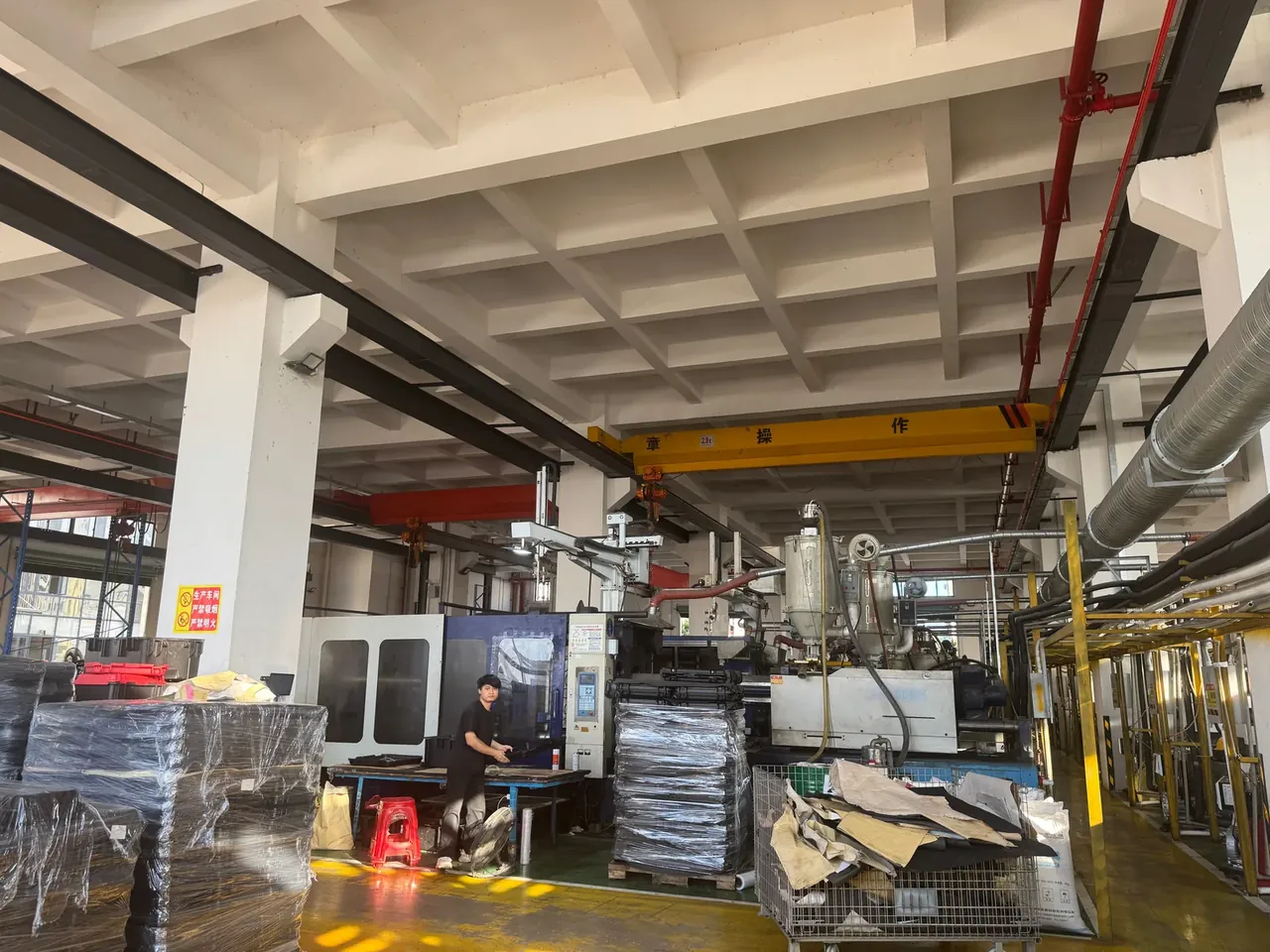
The cost is the weld line. R25 moves the meeting point 22 mm inward and closes the angle from 118° to 96°; matte black hides it, while gloss needs a 0.3 mm vent at the corner.
Cooling turns asymmetric. Converging fronts leave a locally thick zone, stretching cooling from 58 s to 64 s and adding 6 s per cycle; the arc sheds 12% more heat but the thick zone cancels it, so 1000 parts lose 1.7 hours.
Ejection gains. Release resistance falls 8%, ejector pins drop from 6 to 5, and white marks with them. Ejector layout and cooling circuit both change, which quotations fold into a 6000 to 9000 yuan mold line.
5. Seal Face Width at the Corner
The groove sits 8 mm from the edge and is 6 mm wide, with a 7 mm cord at 30% compression, or 2.1 mm. R10 pairs with R18 and R25 with R33, and the groove runs 23.5 mm longer around the corner.
R18 bends too tightly: the cord compresses 38% inside and 21% outside, and that 17-point spread sets a permanent set within six months. At R33 the spread narrows to 9 points and wrinkle height falls from 1.2 mm to 0.4 mm.
A larger radius helps sealing, provided the groove moves with it; at R25 the centreline shifts 2 mm inward, or only 3 mm remains between groove wall and arc and that ring short-shoots.
| Radius | Centreline arc mm | Inner % | Outer % | Spread, points | Wrinkle mm |
|---|---|---|---|---|---|
| R10 | 28.3 | 38 | 21 | 17 | 1.2 |
| R15 | 36.1 | 36 | 23 | 13 | 0.8 |
| R25 | 51.8 | 34 | 25 | 9 | 0.4 |
| R35 | 67.5 | 32 | 27 | 5 | 0.2 |
IP67 testing does not change: 30 kPa for 30 s with no more than 0.3 kPa drop. R10 parts read 0.4 kPa at the corner and need 0.2 mm more groove depth; R25 parts repeat within 0.15 kPa at 3.2 mm.
Conclusion
The trade in case corner radius comes down to two straight lines. On the toolpath side, every 15 mm of radius adds 23.6 mm of arc per corner, 94 mm over four corners, and moves the program from 8 segments to 16, costing 16 s per part. On the volume side, four corners lose 0.2146R² times case height, which is 0.088 L from R10 to R25, only 0.25% of the cavity, while liner relief throws away 14.3% of usable flat area. Divide one by the other: liners with cells under 120 mm take R10, cells over 200 mm take R25, and anything between trades 0.088 L of volume against 94 mm of toolpath, whichever costs more.
This article discusses container-side specifications and design implications only, and does not cover any handling, loading or use of the contents.
Related Reading
- How rounded case corners are molded
- Pre-cut foam liners and toolpath planning
- What to check on a trial-run first article
Related Products
- 8 Series — Gun Cases; Military Equipment Cases; Camera Equipment Cases; Drone Cases; Watch Cases; Knife Cases; First Aid Cases; Electronics Equipment Cases
- WL8-2812 PP Gun Case — model WL8-2812
- All protective cases and toolboxes: 7 series, 158 models