

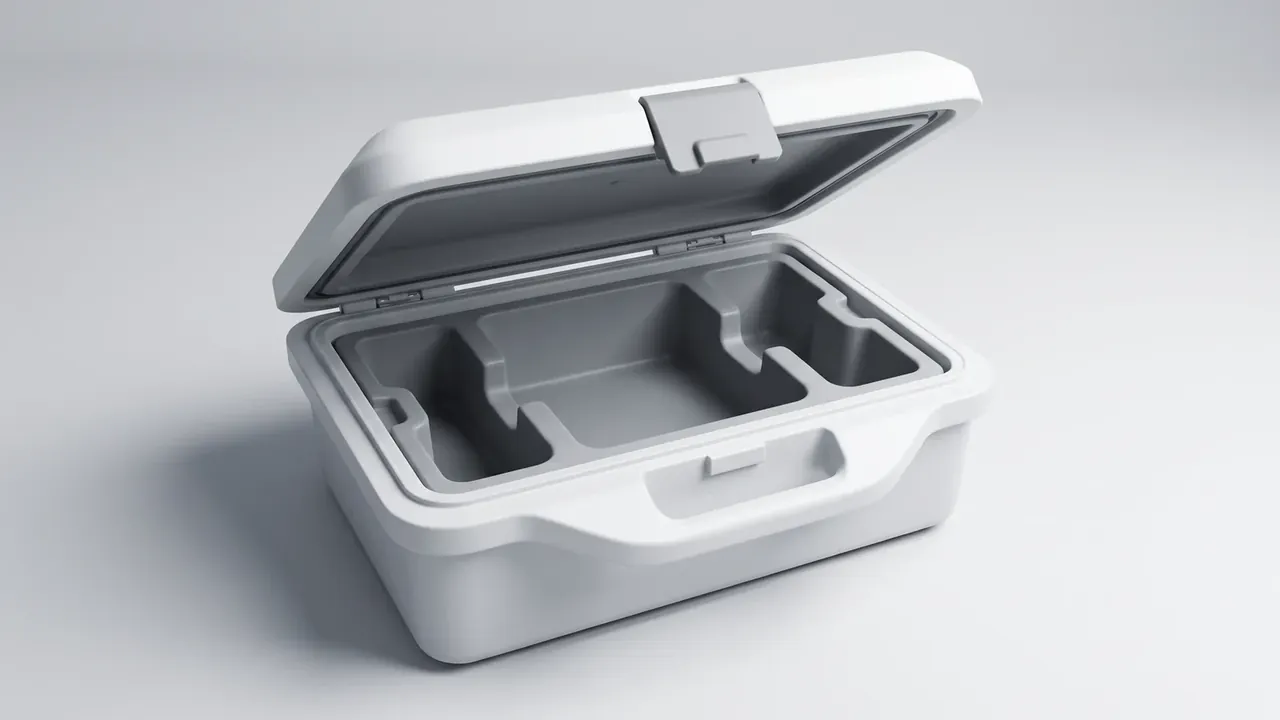
Quick answer: Monitoring Inside a Case is reliable when a -40 to 85 °C logger at ±0.3 °C sits at three fixed points, samples every 5–15 min and is calibrated yearly.
Table of contents
- Why Readings Inside a Case Mislead: Three False Numbers
- Choosing the Logger: Range, Accuracy, Interval
- Internal and External Probes: Sealing the Penetration
- Placement: Three Points and Wall Clearance
- Making the Data Usable: Timestamps, Calibration, Reports
- FAQ
1. Why Readings Inside a Case Mislead: Three False Numbers
Two loggers in one case, on one load, can disagree by 2.4 °C, and the instruments are usually innocent. Monitoring Inside a Case means measuring a small volume that stratifies: air 20 mm under the lid runs more than 2 °C warmer than air 50 mm off the floor, and a probe against a sunlit wall reads 0.8–1.5 °C high. Bury a probe in foam and it reports foam temperature, lagging 20–40 min and flattening every peak by thirty to forty percent.
The second false number comes from the door. Thirty seconds of access lifts the inside by 3–6 °C, and a 15 min interval walks straight past it, so the chart shows what is left after eighty percent of the recovery.
The third comes from accuracy itself. A ±0.3 °C sensor separates differences above 0.6 °C, so a 0.4 °C gap written up as a finding is noise wearing a decimal point.
Response time adds a fourth. Most units reach T90 in 5–8 min, a foam-wrapped probe takes over 30 min, and self-heating of 0.05–0.1 °C sits on top. Humidity cannot be read alone either: a 5 °C drop in temperature lifts relative humidity by roughly thirty percent.
2. Choosing the Logger: Range, Accuracy, Interval
Five parameters, in this order: range, accuracy, interval, memory, battery. Range decides whether a unit can be used, accuracy whether a conclusion can be written, the rest whether the routine lasts a season. Transport and storage inside a case sit between -30 and 60 °C, so -40 to 85 °C leaves margin at both ends.
| Type | Range | Accuracy | Interval | Memory | Battery |
|---|---|---|---|---|---|
| Single-use USB | -30 to 70 °C | ±0.5 °C | Fixed 10 min | 16000 points | Sealed |
| Reusable LCD | -40 to 85 °C | ±0.3 °C, ±2% RH | 5–15 min | 32000 points | CR2032, 12 months |
| External probe | -40 to 125 °C | ±0.2 °C | 1 s to 18 h | 64000 points | 2×AAA, 24 months |
| Wireless gateway | -20 to 60 °C | ±0.3 °C | 1–60 min | Cloud | Lithium, 6 months |
Work memory backwards from the interval. At 15 min, 32000 points is 96 records a day and 333 days of cover, so exporting at 300 days keeps a ten percent margin rather than a full buffer. A CR2032 at -20 °C gives about sixty percent of rated capacity: 12 months becomes 7–8, and winter projects go quarterly on batteries.
Interval trades resolution against capacity: five minutes captures the warm-up after a door opens at three times the cost, fifteen suits transit and storage.
3. Internal and External Probes: Sealing the Penetration
An internal probe needs no hole, but the logger's position is set by a foam pocket, not by the measurement. An external probe on a Ø3 mm lead goes anywhere, at the cost of a hole: seal it badly and the record is bought with water ingress.
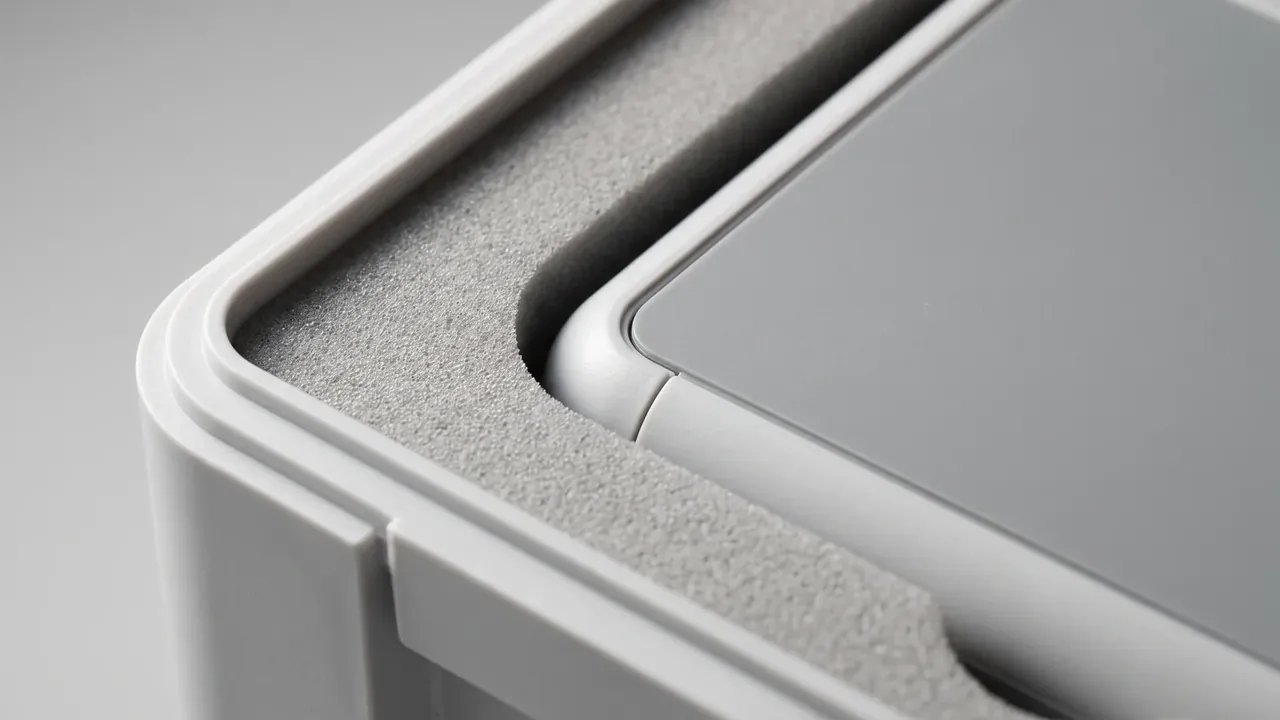
A penetration has four numbers. Drill 3.2 mm for an IP67 gland and verify it against the immersion condition of IEC 60529; keep the hole 30 mm clear of the sealing face so the gland body does not press the lip; tighten to 0.4–0.6 N·m; specify a silicone jacket, because PVC stiffens at -30 °C.
Retest afterwards: charge to 20 kPa and allow no more than a 2 kPa drop in 60 s, the factory criterion. A visual check is not a test, since water shows up in month two.
4. Placement: Three Points and Wall Clearance
Three points is the smallest arrangement that can be explained: 30 mm below the lid, the geometric centre and 50 mm above the floor. Together they show vertical stratification; alone, the centre can stand for the volume while the outer two check the spread. All three stay 50 mm off any wall, clear of stored heat and condensation.
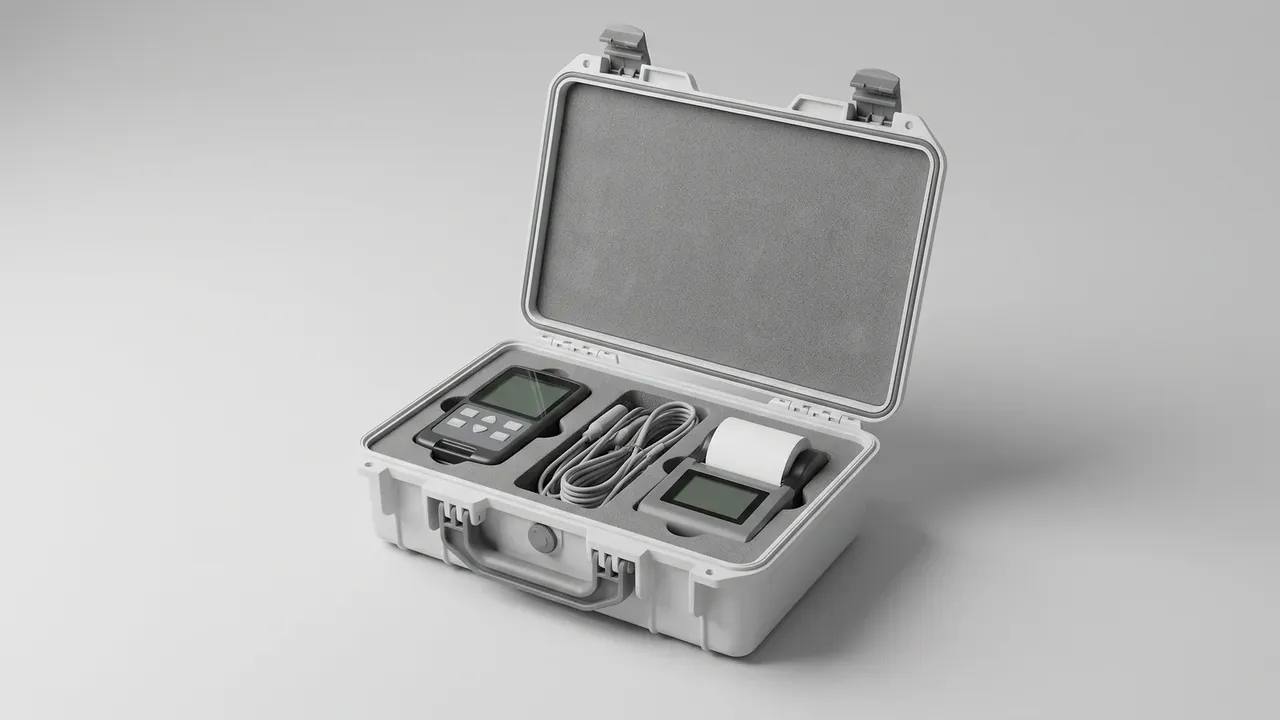
Different readings at the three points are the point, not a fault. Warm air collects near the lid, so the top reads 0.4–0.8 °C above centre; the floor point reads 0.8–1.5 °C below it; a foam pocket stretches the lag to 20–40 min and shaves the peak flat.
| Position | Reading vs centre | Lag | Use |
|---|---|---|---|
| Top, 30 mm below lid | 0.4–0.8 °C higher | 5–10 min | Stratification, lid condensation |
| Geometric centre | Reference | None | Single-point long records |
| Bottom, 50 mm above floor | 0.8–1.5 °C lower | 10–20 min | Heavy loads, floor storage |
| Against the wall | 0.8–1.5 °C higher | 5–15 min | Reference only, not recommended |
| Inside a foam pocket | Depends on depth | 20–40 min | Not recommended, peaks lost |
Write the positions into the work card. One case family, one set of points, or batches stop being comparable: moving a probe changes the system, and the old curve cannot be extended.
5. Making the Data Usable: Timestamps, Calibration, Reports
Data is usable only when four things arrive together: a timestamp, a serial number, the interval and the calibration date. Without all four, a report proves something was measured, not what. Once a record enters a claim, those four are the first questions asked.
Calibrate every 12 months and retire a unit drifting past 0.5 °C or 3% RH. Certificates carry the serial number, and instruments from one certificate should not be mixed across a fleet. Set clocks before comparing months: drift is about a minute a month, 12 min a year, two whole records at a 5 min interval.
Export CSV and PDF together, the first for recomputation and the second for delivery, each page carrying timestamp, serial number, interval and range. Mark gaps longer than 5 min on the chart rather than interpolating across them, because a smoothed line proves nothing about the gap it hides.
Conclusion
A temperature record that contradicts itself is rarely an instrument problem and usually a placement one: a probe in foam loses the peak, a probe on the wall reports the sun, a 15 min interval walks past a 30 s door opening. Monitoring Inside a Case comes down to fixed numbers, a -40 to 85 °C unit at ±0.3 °C and ±2% RH, three points 30 mm under the lid, at centre and 50 mm above the floor, 50 mm off any wall, 5–15 min sampling, a 3.2 mm gland at 0.4–0.6 N·m and a 12 month calibration. Then a 0.4 °C gap stays a number, not a conclusion.
This article discusses only the container (case body) side of specifications and design intent, and does not cover any handling, loading or use of the contents.
Related Reading
- High-temperature storage cases: material limits above 60 °C
- Cold brittleness: where a case shell cracks
- IP rating tests: immersion and spray criteria
- Vibration and seal degradation after long transit
Related Products
- 8 Series — Gun Cases; Military Equipment Cases; Camera Equipment Cases; Drone Cases; Watch Cases; Knife Cases; First Aid Cases; Electronics Equipment Cases
- WL8-2812 PP Gun Case — model WL8-2812
- All protective cases and toolboxes: 7 series, 158 models