

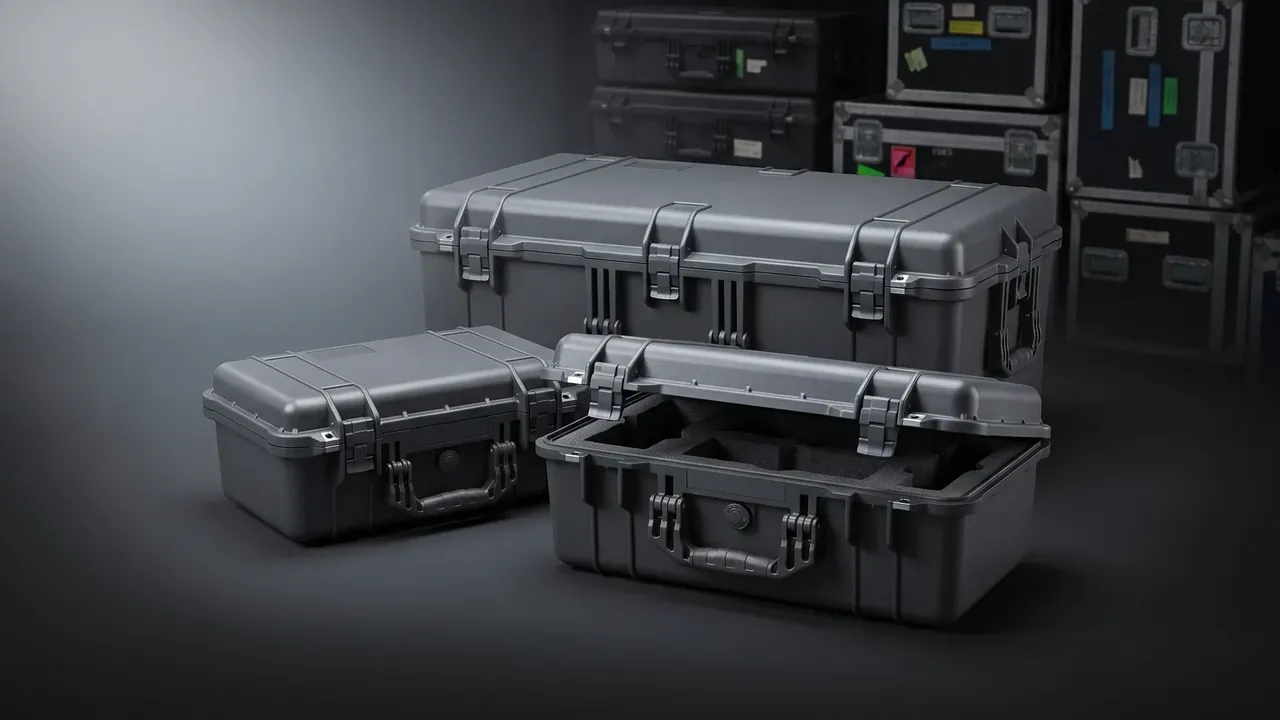
Quick answer: A case factory tour earns its time only when one chain gets traced: load sets the cavity, the cavity sets wall thickness, thickness sets ribs and hardware. Callipers and three questions turn 6 mm into a number.
Table of contents
- What a case factory tour should trace from load to cavity
- Wall thickness is one number on a drawing, seven in a mould
- Hardware and seals come back to wall thickness
- Four checks to run on the floor
- FAQ
1. What a case factory tour should trace from load to cavity
Three hours and forty minutes in a Ningbo plant: twenty on samples, the rest on gauges, drawings and a 1600 t press. The engineer was blunt: anyone can line up samples, a specification must be derived.
This body carries 46 kg packed and stacks three high, so the lowest lid takes another 92 kg. The lid projects 0.44 square metres, roughly 2.1 kPa. Across a 1.05 m span at 40℃, polypropylene at 1200 MPa, holding centre deflection under 2 mm needs 5.5 mm walls; 0.5 mm of regrind allowance makes it 6 mm. A 0.8 m cavity returns 4.5 mm.
Forks and straps push at 0.3 g, so 46 kg becomes 135 N across two 1.05 m edges; 4.5 mm holds. Corners take the extra metal, where bending and torsion meet. Cavity fixes span, span fixes thickness, and the giveaway in a plant is a 1.05 m cavity still carrying a 4 mm wall.
| Load case | Figure | Resulting spec | How to check |
|---|---|---|---|
| Three-high stack | 92 kg | 7.5 mm lid, two ribs | Load, measure deflection |
| Packed weight | 46 kg | 6.0 mm, four feet | Callipers on base rib |
| Side impact at 0.3 g | 135 N | 4.5 mm, 6 mm at corners | Press, watch whitening |
| Lift at one eyelet | 900 N | 9 mm, brass insert | Look for a thick pad |
2. Wall thickness is one number on a drawing, seven in a mould
A drawing shows one thickness; a mould, seven. Long wall 6.0 mm, base 7.5 mm, rim 4.2 mm, rib root 5.0 mm, hinge boss 9 mm, eyelet 8 mm. Write 6 mm everywhere and the part gains 1.8 kg or splits.
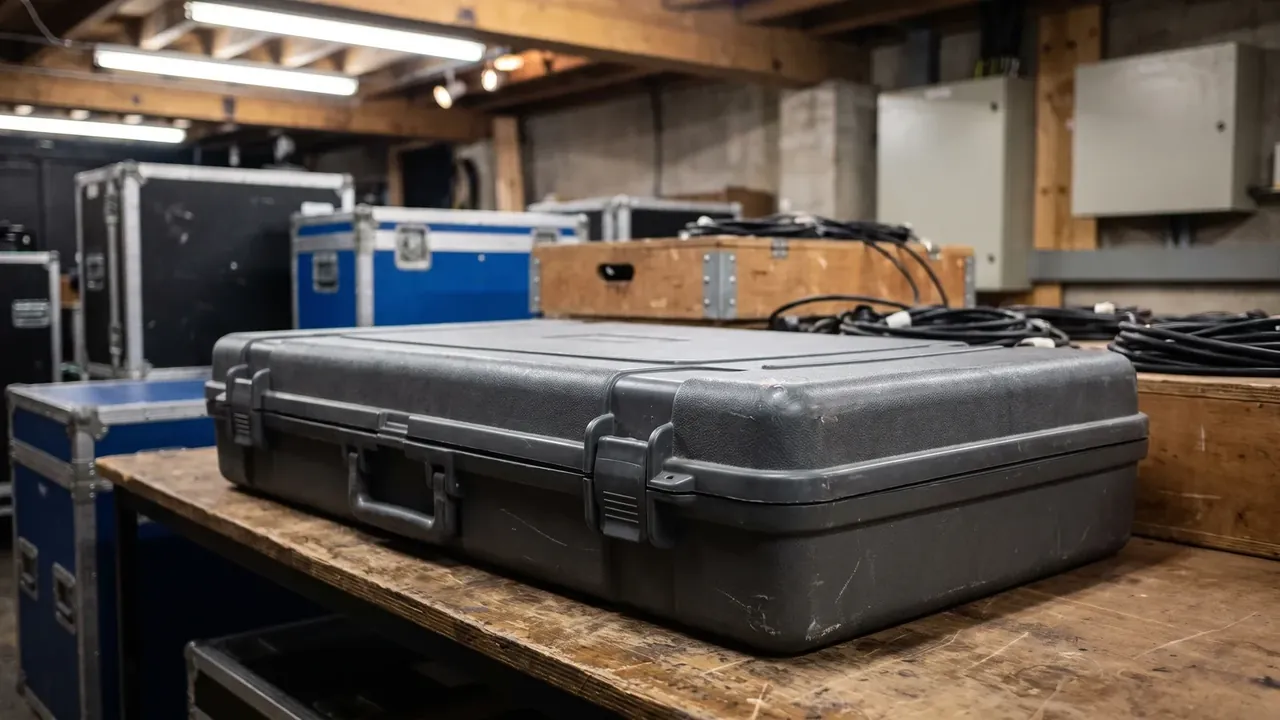
Ribs sit at 0.6 of the main wall: 3.6 mm under a 6 mm skin, so the rib freezes first and the face stays flat. Keep rib height near 8 mm; taller ribs trap heat. Draft runs 1.5 degrees, and a 90 mm cavity gives up 2.3 mm a side. R3 outside and R1.5 inside drop the stress factor from 2.4 to 1.6.
3. Hardware and seals come back to wall thickness
An M6 screw at 2.5 N·m pulls about 4 kN, which a 6 mm hinge boss cannot hold, so that section goes to 9 mm over an 8 mm insert.
Groove size comes back from compression: 4.5 mm wide, 3.5 mm deep, 5 mm silicone cord closing to 28 percent. Below 25 percent the seal passes 0.5 m of water head; past 35 percent the cord sets. At 480 hours of salt spray a 304 pin loses under 0.02 g; a zinc pin whitens at 240 hours and seizes near 400. That is 3.2 yuan a pair against 180 yuan of freight.
| Joint | Criterion | Value | First failure sign |
|---|---|---|---|
| Hinge boss | Wall / insert depth | 9 mm / 8 mm | Stiff opening, white ring |
| Latch | Pull per latch | 180 N up | Ramped tongue, lid opens |
| Gasket groove | Compression | 25 to 30 percent | Permanent witness line |
| Eyelet | Static load | 900 N, 1 hour | White lines at root |
4. Four checks to run on the floor
Instruments beat presentations: 0 to 150 mm callipers, a 200 kg scale, a borrowed ultrasonic gauge.
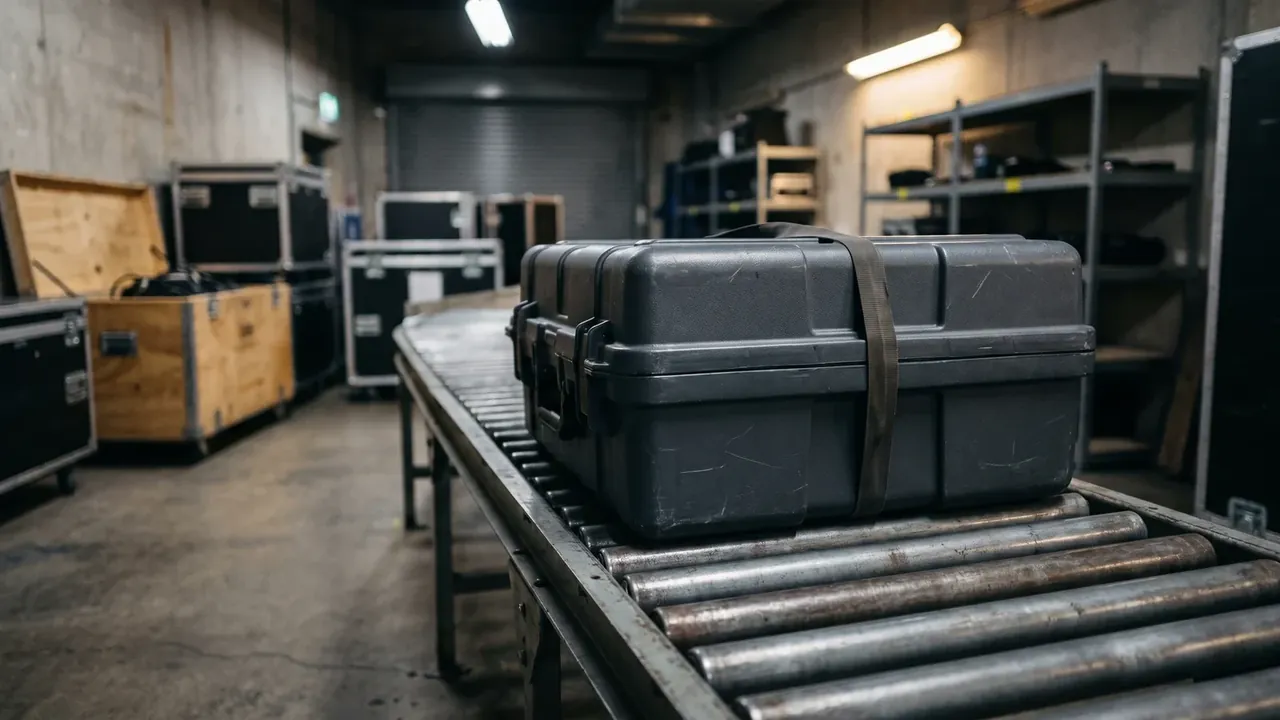
Five readings on the base and both walls; a spread above 0.3 mm means the batch may run 0.4 mm under drawing. At 6.0 mm and 0.91 density the body should weigh near 4.8 kg; a 4 percent gap points at regrind. Put 46 kg on the lid for 24 hours; past 2 mm the ribs are decorative. A weld line across an eyelet holds only 60 percent of parent strength.
Conclusion
Load, cavity, thickness, ribbing and hardware form one chain; skipping a link only moves the cost elsewhere. Ask the cavity length and stack height, and 6 mm either explains itself or falls apart. That is what a case factory tour is for.
This article discusses only the container (case body) side of specifications and design intent, and does not cover any handling, loading or use of the contents.
Related Reading
- A printable checklist for the day you visit a plant
- Wall thickness and cushion layers in airdrop cases
- Matching cavity size to stacking height
- Placing eyelets and fork pockets on transit cases
Related Products
- 8 Series — Gun Cases; Military Equipment Cases; Camera Equipment Cases; Drone Cases; Watch Cases; Knife Cases; First Aid Cases; Electronics Equipment Cases
- WL8-2812 PP Gun Case — model WL8-2812
- All protective cases and toolboxes: 7 series, 158 models