


Quick answer: Case gate location fixes the weld line before steel is cut, and one drop 40 mm off centre runs a 0.08 mm seam straight across a 120 mm nameplate.
Table of contents
- When the Gate Sits on the Front Face
- Where the Weld Line Lands
- Weld Line Strength Loss in Percent
- Balancing Multi-Point Gates
- Gas Marks and Trapped Air
- FAQ
1. When the Gate Sits on the Front Face
In April 2025 a run of 520 mm × 380 mm × 210 mm instrument cases failed trial moulding. The gate sat 40 mm above centre, two drops on the lid, and the melt split around a 120 mm × 90 mm recess before rejoining. The seam was 0.08 mm deep and 112 mm long, exactly where the nameplate goes. Three polishing rounds fixed nothing, and 200 lids were scrapped.
Nobody had calculated the seam position. Its path follows the drops and the geometry between them; process settings change depth, never address.
Mark the visible zones first, strike out nameplate, label and parting-line band, then hand the rest to the gate. A cosmetic gate may only sit where it is hidden or covered.
2. Where the Weld Line Lands
The meeting angle of two flow fronts controls depth. A 90° convergence is head-on: the chilled skin folds into the joint, depth passes 0.1 mm and tensile strength drops to 55–65% of bulk. At 135° the fronts slide past each other and depth falls to 0.04 mm.
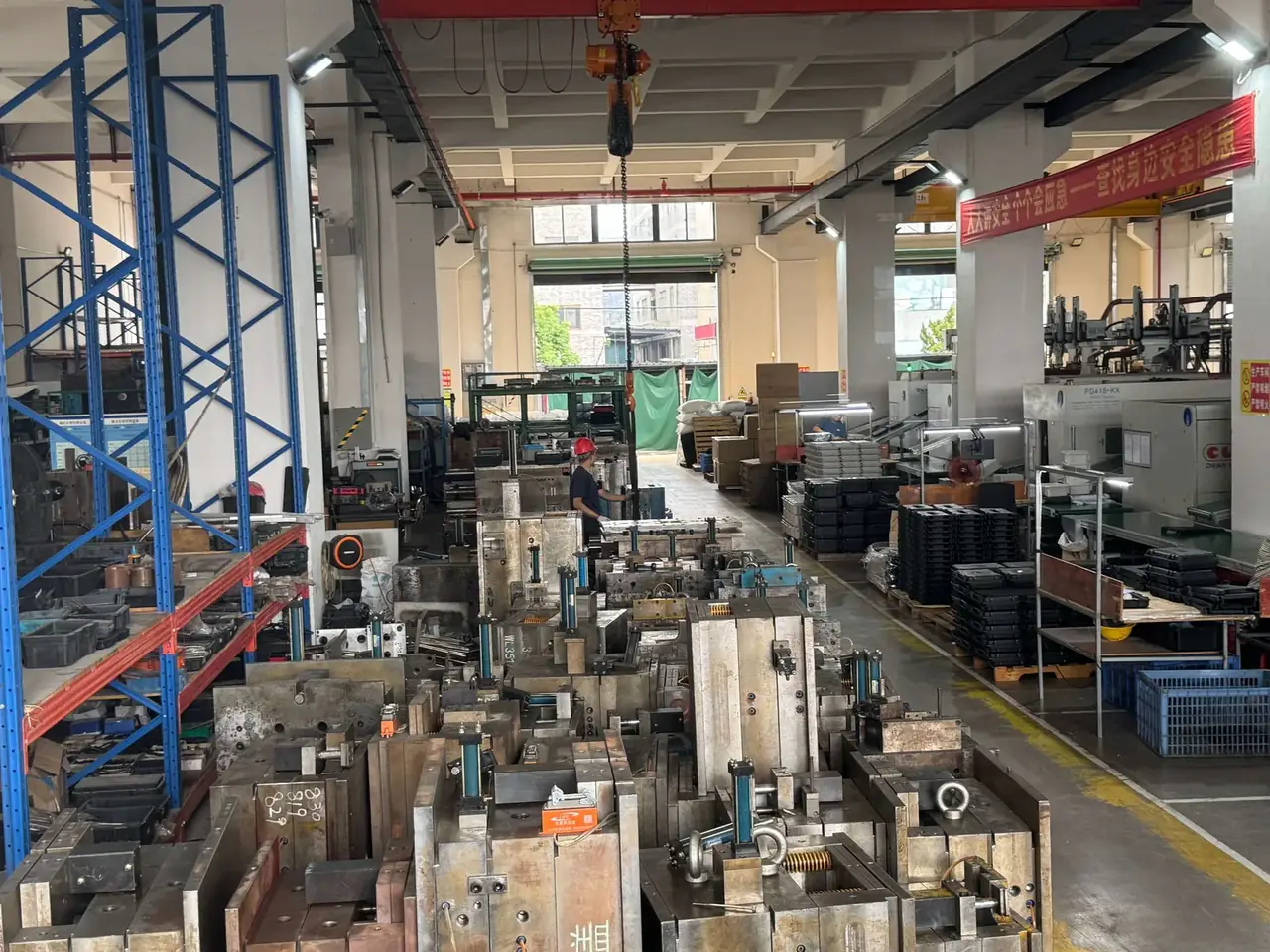
Square recesses, ribs and bosses make most 90° convergences. On a 460 mm lid a 120 mm recess splits the melt into two 170 mm streams; centre the drop and the seam sits on the centreline, shift it 30 mm and the seam moves 8–12 mm toward the longer side. A fill-time plot shows that before the tool is cut.
Angling the drop 12–18° makes one front lap over the other, cutting depth to 40% of a butt joint at 5 mm off centre. Vents must follow the meeting point: beyond 45 mm, gas enters the seam and leaves 0.3–0.5 mm silver streaks.
3. Weld Line Strength Loss in Percent
A weld line is a structural weak line, not a cosmetic defect. A 0.08 mm seam cuts wall from 3 mm to 2.92 mm, only 2.7% of the section, yet strength falls an order of magnitude faster than thickness.
| Material | 90° convergence | 135° convergence | 150° convergence | Fracture face |
|---|---|---|---|---|
| ABS | 45 MPa → 31 MPa, −31% | 37 MPa, −18% | 40 MPa, −11% | Flat along seam |
| ABS/PC blend | 48 MPa → 32 MPa, −33% | 39 MPa, −19% | 42 MPa, −12% | Local streaking |
| PC | 62 MPa → 37 MPa, −40% | 48 MPa, −23% | 53 MPa, −15% | Brittle, bubbles |
| PP plus 20% glass fibre | 38 MPa → 21 MPa, −45% | 28 MPa, −26% | 32 MPa, −16% | Fibres pulled out |
Bars were 3 mm dumbbells cut along the seam and pulled at 50 mm/min, eight per cell. ABS loses least because the butadiene phase still entangles; PC loses most; glass-filled compound loses most of all, fibres aligning in the convergence plane.
A 1 kg tup from 300 mm cracked 3 of 8 specimens at 90° and 1 of 8 at 150°. At 1.2 m onto six faces the finished case broke 4 units, all from the lid seam; with the drop shifted 30 mm onto a rib, 1 broke.
4. Balancing Multi-Point Gates
Cases above 520 mm need two to four drops, all filling inside one window: early melt has skinned, late melt cannot push it, and the seam becomes a cold joint.
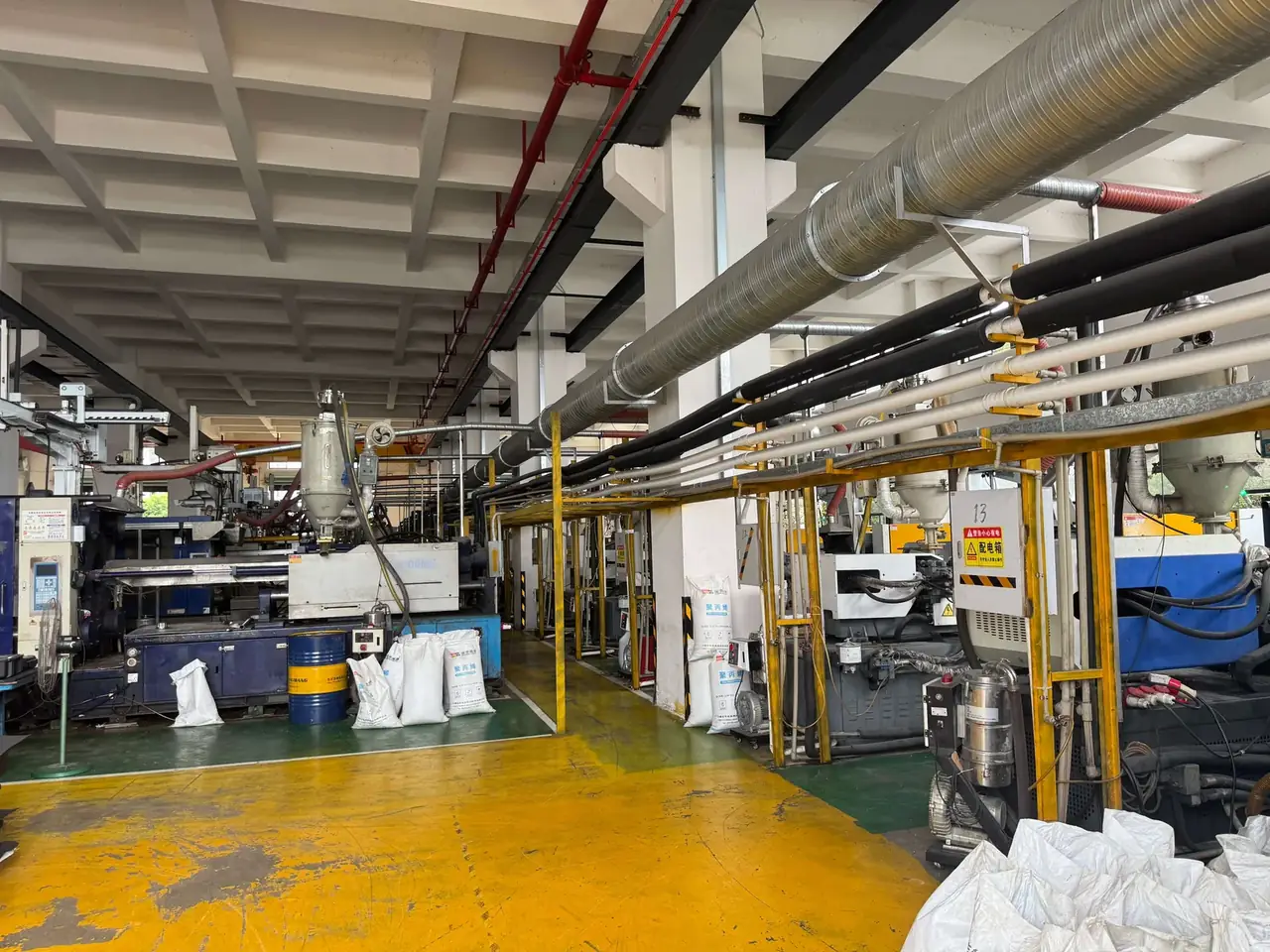
An 8 mm sprue with 6 mm runners holds pressure spread within 2 MPa and fill-time spread at 0.15 s across four drops. Shrinking a gate from 4.5 mm to 3.5 mm raises resistance 2.7 times, and 0.3 mm between drops alone opens 0.4 s.
Four drops on the long sides leave 12 mm of flow difference, natural balance, one 4.5 mm diameter everywhere. Three drops leave the middle path 40 mm short, so that gate comes down to 3.8 mm.
Each drop adds a gate mark, 4.5 mm across and 0.15 mm deep: hidden inside the lid, a defect outside it.
5. Gas Marks and Trapped Air
Gas marks appear where the melt arrives last, twins of the weld line. Gate position sets flow direction, flow decides where the air goes, and the vent only receives. Move a gate 30 mm and the mark often moves 40 mm.
Vent depth has a floor and a ceiling: 0.02 mm by 6 mm works for ABS, 0.04 mm flashes, 0.01 mm quadruples resistance. Spacing along the parting line stays under 60 mm, with a vent at every corner.
Air concentrates at recess floors, boss roots and rib ends. Moving a gate 60 mm off a recess vents that floor through the parting line and shrinks the mark from 40 mm × 25 mm to 8 mm × 5 mm.
| Gate plan | Weld line position | Tensile loss | Gas mark risk | Tool change |
|---|---|---|---|---|
| Single, front centre | Over the nameplate | 31% | High, recess traps air | None, cosmetic scrap |
| Single, 30 mm offset | On a vertical rib | 31% | Medium, streaking | One electrode |
| Two, inside lid | Inside cavity | 18% | Low | New insert, 9 days |
| Four, inside rear | Inside cavity | 12% | Low, plus 4 vents | Runner recut, 14 days |
The plans span 19 points of strength loss and 14 days of tooling.
Conclusion
Case gate location can be written into three drawing notes. First, the exclusion zone on cosmetic faces: 15 mm beyond the nameplate outline, 10 mm either side of the parting line, and the whole handle recess, with no gate coordinate inside. Second, the weld line acceptance zone: the seam lands outside functional areas and at least 30 mm from any corner, with the convergence angle called out at 135° or more and a 0.3 mm groove where that cannot be met. Third, balance and venting: pressure spread within 2 MPa, and a vent within 45 mm of every convergence point, 0.02 mm deep and 6 mm wide. Written into the 2D notes, these three lines make the moulder return a fill-time plot before steel is cut, so a seam across the nameplate is caught at the drawing stage.
This article discusses container-side specifications and design implications only, and does not cover any handling, loading or use of the contents.
Related Reading
- How a case mould trial run is judged
- Matching machine tonnage to case projection area
- Wall thickness and weld line strength in cases
Related Products
- 8 Series — Gun Cases; Military Equipment Cases; Camera Equipment Cases; Drone Cases; Watch Cases; Knife Cases; First Aid Cases; Electronics Equipment Cases
- WL8-2812 PP Gun Case — model WL8-2812
- All protective cases and toolboxes: 7 series, 158 models