

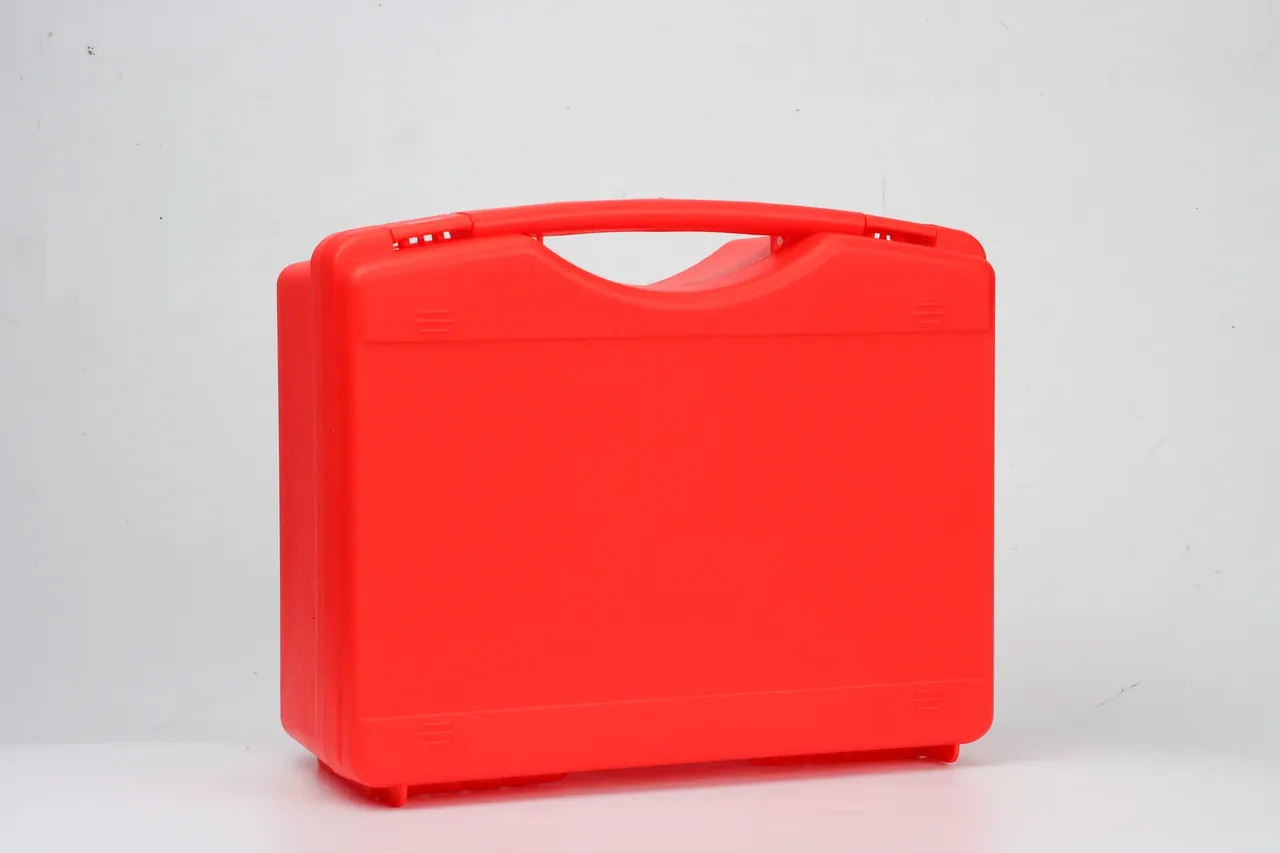
Quick answer: Case handle ergonomics begin with clearance: 25 mm at the thumb crotch, a grip section of 90–110 mm around, and a root radius no tighter than R3. Those three numbers come from hand size, finger strength and case weight, so changing one forces the other two to be recalculated.
Table of contents
- Grip clearance and the thumb crotch
- Grip section and palm contact
- Corner radius and palm pressure
- One-hand carry versus two-person lift
- Root ribs, static load and folding hinges
- FAQ
1. Grip clearance and the thumb crotch
Case handle ergonomics begin with the space between the thumb crotch and the case wall. The hand passes through it, four fingers hook under the bar, and the palm heel rests on the body.
Below 25 mm the palm heel hits the wall first, the fingers only half-close, and load shifts from the pads to the tips. A 15 kg case puts about 150 N on four fingers, 37 N each; flexors hold that inside 30% of maximum voluntary contraction and fade fast beyond it.
Gloves change the geometry: a 3 mm winter glove adds about 6 mm to palm thickness, so clearance grows to 33 mm and the section gains 6–8 mm.
Length matters as much as depth. Four adult fingers span about 80 mm, so the effective grip should not be shorter than 100 mm; under 300 mm of case width the bar can land on both walls instead of cantilevering.
One detail gets missed: the grip axis belongs above the centre of gravity. A 20 mm offset makes the case swing and tires the forearm before the hand.
2. Grip section and palm contact
The section exists to spread load: the wider the palm sits, the lower the force per unit area, and most case handle ergonomics decisions follow from that.
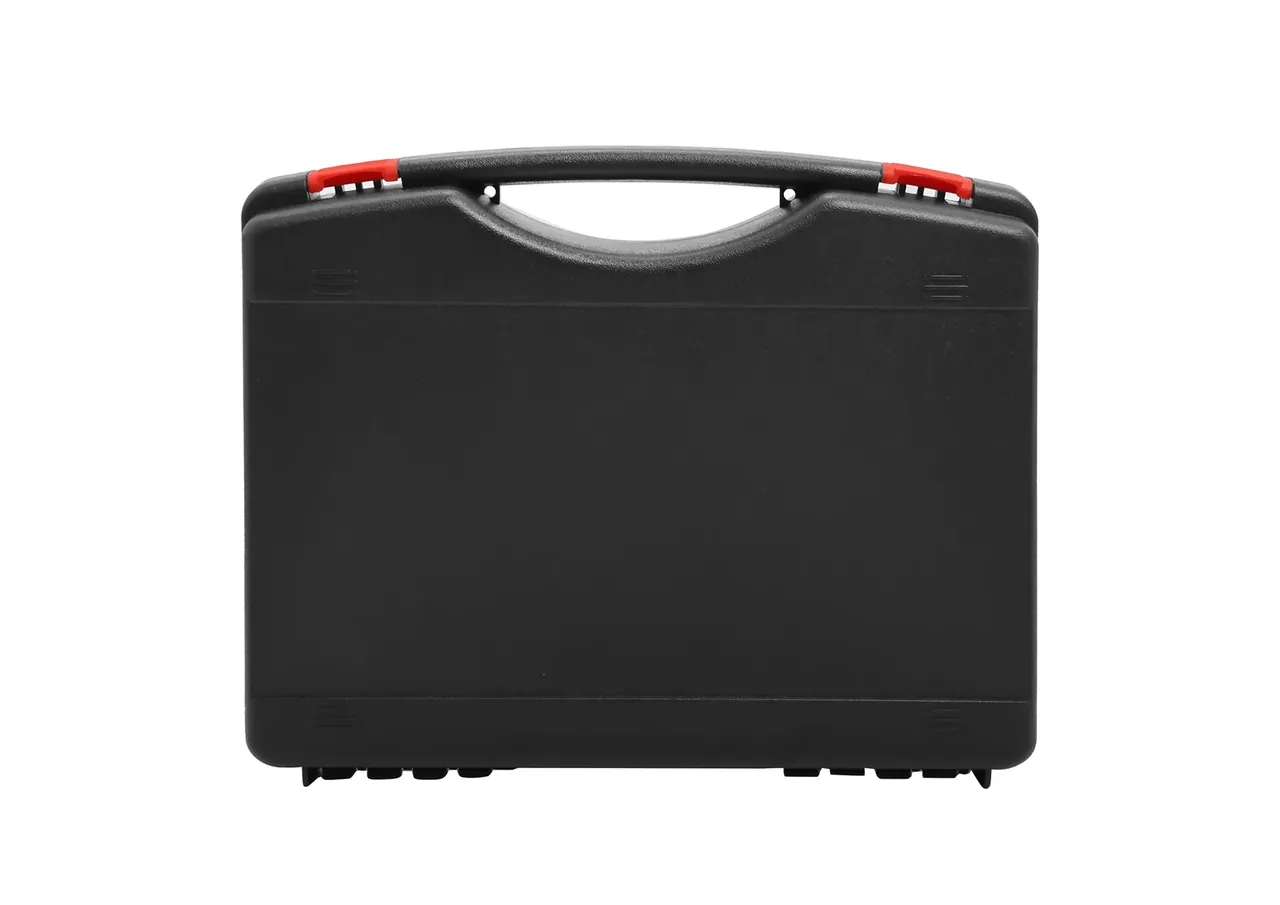
A 30 mm round bar measures about 94 mm around, mid-range in the 90–110 mm window. Average finger length is 75 mm, and hooking a 30 mm cylinder bends the joints to 60°, the angle of peak grip force.
Flat cases favour an oval: 32 mm wide by 24 mm thick, about 88 mm around. With the long axis horizontal the palm lies flatter, contact area runs 15% above a round bar of equal girth, and pressure drops a step.
Bigger is not better. Past 110 mm the fingers no longer meet and grip force falls by a third; under 90 mm the load concentrates on the phalanges and aching starts within 10 minutes.
Finish sets friction, and case handle ergonomics depend on it: bare PP against dry skin gives 0.35, a fine pebble texture 0.6, a 2 mm TPE overmould 0.9. Each 0.2 of added friction cuts finger force by 12%.
| Section | Size | Girth | Case weight |
|---|---|---|---|
| Round | 30 mm dia | 94 mm | 8–15 kg |
| Oval | 32 × 24 mm | 88 mm | 10–20 kg |
| Flat rectangle | 40 × 20 mm | 100 mm | 15–25 kg |
| Finger grooves | 36 × 26 mm | 98 mm | 12–22 kg |
3. Corner radius and palm pressure
Case handle ergonomics are decided at the transition between bar and wall, where the finger roots land.
At R3 the contact width is 4 mm and a 15 kg load produces 0.42 MPa locally. At R8 the width opens to 9 mm and pressure falls to 0.28 MPa, which reads as firm support rather than a hard edge.
Radius cannot grow without limit: beyond R8 the transition flattens, sink marks appear, and grip length shrinks until four fingers no longer fit.
Parting lines must avoid the palm. A flash ridge of 0.05 mm under 0.42 MPa behaves like a hard edge; moving the line 3 mm to the rear flank puts the palm back on a smooth face.
The two are tuned together: an oval with R5 on the short axis and R8 on the long axis evens out the contact map.
4. One-hand carry versus two-person lift
A 15 kg case in one hand loads the shoulder through a lever arm. Hanging at the side, the case centre sits about 0.35 m from the joint, producing 51 N·m that the trapezius must counter; after 2 minutes EMG amplitude climbs 20%.
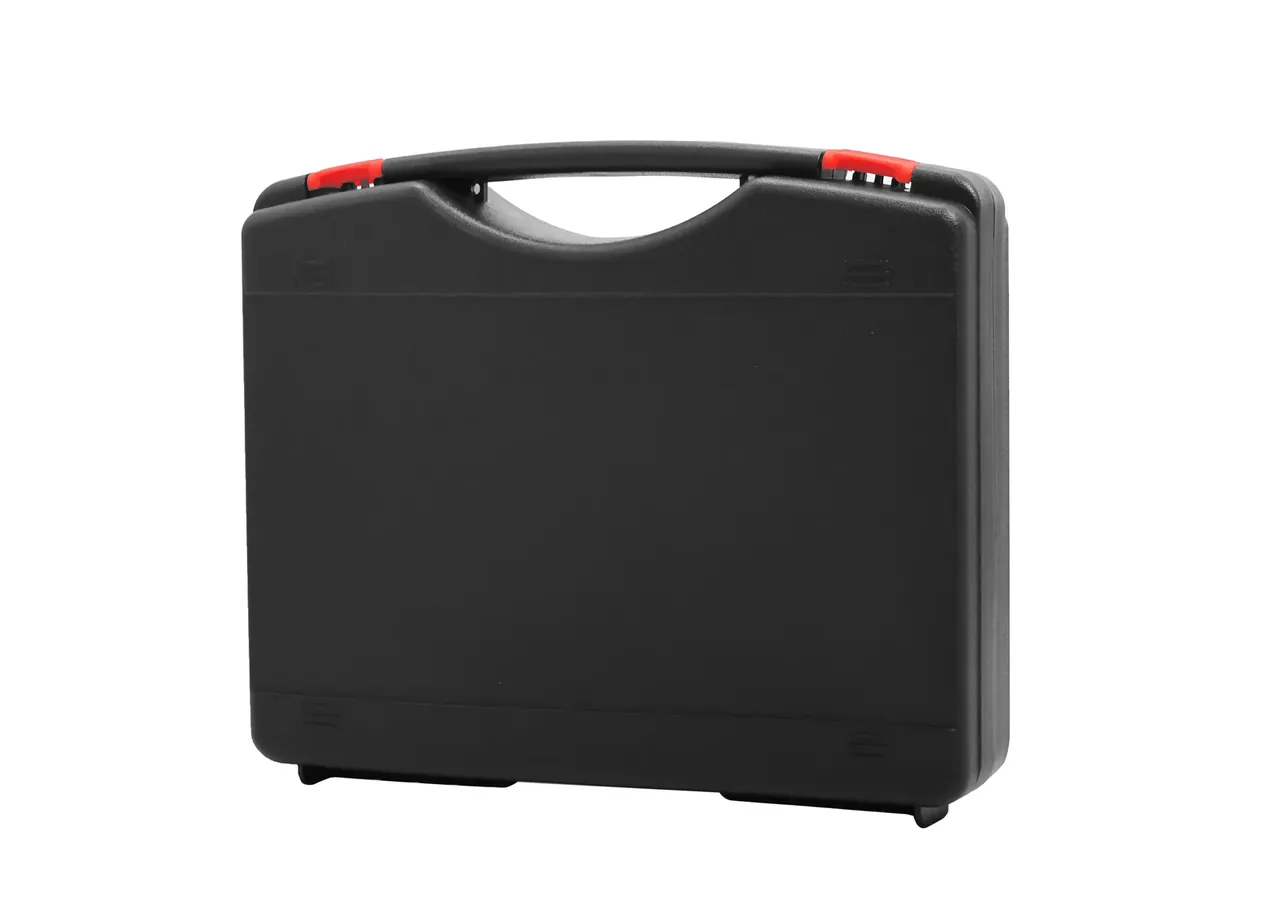
Two-person lifting depends on where the handles sit. At one quarter of the length from each end the load splits evenly and mid-span bending is minimal. Put the handles on the end faces and mid-span deflection grows about 40%, obvious on a 1.2 m case.
Synchrony matters in case handle ergonomics too: symmetric positions and matching grip heights keep two carriers in step, while a 15 mm height difference forces one side to give about 20% more.
| Carry method | Handle position | Load per person | Case weight |
|---|---|---|---|
| One hand | Above centre of gravity | All | 8–15 kg |
| Two hands, hugged | Lower side wall | All | 15–25 kg |
| Two-person lift | Quarter from each end | 50% each | 20–50 kg |
| Lift with shoulder strap | Quarter from each end | 40% each | 30–60 kg |
5. Root ribs, static load and folding hinges
Case handle ergonomics end at the root, where the whole case weight enters the wall.
Ribs radiate from both ends of the grip: 4 ribs, 3 mm thick and 8 mm high, spreading the concentration across 60 mm of shell. Rotomoulded handles are formed with the body at 5–6 mm wall and rely on a fillet; injection moulded handles are separate parts, so ribs can be thinner and denser.
Static testing runs at 50 kg for 24 hours, then the part rests 1 hour: no more than 1.5 mm of permanent set at the root, roughly a 3× safety factor on a 15 kg rating.
Folding handles live or die on the hinge. Clearance of 0.3–0.8 mm is the window: tighter will not assemble, looser rattles. End play stays under 2 mm so the case does not swing, and the spring is rated for 5000 cycles.
The hinge pin should be stainless and no smaller than 4 mm; at 3 mm, shear stress under 50 kg approaches 70% of allowable and the hole ovalises.
| Test | Condition | Requirement |
|---|---|---|
| Static load | 50 kg, 24 hours | ≤1.5 mm permanent set |
| Carry fatigue | 15 kg, 2000 cycles | No crack, no set |
| Hinge cycling | 5000 cycles | ≤20% force loss |
| End play | Hand check at rated load | ≤2 mm |
| Cold carry | −20 °C, 15 kg | No brittle fracture |
Conclusion
Case handle ergonomics come down to four numbers that must agree: 25 mm of thumb clearance, 90–110 mm of girth, R3 or more at the root to drop palm pressure from 0.42 MPa to 0.28 MPa, and handles at the quarter points so two carriers share evenly. Add a 50 kg static test and a 5000-cycle hinge life to the acceptance sheet, and comfort stops being a matter of opinion.
This article discusses container-side specifications and design implications only, and does not cover any handling, loading or use of the contents.
Related Reading
- Choosing a wheeled protective case
- Material comparison for portable tool boxes
- Rotomoulded case forming and wall thickness
- Comparing hard shell case materials
Related Products
- 8 Series — Gun Cases; Military Equipment Cases; Camera Equipment Cases; Drone Cases; Watch Cases; Knife Cases; First Aid Cases; Electronics Equipment Cases
- WL8-2812 PP Gun Case — model WL8-2812
- All protective cases and toolboxes: 7 series, 158 models