

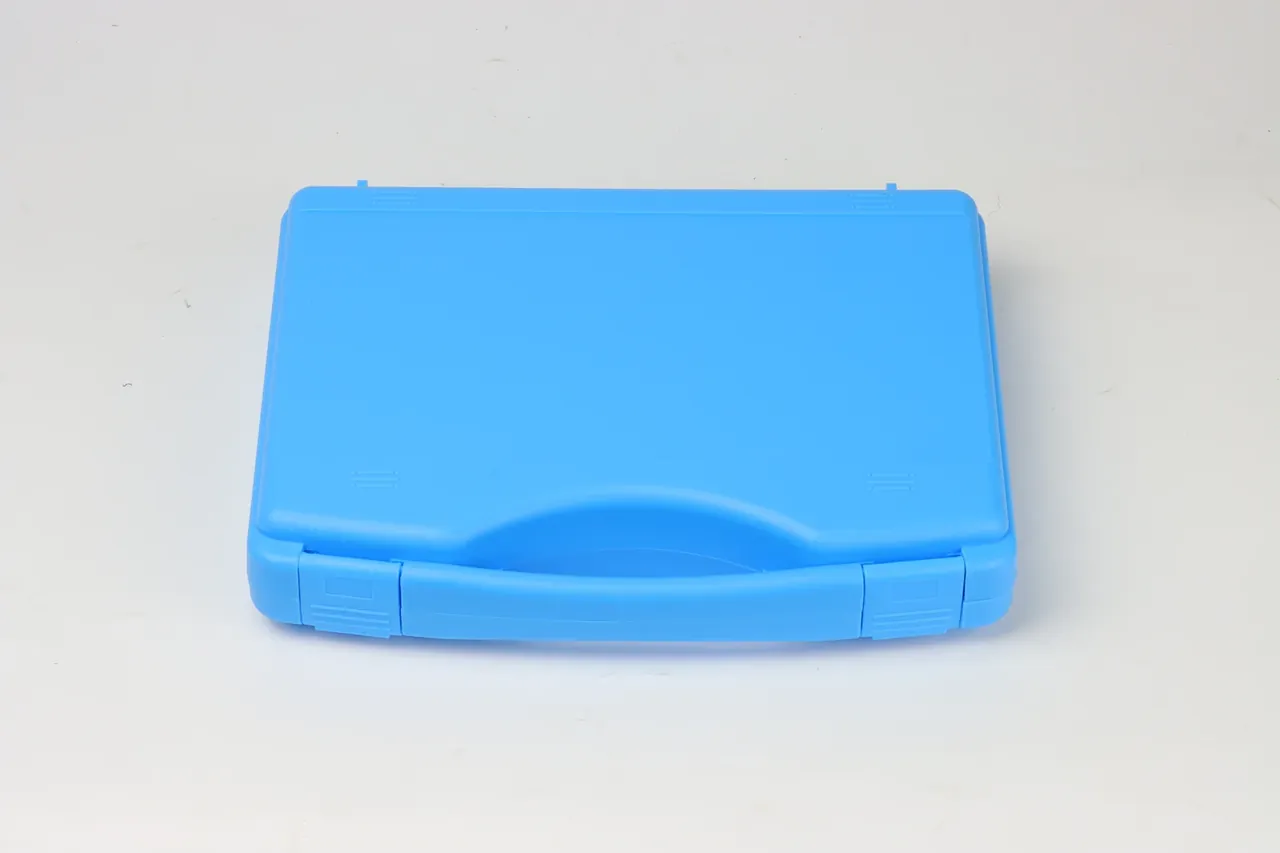
Quick answer: Hinge life counts open-close cycles, one cycle being a lid taken from 0° to 90° and back, so 3000 cycles means eight openings a day for 375 days. Lid angle sets the load: a 1.35 kg lid with its centre of gravity 165 mm from the axis puts 2.18 N·m on the hinge at 90°, and past 120° that moment moves onto the stop rib as 13.2 N. After 3000 cycles the front edge sags 1.6 mm and clearance opens from 0.15 to 0.35 mm.
Table of contents
- Counting Hinge Life
- The Wider It Opens, the Harder It Works
- Film, Pin or Metal
- Three Numbers After 3000 Cycles
- Writing the Hinge Clause
- FAQ
1. Counting Hinge Life
When a supplier claims 3000 cycles, pin the definition down: closed to 90°, held one second, back to closed is one; a 45° flick is not, and a lid laid flat at 180° is a separate class. A rig drives the lid edge at six cycles a minute, so 3000 cycles run in 8.3 hours.
Counting from the user side is more useful. Eight openings a day reaches 3000 in 375 days; twenty a day burns the same count in 150 days. Angle, frequency and lid load belong on the table before any hinge life talk.
The count wears the gasket as much as the hinge, since every closure compresses the seal once, so hinge life carries one more line: the case still passes a 1 m, 30-minute immersion.
2. The Wider It Opens, the Harder It Works
The lid is a cantilever, so gravity gives a moment equal to weight times the horizontal distance from the centre of gravity to the pin. At 1.35 kg with the centre 165 mm behind the axis, the arm peaks at 90° with 2.18 N·m and falls to 1.09 N·m at 30°.
| Lid angle | Moment | Where the load lands |
|---|---|---|
| 30° | 1.09 N·m | Pin and pin seat |
| 90° | 2.18 N·m | Pin, one side of the bore |
| 120° | 13.2 N reversed | Stop rib starts to pull |
| 180° | 13.2 N full weight | Stop rib and ear root |
Past 90° the centre of gravity crosses the axis, the moment reverses, and a 2 mm plastic stop rib takes over from the pin. Its 40 mm² of bearing area turns 13.2 N into 0.33 MPa, mild until it repeats: 3000 cycles round the tip by 0.4 mm.
Letting go at half open is worse. A lid dropping from 60° lands at 1.8 times the static moment, about 3.4 N·m, and that sizes the pin: 64 MPa of shear on 3 mm stainless, a factor of 3.1, against 145 MPa and 1.4 on 2 mm.
3. Film, Pin or Metal
A living hinge joins lid and body with a 0.8 mm PP web, with no assembly and no pin. Its life is the flex life of the material: the crease whitens after 3000 cycles at room temperature without cracking, yet at -20 °C it cracks through near 500 cycles, because PP keeps 40% of its flex strength in the cold.
The pin hinge is the mainstream answer: a 3 mm 304 pin in a PA66 bore with 0.15 mm of clearance. PA66 holds dimensions and wears well, so 3000 cycles open the bore 0.2 mm and clearance reaches 0.35 mm.
A metal hinge bends 1.5 mm cold-rolled strip, screwed with M4 to a reinforced boss, carries 8 kg per pair, and costs 8.6 plus a station.
| Type | Material and size | Sag after 3000 | Cold behaviour | Cost |
|---|---|---|---|---|
| Living hinge | PP, 0.8 mm web | 1.2 mm | Cracks near 500 cycles | 0 |
| Pin hinge | 304 pin, 3 mm, PA66 bore | 1.6 mm | Clean at 3000 | 2.4 |
| Metal hinge | 1.5 mm strip, M4 screws | 0.6 mm | Pin unaffected | 8.6 |
The line is lid weight, not price: under 2 kg a living hinge is enough, 2 to 6 kg goes to a pin, above 6 kg metal earns its cost.
4. Three Numbers After 3000 Cycles
Hinge life needs three measurable numbers, because a lid that still feels smooth tells you nothing. The first is sag, measured 50 mm in from the corner with the lid closed: a new case reads 0.3 mm, 3000 cycles bring 1.6 mm, 6000 cycles reach 2.4 mm, and the limit sits at 2.0 mm.
The second is clearance: hold the lid at 45° and feeler between pin and bore, 0.15 mm from the factory, 0.35 mm at 3000 cycles, new pin past 0.4 mm. The third is debris: pull the pin and look for white powder at the bore mouth, and 0.1 mm of loss means the bore is out of round.
Temperature pushes all three. At 60 °C PP loses about 30% of its modulus, and a lid carrying 5 kg held open 24 hours sags 3.1 mm. At -20 °C sag drops but a struck edge chips. The gasket ages on the same curve: 24 hours at 70 °C leaves 12% compression set, so it returns to 88% of its thickness.
Salt spray is separate. A 304 pin stays clean after 96 hours of neutral spray, a zinc-plated one shows white rust at 48 hours.
5. Writing the Hinge Clause
A clause that can be inspected carries five items; leave one out and the argument happens at the dock:
- Cycles and angle: 3000 cycles, 0° to 90°, one second dwell
- Rate and load: six cycles a minute, 5 kg ballast in the lid
- Limits: sag ≤2.0 mm, clearance ≤0.4 mm, wear ≤0.1 mm
- Seal link: 1 m immersion for 30 minutes after the run
- Report: sag and clearance before and after, not a bare pass
Numbers do more work than adjectives. Replace durable with 3000 cycles, 90°, 5 kg and 2.0 mm, and quotes separate at once: the supplier who can do it moves from a 2 mm pin to 3 mm.
The cost follows: a 3 mm pin adds 0.4 per unit, a doubled seat adds 0.7, and 1.1 across 3000 openings is 0.0004 each. What it buys back is usually a batch of lids.
Conclusion
Hinge life is not a bare count but a count fixed by angle, load and temperature. A 1.35 kg lid at 90° loads the hinge with 2.18 N·m; past 120° the force moves to a 2 mm stop rib as 13.2 N of repeated pull. Run 3000 cycles and the edge sags 1.6 mm, clearance reaches 0.35 mm, wear stays near 0.08 mm, all inside the limits. Write 3000, 90°, 5 kg and 2.0 mm into the order, and the sample no longer needs opening by hand a hundred times.
This article discusses only the specification and design intent on the container (case) side, and does not cover any handling, loading or use of the contents.
Related Reading
- Sealing requirements for hinged-lid waterproof boxes
- Quality checks on a case assembly line
- Mould care and cavity wear
- How immersion and air leak tests are judged
Related Products
- 8 Series — Gun Cases; Military Equipment Cases; Camera Equipment Cases; Drone Cases; Watch Cases; Knife Cases; First Aid Cases; Electronics Equipment Cases
- WL8-2812 PP Gun Case — model WL8-2812
- All protective cases and toolboxes: 7 series, 158 models