

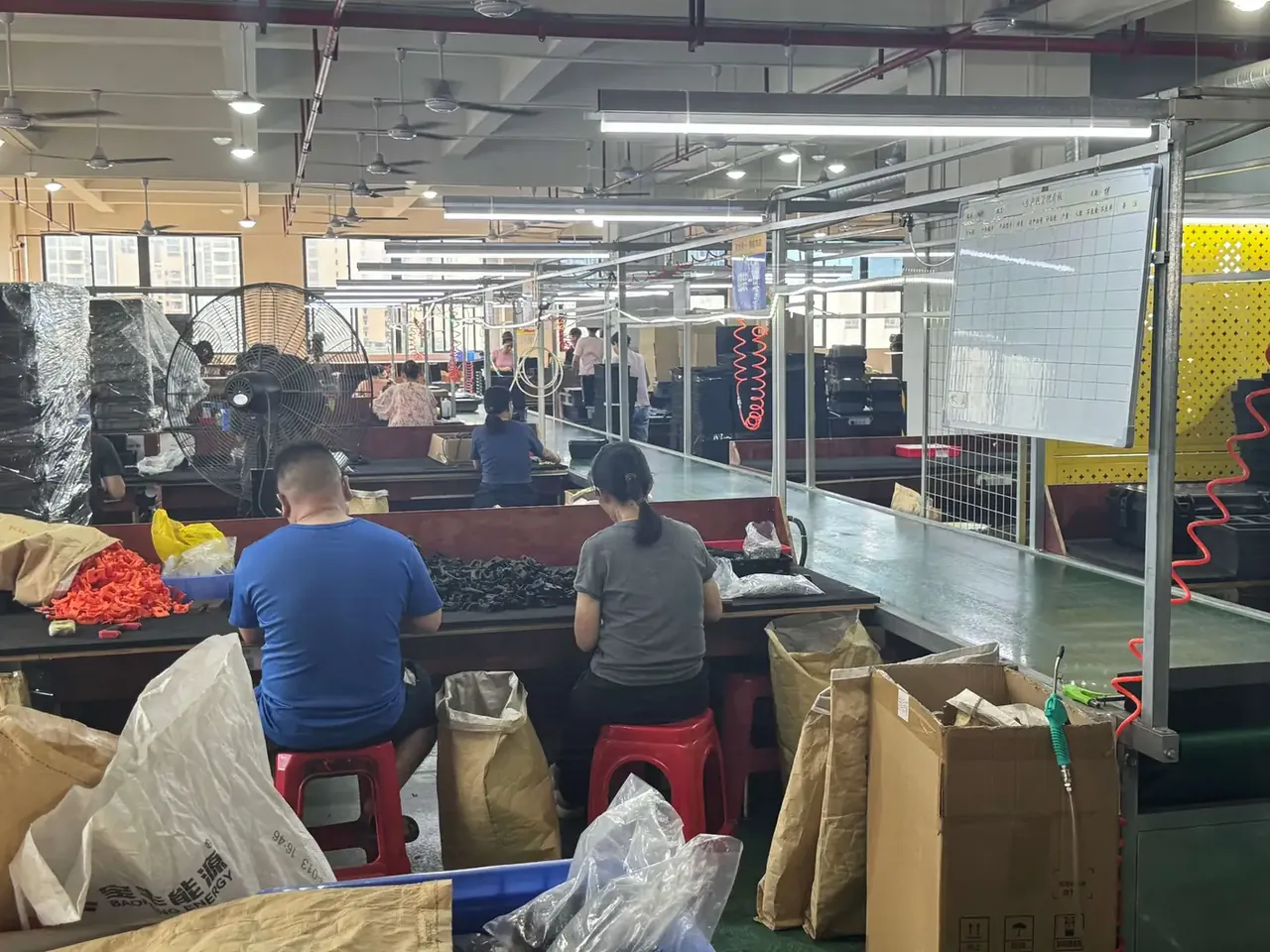
Quick answer: Case Production Training runs in the order the part is made: demoulding and deflashing, then assembly, then final check and stacking. Three days, 18 hours, 30 trial parts on the last day, pass mark 80 out of 100, safety as a hard veto.
Table of contents
- Why Case Production Training Follows the Process Order
- Station One: Demoulding and Deflashing
- Station Two: Assembly and Fitting Press
- Station Three: Final Check and Stacking
- The Three-Day Schedule and How Scoring Works
- FAQ
1. Why Case Production Training Follows the Process Order
New hires usually go wherever hands are short, which is how a first week gets spent refitting the same lid. Case Production Training fixes the sequence to demoulding, assembly and final check because each decision point feeds the next: demoulding judges the blank, assembly judges the fit, final check judges the batch.
Rhythm matters. At the machine the pace belongs to the tool, so the skill is waiting, supporting and setting down flat. Case Production Training books that station first because a machine-driven rhythm is easier to absorb before a self-driven one.
| Station | First thing a trainee learns | Hours | Allowed to work unsupervised |
|---|---|---|---|
| Demoulding and deflashing | Corners, gate position, tool sound | 6 | 50 parts without drag marks |
| Assembly and fitting press | Hinge direction, latch seat | 7 | 20 lids closing quietly |
| Final check and stacking | Colour, sink marks, stack height | 5 | Matches the trainer nine times in ten |
2. Station One: Demoulding and Deflashing
The first move at the machine is looking, not reaching. Watch the corners for whitening and listen for the ejector pins; reach in only when they are back. Support the two base ribs instead of the side wall, since a 2.5 mm wall is soft above 60 degrees Celsius and finger marks on black material never polish out.
Flash comes off in one scrape from the gate, never back and forth, or it presses into the parting face. Leave the gate stub under 0.3 mm, then rest the part in the cooling jig for 60 seconds. Lifting a case by the handle opening and flipping it face down are the day-one mistakes that take two weeks to undo.
3. Station Two: Assembly and Fitting Press
Assembly starts on the long side: hinges, then latches, then handle. Reverse it and the lid lifts when the handle is pressed. The press stroke must be vertical, because angled pressure bends the pin, which stays quiet and then jams after a dozen cycles.
Seal strip is pushed along the groove, never stretched; stretched strip bulges at the corners, exactly where a rain test leaks first. Every 20 parts, open and close the lid three times. The bench runs a 45-second takt, and Case Production Training allows 70 seconds for two days but under 50 on the third.
4. Station Three: Final Check and Stacking
Case Production Training teaches this station last because it carries the longest defect list. Viewing distance is 40 cm, illuminance above 500 lux. Colour is read against a sealed plate renewed every six months, sink marks on the back of the ribs, flash with the back of the hand.
Stacking is a skill: interlocked, half-position offset per layer, six layers maximum, pallet and load under 1.2 m. Past six layers the bottom case deforms within 24 hours and nobody notices until the customer opens the carton. The station also owns a five-line inspection sheet.
5. The Three-Day Schedule and How Scoring Works
Eighteen hours over three days: six at the machine, seven at the bench, five for final check and assessment. Each day starts with two hours of watching, moves to four alongside the trainer, and ends with one hour alone.
Practical work is 60 points from 30 trial parts, 28 good for full marks. Oral questions are 20, paperwork 20. Safety is a veto: bare hands on hot parts or blowing flash voids the day and delays the retest by seven days. A pass brings a refresher every 90 days.
| Item | Weight | Full marks | Veto |
|---|---|---|---|
| Practical work | 60 | 28 of 30 parts good | Any safety breach |
| Oral questions | 20 | 4 of 5 correct | Cannot state stop conditions |
| Paperwork | 20 | All five boxes filled | Two blank days running |
Conclusion
The stations are ordered so each decision carries the one before it: if demoulding is not watched, assembly compensates; if the press is not square, final check absorbs it. Eighteen hours, 80 points and a 90-day refresher set the pace. Case Production Training never buys speed; it buys the odds of getting it right first time.
This article discusses only the container (case body) side of specifications and design intent, and does not cover any handling, loading or use of the contents.
Related Reading
- How a case production line is sequenced
- A day at the case assembly workstation
- Case assembly quality control and rework decisions
- Calculating case capacity from machines, takt and staffing
Related Products
- 8 Series — Gun Cases; Military Equipment Cases; Camera Equipment Cases; Drone Cases; Watch Cases; Knife Cases; First Aid Cases; Electronics Equipment Cases
- WL8-2812 PP Gun Case — model WL8-2812
- All protective cases and toolboxes: 7 series, 158 models