

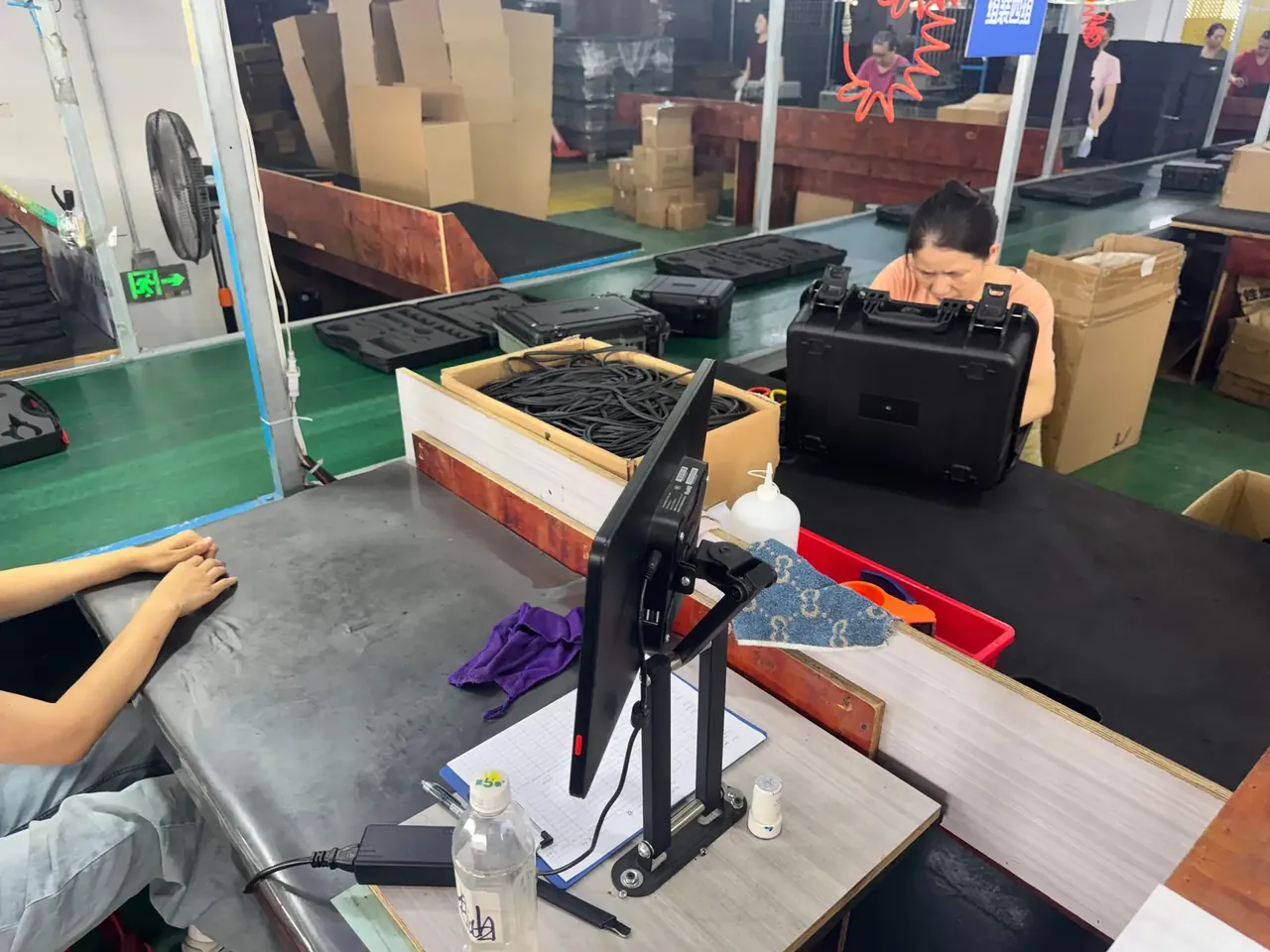
Quick answer: A Case Production Line runs in four segments: molding, trimming, hardware and liner assembly, packing. The split follows the state of the case, not the walls of the shop. Takt sits at 80 seconds, with molding at a 77-second cycle, trimming 62, assembly four stations at 68 or less, packing two at 62.
Table of contents
- How the Case Production Line Splits into Four Segments
- Molding: The Cycle Time Is the Takt
- Trimming: Labor Hidden in Five Motions
- Assembly: Cutting Stations for Hardware and Liner
- Packing, WIP Caps and Changeover Sequencing
- FAQ
1. How the Case Production Line Splits into Four Segments
A Case Production Line splits by the state of the case, not by department: pellets to shell, shell to bench-ready part, part to finished case, case to shipping unit.
Trimming cannot fold into molding: the press cycles in 77 seconds, trimming takes 62, so a shared station idles the machine. Nor can it fold into assembly, where 0.15 mm of flash lifts the liner.
| Segment | Output | Takt (s) | Buffer |
|---|---|---|---|
| Molding | Shell off a 1200 t press | 77 | 6 |
| Trimming | Bench-ready part | 62 | 4 |
| Assembly | Finished case | 68 | 4 |
| Packing | Shipping unit | 62 | — |
2. Molding: The Cycle Time Is the Takt
The takt of molding is the cycle, not the nameplate. A 620 x 440 x 215 mm case with 3.0 mm walls runs 225 C melt and 45 C mold: 27 seconds of injection and hold, 38 of cooling, 12 for opening and removal.
Cooling owns more than half, so a faster robot buys nothing. Channels from 10 mm to 12 mm and water from 45 C to 38 C save about five seconds; push further and the part leaves above 60 C and warps.
One press, one operator, no trimming. Racking, a weigh-in every twentieth shot and an hourly sample fit inside the three seconds between cycle and takt, derived from 25,200 seconds against 315 cases.
3. Trimming: Labor Hidden in Five Motions
Trimming is costed by motion: 14 seconds at the gate, 22 on flash, 9 on ejector marks, 11 of air and check, 6 for the label, 62 in total.
The gate is 4 mm across, cut with 0.3 mm left: more presses into the liner, less leaves a notch. Flash above 0.15 mm comes off, and a thumb along the edge finds it faster than a caliper.
Timing beats technique: at 60 C off the tool the blade runs clean, below 40 C the PP chips. Two sizes on one line split this into 26 and 36 seconds.
4. Assembly: Cutting Stations for Hardware and Liner
Assembly carries 252 seconds, so it must be cut by posture: base hardware upside down, side hardware standing, liner flat. A flip costs four to six seconds.
| Station | Work content | Takt (s) |
|---|---|---|
| Kitting | Hardware, gasket, liner per order | 58 |
| Assembly A | Feet, hinge bases, drain valve | 68 |
| Assembly B | Handle, latches, pressure valve | 64 |
| Assembly C | 30 mm EVA in lid, 25 mm foam in base | 62 |
Sixty-eight seconds is the longest station, under takt; the segment balances near 85 percent; above 92 one stuck case halts the rest. The liner goes last, after an eight-second air pass.
5. Packing, WIP Caps and Changeover Sequencing
Packing takes 124 seconds in two stations at 62: bag and carton, then fold, tape, label.
Work in process is capped at six, four and four, twenty on the line, from the longest stoppage of eight minutes. A full rack is a blockage. Changeover needs the whole line: 38 minutes for a 4.2 t mold, 12 to purge, 15 for the first-off, 65 in total.
| Changeover type | Minutes | Sequencing rule |
|---|---|---|
| Color only | 25 | Light to dark, never reverse |
| Case size | 65 | Before handover, 90-minute window |
| Liner and hardware | 18 | Batched with the mold change |
| Packing spec | 12 | Last 15 minutes, upstream runs on |
Three rules order it: light to dark, because dark purge contaminates light parts; high mold temperature to low, thick walls first; clearing from packing back to molding, so the racks empty before the press stops.
Conclusion
Split the segments, set the takt, cut the stations, cap the work in process: read where the state of the case changes, let the slowest segment set the pace, break any segment that runs longer, then buffer the jitter. When the numbers disagree, change the station before the takt. Done that way, a Case Production Line stays balanced and quick to change over.
This article discusses only the container (case body) side of specifications and design intent, and does not cover any handling, loading or use of the contents.
Related Reading
- What a mold trial run must prove
- One-piece molding and wall control
- How case cost breaks down
- Wall thickness and case strength
Related Products
- 8 Series — Gun Cases; Military Equipment Cases; Camera Equipment Cases; Drone Cases; Watch Cases; Knife Cases; First Aid Cases; Electronics Equipment Cases
- WL8-2812 PP Gun Case — model WL8-2812
- All protective cases and toolboxes: 7 series, 158 models