

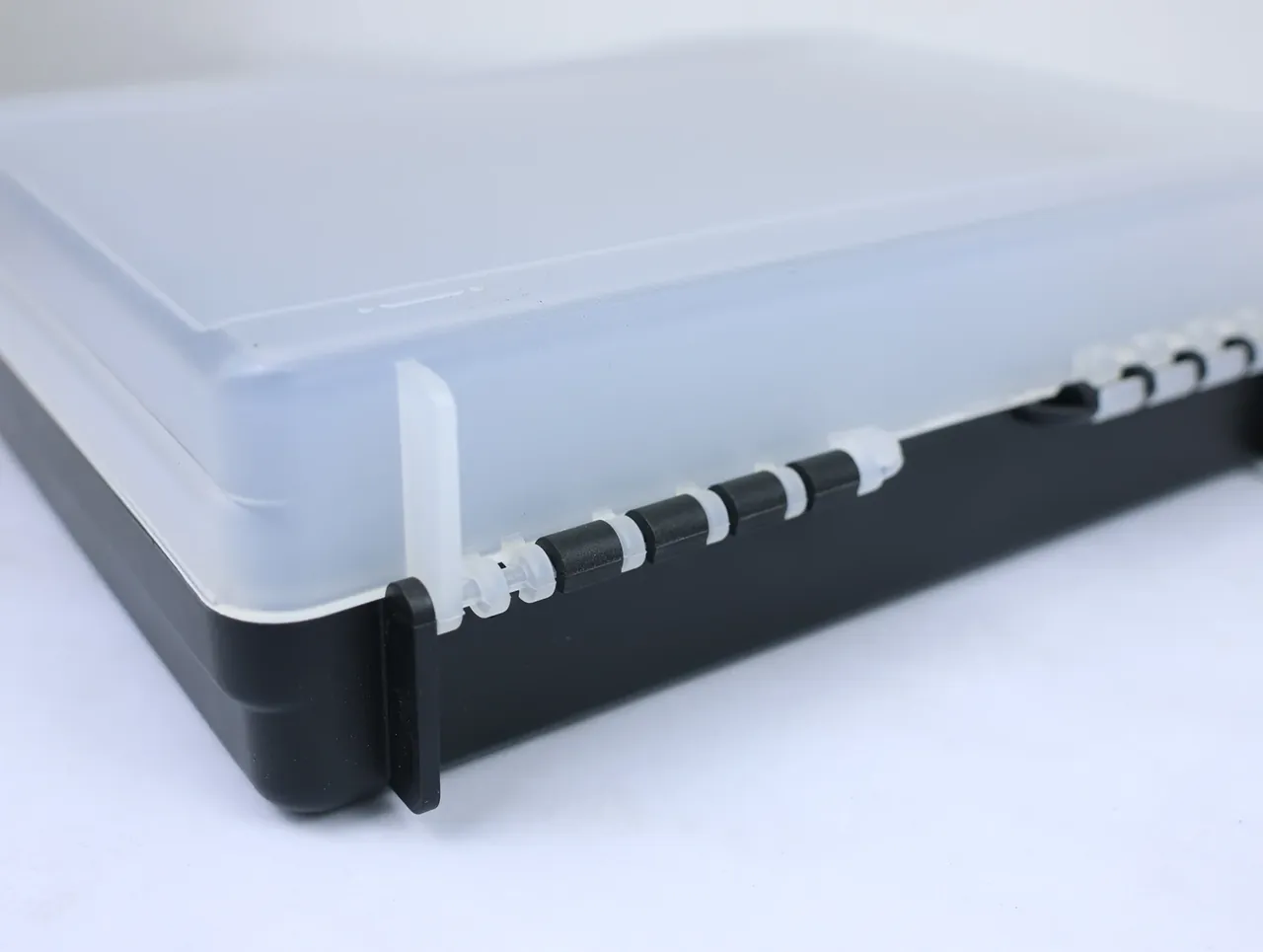
Quick answer: The same case raw material preparation fails differently in a cold store, on a roof, in a chemical warehouse and in a food plant: brittle fracture, chalking, swelling, migration.
Table of contents
- Cold duty: which phase goes brittle first
- UV exposure: chalking starts at the skin
- Chemical contact: solvents, alkali, cleaners
- Food and pharma contact: migration and odour
- FAQ
1. Cold duty: which phase goes brittle first
A case leaves a -30℃ store and meets a 50℃ swing within 2 hours. The M6 screw tightened at assembly becomes the stress raiser; a crack runs from the boss outward and stops at the nearest rib.
The amorphous phase loses toughness first. Ethylene segments in copolymer PP still absorb impact at -20℃, homopolymer PP does not, and swapping resin in the same tool drops the case from 1.2 m to 0.6 m.
Assembly torque follows the resin. 2.5 N·m suits copolymer, while a cold-toughened grade wants 2 N·m before the boss splits; brass inserts beat thread-forming screws, and a POM pin replaces stainless for 200 opens at -30℃.
| Duty | Grade that fits | Field result | Common error |
|---|---|---|---|
| Cold-chain dock, -30℃ | copolymer PP, MFI 8 to 12 | 1.2 m drop, no crack | saving 0.6 yuan per kg on homopolymer |
| Airfreight, -40℃ | copolymer plus 10% toughener | 6 hours in the hold | liner cut to room size |
| Roof rack, 3000 hours | 2% carbon black | colour shift under ΔE 3 | natural grade, fading at 800 hours |
| Chemical store | PP or PE, not ABS | no gloss loss | ABS holding acetone, cracked in 10 minutes |
2. UV exposure: chalking starts at the skin
After 3000 hours on a roof, the outer 0.2 mm chalks, the catch fingers snap on the third closing, and a palm wipe leaves white dust. UV works inside a few microns at the surface, never across the wall.
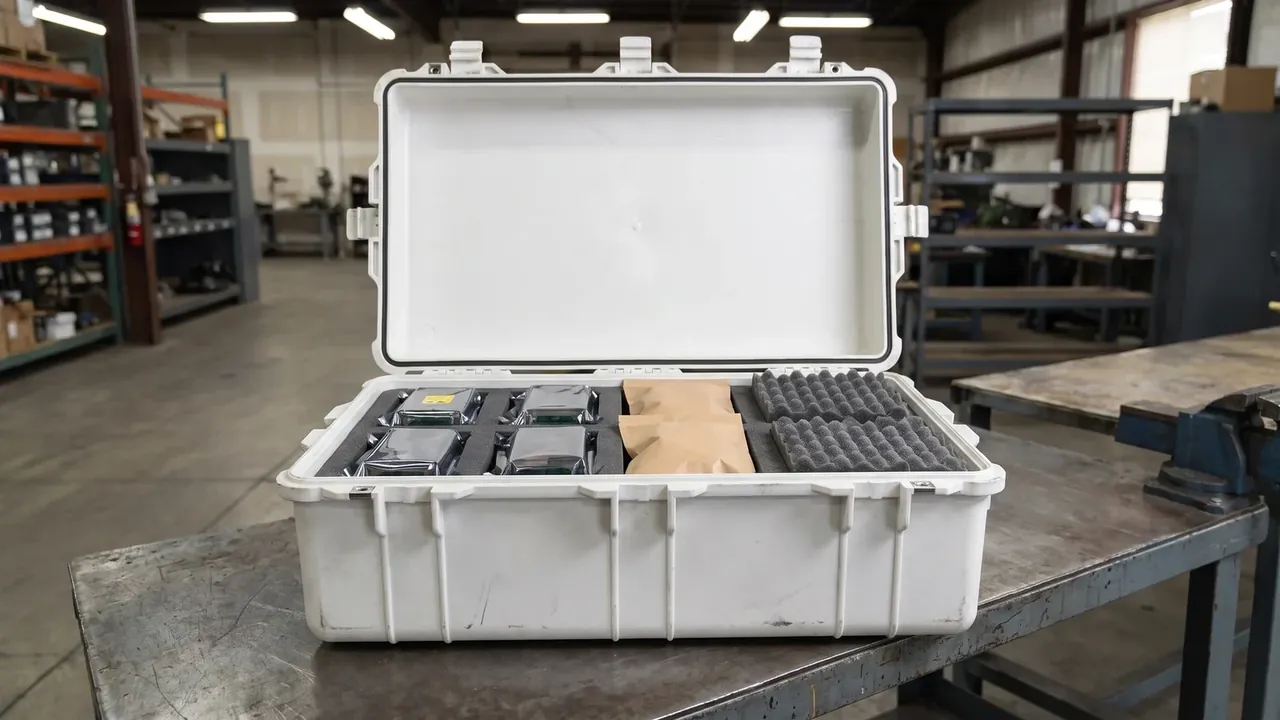
A 2% carbon black compound holds 3000 hours under ΔE 3; unstabilised natural PP fades at 800 hours and sheds flakes by 1200. Above 0.6%, stabiliser blooms, coats the tool and scuffs the part on ejection.
Most assembly failures come from marking. Screen ink on an unstabilised grade cracks first, and each crack feeds UV inward; in-mould labels or laser marking let case raw material preparation skip a dedicated grade for graphics.
3. Chemical contact: solvents, alkali, cleaners
PP shrugs off acids and alkalis and loses to non-polar solvents: 24 hours in petrol adds 8% weight and 1.5 mm of growth, and the latches no longer close. ABS whitens in acetone, so one bucket tells the grades apart.
| Medium | Strength | Temperature | Contact | Result |
|---|---|---|---|---|
| Petrol | industrial | 25℃ | 24 hours | PP gains 8%, ABS softens |
| Sodium hydroxide | 10% | 40℃ | 48 hours | PP unchanged, ABS dulls |
| Acetone | analytical | 25℃ | 10 minutes | ABS cracks, PP swells |
| Ethanol | 75% | 25℃ | repeated wiping | both stable |
Cleaning is the commonest error: 75% ethanol is fine, while acetone on label adhesive leaves a haze in seconds that chalks into fine cracks within six months.
Gaskets and adhesives must match the resin. EPDM bonds to PP, an ABS case needs acrylic; the wrong pair peels off in three months, and no care in case raw material preparation keeps the seal.
4. Food and pharma contact: migration and odour
A food-contact case clears two lines. Soak in 4% acetic acid at 70℃ for 2 hours and overall migration must stay at or under 10 mg/dm²; n-hexane at 60℃ covers fatty simulants.
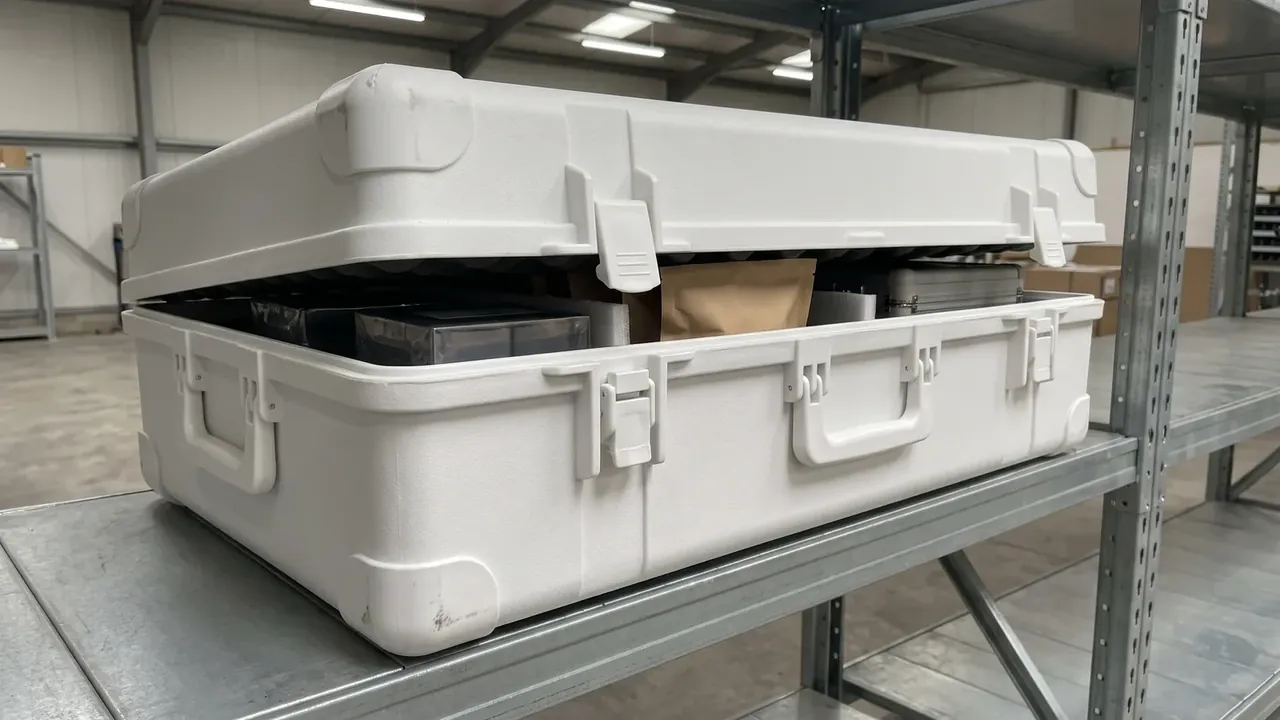
Odour is the second line. A case with 20% regrind smells of plastic when a flour bag opens and fails the sensory panel outright; virgin resin airs off in 24 hours. Plants win on price and lose on smell, 600 cases at a time.
Contamination during assembly beats contamination in the resin: oiled gloves mark the inner wall, and a 5 minute rinse costs less than a better grade.
Conclusion
All four duties point to one order: lowest temperature, then exposure time, then contact medium, then contact object. Reverse it and a UV grade lands in a freezer, or a food-grade compound ends up holding solvent. There is no universal recipe in case raw material preparation, only one that holds under a named duty.
This article discusses only the container (case body) side of specifications and design intent, and does not cover any handling, loading or use of the contents.
Related Reading
- From pellet to melt: the full preparation route
- Weathering and cost across five case materials
- Keeping batch records through preparation
- Airdrop case assembly on cold plateaus
Related Products
- 8 Series — Gun Cases; Military Equipment Cases; Camera Equipment Cases; Drone Cases; Watch Cases; Knife Cases; First Aid Cases; Electronics Equipment Cases
- WL8-2812 PP Gun Case — model WL8-2812
- All protective cases and toolboxes: 7 series, 158 models