

Quick answer: Case selection by industry runs in four steps: ingress rating and drop height, then temperature and sealing, then insert and hardware, then marking and traceability. Sectors differ less in appearance than in the ranges each step will accept.
Table of contents
- Which Three Specs Decide It
- Step One: Ingress Rating and Drop Height
- Step Two: Temperature Range and Sealing
- Step Three: Insert and Hardware
- Step Four: Marking and Traceability
- FAQ
1. Which Three Specs Decide It
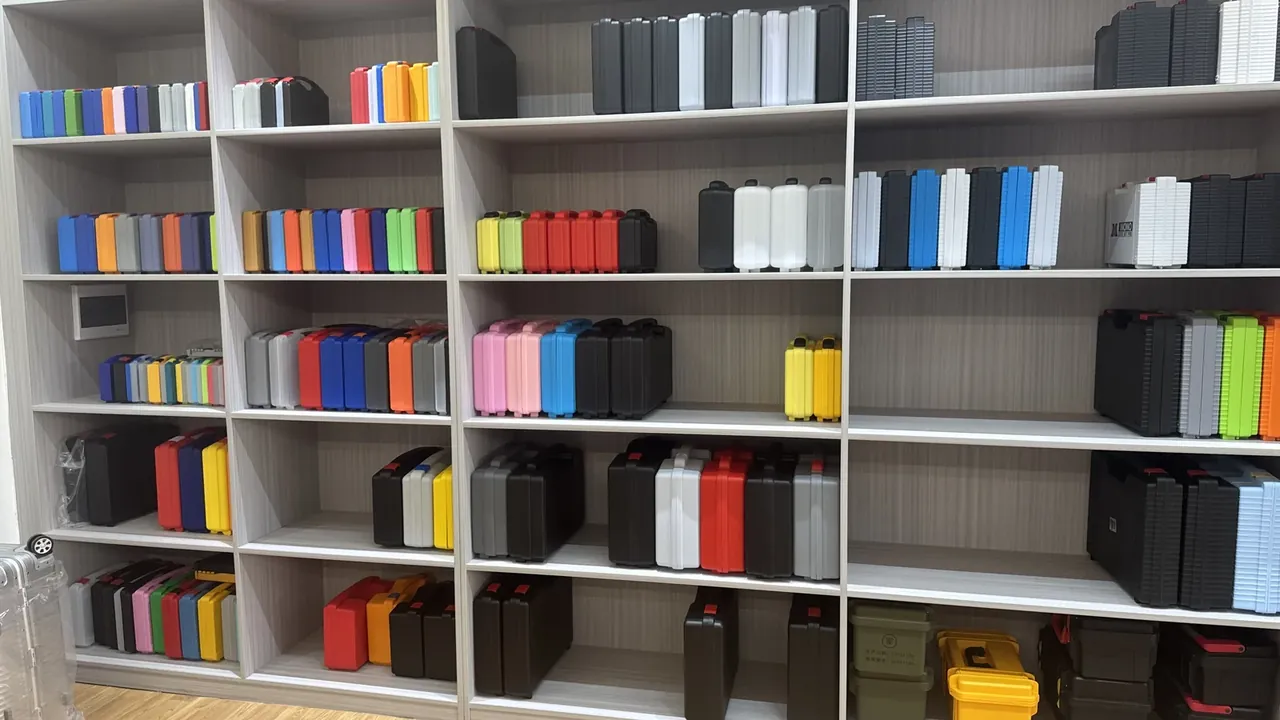
Five sectors on one shelf, differing only in colour. Three specs separate them: ingress rating, drop height, and a third item that shifts by sector, whether insert support for broadcast gear, records for testing, stacking for defence supply, or a wipeable surface for medical equipment.
Case selection by industry begins with a short list: three items, the numbers, and the test behind each.
| Sector | Primary spec | Secondary spec | Can be relaxed |
|---|---|---|---|
| Broadcast gear | Insert support for body and lens | Latch retention after drop | Marking method |
| Third-party testing | Ingress rating | Seal and repeatable closing | Colour |
| Defence supply | Stacking and shell stiffness | Weathering and salt spray | Insert finish |
| Medical equipment | Wipeable surface and seam seal | Drop height | Case weight |
| Emergency stock | Seal after long storage | Thermal cycling | Insert tolerance |
2. Step One: Ingress Rating and Drop Height
Case selection by industry means putting two numbers in the enquiry, not the phrase waterproof and shockproof. In IP65 the second digit means water jets; IP67 one metre of immersion for 30 minutes; IP68 a depth and duration in writing. Drop height needs height, faces and cycles.
Higher is not better by default. Twenty-six drops at 1.2 m across six faces is a common empty-case baseline, but a loaded case loads the latches 30 percent harder, so a loaded corner drop is taken at 0.8 m.
| Tier | Ingress | Drop protocol | Typical setting |
|---|---|---|---|
| Basic | IP54 dust and splash | 0.8 m corner drop | Indoor transfer, vehicle |
| Standard | IP65 water jets | 26 drops at 1.2 m, six faces | Field shoots, inspection |
| Reinforced | IP67, 1 m for 30 min | Six faces at 1.5 m | Outdoors, marine, response |
Acceptance is measured: no latch opens, the seal face shifts under 1 mm, the diagonal under 2 mm.
3. Step Two: Temperature Range and Sealing
Case selection by industry treats temperature as two columns: working, typically -20 to 60 degrees Celsius loaded, and storage 10 degrees beyond, so -30 to 70. Quote one range and the supplier prices its easiest end.
Sealing rests on the O-ring and a pressure test. A 5.5 mm silicone cord in a groove cut to 75 percent of that diameter leaves 25 percent compression; less seeps water, more takes a set. Pressurise to 20 kPa, hold 30 seconds, allow 1 kPa.
Cooling a case from 45 to 5 degrees can build 15 kPa across the lid, so any post opened a dozen times a shift needs a purge valve at 0.35 bar.
4. Step Three: Insert and Hardware
Case selection by industry turns on the insert, which sets how much room the shell needs. EVA at 45 kg/m³ and 25 mm thick rebounds best at 10 to 15 percent compression; foam below 35 kg/m³ collapses within two closures. A 15 by 15 mm pick-and-pluck grid suits regular shapes; irregular items need a cavity cut to drawing.
Internal height is a sum: bottom foam, object height, lid foam, plus 8 mm. Under 5 mm of margin the lid never seats; over 12 mm the load travels.
Case selection by industry also fixes hardware before the tool is cut, since each item needs a hole or a boss, and bolt-on parts break first.
5. Step Four: Marking and Traceability
Case selection by industry ends with marking. Laser burns into the surface and survives 50 wipes with 70 percent alcohol; screen print fails by the third move; a 0.8 mm riveted plate suits changing data, at the cost of two holes.
Traceability needs a 12-digit serial, a 15 by 15 mm code and a batch, always 30 mm in from the lower right corner of the lid, plus a calibration date held behind the code.
Case selection by industry produces twelve to fifteen numbers on one page.
Conclusion
The rating decides whether water gets in, the drop whether the latches hold, temperature and sealing whether the lid still opens, insert and marking whether each shift is easy. Once the numbers sit on one page, quotes compare and acceptance becomes a measurement. Case selection by industry is not five rulebooks; it is one order of four steps.
This article discusses only the container (case body) side of specifications and design intent, and does not cover any handling, loading or use of the contents.
Related Reading
- Case configurations for field inspection equipment
- Modular dividers in emergency kit cases
- Sizing a travel case for cabin or hold
- Shell and hardware on heavy-duty tool cases
Related Products
- 8 Series — Gun Cases; Military Equipment Cases; Camera Equipment Cases; Drone Cases; Watch Cases; Knife Cases; First Aid Cases; Electronics Equipment Cases
- WL8-2812 PP Gun Case — model WL8-2812
- All protective cases and toolboxes: 7 series, 158 models