

Quick answer: Storing cases needs three figures: minus 10 to 40 °C, 40 to 70 percent RH, and 150 kg of allowable load divided by the real load per lid.
Table of contents
- Three Numbers and One Division
- Temperature: Two Edges and a Condensation Margin
- Humidity: Where the Narrow Band Sits
- Stacking Limits: One Division, Run to the End
- Pallets, Clearance and Long-Term Posture
- FAQ
1. Three Numbers and One Division
A store room needs three figures: a temperature band, a humidity band, a stack count. The first two come off a table; the third has to be worked out.
Two 60 L cases under the same 30 kg load for two years, one at 23 °C and one under a 38 °C roof, end 3 mm apart at the lid centre.
Get them wrong and every later step turns into damage control.
Temperature carries the most weight because PP creeps faster as it warms: above 40 °C the rate runs about twice the 23 °C figure. Humidity leaves stiffness alone and works on hardware and foam. The stack count answers to both.
| Parameter | Limit | Cost of crossing | Check |
|---|---|---|---|
| Temperature | -10 to 40 °C | creep doubles past 40 | 2 meters, 1.5 m up |
| Humidity | 40 to 70 percent RH | white rust at 48 h | weekly |
| Light | 2000 UV hours | impact under 70 percent | blind, 3 years |
| Floor | 100 mm up, 300 mm off wall | damp, dead air | quarterly |
2. Temperature: Two Edges and a Condensation Margin
The lower edge sits at -10 °C for the gasket, not the shell. TPE and EPDM gain about 5 Shore A and rebound stretches from 2 s to 5 s. Latch a cold case before the lid settles and the sealing face takes a set.
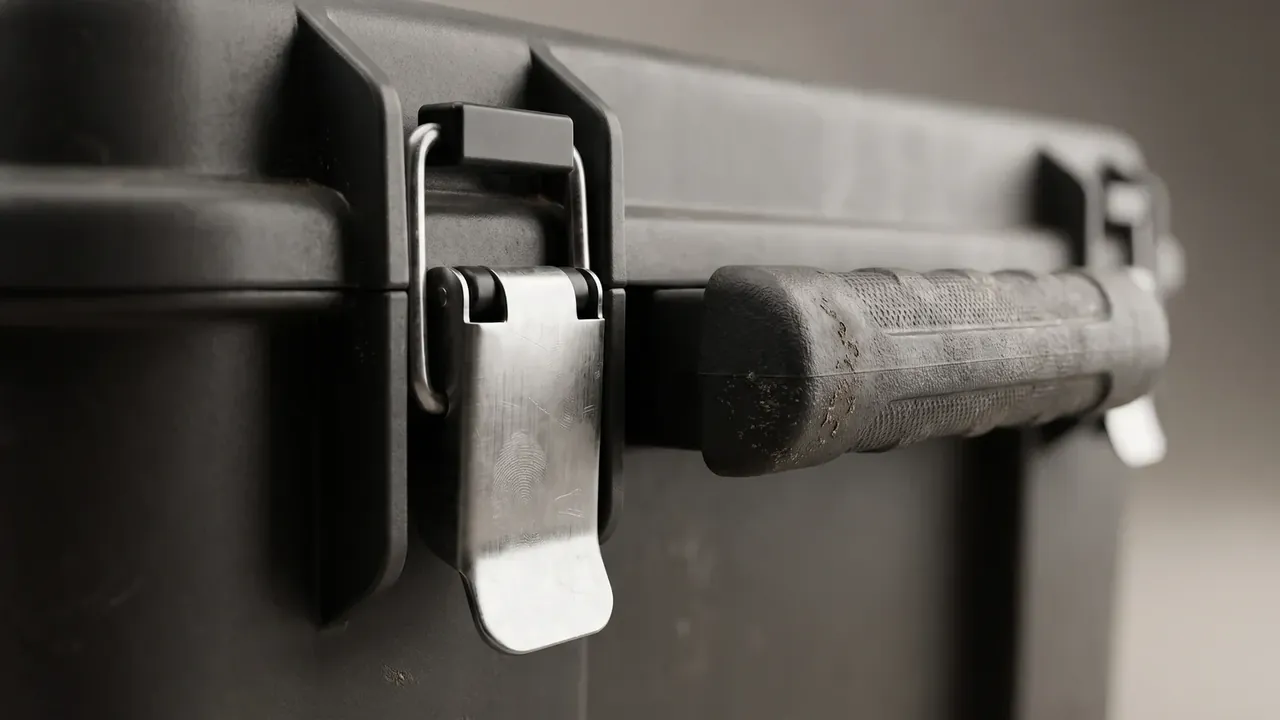
The upper edge sits at 40 °C for the lid. Under a 38 °C roof a loaded stack of 2 sinks 2 to 3 mm at the lid centre in a year; at 23 °C it takes two. Roofing radiates enough to push the skin 5 to 8 °C above air, so hang the meter beside the stack.
Condensation gets a 3 °C margin. Read the wall with an infrared gun, read the air, and treat any gap over 3 °C above 70 percent RH as condensation. The line is conservative: a face against a wall runs 2 to 3 °C cooler.
3. Humidity: Where the Narrow Band Sits
For storing cases the band runs 40 to 70 percent RH, and both ends cost something. Above 70 percent, 304 latches and plated rivets show white rust within 48 h, and rust inside a rivet hole does not stop. Below 40 percent, open-cell foam crumbles into the sealing face.
The middle is the easy part and the hardest to hold.
Pulling a damp-season room under 70 percent takes air movement and a dehumidifier, not bags. A sealed poly bag traps the moisture already inside, so the first cold night condenses it on the inner wall, worse than storing open.
Humidity also eats the margin under a stack. A corrugated pallet above 70 percent loses half its stiffness, and once it sags, a stack set for 2 layers leans. Timber also needs moisture content under 18 percent.
4. Stacking Limits: One Division, Run to the End
No estimating needed. Take the allowable load on the bottom lid, multiply by a long-term factor, divide by the load that lid carries, round down, add 1. The allowance is 150 kg at 25 °C. Long storage takes 0.25, because three years of creep cuts capacity to a quarter, leaving 37.5 kg.
A 30 kg case goes one layer per pallet, 6 to a pallet, and the 22 kg pallet spreads to 3.7 kg per case. The bottom lid sees 33.7 kg against a 37.5 kg allowance, so 2 layers hold. A third puts 67.4 kg on it, 1.8 times the allowance.
| State | Mass | Load on lid | Layers |
|---|---|---|---|
| Empty, 60 L | 5 kg | 5 kg plus shells | 4, by height |
| Loaded 30 kg | 30 kg | 33.7 kg | 2 |
| Loaded 45 kg | 45 kg | 48.7 kg | 1 |
The 4 layers for empties is measured, not calculated. A case stands 380 mm, so 4 layers reach 1.52 m and a driver still sees the top; at 5 the stack hits 1.9 m, sight lines break, and a clipped corner does more harm than load. An empty case weighs 5 kg, far under the line.
5. Pallets, Clearance and Long-Term Posture
Pallets are sized to the base. A 390 by 380 mm footprint goes 3 across and 2 deep on a 1200 by 800 mm pallet, 6 cases, leaving 15 mm on the long edge. Under 10 mm of margin a fork nudge sends the outer case off the deck.
Clearance is the damp-proofing baseline: 100 mm up on pallet feet or 90 mm bearers, 300 mm off walls, floor slope at or below 3 degrees. Past that a forklift turns wide and the stack leans.
Windows need their own rule. After 2000 UV hours PP keeps around 70 percent of its impact strength under the GB/T 16422.3 and ISO 4892-3 cycles. A south-facing window logs 600 to 800 hours a year, so 3 years reaches the line. Fit a blind, or move the stack 1.5 m inward.
Back the latches off one notch instead of clamping. Clamped, the gasket sits at 30 percent compression, and 24 months of that spends its rebound reserve. One notch down brings it to 10 percent, the section merely touches, and the same gasket stretches from 5 years to 8.
Conclusion
Storing cases comes down to three figures and one division: hold -10 to 40 °C with 23±5 °C as the target, keep 40 to 70 percent RH, and divide 150 kg times 0.25 by the real load on one lid, which gives 2 layers at 30 kg and 4 for empties. Set pallets at 1200 by 800 mm for 6 cases, lift the stack 100 mm, hold 300 mm from walls, back the latches off one notch. Keep all of it and a two-year lid deflection stays under 3 mm. Miss one item and the failure will be the gap along the lid centre, not the shell.
This article discusses only the container (case body) side of specifications and design intent, and does not cover any handling, loading or use of the contents.
Related Reading
- Where long-term storage distorts a case
- Zoning and patrol rules for a case warehouse
- How long a sun-exposed case stays serviceable
- Pallet planning: how many cases per load
Related Products
- 8 Series — Gun Cases; Military Equipment Cases; Camera Equipment Cases; Drone Cases; Watch Cases; Knife Cases; First Aid Cases; Electronics Equipment Cases
- WL8-2812 PP Gun Case — model WL8-2812
- All protective cases and toolboxes: 7 series, 158 models