

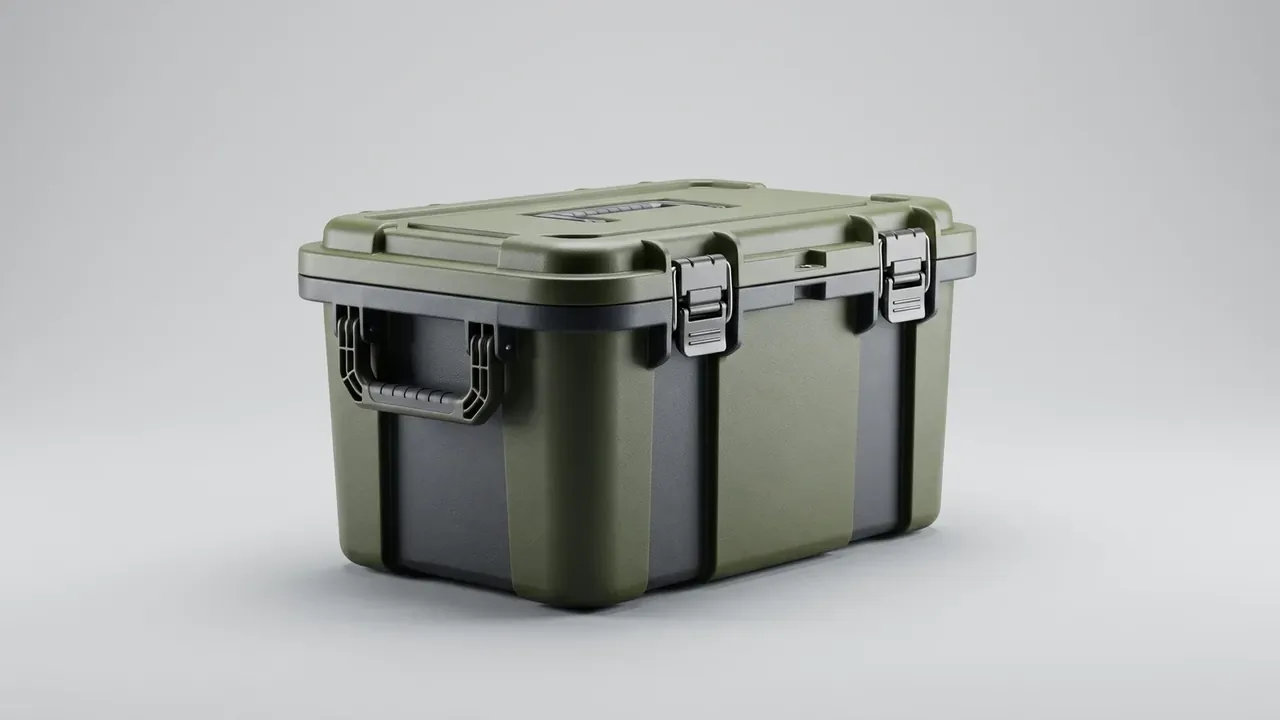
Quick answer: Long-term storage damages a case through the load left on the lid and a gasket held compressed, not through age: four empty layers or three loaded ones, a 12 mm plywood board between them, and latches one notch open take the set out of the seal.
Table of contents
- The First Variable: Load on the Lid
- Layers and Boards by Moulding Process
- Offset Stacking, Pallets, Flat Versus Edge
- The Gasket: One Latch Notch Open
- Environment and Inspection Cycle
- FAQ
1. The First Variable: Load on the Lid
Warping in a warehouse takes two years and no impact at all. A 2.8 mm injection-moulded lid under three loaded cases, 75 kg spread over its face, shows nothing at room temperature. At 35 °C PP creeps twice as fast, so the lid centre sinks 2–4 mm a year and the seal face is out of flat before anyone notices. Long-term storage fails in that shape: modest load, long time, warm air.
An empty case stacks worse. With nothing inside to brace the walls, the lid is a plate with air under it.
A 60 L case weighs 5 kg empty and 25 kg loaded. Loaded, the walls carry the load to the base and the lid only closes the box; empty, the bottom case of four takes the weight above on an unsupported panel, which is why the limit for long-term storage is written for empty cases.
2. Layers and Boards by Moulding Process
| Moulding | Empty | Loaded | Board between |
|---|---|---|---|
| Injection, 2.8 mm | 4 | 3 | 12 mm ply |
| Injection, 3.5 mm | 5 | 4 | 12 mm ply |
| Rotomoulded, 6–8 mm | 5 | 4 | 9 mm ply |
| Blow moulded | 3 | 2 | 15 mm ply |
In long-term storage the limit comes from deflection in the bottom lid, not from rack height. Each extra layer adds 25 kg of spread load; by the fourth layer deflection nears 3 mm, by the fifth 4 mm, and past 5 mm the lid centre lifts off the gasket and the case stops sealing. Rotomoulded bodies at 6–8 mm are stiffer and heavier, so the fifth layer carries its own weight too.
A board spreads a point load cheaply. Without one, the four feet above press on four spots of the lid below, contact under 20 cm², and local stress runs six times higher. A 12 mm board spreads load over 60% of the lid and costs 15 mm of height.
3. Offset Stacking, Pallets, Flat Versus Edge
Offset stacking is the first safeguard in long-term storage: shift every second layer by a third of the case length, so weight lands on ribs and side walls rather than mid-lid. A squared stack puts four corners on one vertical line, and pulling one case out tips the column.
A pallet beats a floor and has to match the base: 22 mm decking is a board in itself, but overhang past 30 mm leaves half the base unsupported and the corners lift. Keep stack height under 1.8 m.
Standing a case on its short edge is worse than laying it flat. On edge the base ribs carry the whole weight and take a 3 mm set in a year; flat, the load spreads over the base and the same year costs under 1.5 mm. Store flat, lid up, labels out.
4. The Gasket: One Latch Notch Open
The gasket is where long-term storage is most often mis-booked. Closed latches hold it at 30% compression, a figure written for a closed case. Hold that 24 months and EPDM takes a 40% compression set, rebound stretching from 2 s to 8 s, and the lid no longer seals. One notch open drops compression to 10%. The gasket is touched, not loaded. The strip lasts 8 years instead of 5.
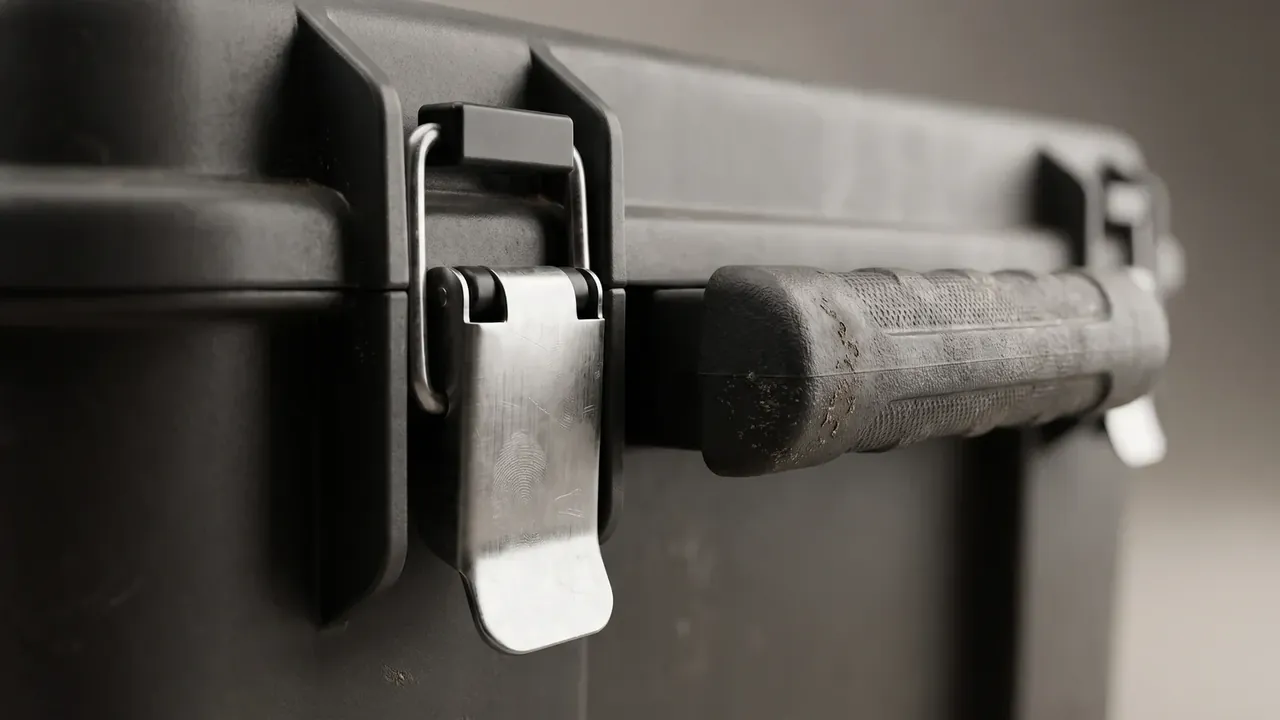
One notch open is not open: the lid stays down, the latch stops 3 mm short of closed travel, and dust is kept out.
With a pressure valve, open it for the storage period so the gasket is not held by a pressure difference.
5. Environment and Inspection Cycle
Four limits cover the room: 5–35 °C, humidity at or under 70%, 100 mm clear of the floor, 300 mm clear of the wall. Above 35 °C PP creeps faster, above 70% the steel latches show white rust, and without clearance the floor pushes moisture into the base. Keep cases from afternoon sun: 2000 h of UV leaves PP with 70% of its impact strength.
| Item | Target | Beyond it |
|---|---|---|
| Temperature | 5–35 °C | Creep doubles |
| Humidity | ≤70% | White rust in 6 months |
| Floor clearance | ≥100 mm | Damp base, wet foam |
| Wall clearance | ≥300 mm | Dead air, condensation |
| Stack height | ≤1.8 m | Top layer tips |
For long-term storage, inspect every 6 months on a 5% sample, never fewer than three cases. Three actions: a steel rule on the lid for centre deflection past 3 mm, four corners pressed for a click that means a rib root has come away, and white rust at latches and rivets. A failed sample means the whole stack, since the load history is identical.
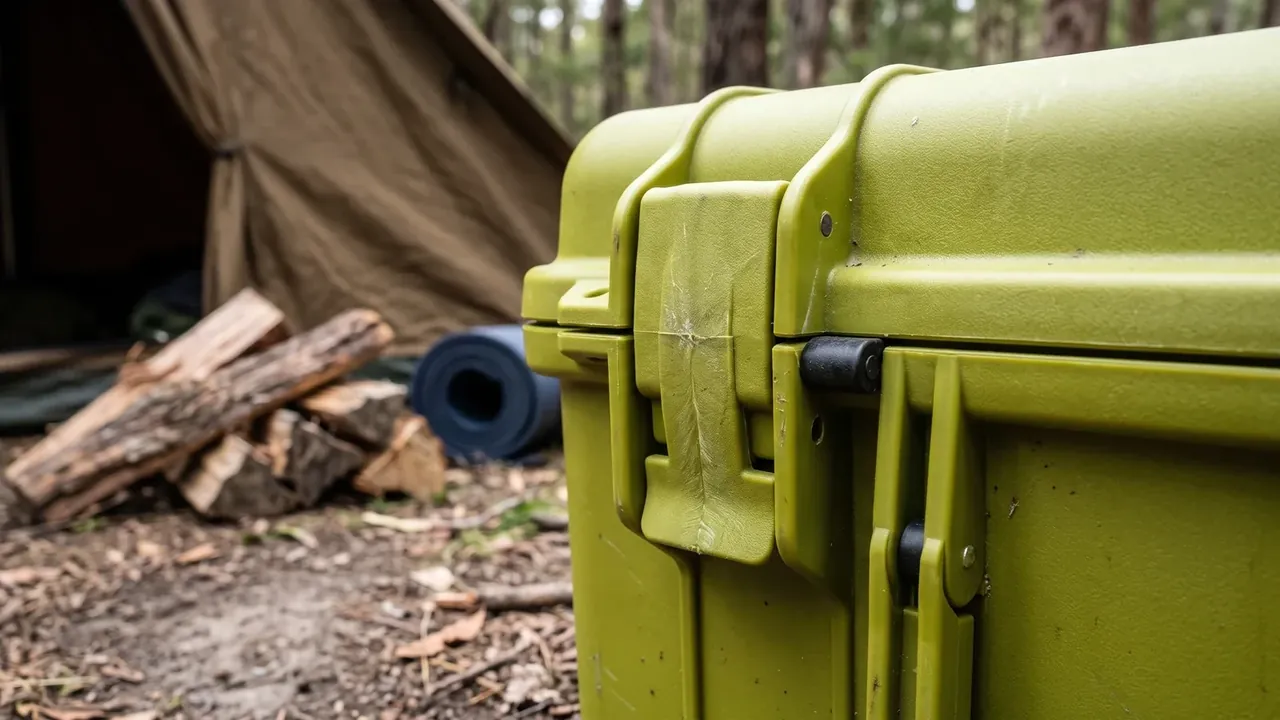
Three signs condemn a stack: a lean along the diagonal, a 5 mm dent in a board between layers, a bulging side wall on the bottom case. Re-stacking fixes the first two; in long-term storage a bulged wall means the body has yielded.
Conclusion
Long-term storage comes down to three things: the load on the lid, how long the gasket stays compressed, and whether the stack is offset. Load is set by layer count, four empty layers or three loaded, with 12 mm boards between them. Compression is set by the latch, one notch open taking 30% down to 10%. Offset is set by a third of the case length, so weight travels through ribs instead of mid-lid. Meet all three and the lid still sits within 3 mm after two years; miss one and the first place to fail is the gap between lid centre and gasket, without warning.
This article discusses only the container (case body) side of specifications and design intent, and does not cover any handling, loading or use of the contents.
Related Reading
- How the Four Corners Carry a Stack
- Pallet Planning: Cases per Pallet
- Stacking Load Test: Deflection and Pass Lines
- Ammunition Box Stacking and Storage Practice
Related Products
- 8 Series — Gun Cases; Military Equipment Cases; Camera Equipment Cases; Drone Cases; Watch Cases; Knife Cases; First Aid Cases; Electronics Equipment Cases
- WL8-2812 PP Gun Case — model WL8-2812
- All protective cases and toolboxes: 7 series, 158 models