

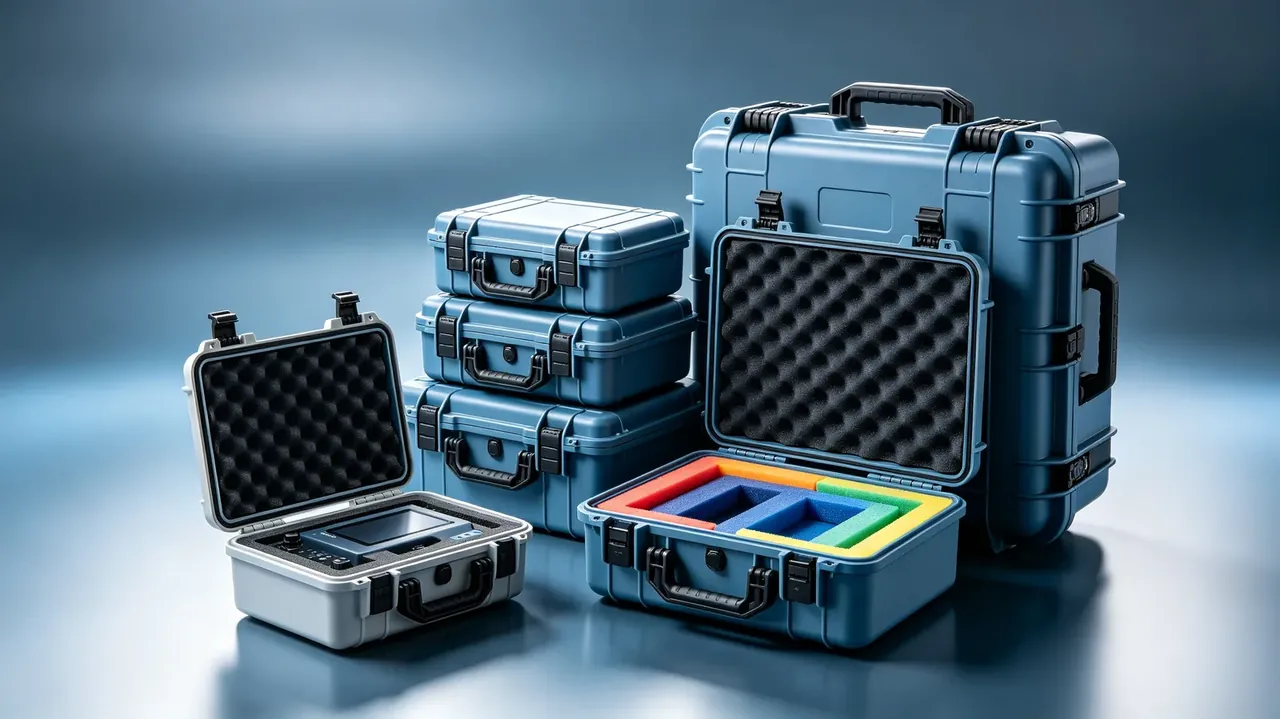
Quick answer: Case surface finish runs three roads: MT-11020 texture at Ra 2.0–2.6 μm, 120 grit blasting at Ra 0.8–1.2 μm and laser texture at Ra 0.4–1.0 μm.
Table of contents
- Three routes for case surface finish
- MT numbers and roughness
- Blasting grit and roughness
- Etching versus laser
- Wear, repair and rework
- Visible and structural faces
- FAQ
1. Three routes for case surface finish
One 520 mm × 380 mm × 200 mm case was finished three ways: MT-11020 on the lid, MT-11040 on the sides, bare steel inside. After three months the lid measured Ra 2.4 μm with 6% of parts showing scratches, the sides Ra 5.8 μm with 2.5%, and the inside Ra 0.35 μm with 12%.
They are three tools: a film-etched MT grade, grit blasting for a random matte, laser cutting for a fixed pattern, with Ra ranges, drafts and repairs that do not interchange.
| Route | Ra (μm) | Depth (mm) | Draft | Repair |
|---|---|---|---|---|
| MT-11010 | 1.2–1.6 | 0.02 | ≥1.5° | Re-etch |
| MT-11020 | 2.0–2.6 | 0.03 | ≥2.0° | Re-etch |
| MT-11040 | 5.0–6.5 | 0.08 | ≥4.0° | Full re-etch |
| Blast 120 | 0.8–1.2 | 0.01 | ≥1.0° | Local |
| Blast 80 | 1.6–2.0 | 0.02 | ≥1.5° | Local |
| Laser | 0.4–1.0 | 0.01–0.03 | ≥1.0° | Return |
Settle visible versus structural faces first: visible faces want evenness, structural faces want hiding power.
2. MT numbers and roughness
The MT number is a texture standard, and higher numbers run deeper. MT-11010 sits at Ra 1.2–1.6 μm and 0.02 mm, MT-11020 at 2.0–2.6 μm and 0.03 mm, MT-11030 at 3.2–4.0 μm and 0.05 mm, MT-11040 at 5.0–6.5 μm and 0.08 mm.
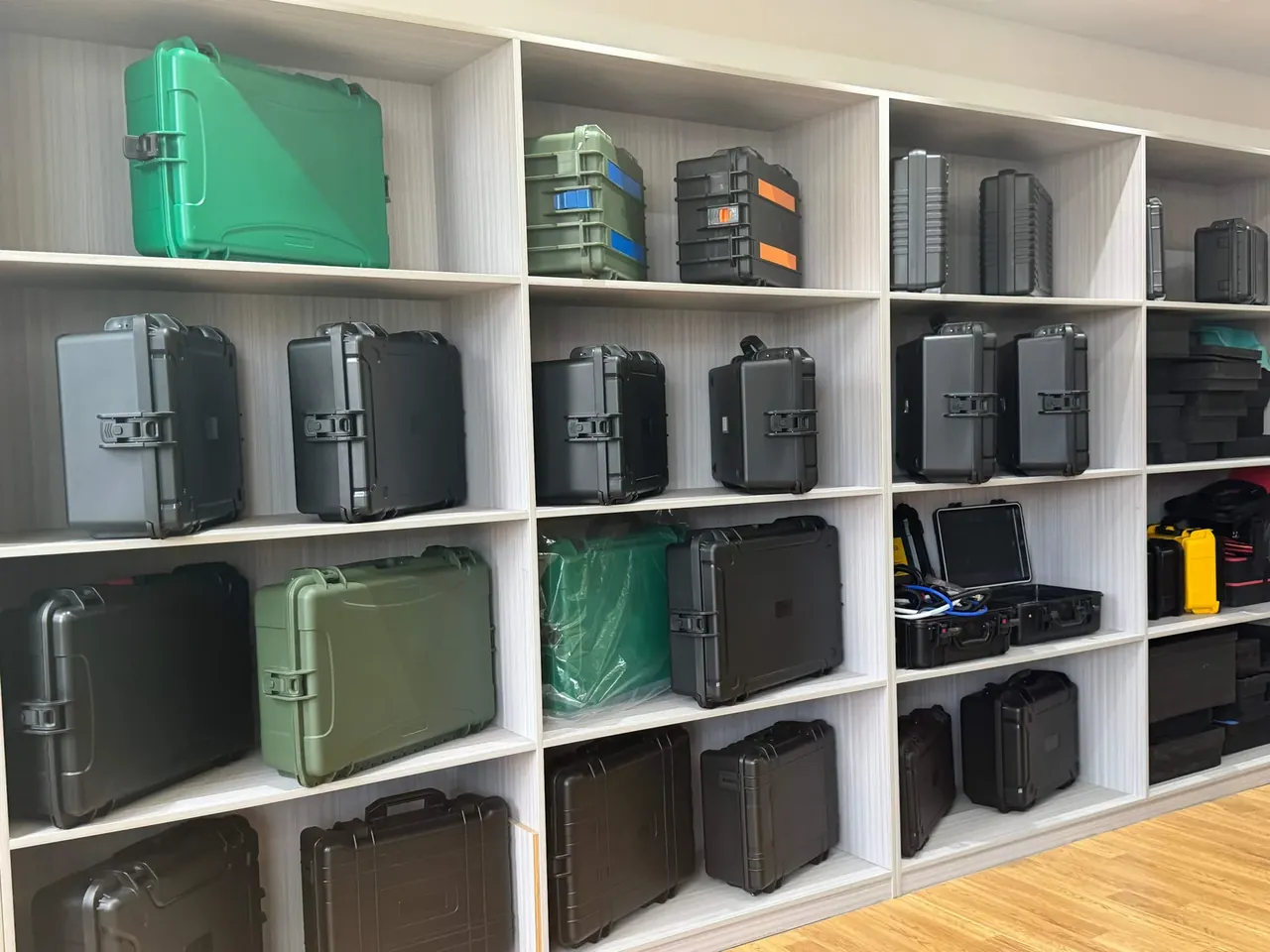
An order saying fine grain buys whatever the shop stocks: write the number and the depth, since two suppliers reach the same Ra at different depths.
| MT | Ra (μm) | Depth (mm) | Use |
|---|---|---|---|
| MT-11010 | 1.2–1.6 | 0.02 | Instrument lids |
| MT-11020 | 2.0–2.6 | 0.03 | General shells |
| MT-11030 | 3.2–4.0 | 0.05 | Tool case sides |
| MT-11040 | 5.0–6.5 | 0.08 | Grip areas |
Draft follows depth: 1° per 0.02 mm of grain, so MT-11020 needs 2° and MT-11040 needs 4°. Short draft pulls texture white, and only polishing fixes it.
Five tools cut from one film stay within 0.3 μm of each other, which is why volume orders accept a 3–5 day etch. Deeper is not better: MT-11040 traps oil on a lid but adds 30% grip friction.
3. Blasting grit and roughness
Grit sets roughness: 80 grit glass bead gives Ra 1.6–2.0 μm, 120 grit 0.8–1.2 μm, 240 grit 0.4–0.6 μm. Halving grit roughly halves Ra, a smoother scale than MT numbers.
Repeatability needs fixed air at 0.4–0.6 MPa, nozzle at 150 mm, 60° incidence, three crossed passes. Skip the grit change and Ra drifts 0.2 μm coarser.
Repair is the real advantage: a bright knock is masked, re-blasted twice and blended with 120 then 240 grit, vanishing at 300 mm, while an etched face needs everything re-etched.
Randomness cuts both ways, with Ra varying 0.4 μm across one cavity, so lids above 1 m are rarely blasted all over.
4. Etching versus laser
In-mould texture means a fixed pattern in the cavity: logos, grids, woven effects. Chemical etching reaches 0.02–0.10 mm in 3–5 days; laser stops at 0.05 mm in 6 h, but rework means recutting the face.

Laser leaves a 0.02 mm step at each edge that drags material at ejection, marking the wall. Etched valleys end in R0.03 mm, cutting release force 8% at equal depth.
Laser wins on detail: a 0.3 mm line cuts cleanly where etching widens it 0.05 mm. Etching costs about CNY 4000 for MT-11020 on a 520 mm × 380 mm tool; laser runs near CNY 1800 for 6 h.
5. Wear, repair and rework
Taber with a CS-10 wheel at 500 g for 500 cycles gives 12 mg loss on MT-11040, 8 mg on MT-11020 and 5 mg on a polished face. Field use reverses that, because deep valleys hold grit.
Repair follows the route: blasting takes 2 h on site, etching needs a new film and 3–5 days, laser means a week at the shop.
Rework tracks how visible a scratch is. Across three lots of 500 shipped alike, polished shells returned 12%, MT-11020 returned 6% and MT-11040 returned 2.5%.
Mixing grades in one lot is worst: inspectors cannot separate a scratch from a texture step, so they judge by the shallowest face, and the number must be frozen before tooling.
6. Visible and structural faces
Visible faces are the lid top, side walls and latch area: Ra 1.2–2.6 μm from fine etching or 120 grit, draft of 2° or more, grain along release.
Structural faces are inner walls, ribs, base and bosses: no decoration, Ra 0.3–0.6 μm, 1° of draft, and shallow grain releases cleanly.
| Area | Ra (μm) | Draft | Route | Test |
|---|---|---|---|---|
| Lid top | 1.2–2.6 | ≥2° | MT-11020 | No seam at 300 mm |
| Sides | 2.0–4.0 | ≥3° | MT-11030 | Grip holds |
| Inside | 0.3–0.6 | 1° | None | No white marks |
| Base | 3.2–6.5 | ≥4° | MT-11040 | No sliding |
Leave 15 mm between zones, blended at 240 grit, or the boundary becomes a 0.03 mm step that tears first. Check visible faces at 300 mm, structural faces for pull marks under 0.05 mm.
Conclusion
Two questions settle case surface finish: will this face be seen, and can a scratch there be repaired. Visible faces are judged at 300 mm and take MT-11020 or 120 grit at Ra 1.2–2.6 μm with 2° or more of draft, while structural faces only need clean release at Ra 0.3–0.6 μm with 1° and no grain. Keep 15 mm of blended transition between them, because skipping it guarantees a torn seam. Write repair rights into the purchase terms: blasting may be touched up on site, etching allows two re-etches, laser returns to the shop. Where grain exceeds 0.05 mm, add 1° of draft per 0.02 mm of depth instead of polishing damage out later, since polished patches show at once at 300 mm. Applied together, these rules hold scratch returns under 3% on a 500 piece lot, half the rate of a polished shell.
This article discusses container-side specifications and design implications only, and does not cover any handling, loading or use of the contents.
Related Reading
- Mould acceptance and texture standards
- Mould maintenance and cavity repair
- Mould cost structure and etch charges
- How a case mould goes from design to parts
Related Products
- 8 Series — Gun Cases; Military Equipment Cases; Camera Equipment Cases; Drone Cases; Watch Cases; Knife Cases; First Aid Cases; Electronics Equipment Cases
- WL8-2812 PP Gun Case — model WL8-2812
- All protective cases and toolboxes: 7 series, 158 models