

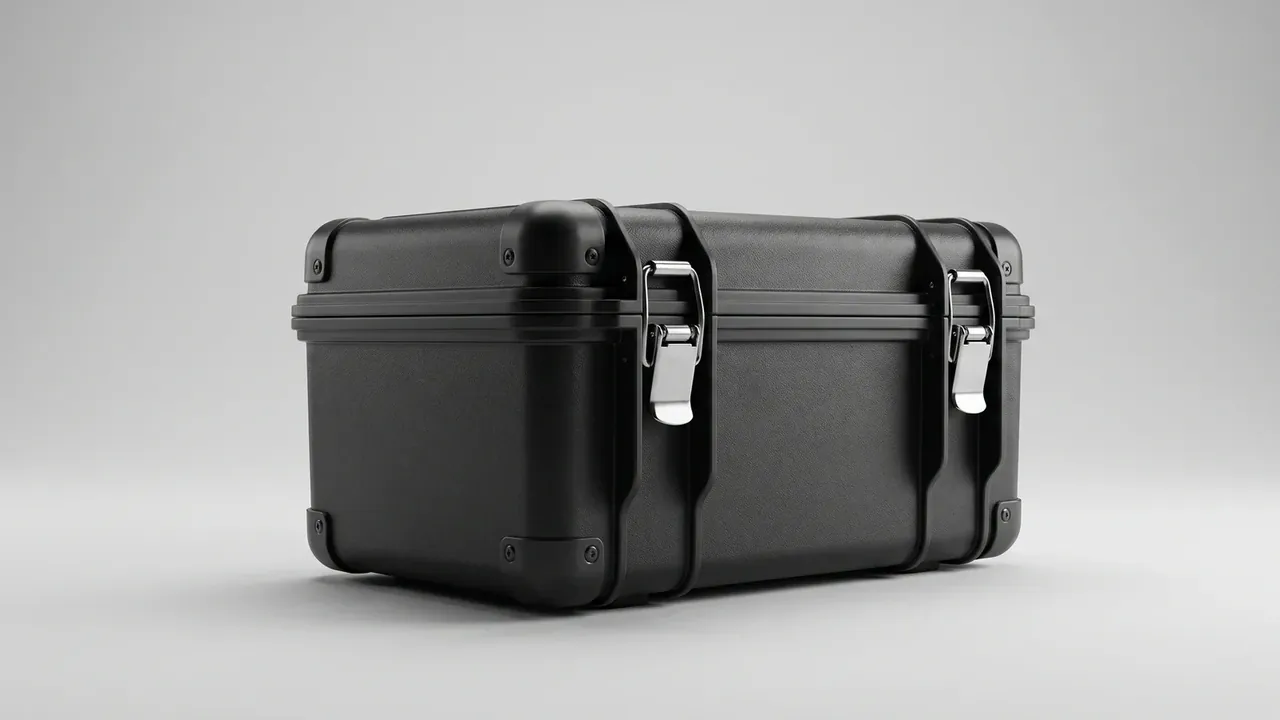
Quick answer: Case warehouse storage acceptance is a batch split, a fixed list of measurements and a decision number. Below: 480 arriving cases, 50 sampled, wall at five points, latch force 60 to 110 N, a 200 kg stack load for 24 hours.
Table of contents
- Splitting the Incoming Batch
- Visual Checks and Wall Thickness
- Seal, Latch and Stack Test Lines
- Defect Classes and Disposition
- Records, Retained Samples and Re-tests
- FAQ
1. Splitting the Incoming Batch
On a Tuesday, 480 rotomolded cases of 600 × 400 × 340 mm arrived on three wrapped pallets. Inspection opened the bottom one first: it had carried the two above it for 36 hours. The first case showed 1.8 mm of lid warpage against a 1.5 mm limit, and the lot moved to hold.
One mould, one material lot and one shift make one batch; a colour change or a four-hour stoppage starts a new one.
Sampling follows an attribute plan: a lot of 480 sits in the 281 to 500 band, code letter H, sample size 50, Ac 3 / Re 4 at AQL 2.5.
Samples come from all three pallets, 2:2:1 by layer. Top-layer-only sampling inspects a batch that does not exist.
| Lot size (pcs) | Code letter | Sample size | Ac | Re |
|---|---|---|---|---|
| 281 to 500 | H | 50 | 3 | 4 |
| 501 to 1200 | J | 80 | 5 | 6 |
2. Visual Checks and Wall Thickness
Visual judgement in case warehouse storage happens at the bench, lit to 1,000 lux with the lamp 1.5 m up. The inspector sweeps four sides from 300 mm for flash, flow marks, sink marks and colour shift. Flash above 0.5 mm is minor; colour is read against a chip, where ΔE above 1.5 is minor. A sink mark inside a 100 mm square on the front face goes to major.
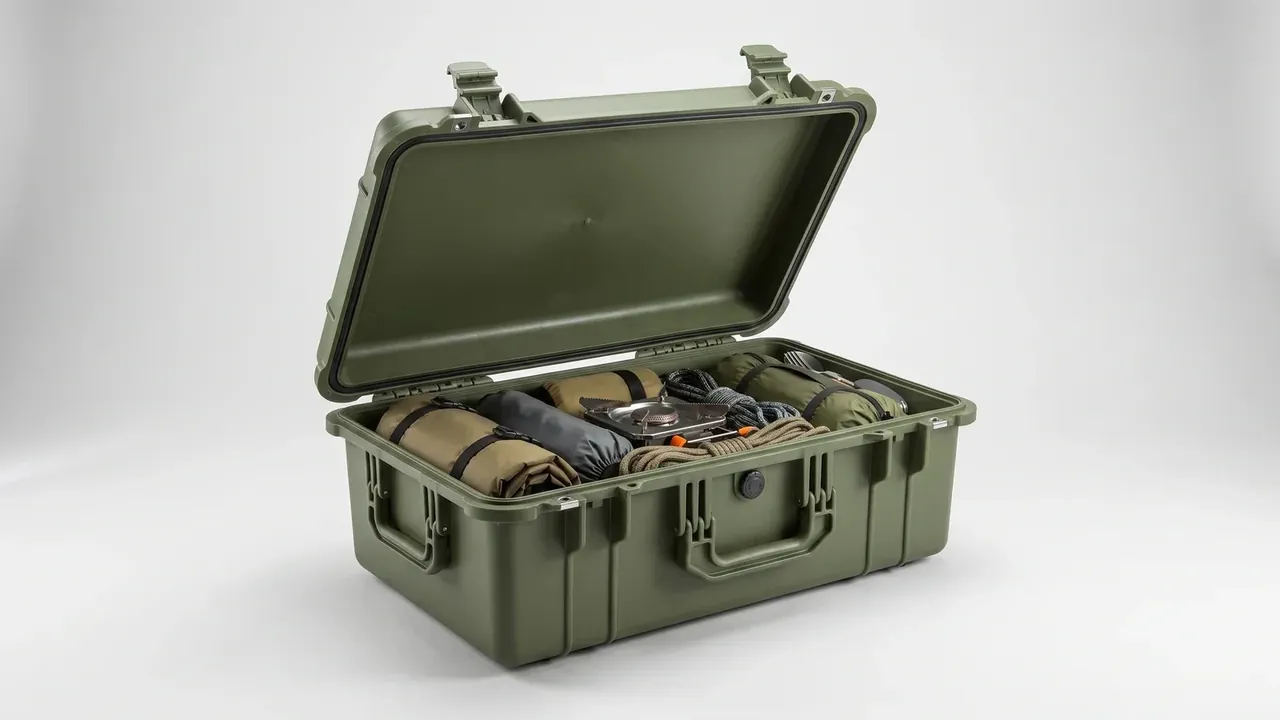
Wall thickness is read with an ultrasonic gauge at five points: the middle of each long side, one short side, the base centre and one corner radius. The drawing calls for 3.2 mm plus or minus 0.3 mm, and the 50 cases read 3.02 to 3.31 mm. The verdict uses each case minimum, never the average: a passing average with one case at 2.85 mm hides a bulge in the third layer.
Weight supports it: 6.2 kg within 2.5 percent gives a 6.05 to 6.34 kg band.
3. Seal, Latch and Stack Test Lines
Test lines must be repeatable actions, not adjectives. Most disputes in case warehouse storage begin with adjectives, and a number ends the argument.
- Seal: 20 kPa through the vent, 60 seconds, drop of 0.5 kPa or less.
- Latch force: 60 to 110 N, widened to 130 N after 5,000 cycles.
- Stack: three loaded cases, 200 kg on top, 24 hours, 2 mm deflection.
- Handle: 75 kg static, three times the 25 kg working load, 10 minutes.
- Flatness: mouth down on a grade 1 plate, 0.5 mm feeler gauge must not enter.
- Marking: moulded lettering, lot code and pallet label agree.
Order matters. Seal precedes stacking, because a case that carried 200 kg has a distorted mouth and the drop then describes distortion, not the gasket. Latch force is read at room temperature, where a case from a 40 °C oven reads about 10 N lower.
Do not add checks on the fly; a new rule goes into the work instruction.
4. Defect Classes and Disposition
Classification comes first in case warehouse storage.
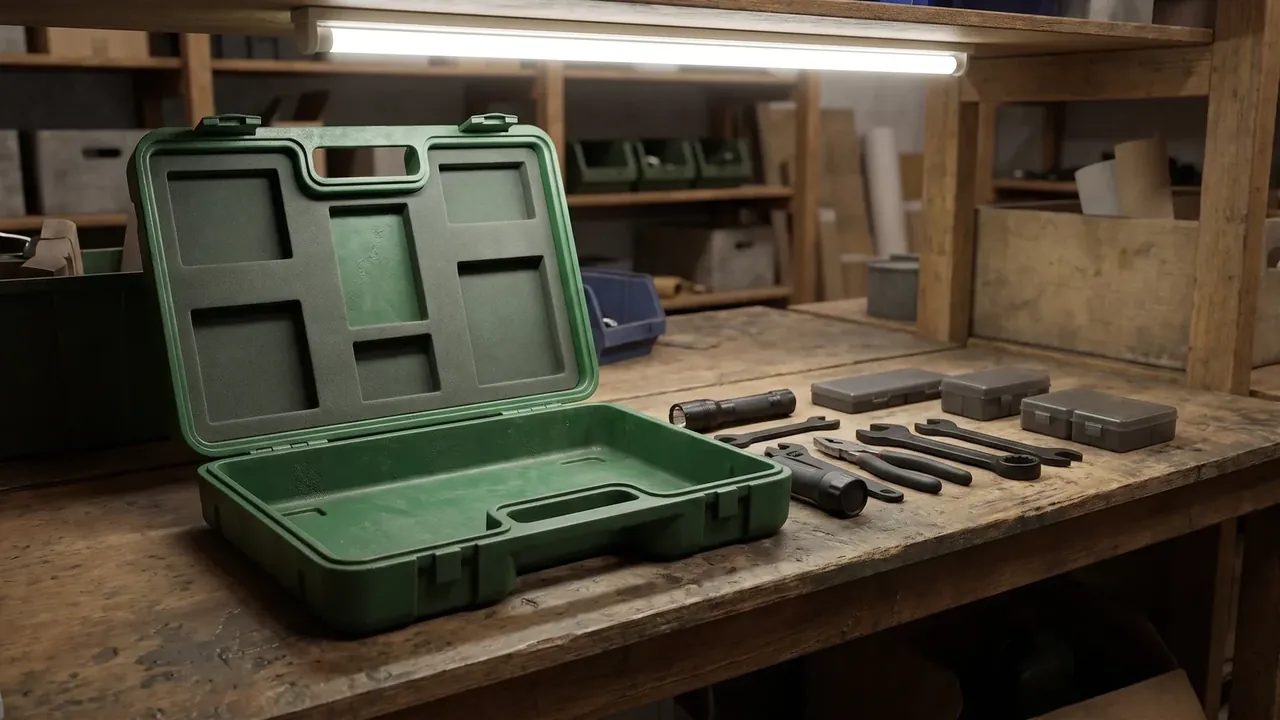
Four dispositions: return, 100 percent sort, rework and concession. Return suits a run of class A defects; sorting an isolated find at 1.2 CNY per case, charged to the supplier; rework covers class C; concession needs a written deviation permit.
Class A never gets a concession: a case at 2.85 mm under 25 kg three high collapses as a stack.
| Class | Typical criteria | Counting | Disposition | Re-check |
|---|---|---|---|---|
| A critical | Drop over 1 kPa, wall under 2.9 mm | One piece rejects the lot | Return | 100 percent |
| B major | Stack set over 2 mm, ΔE over 3 | Accumulated at AQL 2.5 | Sort or rework | Double sampling |
| C minor | Flash within 1 mm, offset 3 mm | Recorded only | Concession | 20 pieces |
5. Records, Retained Samples and Re-tests
Six case warehouse storage record fields are mandatory: batch, mould, material lot, sample size with defect count, verdict and disposition number. The verdict column accepts pass, fail or concession only.
Three cases are retained per batch at 23 °C for 12 months; they prove their worth when a complaint arrives and that batch can be re-measured.
Case warehouse storage re-testing runs quarterly on five cases; beyond six months the stack load drops from 200 kg to 150 kg because polymer creeps.
A record nobody can read back is not an acceptance record.
Conclusion
The lot failed: four class A and two class B defects among 50 samples, all from the bottom pallet, warped by excessive stretch-film tension over 36 hours. The supplier sorted 100 percent, reshipped, and the second lot passed. What counts is whether the next inspector can reproduce every judgement: lot size against sample size, measuring point against limit, defect against disposition. Fix those pairings and case warehouse storage acceptance stops being a signature ritual.
This article discusses only the container (case body) side of specifications and design intent, and does not cover any handling, loading or use of the contents.
Related Reading
- How to plan case warehouse storage layout
- Mould storage and rust control
- Foam insert storage rules
- Airdrop case acceptance
Related Products
- 8 Series — Gun Cases; Military Equipment Cases; Camera Equipment Cases; Drone Cases; Watch Cases; Knife Cases; First Aid Cases; Electronics Equipment Cases
- WL8-2812 PP Gun Case — model WL8-2812
- All protective cases and toolboxes: 7 series, 158 models